Ripple effect: A shift has been taking place around Apple's Mac mini. A surge in demand from AI developers and enthusiasts running local AI workloads has pushed the compact desktop into unexpected territory: backordered for months, stripped of its entry-level $599 configuration, and now the subject of a growing ecosystem of third-party accessories aimed at extending what a fixed-spec machine can do.
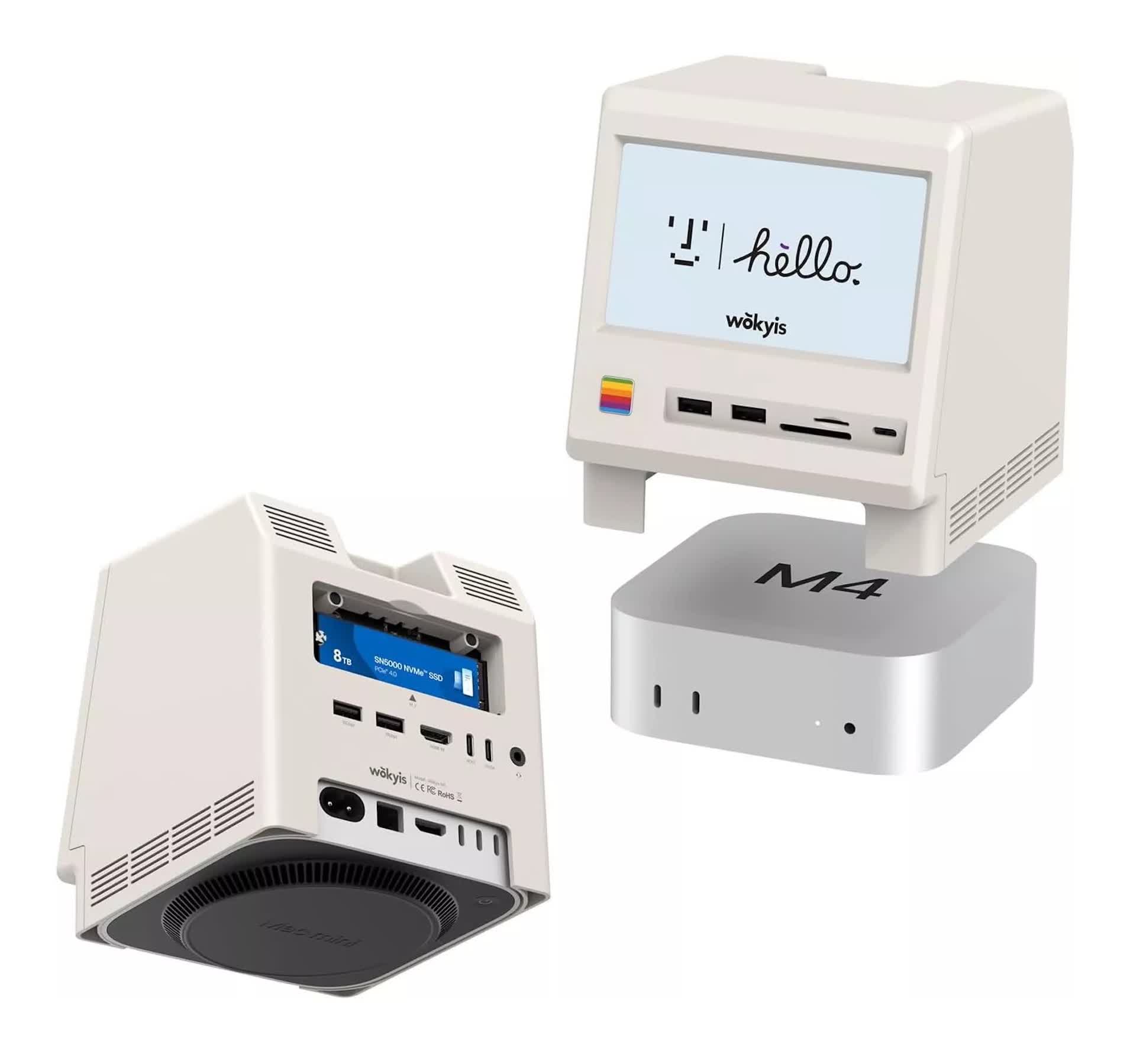
One of the more distinctive entries in that category comes from Wokyis: a retro-styled dock that adds NVMe storage, extra ports, and a small secondary display, all within a chassis designed to sit directly under the Mac mini.
The M5 Retro Dock Station connects over USB-C and serves as both a port hub and a secondary screen. The front panel houses a 5-inch display with a 1,280×720 resolution – modest by any measure, but adequate for always-on tasks like system metrics, widget dashboards, or media controls. It isn't built for productivity work; it's built to be glanced at.
The more practical feature is inside the enclosure. The dock includes an M.2 NVMe slot, allowing users to add high-speed storage without paying Apple's upgrade prices. Because the Mac mini's internal storage can't be upgraded after purchase, many users lean on external NVMe drives instead. This dock tucks that storage into the same footprint as the desktop, rather than adding a separate enclosure.
– ZARA (@HeyZaraKhan) May 1, 2026
Wokyis is selling two versions of the dock with different capabilities. The base model, priced at $169.99, supports up to 10 Gbps transfer speeds and includes a wide range of ports: four USB-A, three USB-C (one for power and one for the host connection), SD and microSD card slots, HDMI output, and a 3.5mm jack.
The $339.99 version upgrades to Thunderbolt 5 capable of up to 80 Gbps throughput, swaps HDMI for DisplayPort, and adds another USB-C port, which better suits high-bandwidth storage and multi-display setups.
Despite being designed around the Mac mini's size and layout, the dock isn't locked to Apple hardware. Any device that supports DisplayPort over USB-C should work, including laptops, Android devices, and even smaller systems like Raspberry Pi boards. So it ends up being a general-purpose dock that just happens to look like it was built for a Mac.
That design is big part of the appeal though. The unit borrows heavily from classic Macintosh design, echoing the look of early compact all-in-ones without requiring any hardware modification. The Mac mini drops into the dock from above, raising the total height to around 6.21 inches combined, and a removable base plate keeps the Mac mini's own front and rear ports accessible.
The Mac mini has been harder to get in recent months, with delivery windows stretching out as demand increases. Most of that demand is tied to local AI workloads like OpenClaw. Apple has since quietly discontinued the entry-level $599 configuration, raising the starting price to $799 while keeping the M4 chip but bumping base storage to 512GB. The global memory shortage driven by AI infrastructure demand is compounding that further, with some higher-RAM configurations listed as currently unavailable entirely.
A third-party dock doesn't fix any of that. But for users already holding existing hardware, it can get you more storage without paying Apple's upgrade premium, more connectivity without stacking cables, and a secondary display for ambient information without occupying a full monitor – that plus that retro look value.