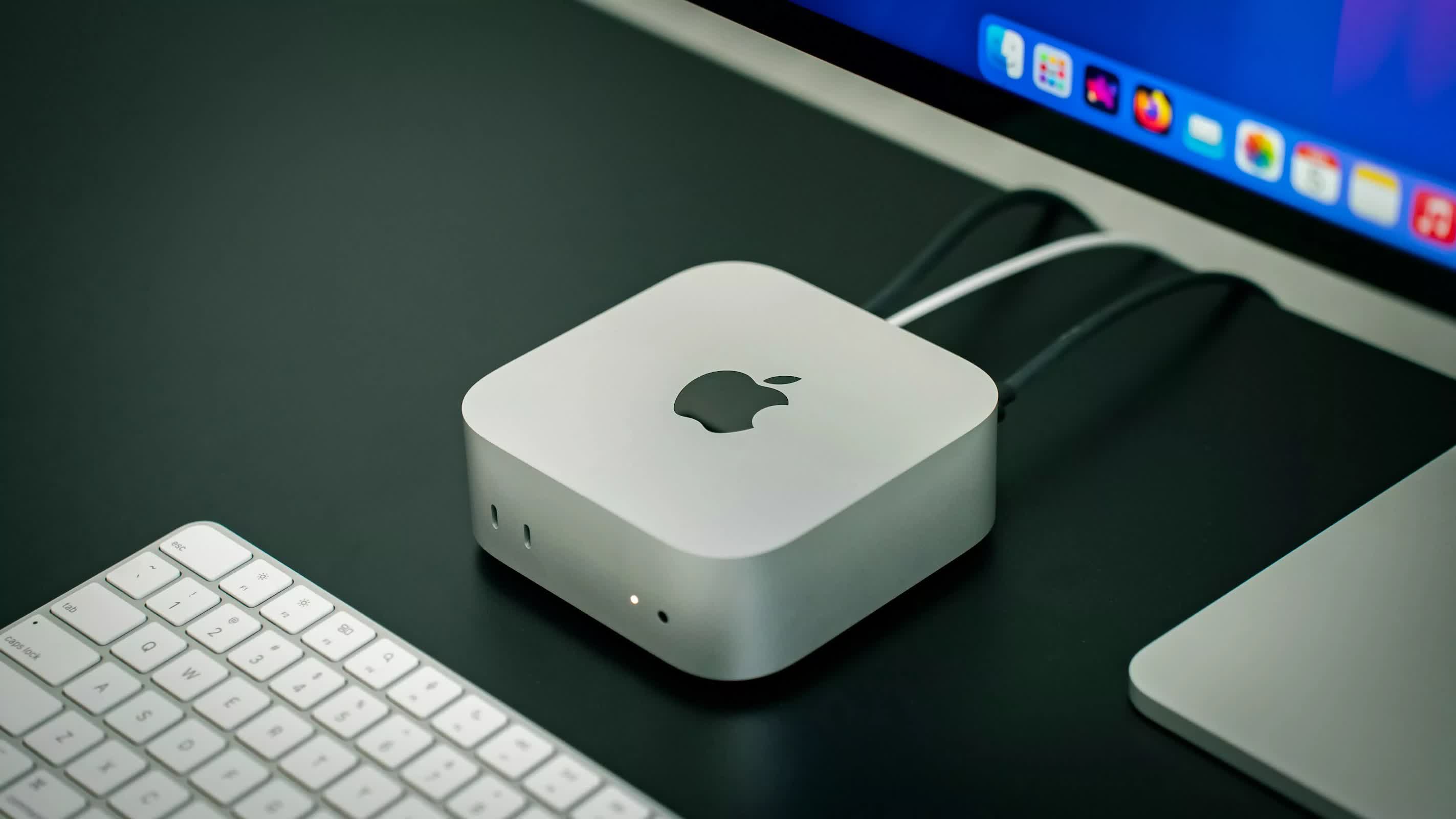
Ripple effect: Apple is running into an unusual supply problem: one of its smallest, least flashy Macs is suddenly in high demand among AI developers. On the company's latest earnings call, CEO Tim Cook said customers may be waiting "several months" to get their hands on a Mac Mini as Apple works to catch up with demand. The surge isn't coming from typical desktop buyers. Instead, developers have gravitated toward the machine as a practical platform for running agentic AI tools locally.
"On the Mac Mini and Mac Studio, both of these are amazing platforms for AI and agentic tools," Cook said. "And customer adoption of that is happening faster than we expected."
That shift appears to have caught Apple off guard. The Mac Mini has long been a niche product in Apple's lineup, especially compared to the iPhone, which generated nearly $57 billion in revenue this quarter. Mac sales, by contrast, totaled $8.4 billion. Within that category, the Mac Mini represents only a small share. But its role is changing as AI development workflows evolve.
Part of the appeal comes down to how developers are using these systems. Rather than relying entirely on cloud infrastructure, some are opting for local environments that can run continuously and handle autonomous agent tasks without interruption. The Mac Mini, particularly in higher-memory configurations, offers enough performance for these workloads in a compact, relatively affordable package.
The release of OpenClaw earlier this year appears to have accelerated that trend. The open-source tool, designed for building and running autonomous AI agents, has been adopted by developers experimenting with local-first setups. In that context, the Mac Mini has become a convenient option: a dedicated system that can run agents persistently without tying up a primary workstation.

Apple's silicon also plays a role here. Its unified memory architecture allows the system to handle certain AI tasks efficiently without requiring discrete GPUs, which remain expensive and difficult to source. While these machines are not being used for large-scale model training, they are well-suited for inference and orchestration – two areas that are important for agent-based systems.
The downside for buyers is availability. Some configurations have already disappeared from Apple's lineup, including a version of the Mac Mini with 512GB of memory. Reports of long wait times have been circulating for weeks, and as of late April, even the base model was sold out through Apple's online store.
The Mac Mini is not the only product under pressure. Apple said it faced supply constraints across both its iPhone and Mac lines this quarter. For the iPhone, the issue largely comes down to limited access to advanced chips. On the Mac side, the picture is more mixed. Alongside the surge in AI-related demand, Apple is also seeing strong interest in newer hardware like the MacBook Neo.
But the Mac Mini situation stands out because it highlights a demand pattern Apple did not fully anticipate – one driven less by consumers and more by developers adapting hardware to emerging AI use cases.
For now, Apple's more immediate challenge is practical: building enough of a product that was never intended to become this important to a fast-growing corner of the tech industry. The Mac Mini was not designed as an AI workhorse, but it is increasingly being used as one – and demand is reflecting that shift.