Looking ahead: Development of the next generation of PCIe connector technology has reached a new milestone. The PCI Special Interest Group (PCI-SIG) has released an updated outline of its plans to continue the upgrade cadence it has maintained for two decades. Although PCIe 8.0 is not scheduled for completion before 2028, it could offer eight times the bandwidth of today's fastest motherboard components.
Manufacturers can now review the 0.5 draft specification for PCIe 8.0. The spec aims to increase bandwidth significantly while reducing power consumption.
PCIe is the technology that connects expansion cards installed on PC motherboards. The constant need for higher bandwidth became apparent when 3D accelerator cards (the predecessors to modern GPUs) became popular. NVMe SSDs also leverage PCIe to achieve higher transfer speeds than older SSDs and hard drives that used SATA cables. Each new PCIe generation typically doubles the available bandwidth for NVMe SSDs.
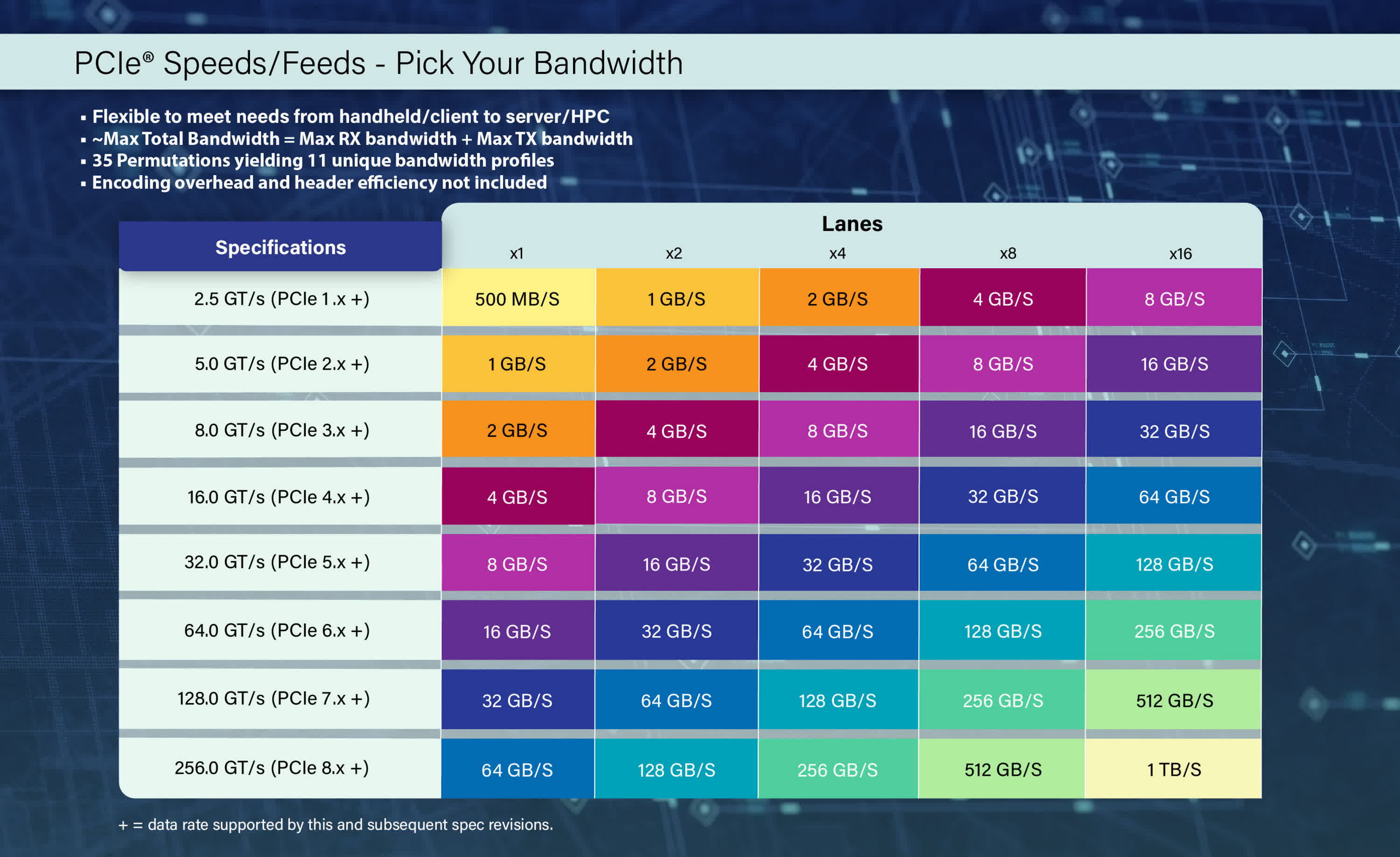
The new specification is the first draft release that outlines all of PCIe 8.0's technical goals. The primary aim is to deliver a raw bitrate of 256 GT/s, enabling 1 TB/s of bidirectional bandwidth while in x16 configuration.
Achieving this goal would keep PCIe on track to double its bandwidth with each generation since PCIe 1.0. The latest PCIe 8.0 draft specification is ahead of schedule, so PCI-SIG remains confident that the final specification will arrive before the end of 2028. It will likely appear first in enterprise applications such as AI, data centers, machine learning, edge computing, aerospace, and automotives.
Must Read: The Inner Workings of PCI Express
For most consumer devices in 2026, PCIe 3.0 (capable of 32 GB/s) and 4.0 (64 GB/s) remain sufficient, with PCIe 5.0 (128 GB/s) representing the cutting edge. While some PCIe 5.0 SSDs can achieve read speeds of around 14 GB/s, Micron recently unveiled an enterprise PCIe 6.0 drive that reaches 28 GB/s. Meanwhile, PCIe 7.0's final specification emerged last year.
Investigating new connector technology is another primary goal for PCIe 8.0. The last few generations have pushed up against the limits of traditional copper cabling, prompting manufacturers to explore fiber-based alternatives. Additional aims include maintaining latency standards, enhancing protocols to increase bandwidth even further, minimizing power consumption, and ensuring backward compatibility with earlier PCIe generations.