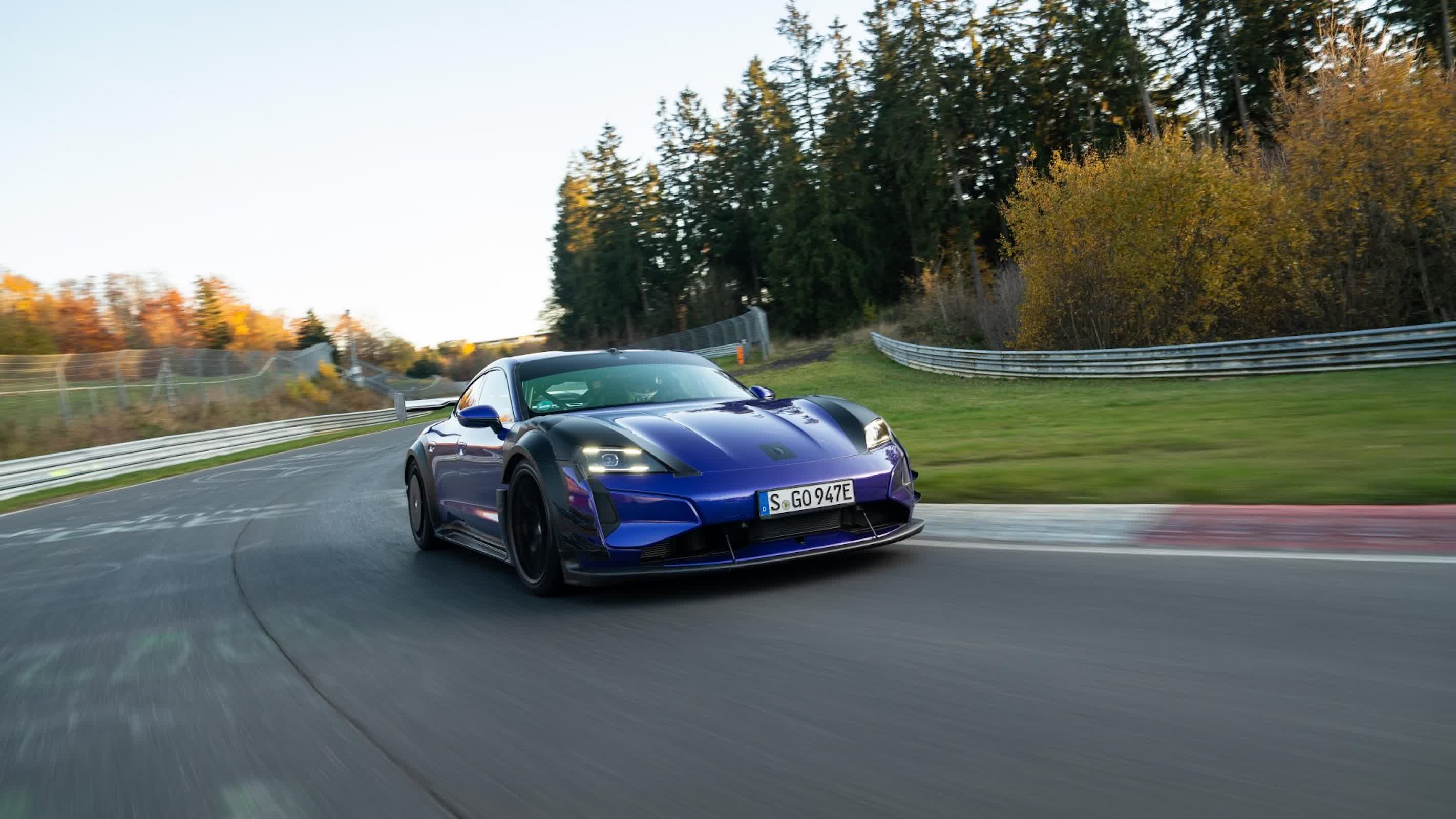
What just happened? Porsche's latest run at the Nürburgring isn't just about reclaiming a record – it highlights how performance gains in modern EVs increasingly come down to refinement rather than reinvention. The Taycan Turbo GT, updated with a Manthey Racing package, has set a new benchmark for production electric vehicles at the Nordschleife with a lap time of 6:55.53. The result puts Porsche back on top after a short but intense period of competition that saw the record pass between several high-profile challengers, including the Rimac Nevera, Xiaomi SU7 Ultra, and Yangwang U9 Xtreme, the latter of which pushed the time below seven minutes.
Porsche's approach is less about chasing extremes and more about refining every variable that affects lap performance. Manthey Racing – best known for its work on Nürburgring-dominating 911 variants – applied a familiar formula to the Taycan: incremental improvements across software, aerodynamics, and chassis hardware.
The most consequential changes begin with the car's control systems. While Porsche hasn't detailed every adjustment, the retuned software likely alters how the car manages torque delivery, stability, and traction under load. On a circuit like the Nordschleife, where grip levels and elevation change constantly, those calibrations can have as much impact as raw power.
The aerodynamic updates are more visible. A revised rear wing with larger endplates, a bigger front splitter, a modified rear diffuser, and rear-wheel aerodiscs work together to significantly increase downforce. At 200 km/h, the car now generates 310 kilograms of downforce, up from 95 kilograms previously. That added stability enables higher cornering speeds and inspires greater confidence through the track's faster sections.
Wheel and tire selection also play a role. The Taycan rides on lightweight 21-inch forged wheels paired with Pirelli P Zero Trofeo RS tires, a setup designed to balance reduced unsprung mass with maximum grip. It's a combination aimed squarely at track performance rather than everyday usability.
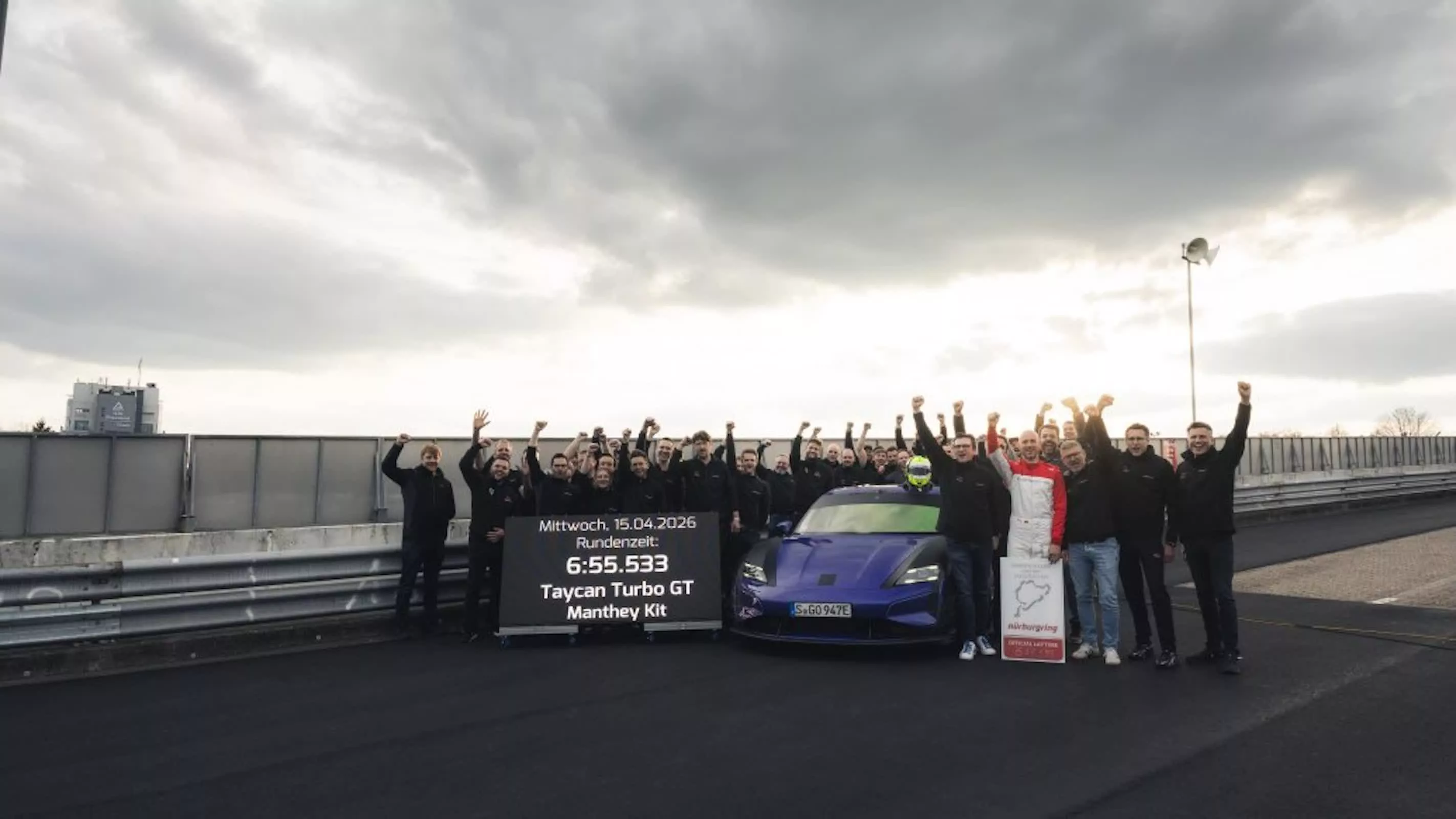
Manthey's involvement goes further than in previous Porsche performance packages. For the first time on a package like this, the powertrain itself has been upgraded. Output in standard driving mode increases by 20 kW to 600 kW, while torque rises from 1240 Nm to 1270 Nm when launch control is engaged. The Taycan's Attack Mode – essentially a temporary performance boost – adds another 130 kW, bringing peak output to 730 kW when activated.
That additional performance places greater strain on the braking system, which has been upgraded accordingly. The front discs grow from 420 mm to 440 mm and are paired with higher-performance pads, helping the car withstand repeated heavy braking zones without fade. On a track as long and demanding as the Nürburgring, braking consistency is just as important as acceleration.
Taken together, the changes shaved roughly 12 seconds off the Taycan Turbo GT's previous lap time. That kind of improvement is substantial on a circuit where even a one-second gain can be difficult to achieve.
Even with the new record, the result comes with some important context. Porsche's own 911 GT3, also equipped with a Manthey package, recently posted a 6:52.981 lap – quicker than the Taycan despite having roughly half the power and a fraction of the torque. The contrast highlights the ongoing challenges EVs face with weight and sustained performance, particularly on longer, more technical circuits.
Still, the Taycan's return to the top spot reflects how quickly the EV performance landscape is evolving. The Nürburgring has become a proving ground not just for outright speed, but for how effectively manufacturers can fine-tune increasingly complex systems. In this case, Porsche didn't need an entirely new car to move the needle – just a sharper, more focused version of the one it already had.