
The big picture: While consumers and manufacturers scramble to keep up with the AI boom that has turned microchips into increasingly scarce commodities, the "old" desktop monitor is flying off the shelves. Gamers are leading the trend, driving growing demand for dual-mode and high-refresh-rate displays.
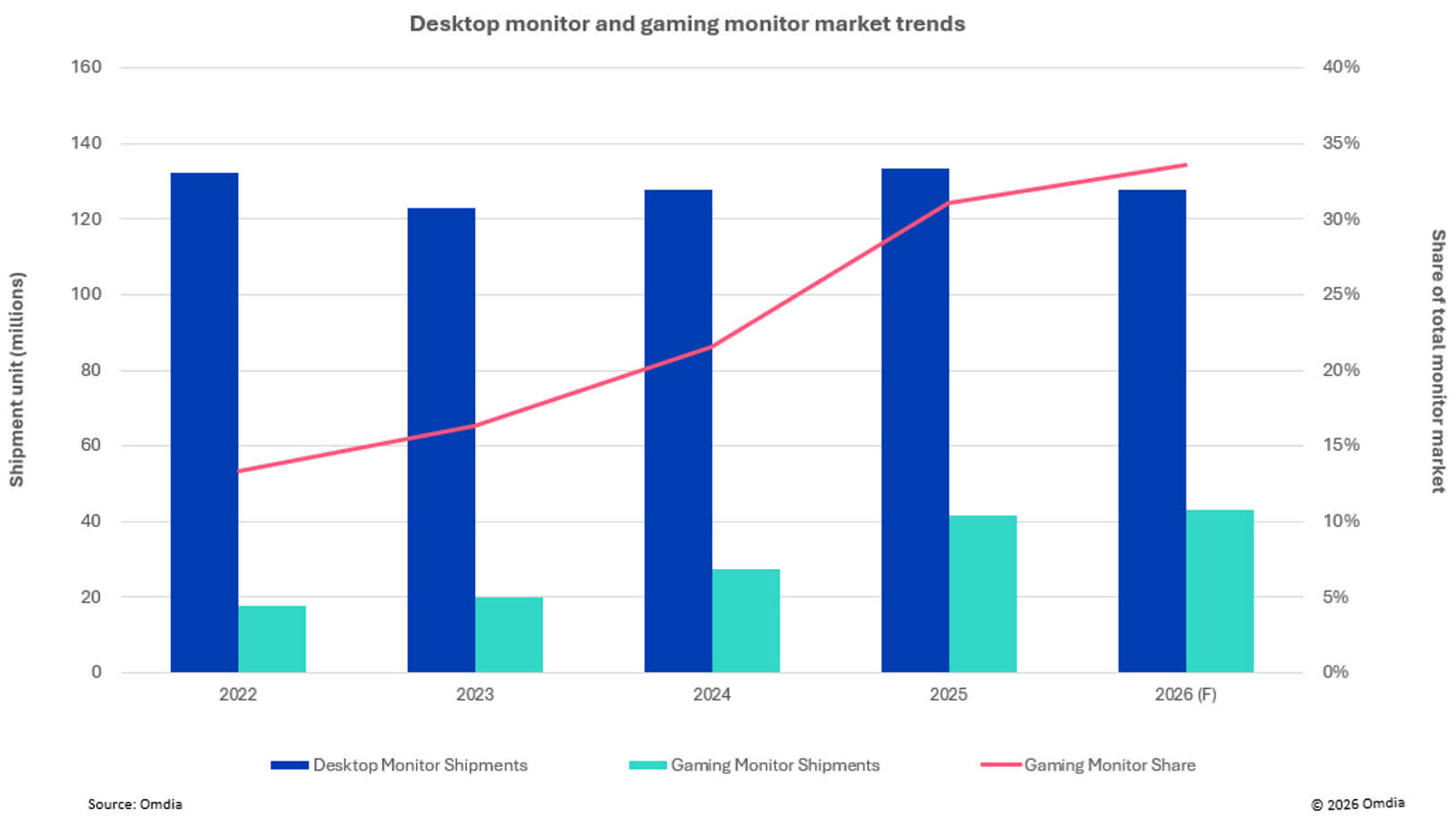
Research firm Omdia reports that desktop monitor manufacturers shipped 133.4 million units in 2025. The market grew by a solid 4.3% year over year, recovering from the "disruption" that followed the Covid-19 pandemic. Omdia said that classic desktop monitors are evolving into more versatile, high-end visual devices in a laptop-dominated world.
Monitors designed for gaming are a major driver of this market resurgence. Gaming monitor shipments reached 41 million units in 2025, representing 50.2% year-over-year growth. The segment now accounts for 31.1% of total desktop monitor shipments and has grown for 11 consecutive quarters through Q4 2025.
Omdia forecasts that gaming monitor shipments will reach 43 million units in 2026, with additional features and more affordable pricing strategies driving consumer interest. According to Senior Principal Analyst Hidetoshi Himuro, gaming monitors are expected to keep pace with the evolution of other key components in the PC gaming ecosystem, including CPUs and GPUs, which continue to advance in performance and capability.
Himuro explained the close relationship between monitors and other PC hardware by referencing the launch of Nvidia's GeForce RTX 50 GPU series. When Blackwell-based cards arrived, the analyst said, monitor manufacturers followed by releasing more high-refresh-rate models.
Beyond higher refresh rates, newer monitors are attracting consumers with additional "premium" features such as dual-mode configurations and OLED (organic light-emitting diode) panels. More gamers are reportedly seeking monitors that deliver competitive performance in esports titles at lower resolutions and very high refresh rates, such as 1080p at 480Hz, while also supporting more immersive experiences at higher resolutions like 4K at 240Hz.
Unlike traditional displays with fixed refresh behavior, dual-mode models offer greater flexibility by switching between performance-focused and quality-focused modes. Meanwhile, OLED and QD-OLED displays now account for a "significant" share of total shipments, with 27-inch QHD 240Hz models driving much of the adoption of organic panels.
Looking ahead, Omdia expects the dual-mode segment to see double-digit shipment growth through 2026, as consumers increasingly look for monitors that can keep up with both current GPUs and future hardware upgrades.
However, ongoing constraints in the semiconductor and component supply chain could negatively affect market trends. Gaming monitors may face price increases, while concerns over OLED burn-in continue to deter some potential buyers.