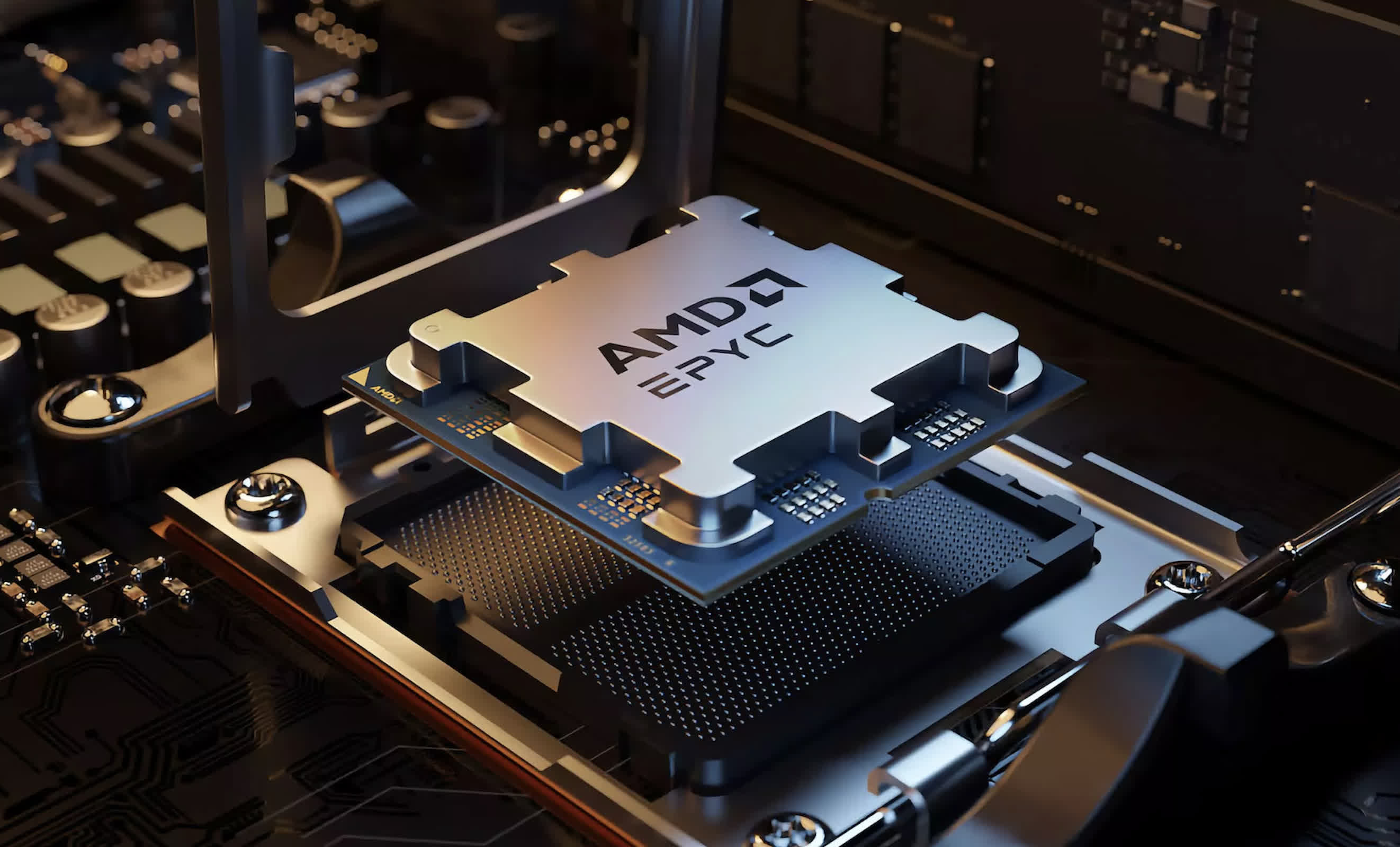
Looking ahead: AMD's next wave of server processors is beginning to come into focus, and the company appears poised to deliver more than a typical generational refresh. While its upcoming Epyc Venice chips, based on the Zen 6 architecture, are already entering production on TSMC's 2-nanometer process, attention is increasingly shifting toward what comes next – and how far AMD plans to push both chip manufacturing and CPU architecture.
According to a report from Taiwan's Commercial Times, AMD is considering TSMC's A14 process node for its Zen 7 generation. Such a move would push AMD into the angstrom-era of semiconductor manufacturing for the first time, taking the company beyond the traditional cadence of incremental node shrinks and into a new scale of transistor design.
If AMD does transition Zen 7 to A14, the shift could influence not only peak performance, but also how efficiently the chips handle demanding data center workloads.
Zen 7 itself, tied to a core complex design codenamed "Grimlock," is expected to reflect a broader shift toward AI-focused computing. Rather than simply pursuing higher core counts or clock speeds, AMD appears to be optimizing Zen 7 for the types of workloads driving modern enterprise and cloud infrastructure.
Each core complex die is still expected to feature 16 cores, but the emphasis appears to be on making those cores more effective at handling parallel, data-intensive tasks.
A significant part of that effort involves changes to the instruction set. Zen 7 is expected to introduce AVX10, which combines elements of AVX-512 and AVX2 into a more unified framework. That consolidation could simplify software optimization while improving performance across vector-intensive workloads, including scientific simulations, media processing, and certain AI inference tasks.
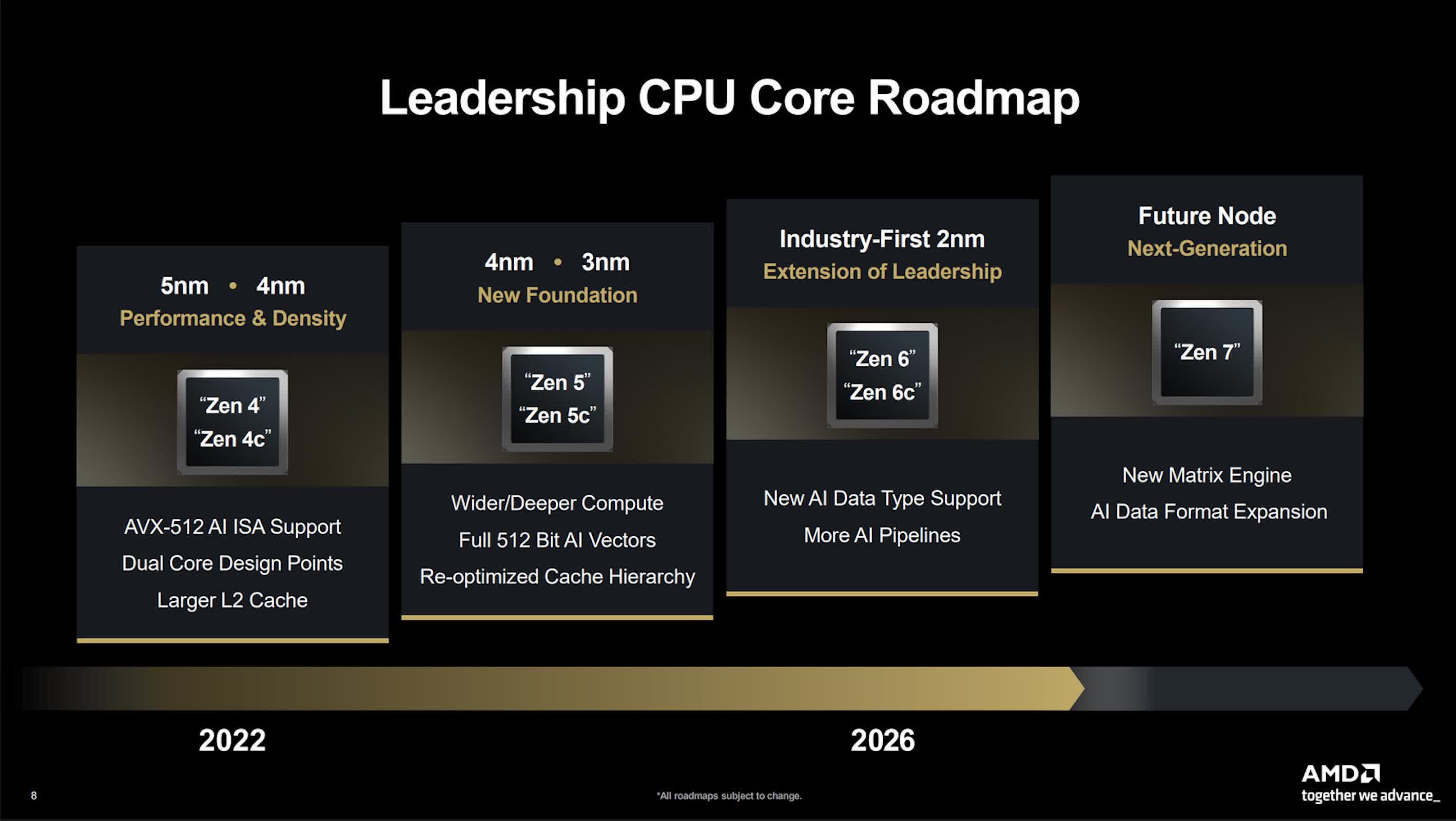
Another addition, ACE – short for Advanced Matrix Extensions – targets matrix operations more directly. These are the same types of calculations that underpin machine learning models and large-scale data analysis.
By integrating this capability into the CPU instruction set, AMD is positioning its processors to handle more workloads that might otherwise be offloaded to specialized accelerators.
Beyond raw compute performance, Zen 7 is also expected to introduce changes aimed at reducing system overhead. The architecture is rumored to incorporate FRED, or Flexible Return and Event Delivery, which replaces the traditional interrupt-handling model. The goal is to reduce system-level latency, an increasingly important factor as applications demand faster and more responsive data processing.
Security is another area receiving attention. The architecture is expected to include ChkTag x86 Memory Tagging, a feature designed to mitigate vulnerabilities tied to memory handling, including buffer overflows and use-after-free errors. Integrating these protections at the hardware level would give AMD an additional layer of security for systems where stability and isolation are critical.
At the same time, AMD appears to be looking beyond the silicon itself and rethinking how its processors are packaged. The company is reportedly evaluating next-generation packaging approaches, including further iterations of its 3D V-Cache technology.
AMD is also said to be considering Fan-Out Panel-Level Packaging (FOPLP) technology from Powertech Technology, a Taiwan-based OSAT provider. Such a move could signal an effort to diversify AMD's manufacturing ecosystem and reduce reliance on TSMC for advanced packaging.
Powertech offers multiple FOPLP technologies, potentially giving AMD greater flexibility in configuring multi-die layouts as its chiplet-based designs grow more complex. For AMD, packaging is no longer just a manufacturing detail; it has become a critical part of how performance, efficiency, and cost are balanced in a finished product.
Taken together, AMD's recent moves suggest the company no longer views CPU development as a simple linear progression. The shift toward angstrom-scale nodes, broader instruction sets, and advanced packaging points to a future of more specialized, workload-aware processors. Zen 6 may be the next architecture to reach the market, but Zen 7 is already shaping up to represent a more fundamental shift in AMD's approach to high-performance computing.