Crystal ball: A research team has developed a new way to extract lithium from rock, a change that could reshape battery costs if supply gets tight. The study, published in Science, examines how to reduce energy use and waste when extracting lithium from hard rock ore.
For now, lithium-ion batteries continue to dominate for a simple reason – scale. The global lithium supply chain is already well-developed and highly efficient, making it difficult for alternatives to compete on cost.
But that advantage depends heavily on access to inexpensive lithium, much of which comes from brine deposits concentrated in South America. While lithium itself is abundant, deposits that are easy and cheap to extract are not.
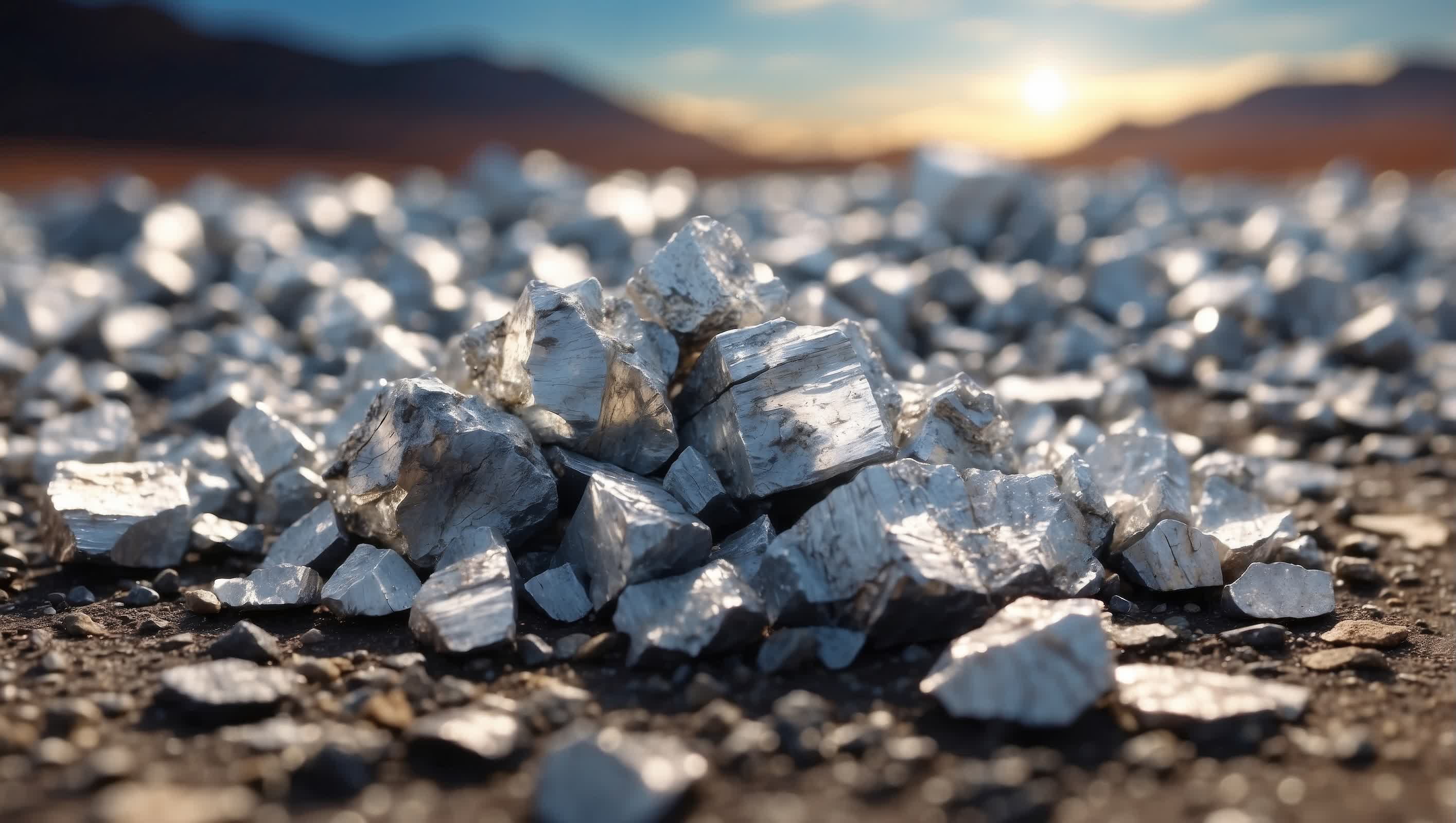
That reality has kept attention on spodumene, a lithium-bearing mineral found in hard rock. It is the most abundant lithium ore globally, but processing it is expensive. The standard approach requires heating the material to around 1,000 °C before treating it with sulfuric acid to extract lithium. The process works, but it consumes large amounts of energy and leaves behind sulfur-based waste.
The method developed by researchers at MIT and collaborating companies takes a different approach. Rather than roasting the ore at high temperatures, the team uses an ammonium fluoride solution heated to about 70 °C to break down the mineral. At that point, the reactions separate the ore into streams of lithium, silicon, and aluminum.
Lithium ends up dissolved in solution as lithium fluoride, while silicon and aluminum follow separate pathways. Silicon forms a soluble compound, and aluminum becomes a solid intermediate. From there, each material can be processed independently.
The aluminum stream is the most energy-intensive part of the revised process. It requires heating in stages – first to about 300 °C and then to 700 °C – to ultimately produce aluminum oxide. This heating comes after the initial separation, not at the start, and produces aluminum oxide with more than 98% purity.
By comparison, the silicon side is relatively straightforward. Adding ammonia causes the dissolved compound to convert to silicon dioxide, which precipitates from solution. Because it can be used as an additive in concrete, it could help recoup part of the processing cost.
The lithium itself remains in solution as lithium fluoride. From there, it can either be used directly in the production of lithium hexafluorophosphate, a common electrolyte in lithium-ion batteries, or converted into lithium nitrate and then lithium oxide – both standard intermediates in battery manufacturing.
One of the more notable aspects of the process is how it handles its own chemistry. Ammonia and hydrogen fluoride are generated during several of the reaction steps. Rather than treating those as waste, the system recombines them to regenerate ammonium fluoride, the same compound used at the start. That closed-loop element helps limit both material losses and waste, though hydrogen fluoride remains a hazardous substance that requires careful handling.
On paper, the economics are compelling. The researchers estimate that conventional spodumene processing costs just under $9,000 per tonne of lithium produced. Their method could bring that down to a little over $5,000 per tonne, putting it in line with extraction from high-quality brine deposits. If the aluminum and silicon byproducts are successfully sold, the cost could drop further.
There are still open questions. Real-world costs depend on ore quality, market price fluctuations, and the capital required to build or retrofit facilities for a new process. Even so, the work points to a different way of thinking about lithium supply, not just where it comes from, but how it is extracted.