
The big picture: As with all things AI, the world of semiconductors has seen its rate of change increase dramatically over the last year or so. Big traditional players have been inspired to make meaningful advances to their roadmaps, driven in part by a surprisingly large number of smaller startups and new custom silicon entrants from other large tech companies. Most of these efforts have been driven by the sudden transition to agentic AI workloads and the new types of demands placed on computing devices, both on the edge and in the datacenter.
Not surprisingly, Arm just announced a series of agentic AI-focused enhancements to its range of IP offerings at its Arm Everywhere China event. The news encompasses mobile devices, physical AI and robotics, and AI infrastructure for the cloud and enterprise environments.
Unlike many others, however, Arm's technology is a critical enabler for many other companies' efforts as well. As a result, the impact of the changes that Arm announced has a significantly larger effect than those of other individual companies. As it likes to proudly point out, Arm has a massive developer base of 22 million people, creating software for billions of Arm-based devices in numerous product categories around the world.
These newest changes build on the company's efforts to design not just individual chip architecture advancements, but system-wide capabilities as well. From its CSS (Compute Subsystem) concept to its Total Design principles, Arm highlighted efforts to make working with its offerings much easier.
CSS allows companies to start with a fully designed platform on which they can create their products, and Total Design pulls together multiple companies across an ecosystem of partners to similarly ease the product creation process. Along the way, the company also managed to hit home the range and consistency of its development tools. To that end, it announced a new Arm AI portal that pulls together a number of these tools along with models and agentic harnesses optimized for the Arm platform.
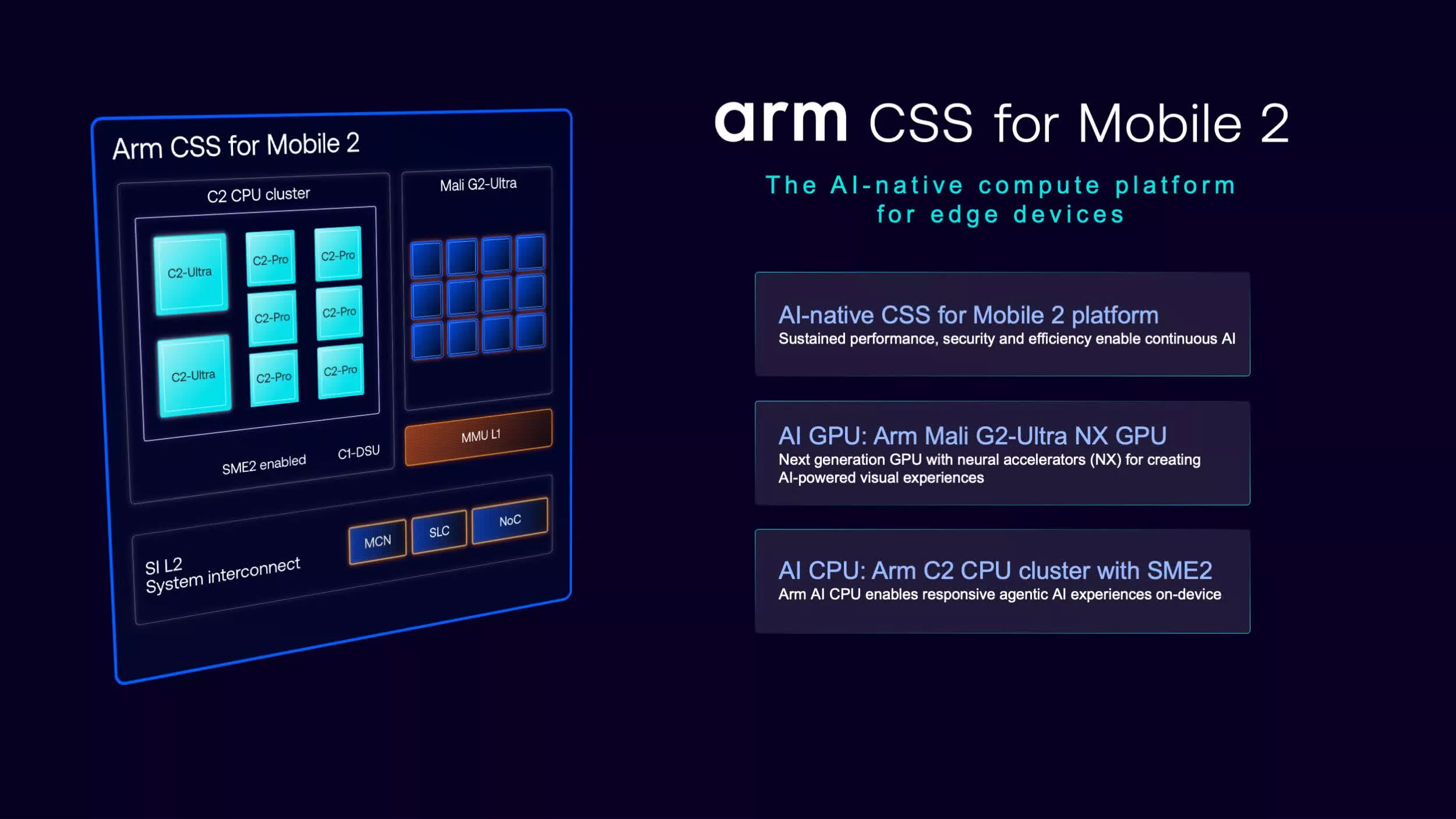
CSS for Mobile 2 brings CPU, GPU and system technologies together in an AI-native compute platform for edge devices.
There were individual chip architecture enhancements as well. As part of its new CSS for Mobile 2, the company debuted a new design for its Mali GPU dubbed Mali G2-Ultra NX that includes AI-enabling neural accelerators for the first time.
This allows it to produce AI-generated graphics that leverage techniques similar to what many desktop PC graphics cards do, but at the tiny (sub-1 watt) power levels that mobile devices require.
The CSS for Mobile 2 platform also includes the company's latest C2-Ultra and C2-Pro CPUs and, most importantly, two blocks of compute specifically designed to accelerate Arm's SME2 instruction set extensions. These extensions are optimized for the kind of matrix math commonly used in agentic AI workloads and can bring up to 1.7x improvements in AI applications and models written to take advantage of SME2.
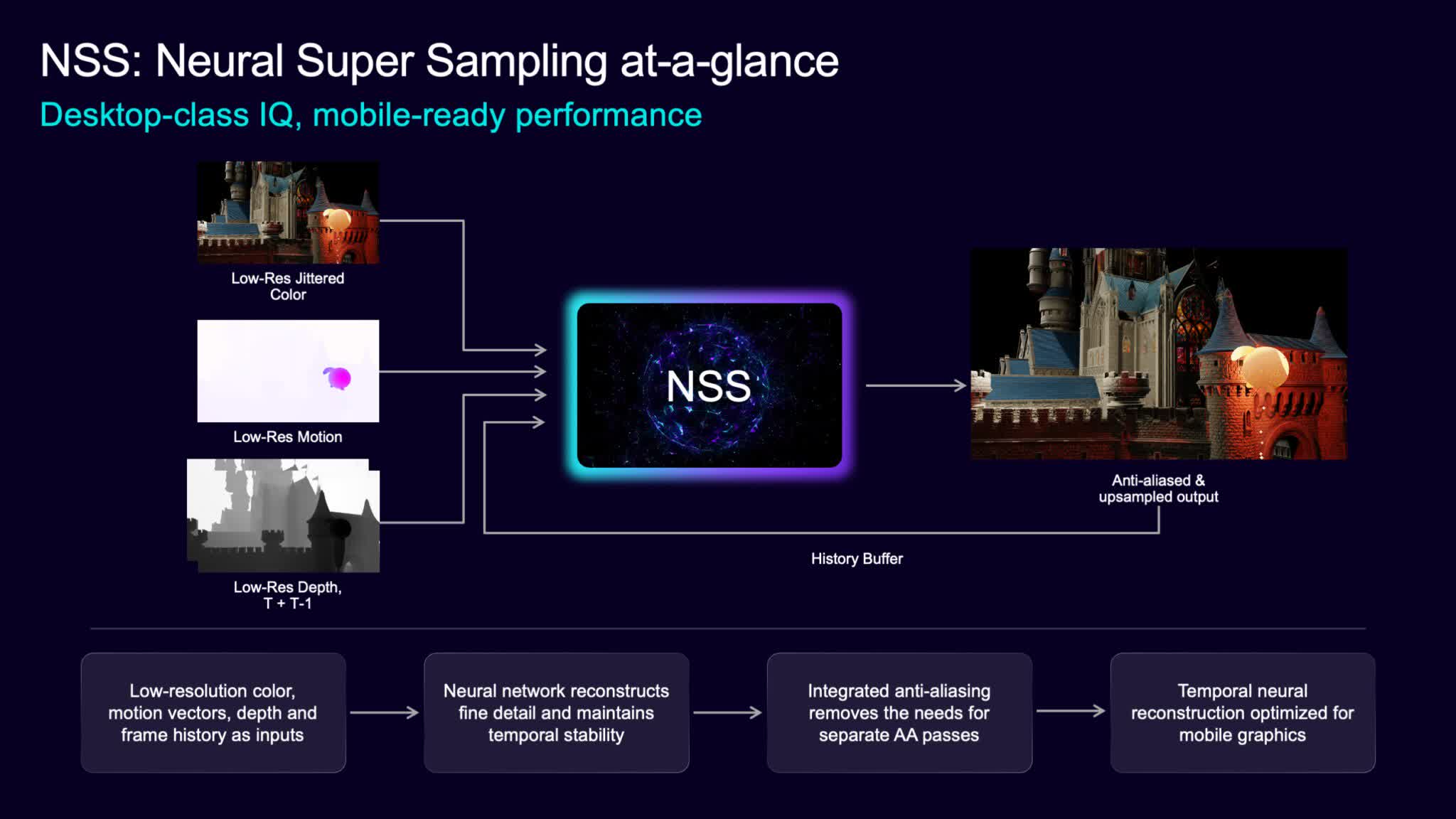
NSS reconstructs higher-resolution images from lower-resolution inputs, combining temporal data and integrated anti-aliasing to improve image quality efficiently on mobile.
In the nascent world of physical AI and robotics, Arm focused on pulling together businesses across the incredibly large and complex robotics supply chain.
As the company pointed out, no one supplier can serve the diverse needs of robotics and physical AI applications. With its new Arm Total Design for Physical AI, patterned after the existing Total Design for Cloud AI, the company has brought together over 80 companies that are creating various elements necessary to put together a finished robotics-based product.
From sensor and actuator companies to operating system, software development and semiconductor partners, Total Design for Physical AI incorporates a group of companies that have pledged to make their various components work together. The fact that Arm was able to create such a group highlights its unique position, not just in physical AI, but across the semiconductor and technology spectrum.
In addition, given the relative newness of AI-powered robots (robotics-based control systems have, of course, been around for decades), Arm wanted to help the industry come up with a common set of terminology and definitions to try to tame the current wild, wild west atmosphere of the industry.
To do that, it released a new Robotics Capability Framework that defines six types of autonomous robots with increasing amounts of capabilities and self-governance (based loosely on the five levels of autonomous driving that the car industry created many years ago).
For AI infrastructure, Arm delivered the latest version of its CSS platform for that market, dubbed Neoverse CSS N4. Building on previous generations of server architecture design, CSS N4 adds the ability to create designs that incorporate up to 128 cores, along with support for both LPDDR6 memory and PCIe Gen 7 connectivity.
In addition, the company highlighted the early success it was seeing with its own AGI CPU chip that was introduced at its first Arm Everywhere earlier this year.
While the announcement of its own chip was met with a degree of controversy initially, given the company's multi-decade history of licensing chip IP only, the company has shown that its own design is yet another alternative for organizations to consider as they build their own AI infrastructure product offerings.
As the large number of new semi-industry players have shown, there's a huge range of different applications that companies are looking to optimize for, and having a wide range of different chip designs to choose from is proving beneficial to most (at least for now!).
Individually, each of the different announcements highlights the advances that Arm continues to bring to each of its core markets, and collectively, they show how the company is evolving its offerings to meet high-level tech industry trends.
We're still early in the agentic AI era, so there are bound to be even more and even bigger changes to come, particularly in physical AI. It will be interesting to see how the Arm strategy evolves.
Bob O'Donnell is the founder and chief analyst of TECHnalysis Research, LLC a technology consulting firm that provides strategic consulting and market research services to the technology industry and professional financial community. You can follow him on Twitter @bobodtech