
Bottom line: Micron just put the biggest employee payout in its history on the table in Taiwan, and the union at its Taoyuan plant rejected it the same day. That reads as irrational until you get into the fine print. The workers aren't haggling over the size of this year's check. They're fighting over whether a formula exists at all – and the difference between those two things is worth roughly half a million dollars per head.
Following up on our report last month, Micron has now made its offer to employees demanding AI boom bonuses. Every Taiwan-based employee hired on or before August 29, 2025 gets a one-time cash bonus of NT$1 million, about $31,650, with prorated amounts for anyone who joined afterwards.
Direct labor staff are guaranteed minimum total cash compensation of NT$1.7 million, roughly $54,000, which Micron describes as the equivalent of 35 to 68 months of pay.
Entry-level engineers average NT$3.4 million in total rewards, about $107,000, most of it in cash and a smaller portion as equity at grant value. More than 60,000 employees globally are in line for fiscal 2026 rewards, which the company frames as following "an extraordinary year."
It should be mentioned that the "68 months" of pay is a ratio against basic salary, not total compensation – and in Taiwan's manufacturing pay structure, basic salary is a narrow slice that excludes shift differentials, overtime, and allowances.
As a response, the union's statement said the package "sidestepped" discussion of the bonus system itself. What they want is structural: scrap the existing "Incentive Pay Plan" and replace it with a permanent mechanism allocating 15% of operating profit to worker bonuses, distributed quarterly rather than annually, plus a one-off payment equal to 83 months of salary for fiscal 2026.
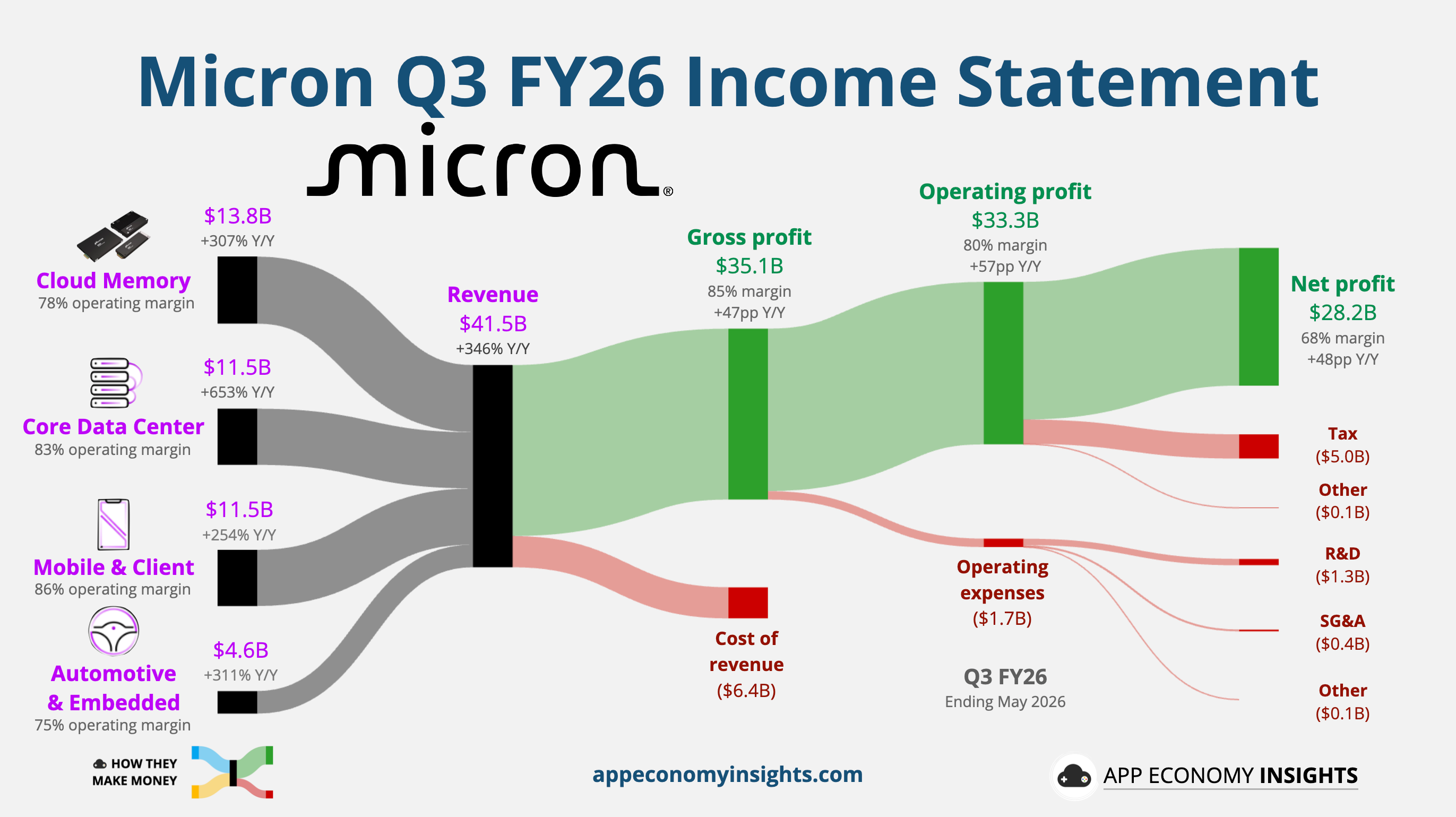
The IPP is the real grievance. Micron's Incentive Pay Plan has been paying out around 2.6 months of salary, under a cap that tops out near five months.
That's what workers got in a year when quarterly revenue jumped 346% and the company banked $28 billion in profit in a single three-month stretch. Lin Jer-ray, who heads the Micron Wafer Technology Enterprise Union, has summed up the complaint plainly: profits went vertical, pay didn't.
And the 15% figure isn't a negotiating fantasy pulled from the air. The unions circulated a peer comparison to justify it. Samsung's DS division distributes 10.5% of operating profit under the deal that called off an 18-day strike involving as many as 48,000 members in May. SK Hynix agreed last year to share 10% of annual operating profit for a decade. Domestically, Macronix pays 15% of net profit, Nanya 6%, Powerchip 5%, TSMC 4.7%, Winbond 2%. Micron trails all of them.
That comparison is also why the two sides are so far apart. SK Hynix's 10% formula is on track to pay its workers somewhere around $547,000 each this year. Micron's offer guarantees $54,000. The unions aren't asking to be paid better than the industry, they're asking to be at least in the same ballpark.

A second round of mediation is set for September 21. Taiwan law requires mediation before a legal strike, so if that session collapses, a formal strike vote follows. The two unions count somewhere between 10,000 and 12,000 members, out of roughly 15,000 Taiwan staff.
Nine days after that mediation, on September 30, Micron reports quarterly earnings it has already told investors will land near $50 billion in revenue. Taiwan produces 50-60% of Micron's chips and the bulk of its HBM, which means a walkout would hit at the worst possible moment for the company. The Central Taiwan Science Park administration has warned that a stoppage could ripple out across the island's chip supply chain and assigned staff to keep both sides talking.
Most analysts still expect a deal. The profit behind this year's bonus is already made, and Micron can close most of the gap with money it's currently generating, which is exactly how the Samsung and SK Hynix standoffs ended. In South Korea, some in the industry see the mess as a chance to win back engineers who left for Micron over the years.
For anyone shopping for memory, the stakes are simpler. DRAM supply is already tight and prices are expected to stay high well past 2027.