The takeaway: After months of rumors and leaks, Valve has finally launched its standalone VR headset, complete with pricing and shipping details. At nearly twice the cost of Meta's similarly specced Quest 3, the Steam Frame's value leans heavily on Valve's software stack and its support for a fully open Arm Linux desktop experience.
Customers interested in Valve's new headset can register for a reservation lottery, which closes on September 17 at 1 PM ET. The Steam Frame is available at $1,059 for a basic kit with 256GB of internal storage or $1,299 for a 1TB premium model.
Valve will randomize the list once sign-ups end, with the first purchase invitations going out on September 18. Both configurations ship with two controllers and Valve's dedicated 6GHz wireless adapter, along with a free copy of Half-Life: Alyx, which Valve has rebuilt as a native Arm64 version that runs standalone on the headset.
Valve's own power supply costs $29 extra, though the Steam Frame also works with the Steam Deck charger or any compatible USB-C supply. Meanwhile, a $59 ergonomic accessory kit includes controller hand straps, a headset top strap, and an extended light blocker that seals the gap at the nose.
Like the similarly priced Steam Machine, the Steam Frame is likely a victim of the RAM shortages caused by the AI data center buildout. Rising supply costs also prompted Qualcomm to hike prices for its processors at the beginning of this month.
As Valve previously confirmed, the Steam Frame packs a Snapdragon 8 Gen 3 SoC with 16GB of LPDDR5X RAM, a 2160 x 2160 LCD panel per eye behind custom pancake lenses, refresh rates up to 120Hz with an experimental 144Hz mode, and monochrome exterior cameras.
The hardware doesn't appear to be a transformative upgrade over the $600 Meta Quest 3 or $450 Quest 3S; its main advantages are a larger memory pool, a microSD card slot for expanded storage, eye tracking, more controller inputs, and a potentially larger software library.
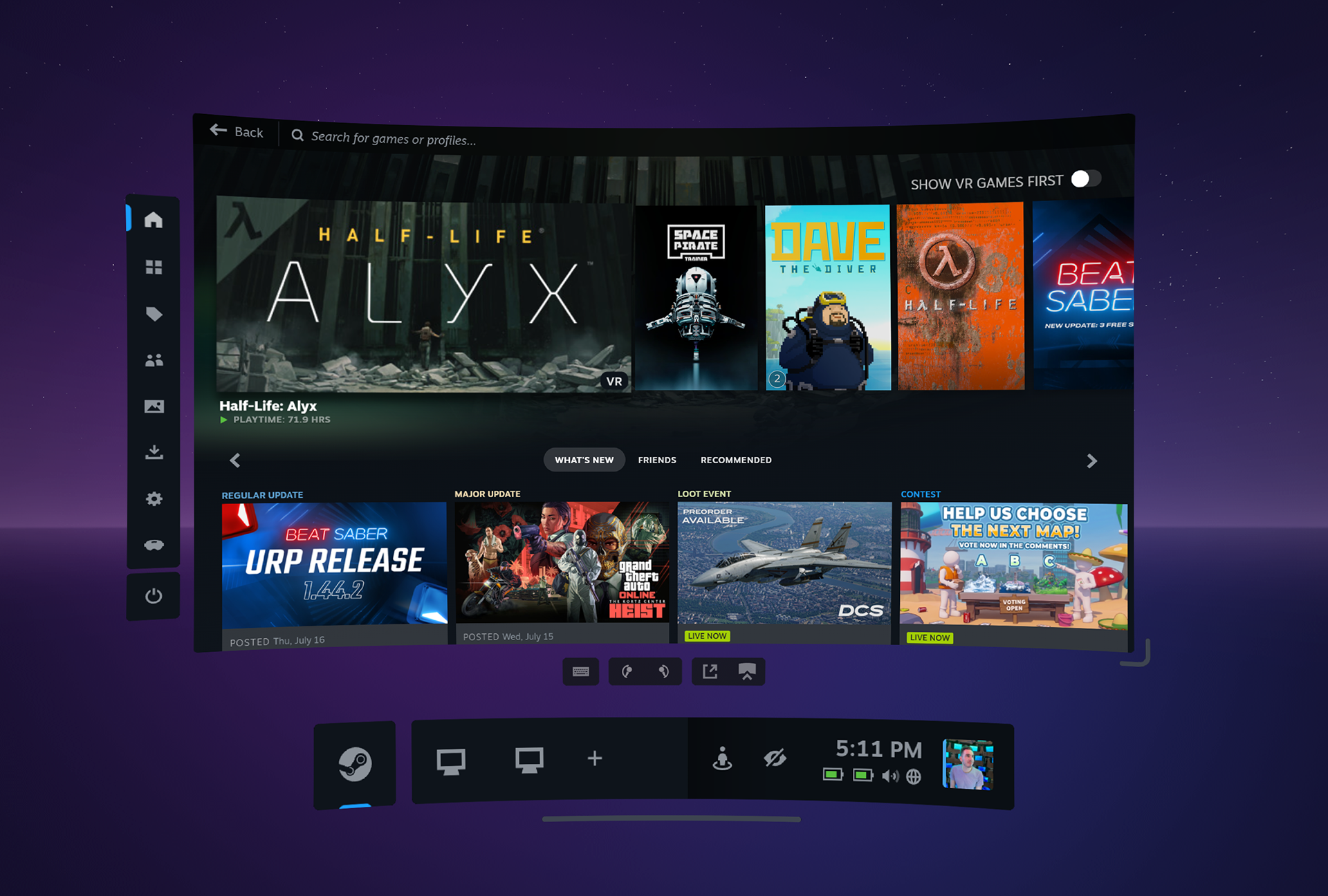
While the Quest headsets more or less lock users into Meta's software ecosystem with PC streaming as a bonus, Valve's alternative supports Steam games via streaming or standalone play using multiple compatibility layers.
An initial list of games verified for local installation includes VR titles such as Keep Talking and Nobody Explodes, Superhot VR, and Pistol Whip. Meanwhile, traditional games like Hollow Knight: Silksong, Hades II, Balatro, Portal 2, and Cuphead also run well on a virtual screen. Users can boot out of Steam into a fully unlocked Arm64 Linux desktop environment to install PC and even potentially Android apps.
Official videos walking users through the initial setup leaked late last month, and the YouTube channel ShortCircuit accidentally uploaded first-impression videos early over the weekend.