
In today's market, the Radeon RX 9070 XT is the best-value high-end GPU you can buy, which is brutal considering that pricing starts at around $900 (against a $600 MSRP). Still, that's about how much you'll pay for an RTX 5060 Ti 16GB in some markets, and the Radeon GPU is on average 70% faster at 4K gaming.
With that kind of performance gap, it's hard to make a case for GeForce right now, at least if you're shopping for something with more than 8GB of VRAM.
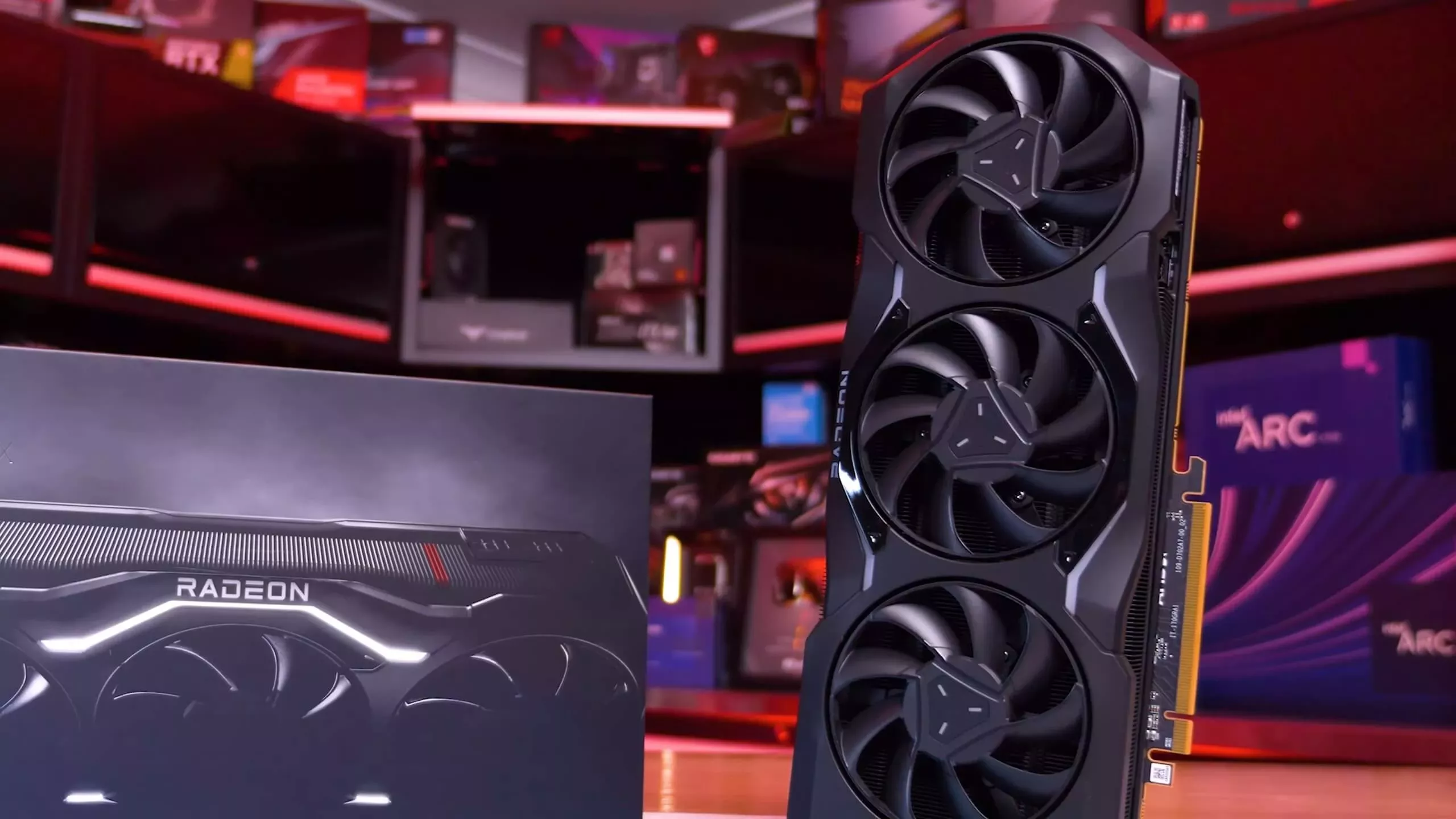
So, is it an open-and-shut case for the 9070 XT? Well, not so fast. Many readers have been asking us to revisit the Radeon RX 7900 XTX. Some have cited it as a potentially viable purchase in their region, while others simply want to see how AMD's RDNA 3 flagship has aged, and not just across 10 games, but more like 50+ titles. And that's exactly what we're going to do.
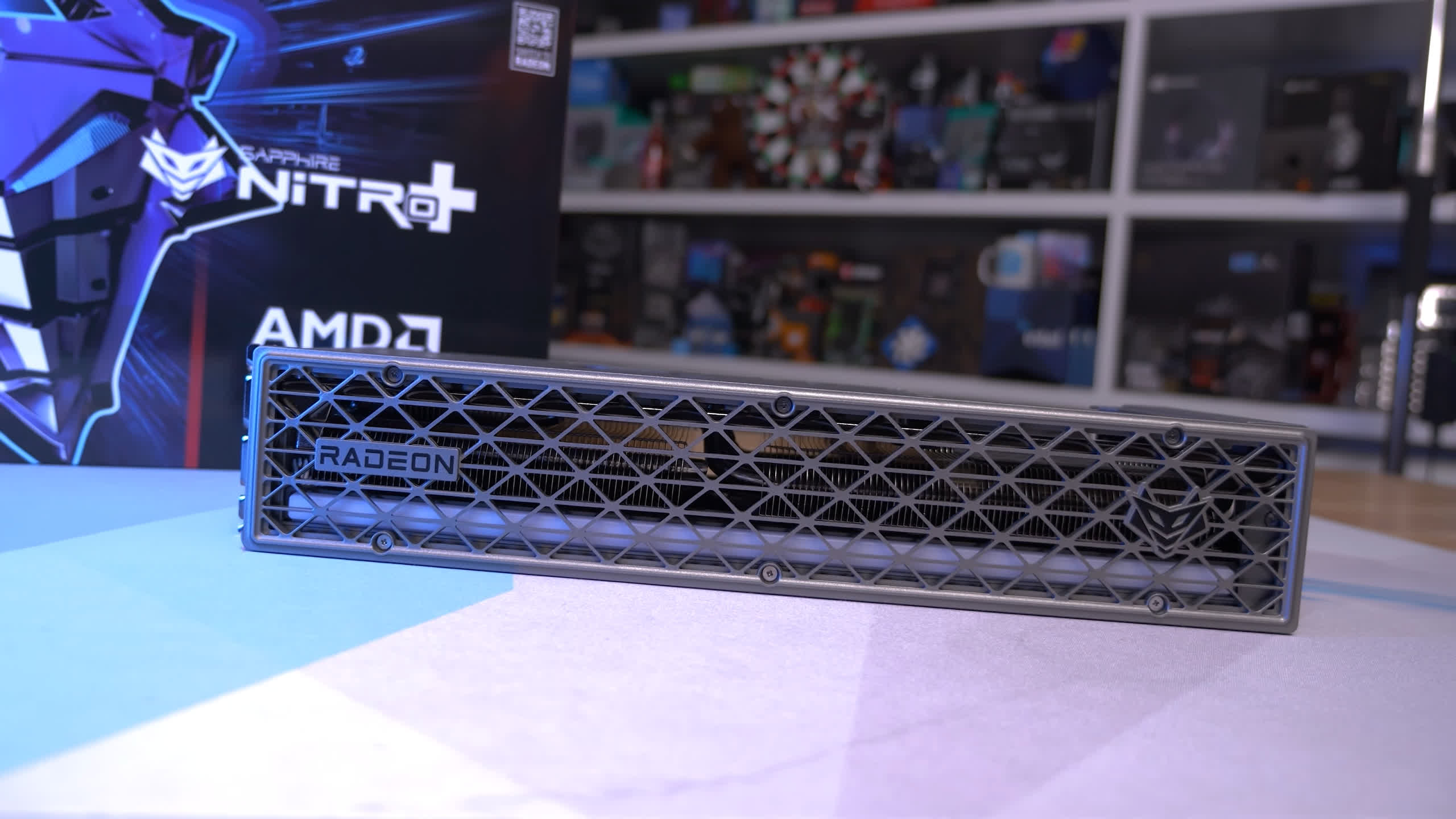
There's a lot of data to go over, after all we did test 51 games in total. However, much of it tells a similar story because the 9070 XT and 7900 XTX often deliver very similar gaming performance. So we'll focus on the games where we found notable results before diving into the overall performance summaries.
Test System
As usual, we're using our Ryzen 7 9800X3D GPU test system, equipped with 32GB of DDR5-6000 memory. The latest available display drivers at the time of testing were also used.
| CPU | AMD Ryzen 7 9800X3D |
| Motherboard | MSI MPG X870E Carbon WiFi [BIOS 7E49v1AA7] |
| Memory | G.Skill Trident Z5 RGB DDR5-6000 32GB CL30 [CL30-38-38-96] |
| Graphics Card | Radeon RX 9070 XT, Radeon RX 7900 XTX |
| ATX Case | MSI Prospect 700R |
| Power Supply | Kolink Regulator Gold ATX 3.0 1200W |
| Storage | TeamGroup T-Force Cardea A440 M.2 PCIe Gen4 NVMe SSD 4TB |
| Operating System | Windows 11 26H2 |
| Display Driver | AMD Radeon Adrenalin 26.9.2 (9070 XT) AMD Radeon Adrenalin 26.10.1 (7900 XTX) |
Gaming Benchmarks
Assassin's Creed Black Flag Resynced
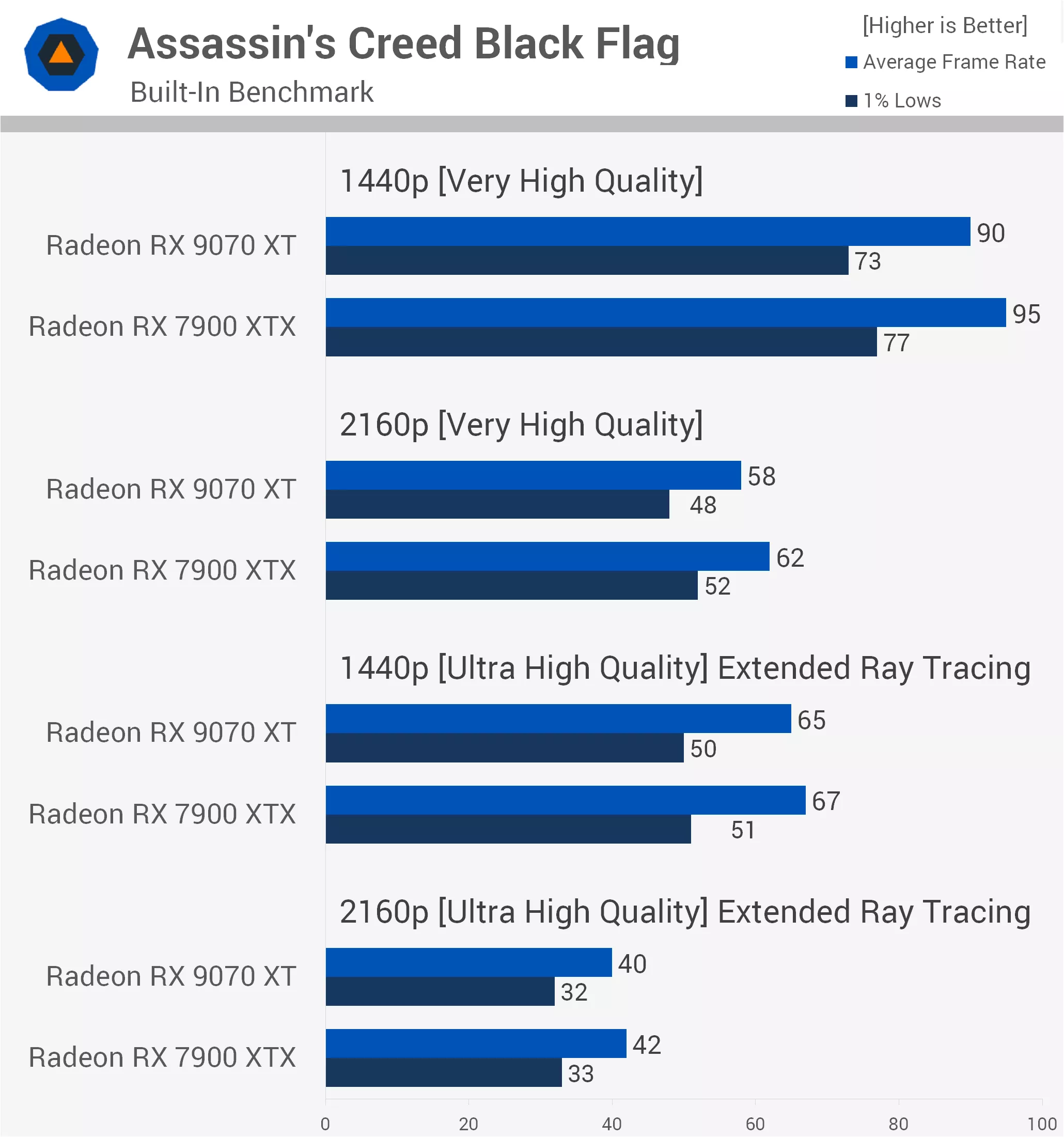
Believe it or not, the margins we're seeing here in Assassin's Creed Black Flag Resynced are on the larger side of what we observed across the 51 games. In this example, the older 7900 XTX was 6-7% faster using the Very High quality preset, but when we enabled Extended Ray Tracing, that margin dropped to just 3-5%, depending on the resolution.
Black Myth: Wukong
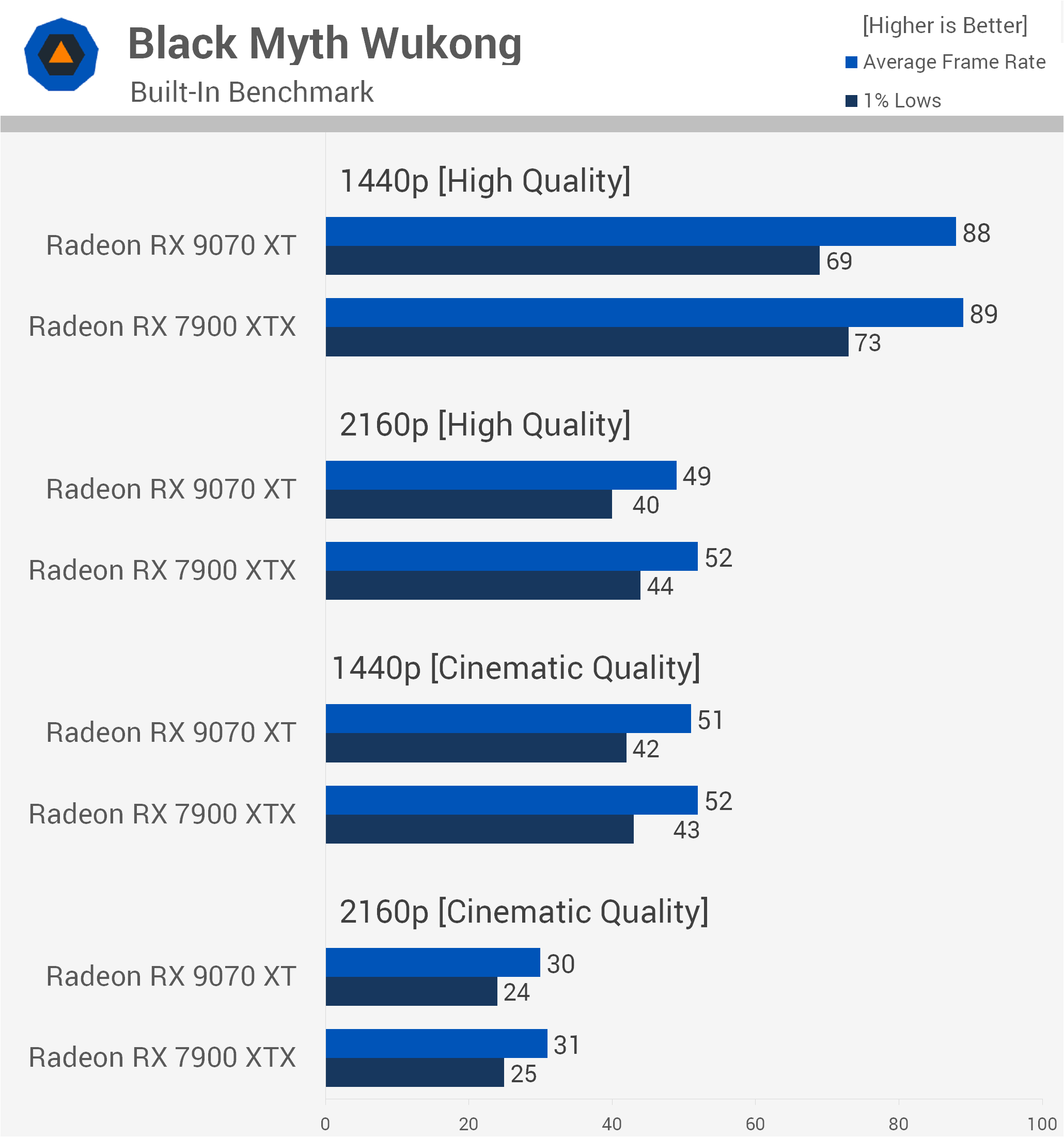
Performance in Black Myth: Wukong is also much the same, though we are seeing up to a 6% performance advantage for the 7900 XTX using the High preset at 4K. That margin is reduced to just 3% when using the Cinematic preset.
Arc Raiders
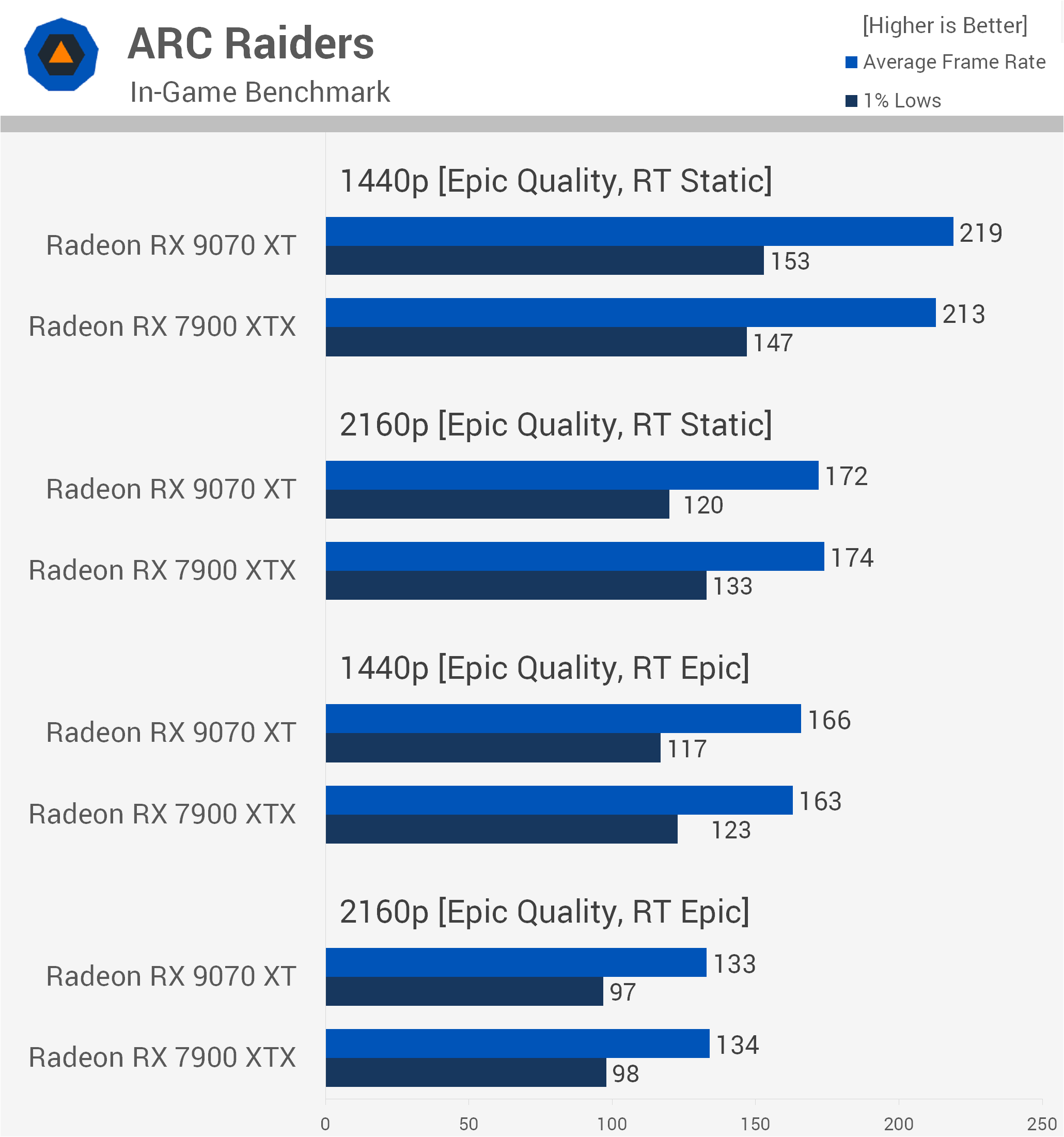
Arc Raiders is more representative of the typical performance margins we saw. Here, the 9070 XT was 2-3% faster at 1440p, while the 7900 XTX nudged ahead at 4K by just 1%.
Borderlands 4
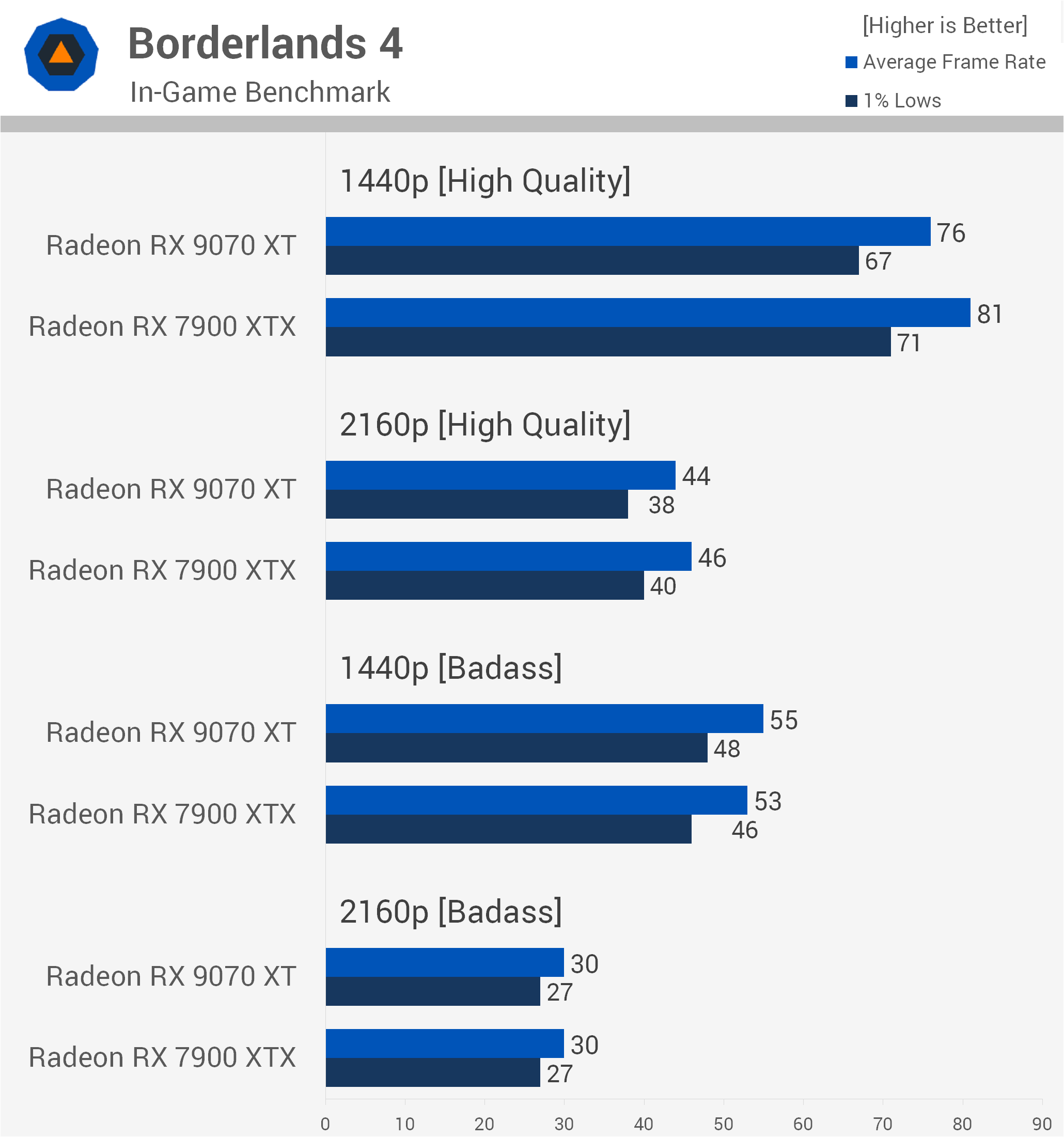
Borderlands 4 is a mixed bag. For example, the 7900 XTX was up to 7% faster at 1440p using the High preset, and 5% faster at 4K. However, switching over to the Badass preset allowed the 9070 XT to pull out a 4% win at 1440p, though the results were tied at 4K.
Crimson Desert
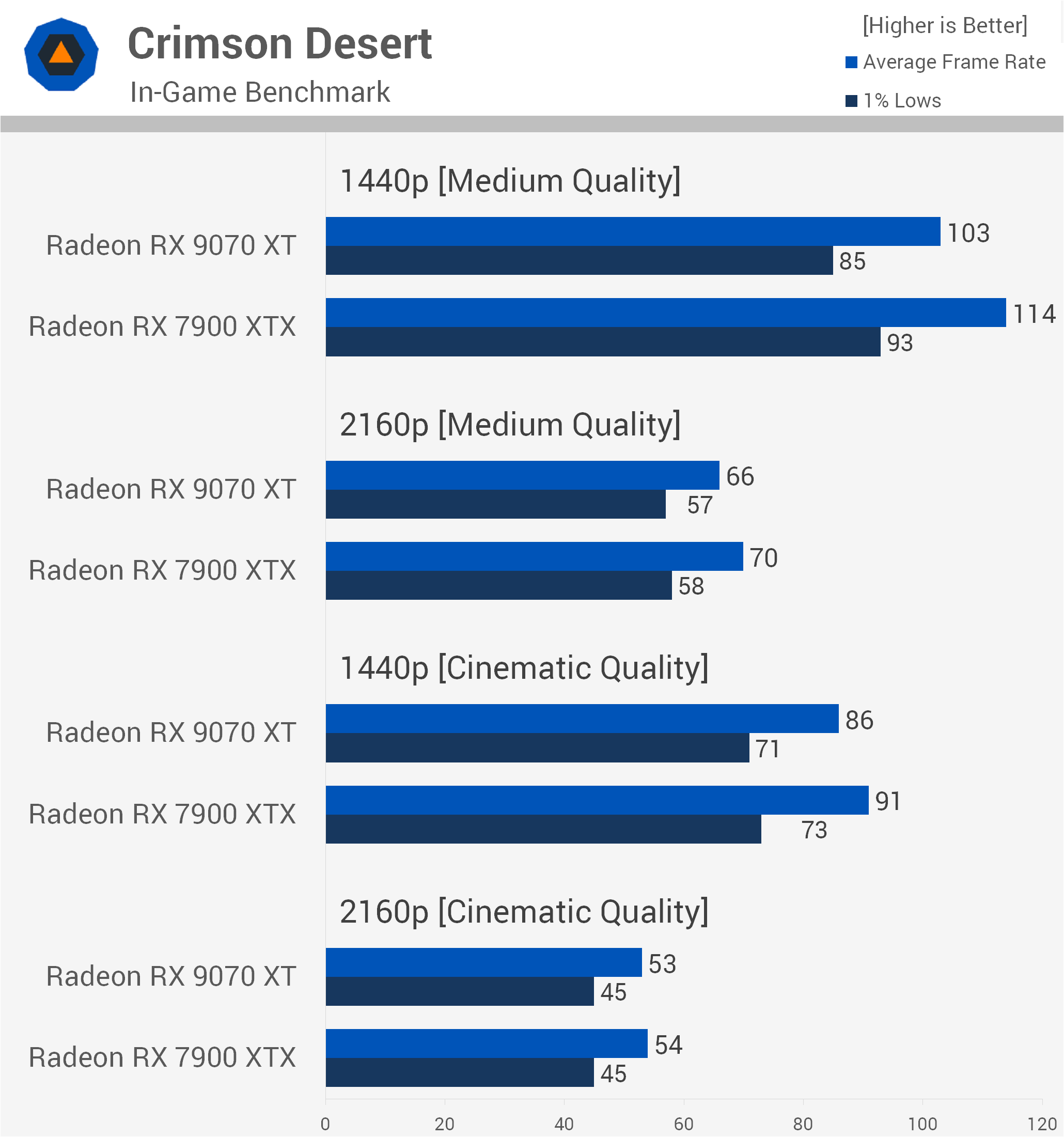
The older 7900 XTX enjoyed Crimson Desert, delivering 11% greater performance at 1440p when using Medium settings. Beyond that, though, we're looking at margins of around 6% or less.
Clair Obscur: Expedition 33
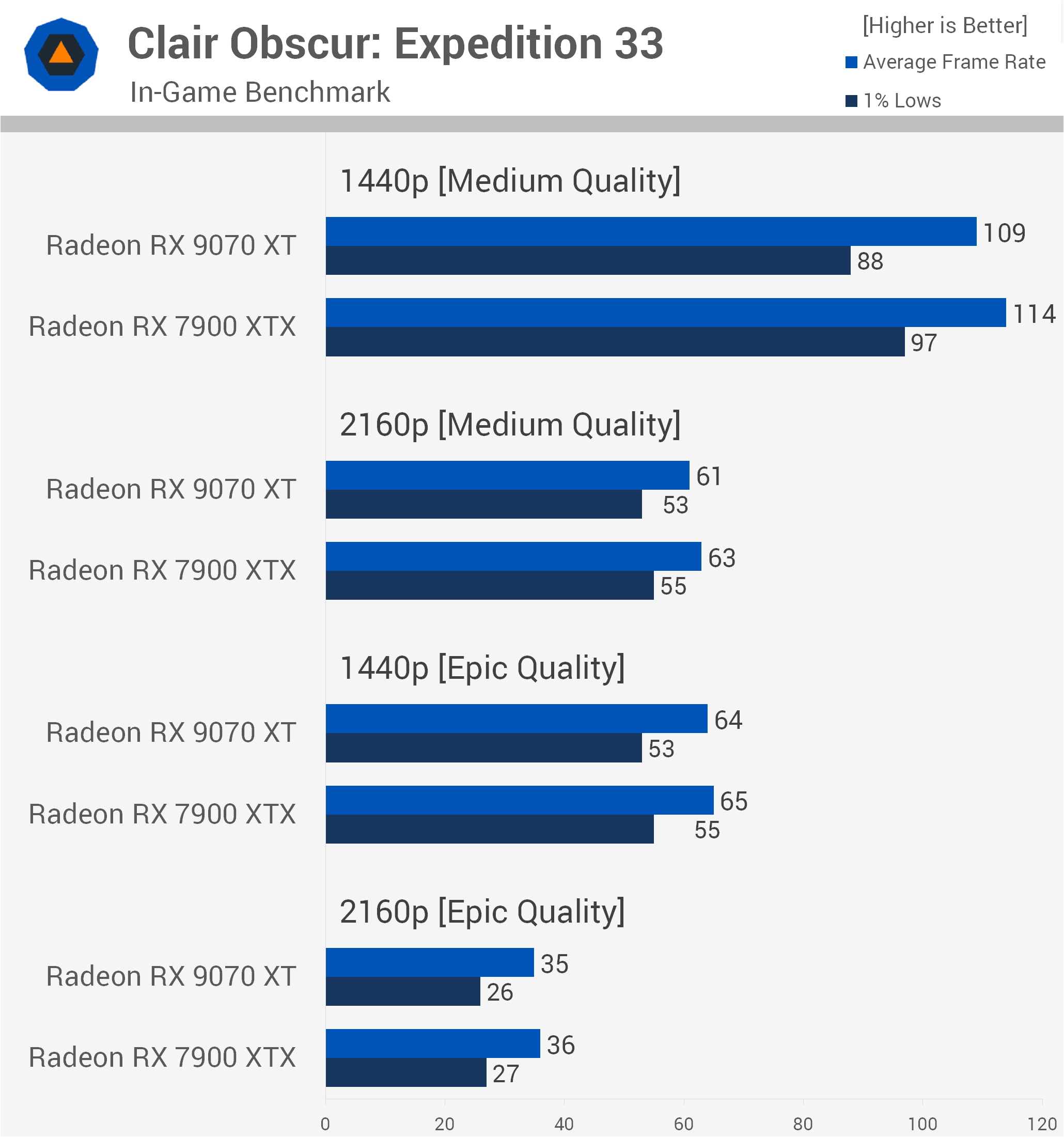
The Clair Obscur: Expedition 33 results are very typical. For the most part, we're seeing nearly identical performance between these two GPUs. The only exception was at 1440p using Medium settings, where the 7900 XTX pulled out a 5% win. That's close enough to call a tie, but in this data set, it stands out as a relatively large margin.
Doom: The Dark Ages
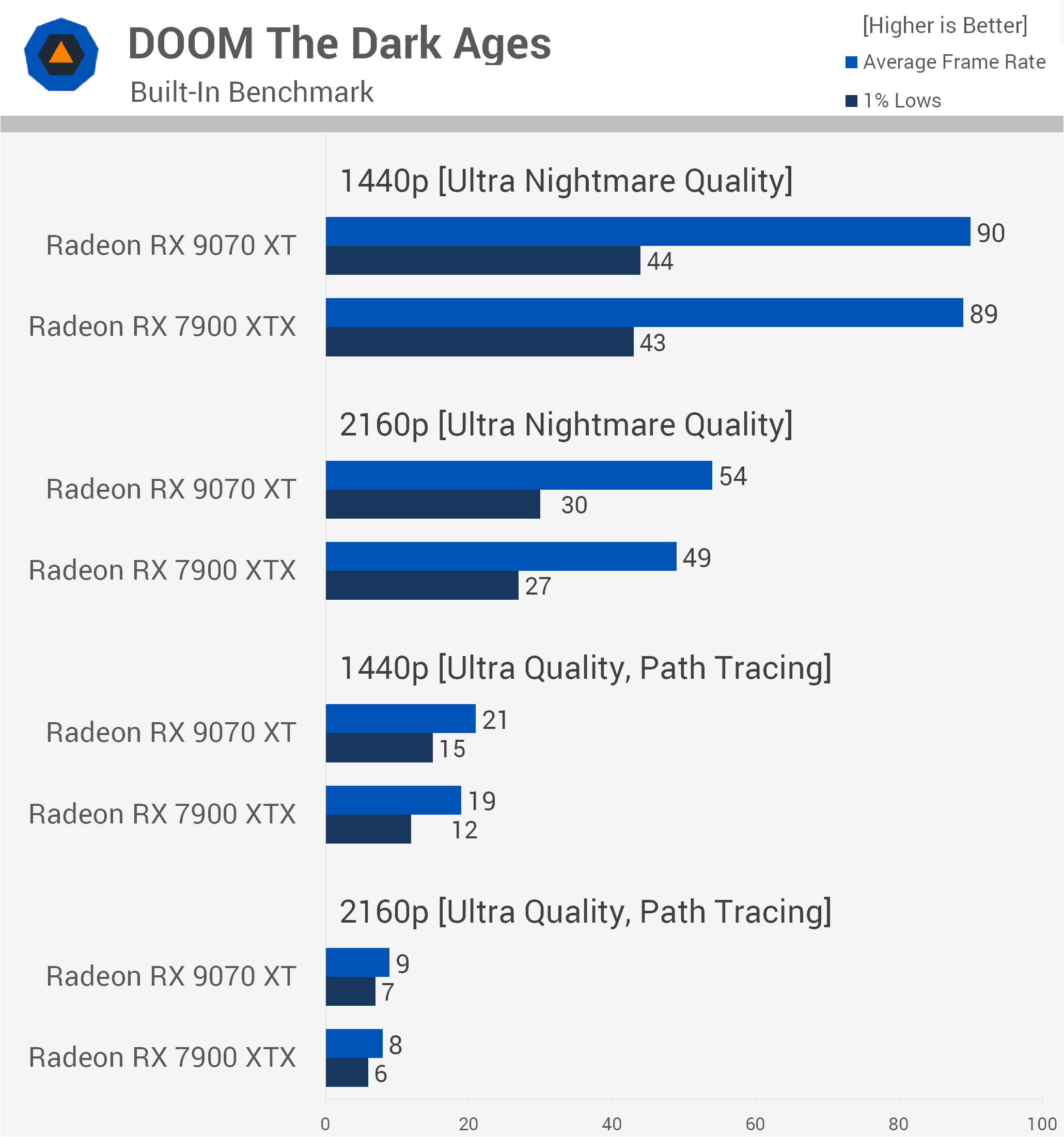
The 9070 XT does quite well in Doom: The Dark Ages. At 1440p, we see no real difference between these two GPUs, but at 4K using the Ultra Nightmare settings, the newer Radeon GPU was 10% faster. However, despite the RDNA 4 architecture offering better ray tracing support, that advantage doesn't matter much with path tracing enabled, as both GPUs get smashed.
F1 25
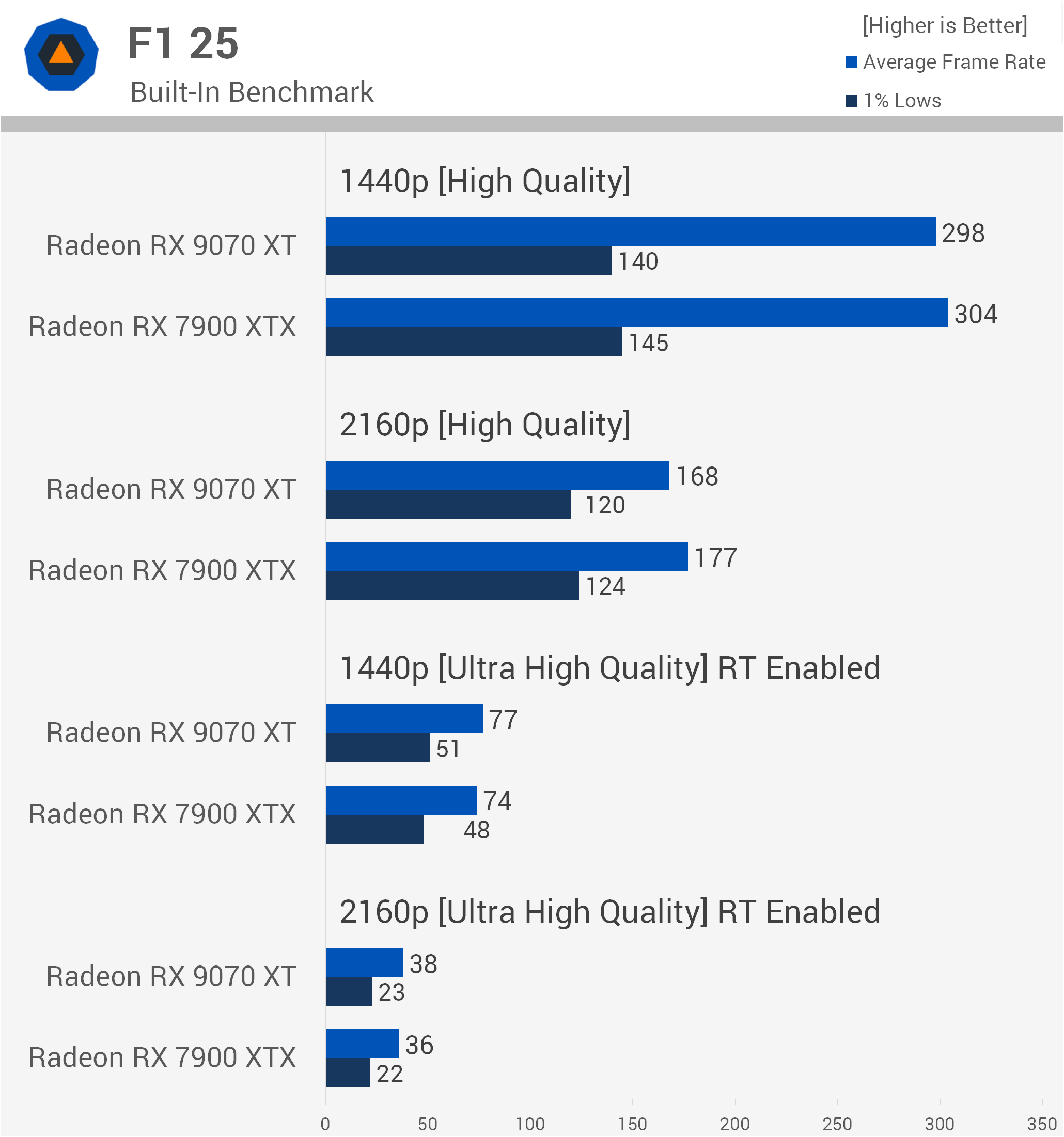
F1 25 saw the 7900 XTX delivering up to 5% greater performance when using the High preset, as seen at 4K. However, enabling ray tracing favors the 9070 XT, though only slightly, with the newer Radeon GPU pulling ahead by 4-6%.
Hell is Us
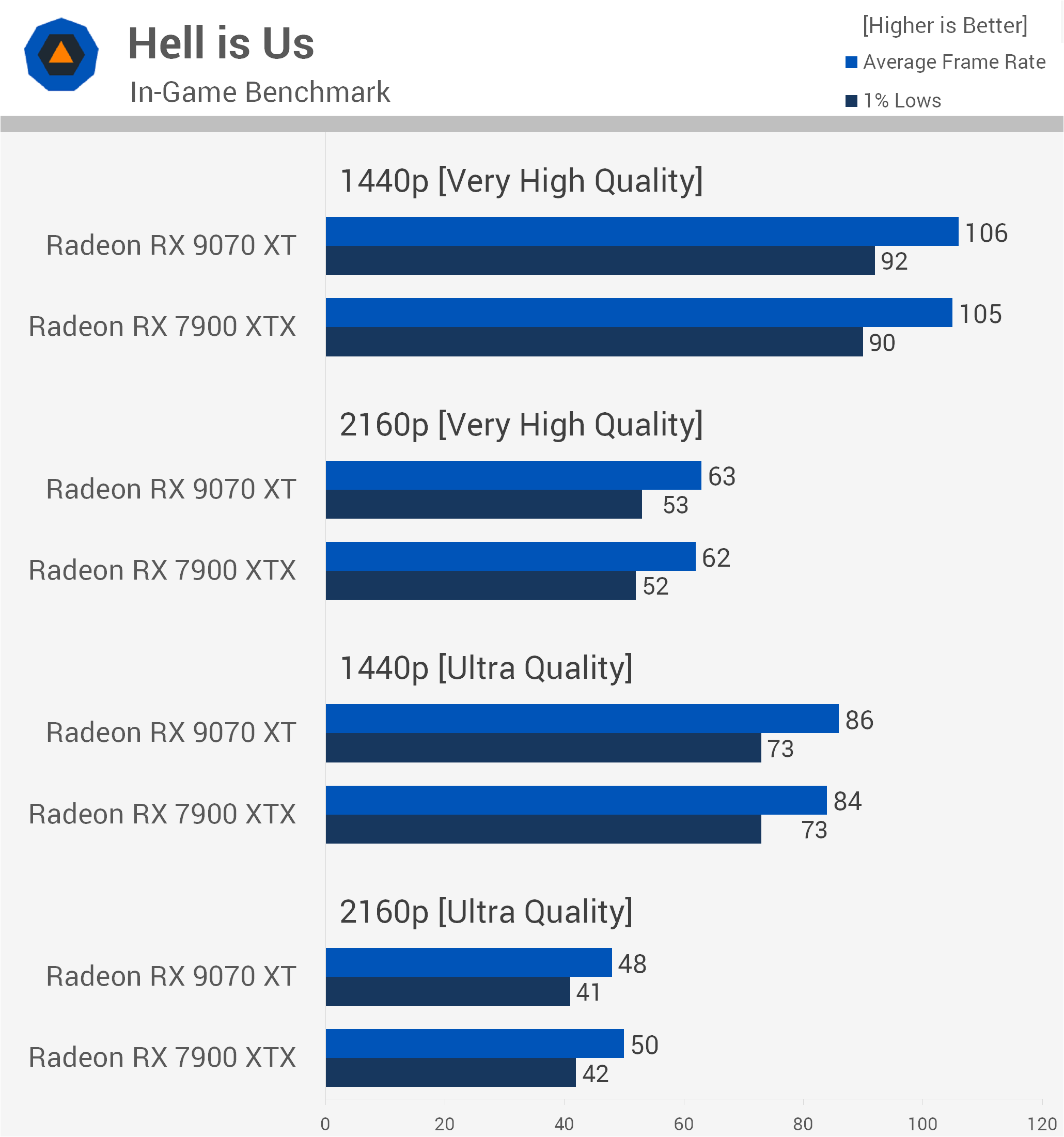
Performance in Hell is Us is pretty typical of what we saw across most of the 51 games tested, with just a few frames separating these GPUs. In this example, the 9070 XT was generally ahead, but again, we're talking about low single-digit margins here.
Indiana Jones and the Great Circle
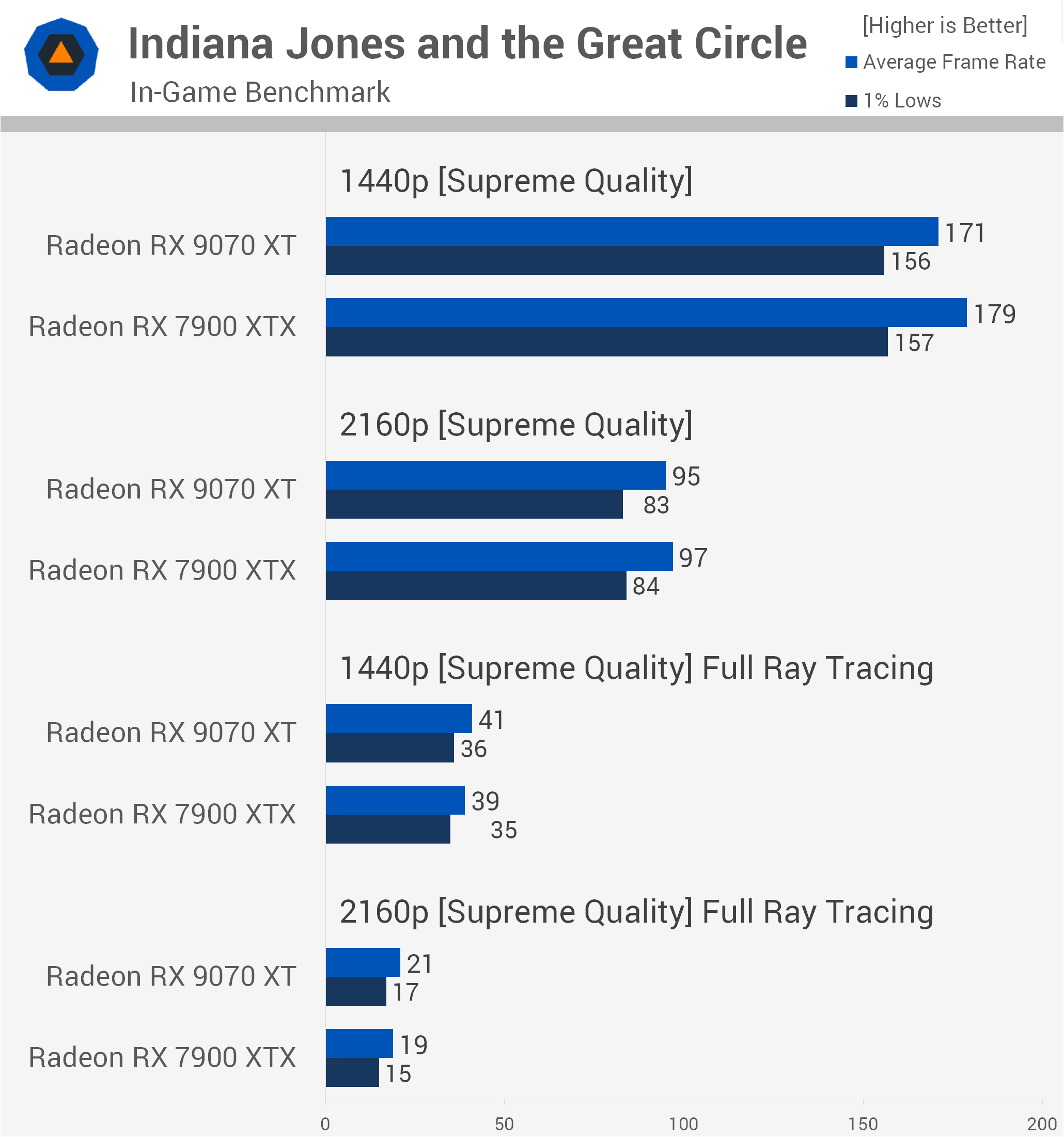
Indiana Jones and the Great Circle is another example where performance was largely the same. The 7900 XTX was up to 5% faster at 1440p using the Supreme preset, but that margin quickly shrank to just 2% at 4K. Then, when enabling full ray tracing, the 9070 XT takes the lead, though only just, offering around 5% better performance.
Lego Batman
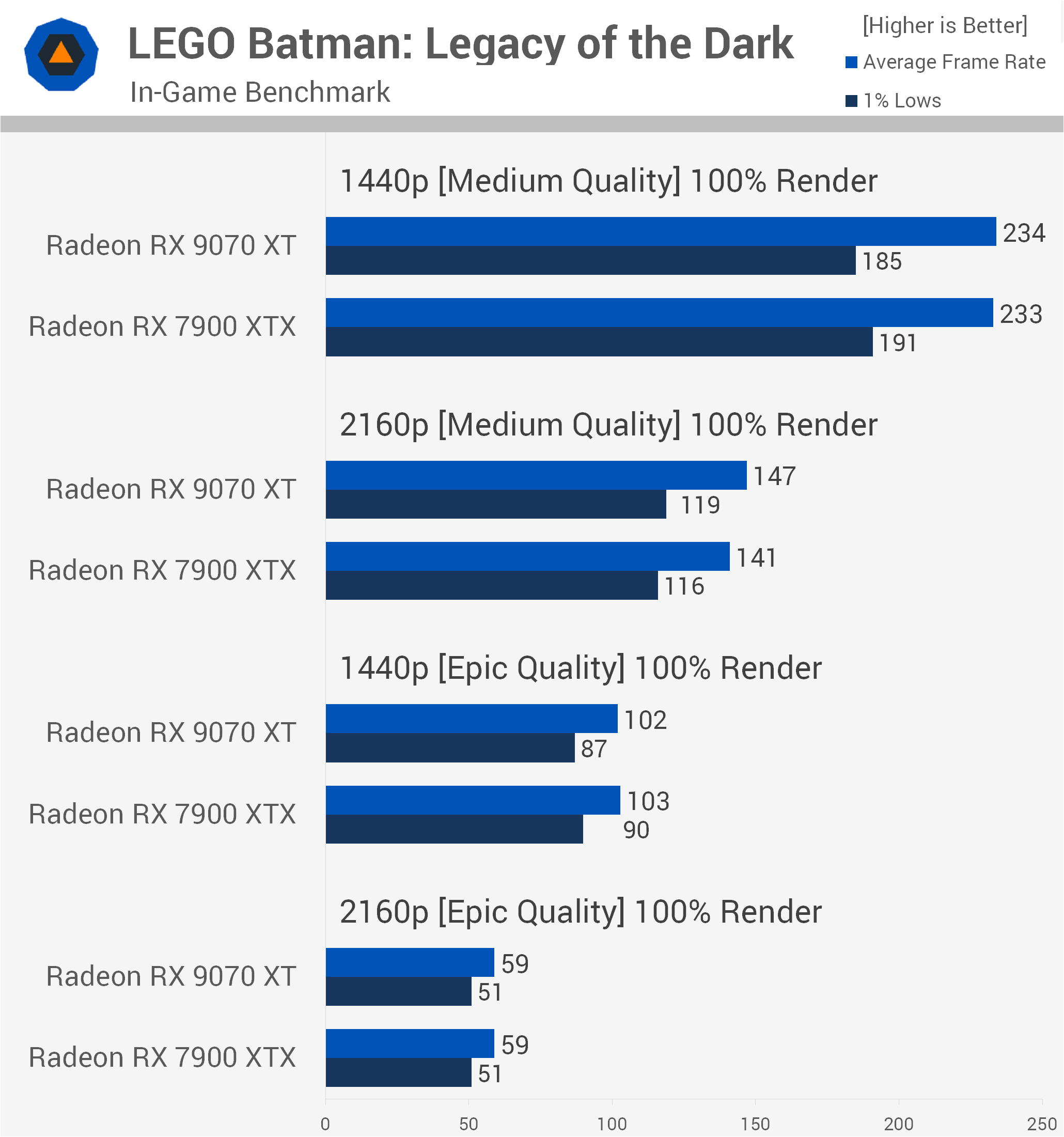
Lego Batman provided us with more of the same. For the most part, there's little to nothing separating these two GPUs. At most, we saw a 4% margin at 4K using Medium settings, which favored the 9070 XT.
Monster Hunter Wilds
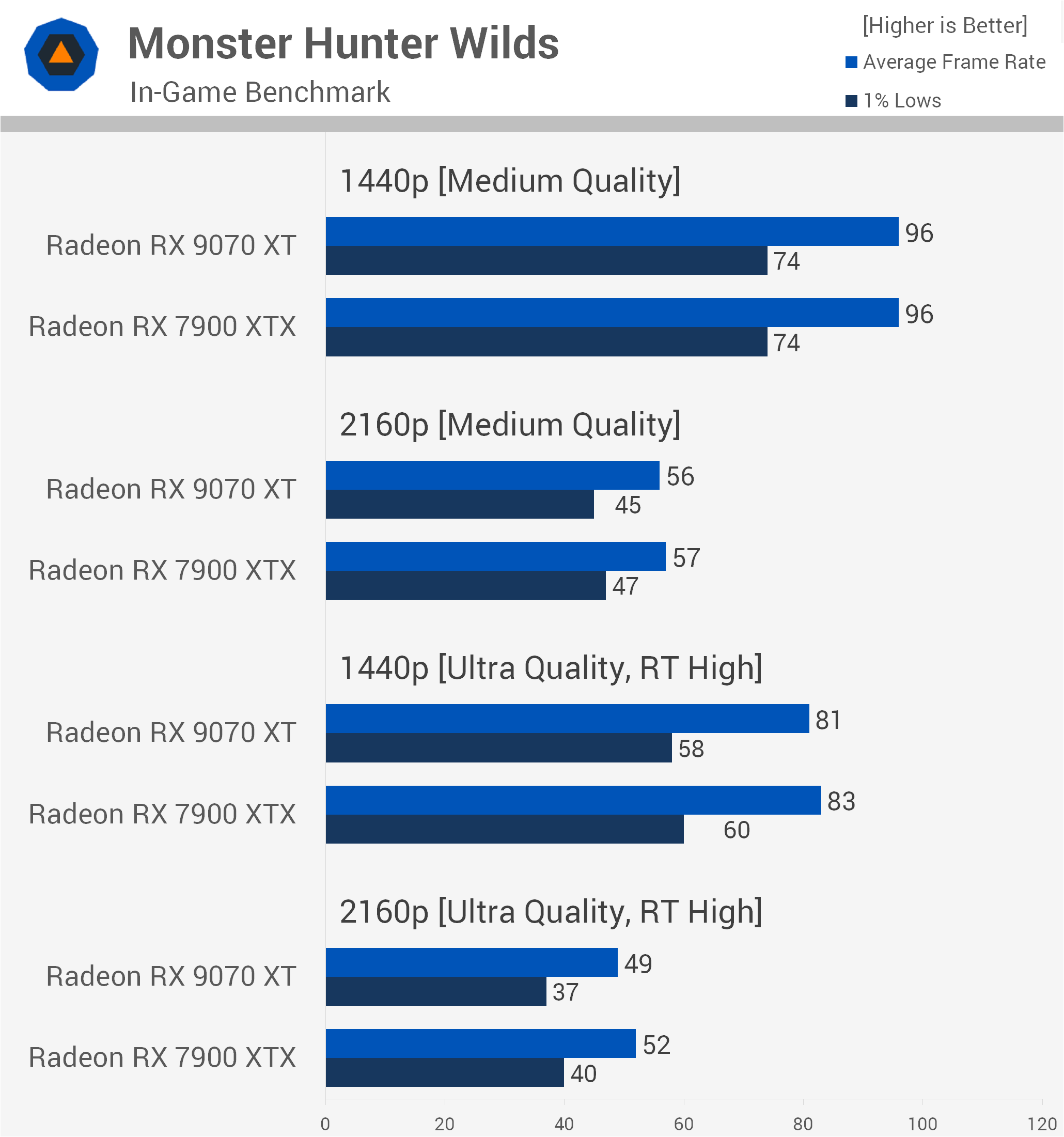
The same is true of Monster Hunter Wilds. Here, we're looking at identical or near-identical performance for the most part. The only somewhat noteworthy results can be seen at 4K using the High ray tracing settings, where the 7900 XTX was actually faster. So the 9070 XT isn't always superior when using RT effects.
Pragmata
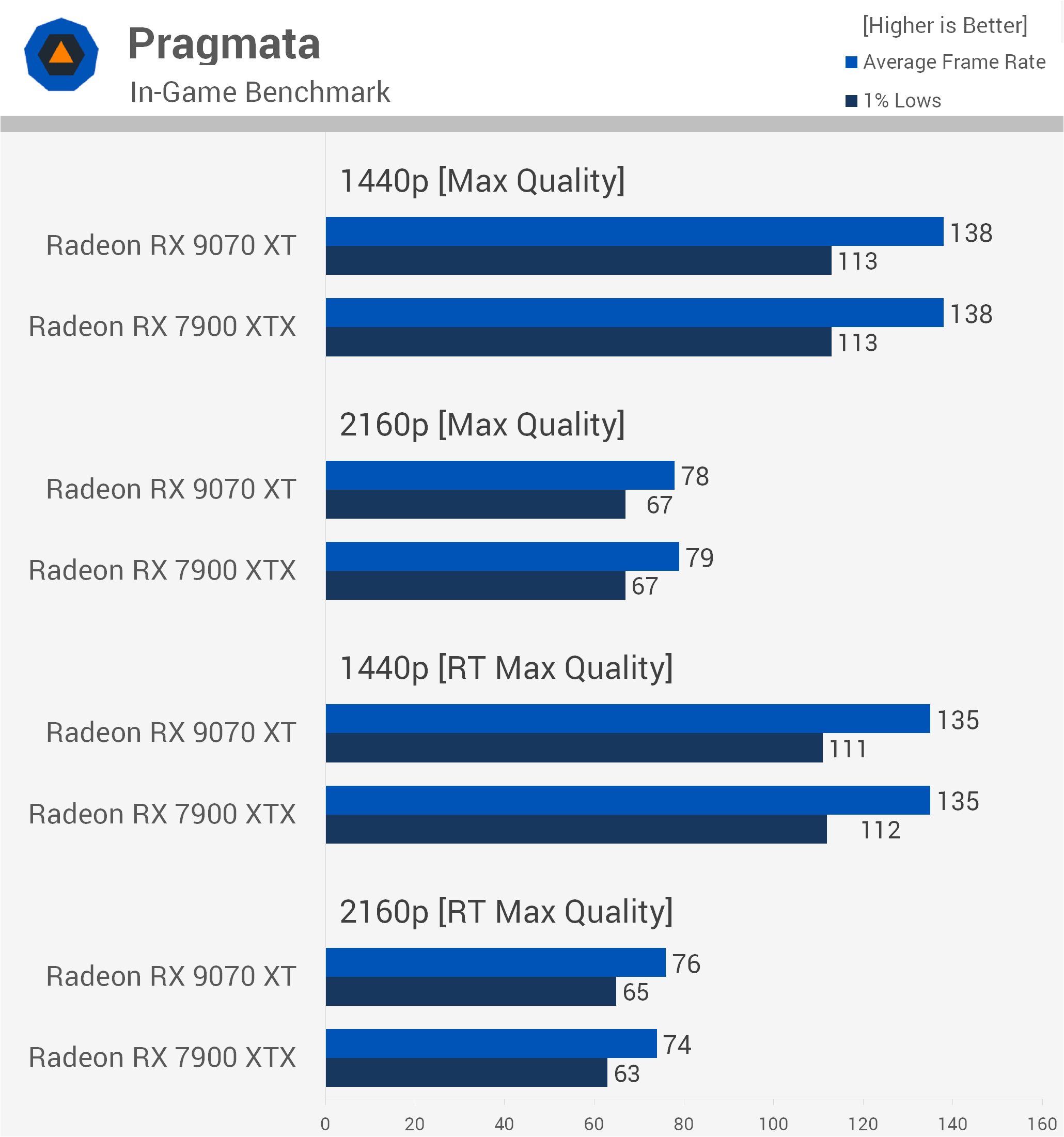
Another typical example can be seen in Pragmata. Here, the 7900 XTX and 9070 XT deliver virtually identical performance, with or without ray tracing enabled.
Marvel Rivals
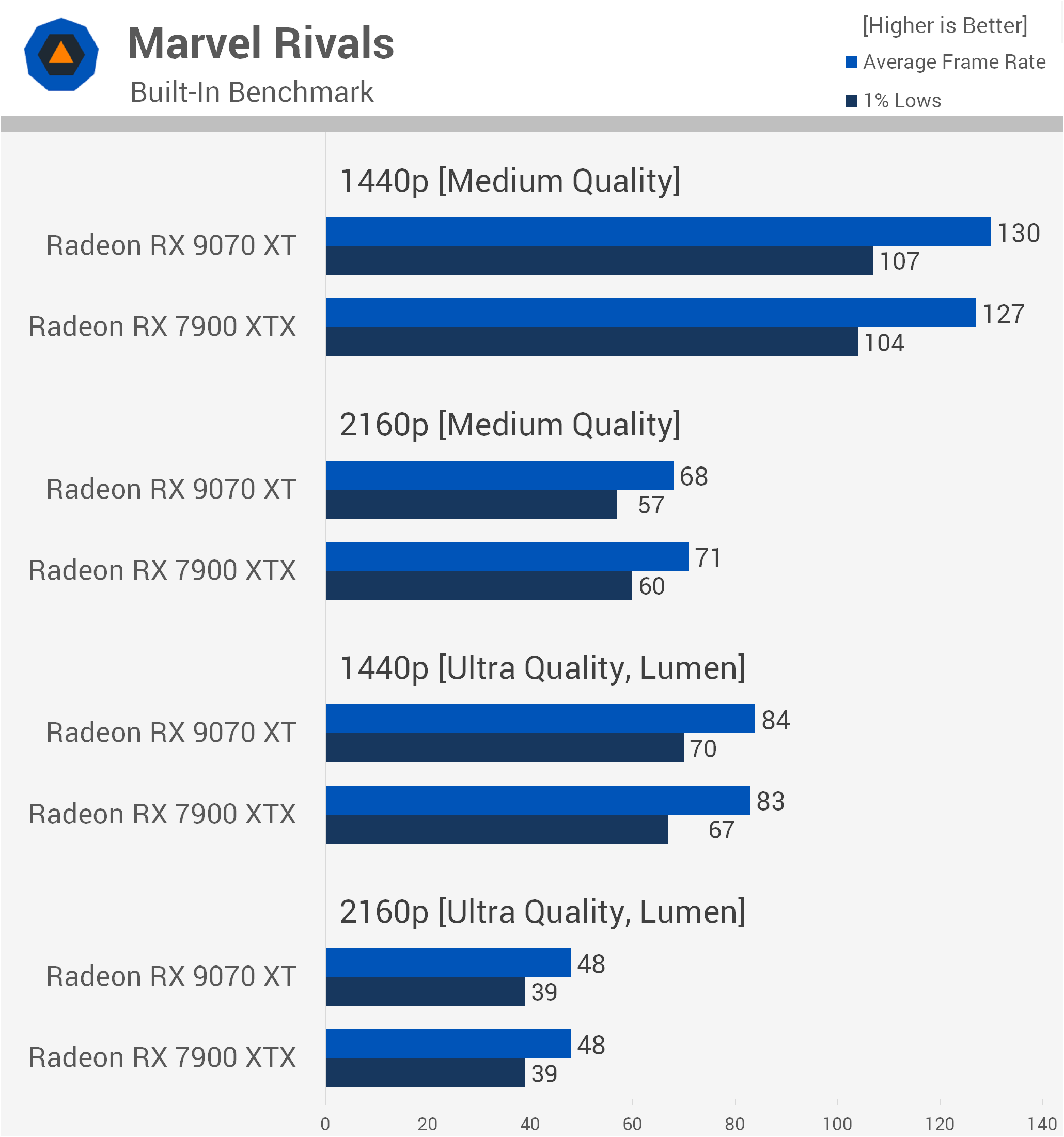
The same is also true of Marvel Rivals. The two GPUs trade blows using Medium settings, with performance swings no larger than 4%. But once we max out the quality settings, performance is virtually identical.
007 First Light
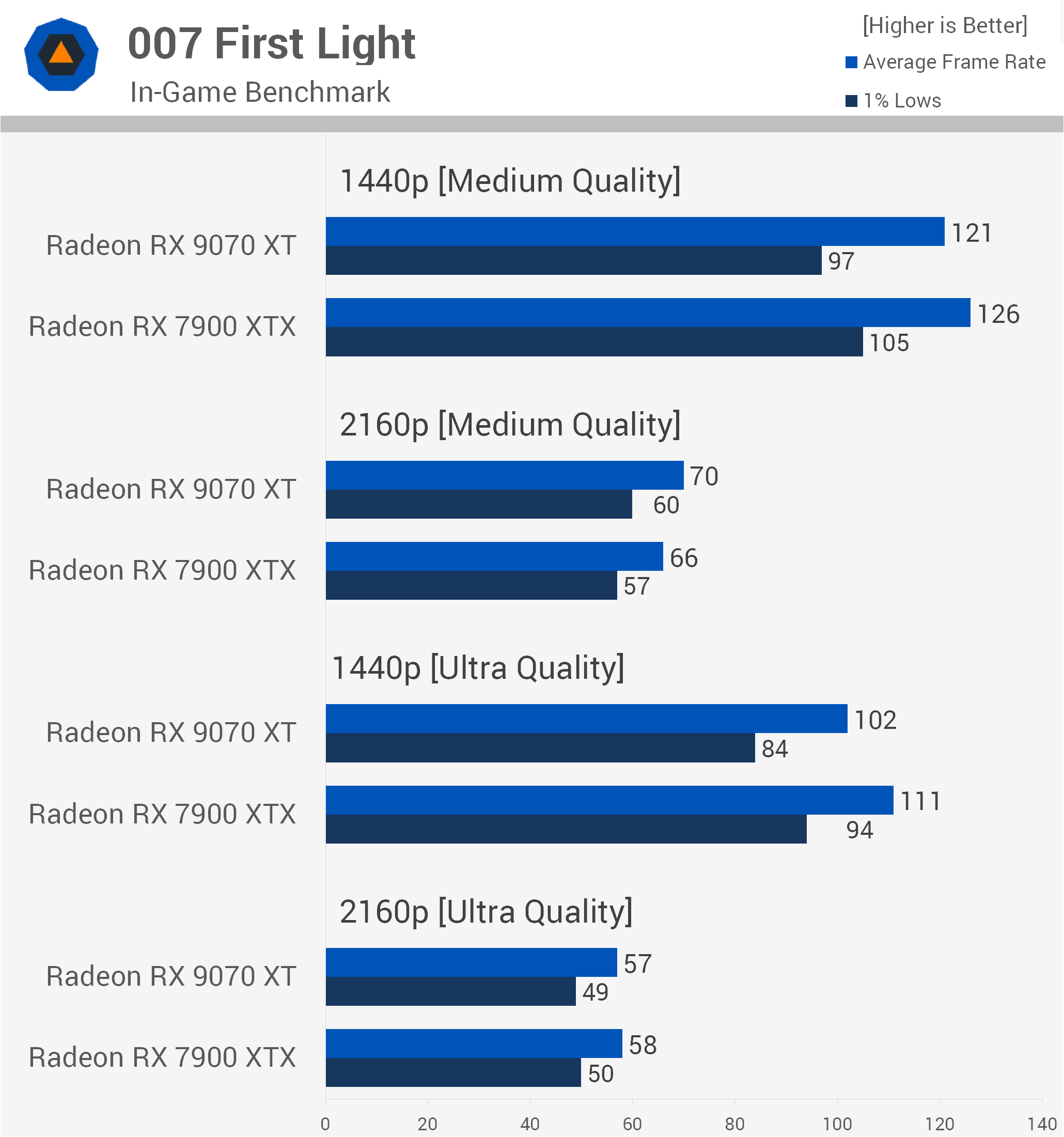
007 First Light gives us a mixed bag of results. Using Medium settings at 1440p, the 7900 XTX was 4% faster, not a big margin, but at 4K the results are flipped, and now it's the 9070 XT that's faster, leading by a slim 6% margin. Back at 1440p, but this time with Ultra settings, the 7900 XTX gets out to a 9% lead, only for that margin to shrink to 2% at 4K.
Cities: Skylines
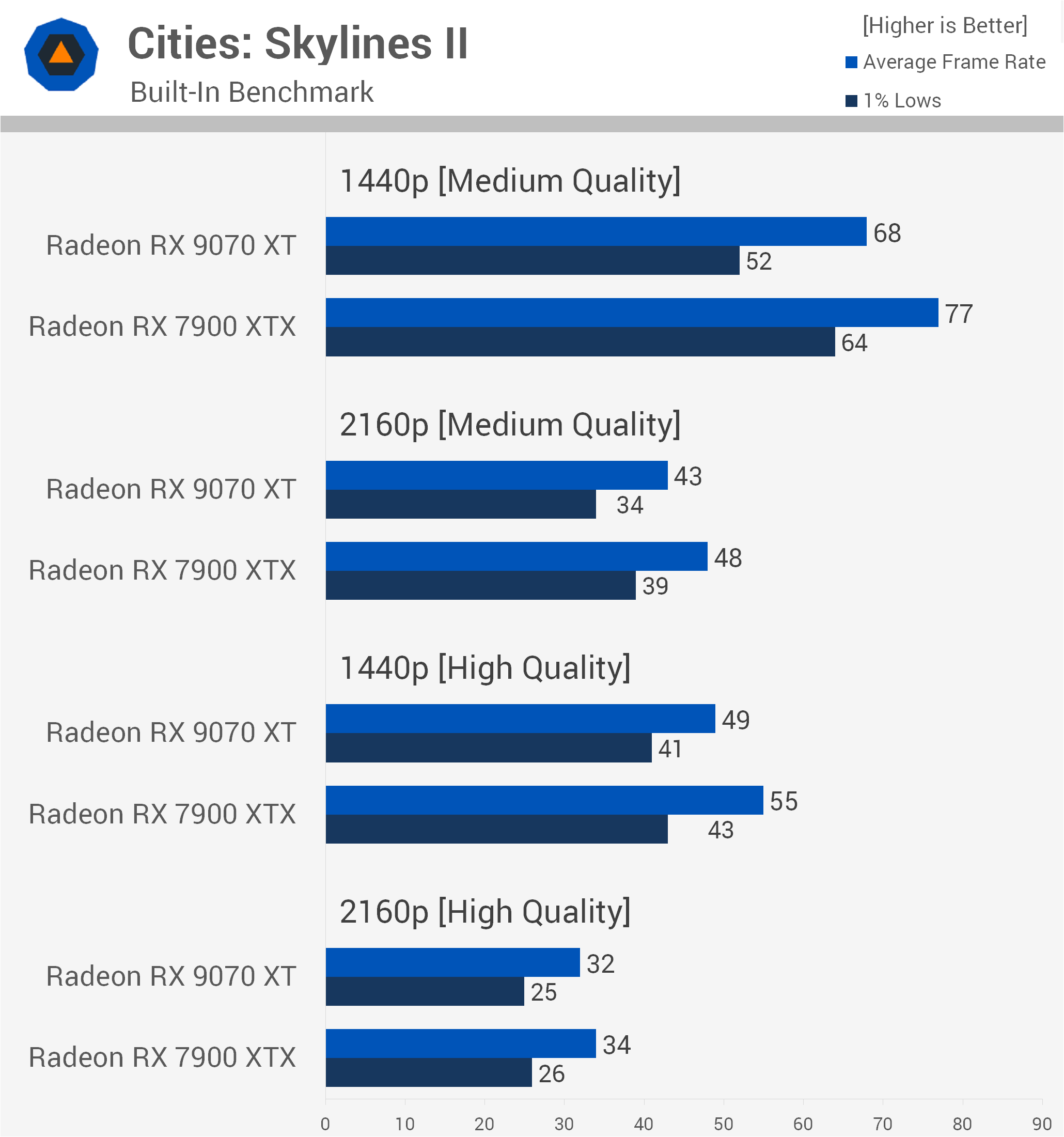
Cities: Skylines provides us with some unusual results. In this example, the older 7900 XTX is quite a bit faster, delivering 12-13% greater performance using the Medium preset and then 12% at 1440p using High settings, though just 6% at 4K. Still, overall, the 7900 XTX was the faster GPU in this title.
Counter-Strike 2
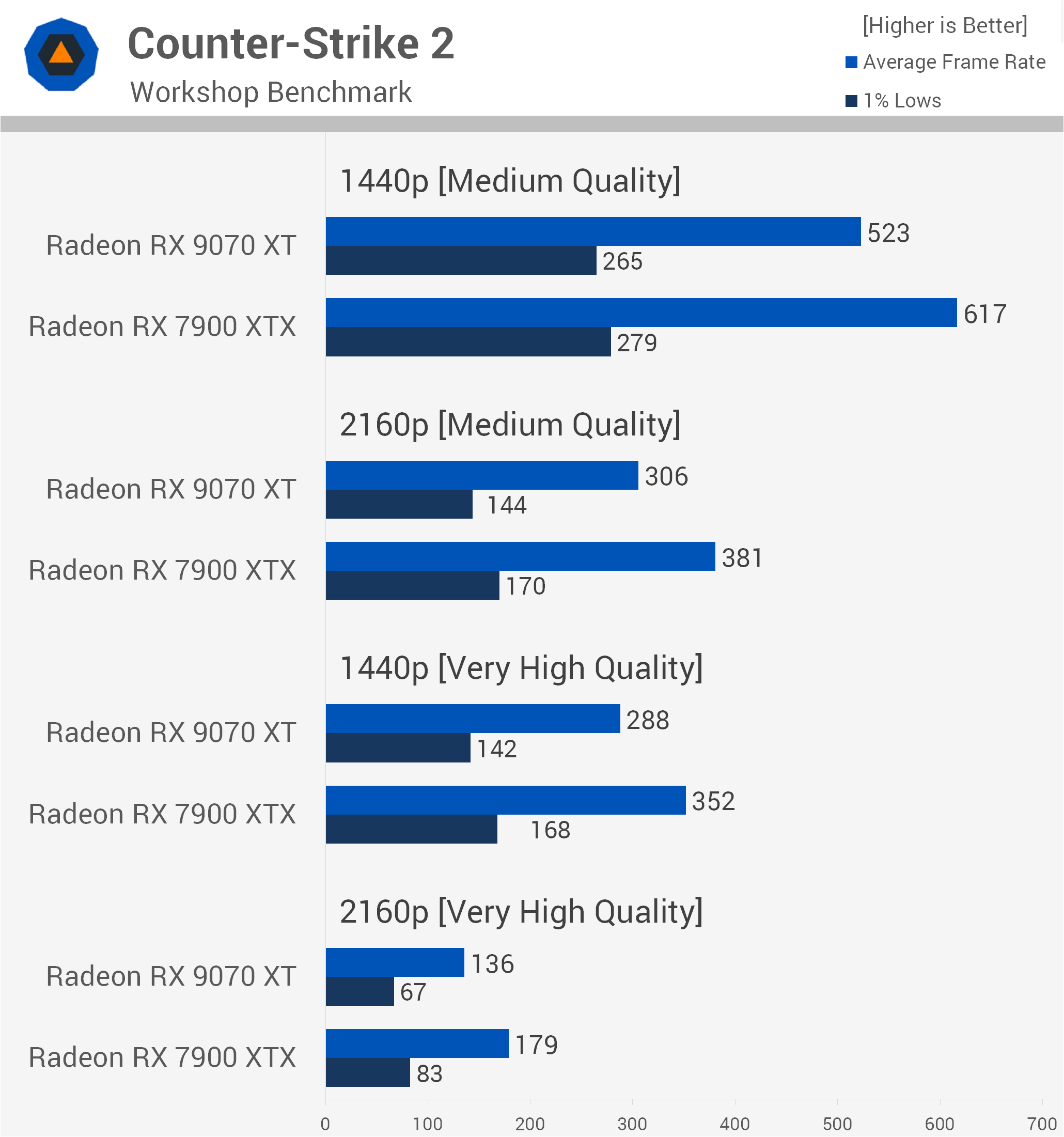
The 7900 XTX was also dominant in Counter-Strike 2, delivering 18% greater performance at 1440p with Medium settings and 25% at 4K. These gains were maintained using Very High settings, with the older Radeon delivering 22% greater performance at 1440p and then a massive 32% increase at 4K.
Delta Force
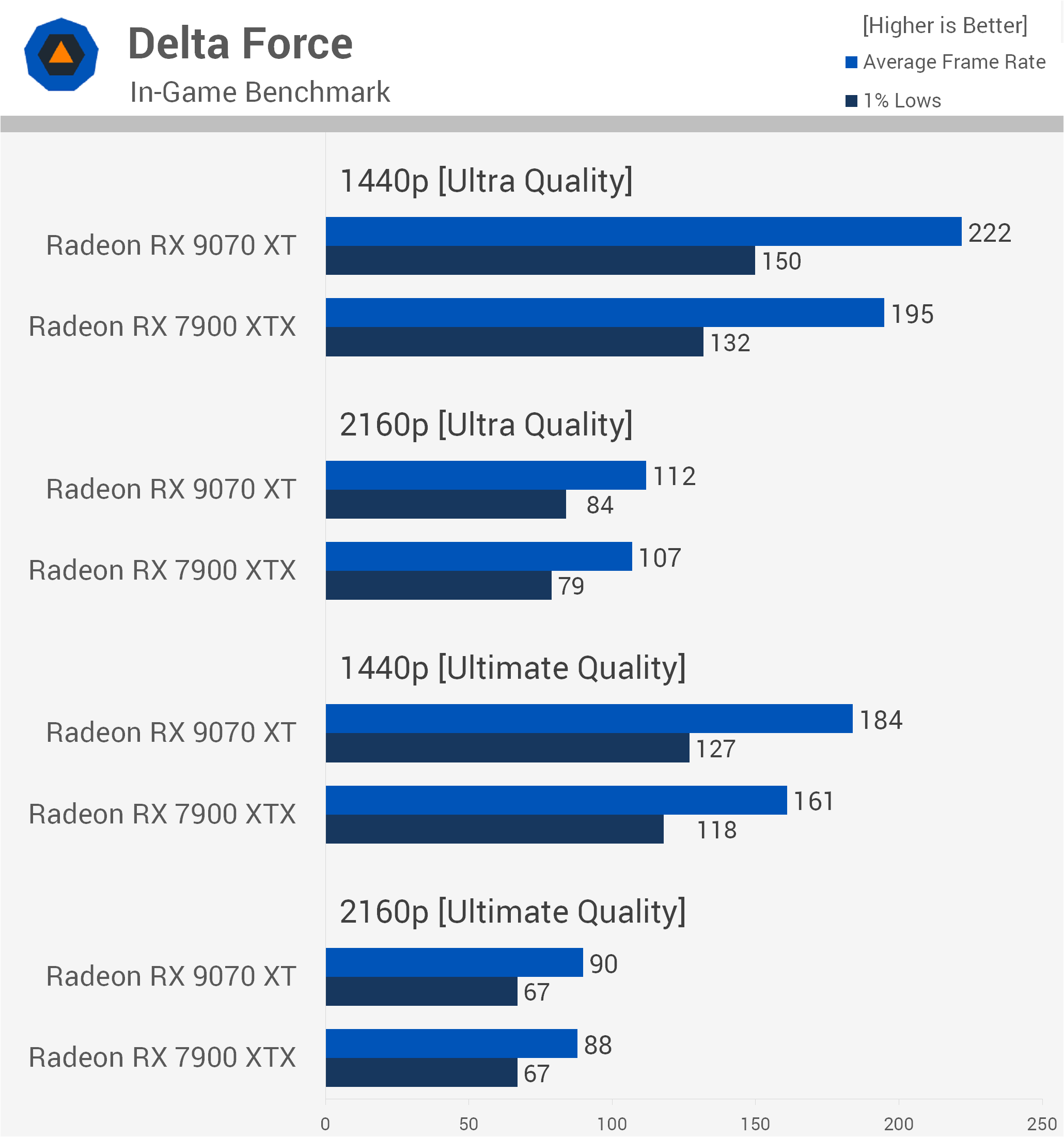
In this example, we see that Delta Force favors the newer 9070 XT. Here, the RDNA 4 GPU delivered 14% more performance at 1440p using Ultra settings, though just 5% more at 4K. We also saw similar scaling using the Ultimate preset.
Forza Horizon 6
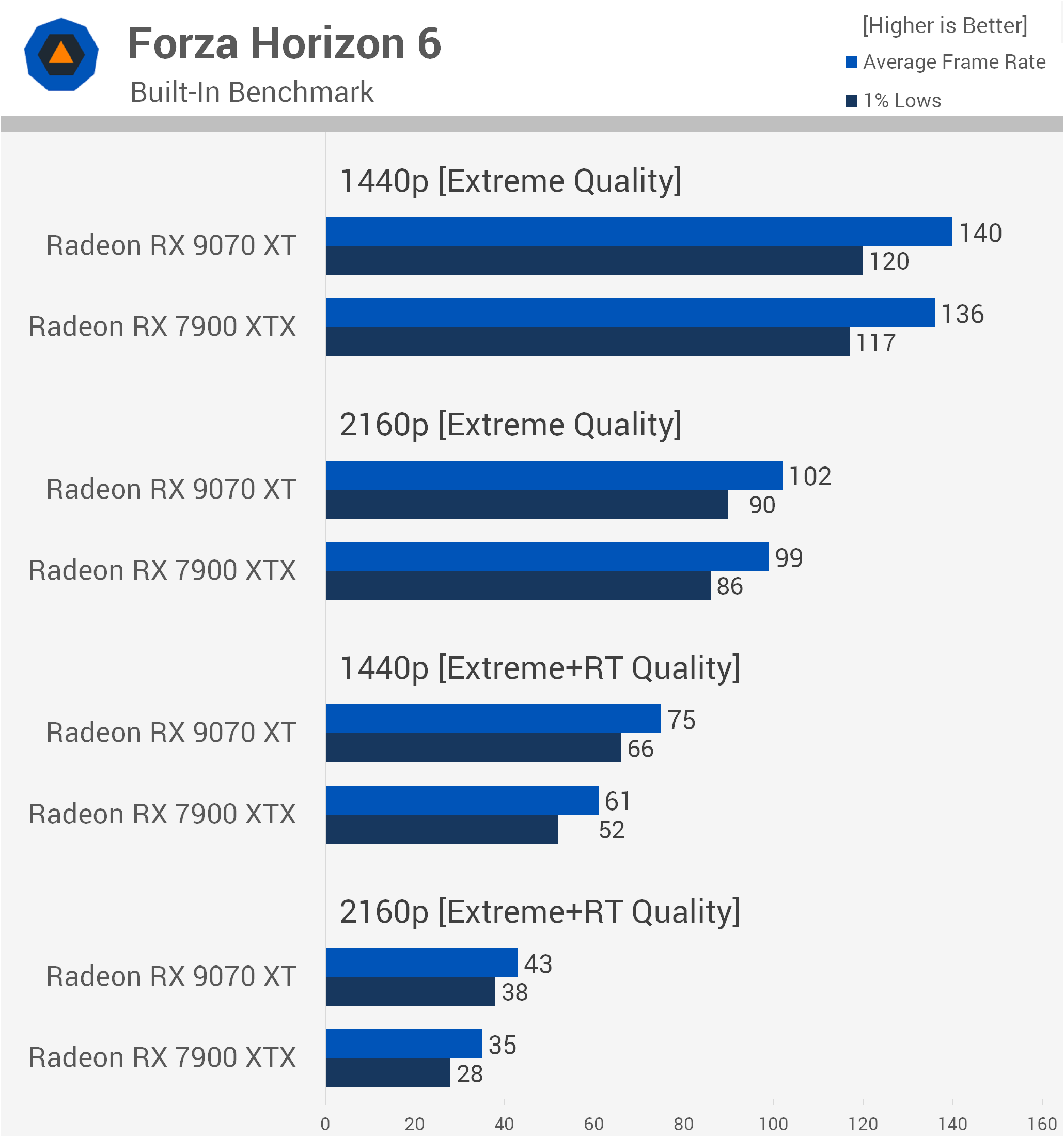
Forza Horizon 6 provided the kind of data I expected to see more of, that is, competitive rasterized performance with the newer 9070 XT taking the cake once ray tracing is enabled. Using the Extreme preset, the 9070 XT was 3% faster, but when we switched over to ray tracing, that margin grew substantially to 23%.
Fortnite
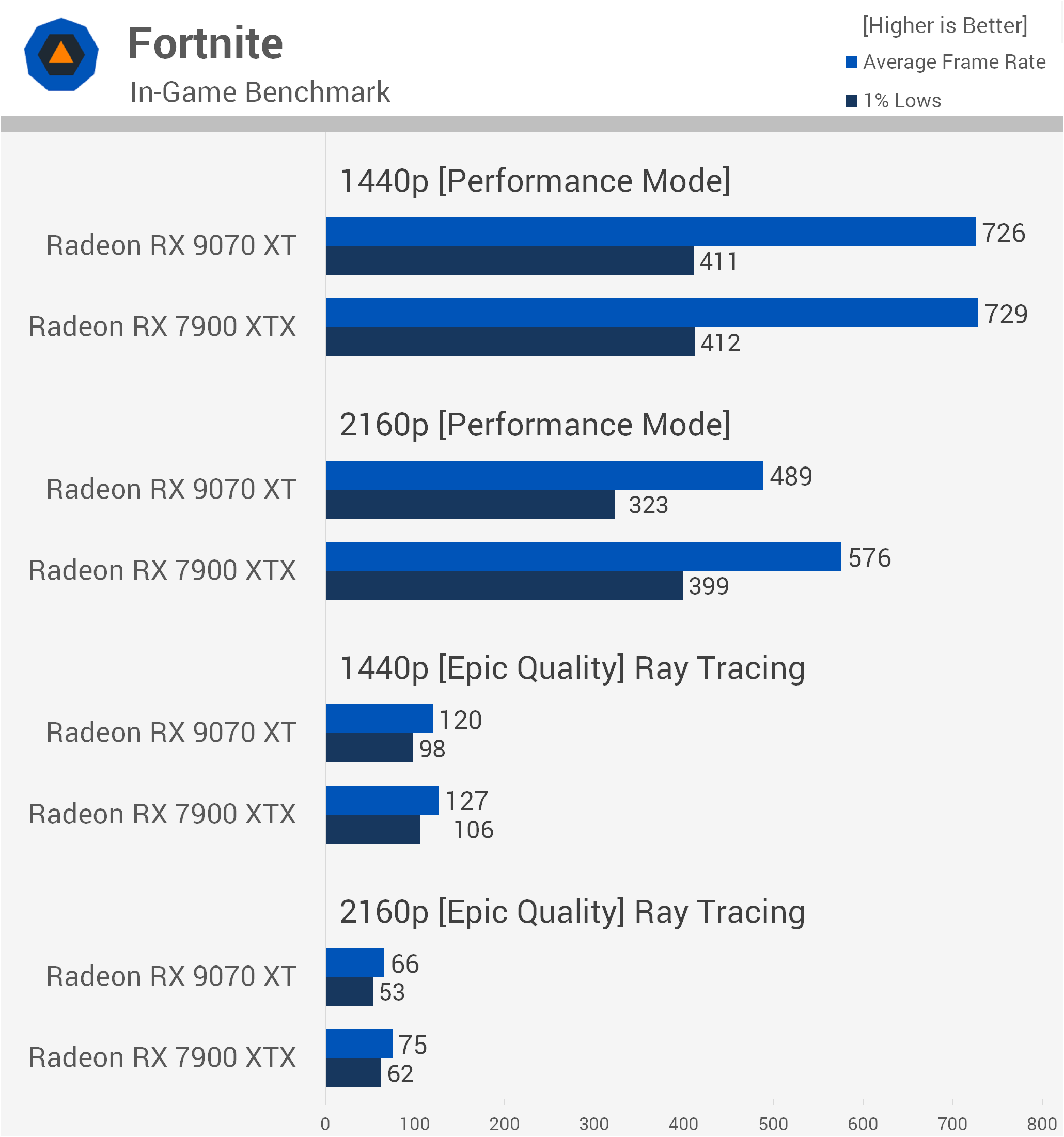
Testing with Fortnite, we find the limits of our Ryzen 7 9800X3D processor at 1440p using Performance mode, reaching just over 700 fps, which seems like enough to me, for now. Anyway, at 4K, the 7900 XTX delivered 18% stronger performance, and even with ray tracing enabled, the older RDNA 3 GPU still came out on top, offering 14% better performance.
Grand Theft Auto V
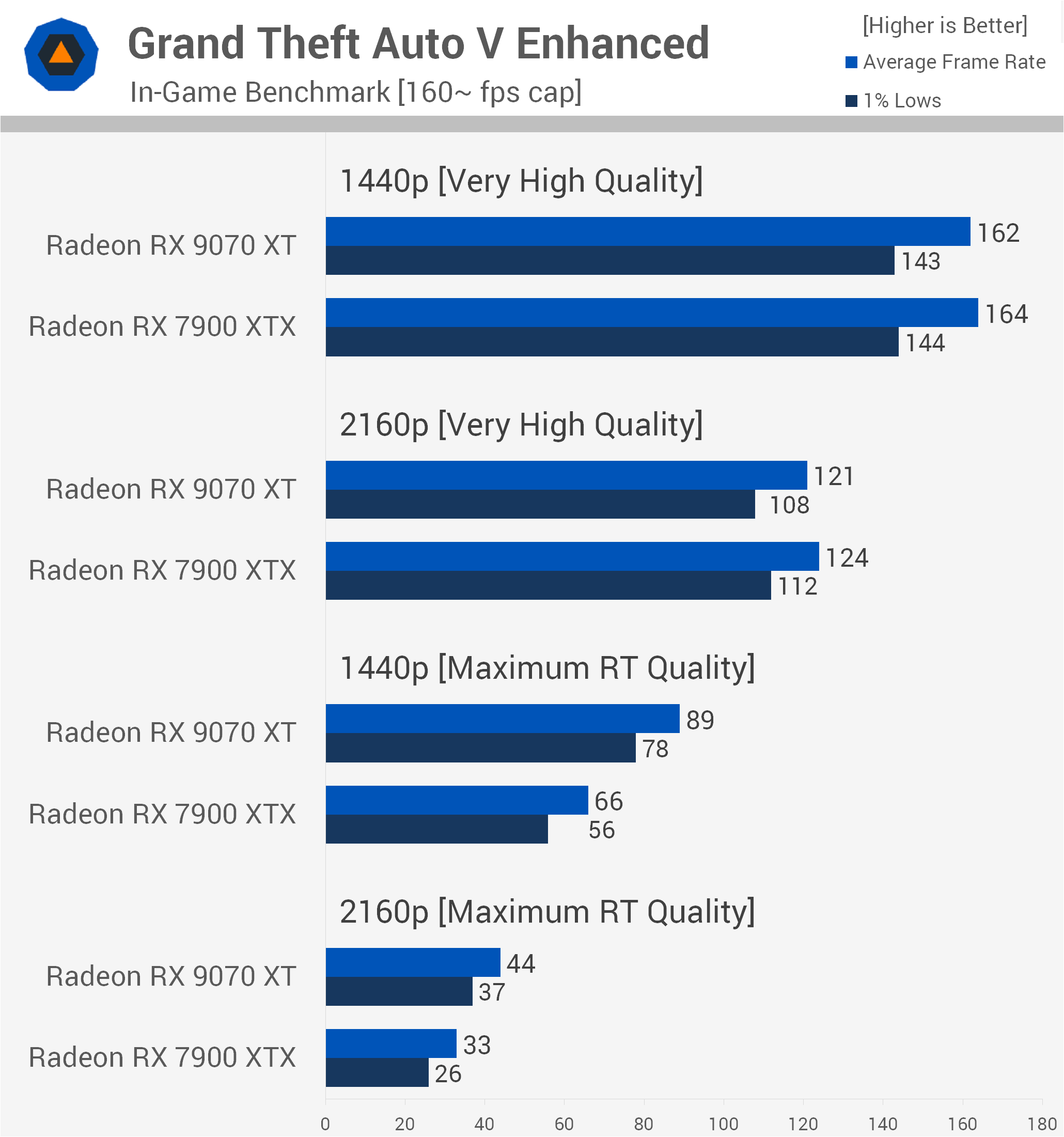
Testing with Grand Theft Auto V shows very similar rasterized performance between these two GPUs, but once we enabled ray tracing using the Maximum RT preset, the 9070 XT takes over, crushing the 7900 XTX by 35% at 1440p and 33% at 4K.
Spider-Man 2
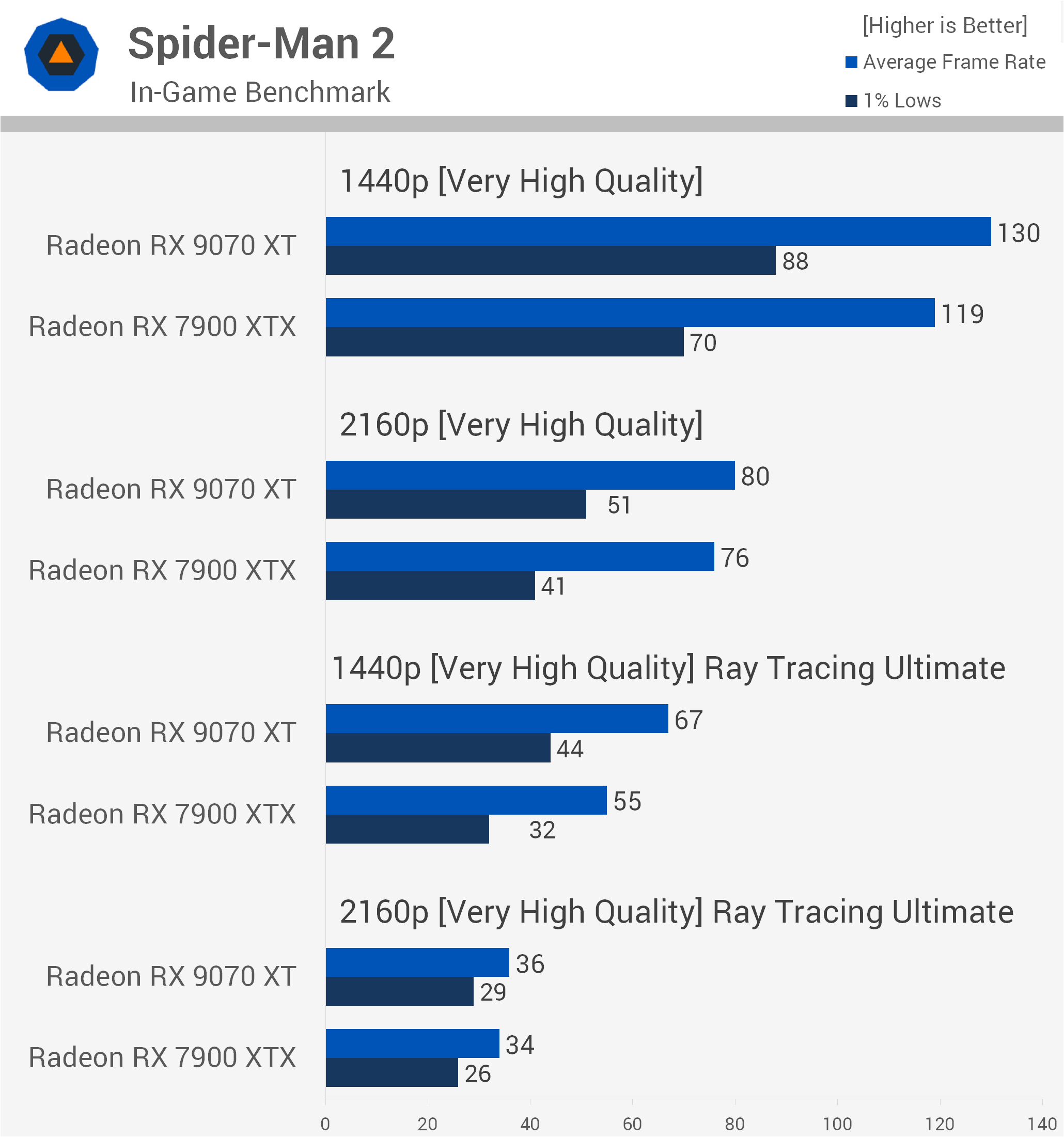
The 9070 XT also dominated our Spider-Man 2 testing, well, at least at 1440p, where it was 9% faster using the Very High preset and then 22% faster with the maximum ray tracing settings enabled. At 4K, the margins were much smaller, in the 5-6% range.
Performance Summary
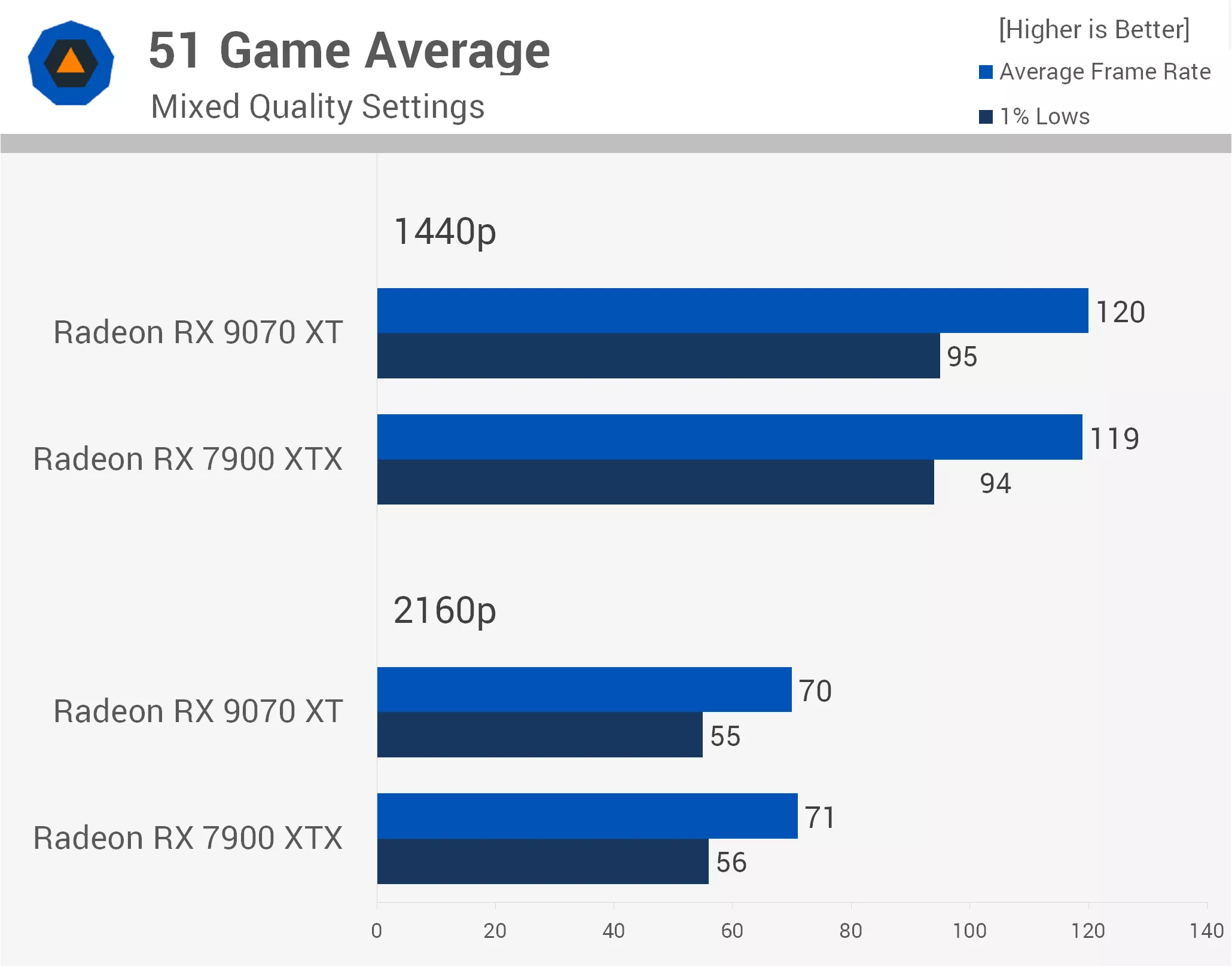
Across the 51 games tested, how do the 9070 XT and 7900 XTX compare?
Well, they're nearly identical in terms of performance. This data doesn't tell us too much, other than the fact that overall, these GPUs deliver very similar performance. So let's take a closer look at the per-game results.
Average Performance by Game
Please note that this data is based on average frame rates, calculated using the geo mean, and combines the two quality configurations tested, as well as both resolutions.
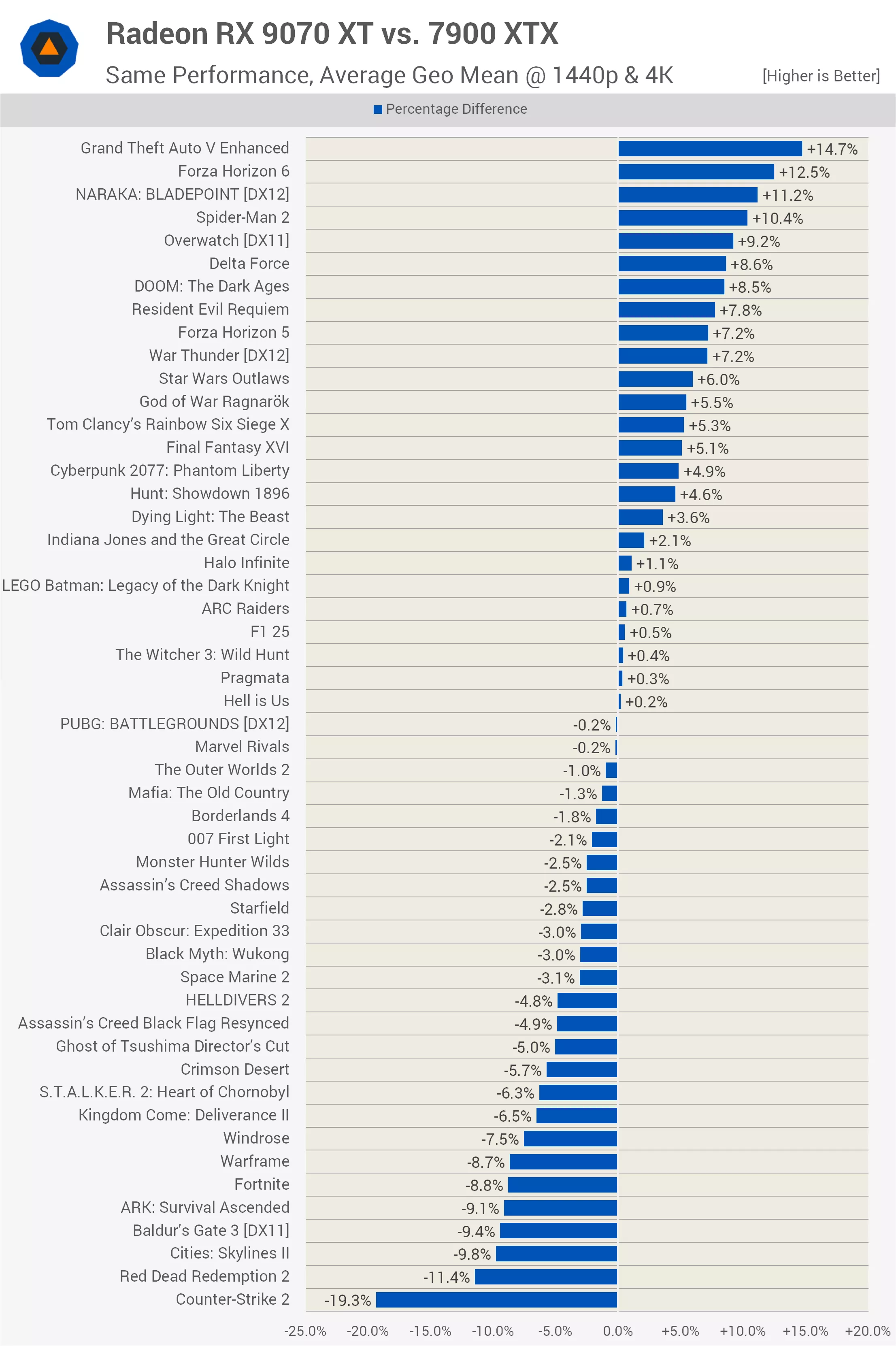
As you can see, the vast majority of games saw less than a 10% difference in performance between these two GPUs. In fact, just five games exceeded 10%. The worst examples for the 9070 XT were Counter-Strike 2 and Red Dead Redemption 2, while its best results came in GTA V, Forza Horizon 6, and Naraka: Bladepoint.
What We Learned
The Radeon RX 9070 XT has continued to age well, and we've seen plenty of evidence of this recently. We've seen it matching and even beating the RTX 5070 Ti in newer titles such as Gears of War: E-Day, The Witcher 3 Remastered, and Assassin's Creed Black Flag Resynced, to name a few, though that will depend on the settings used.
Not only did most early reviews of the 9070 XT find it trailing the 5070 Ti by a reasonable margin, but also the 7900 XTX. Now the 9070 XT and 7900 XTX appear to be pretty much neck and neck.
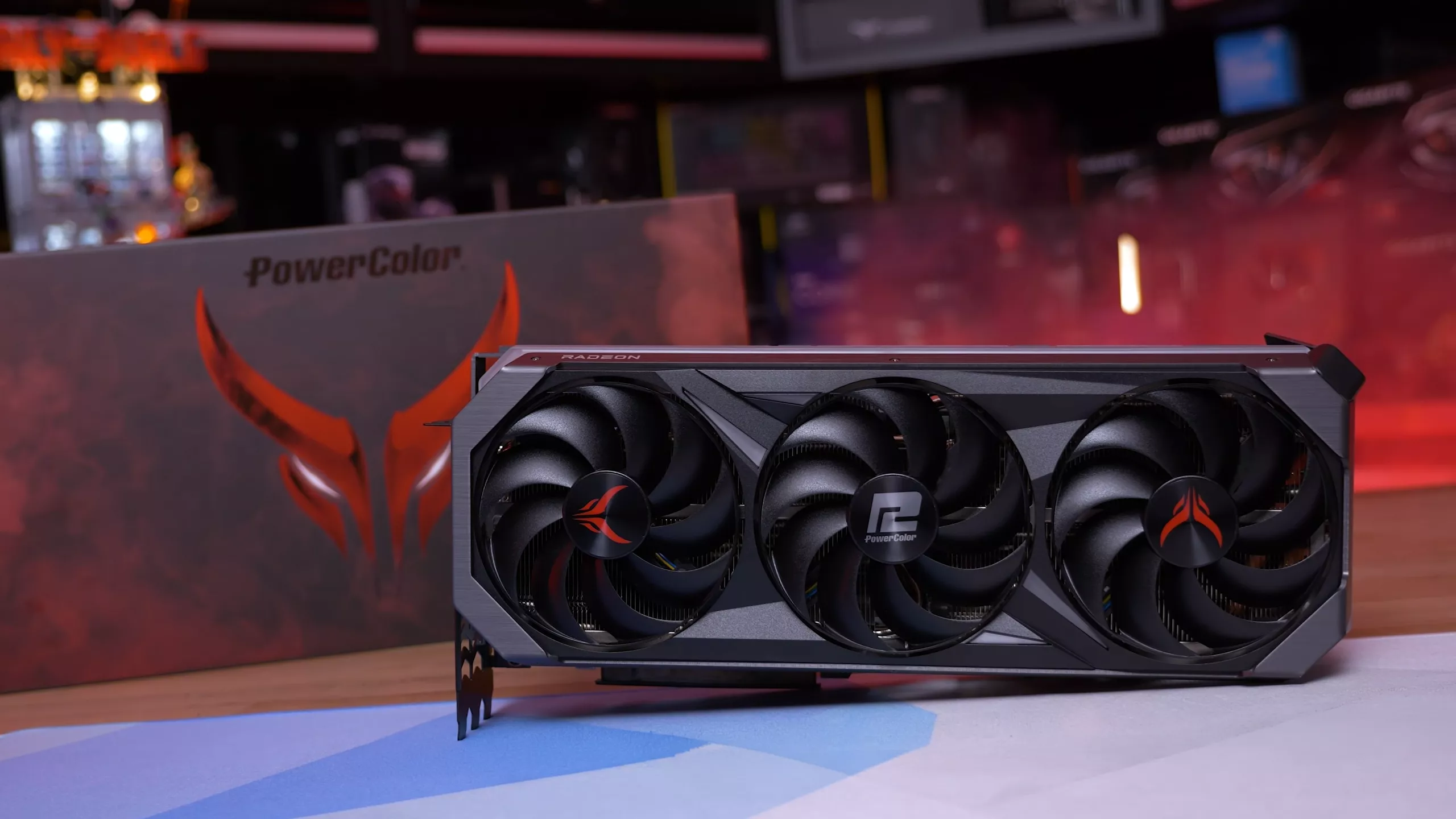
Looking across all 51 games tested, the performance margins generally fall into three categories: 1) near-parity in standard rasterization, 2) ray tracing and path tracing gives the advantage to the newer RDNA 4 architecture, and 3) specific titles where the older 7900 XTX flagship flexes its memory bandwidth and compute muscle.
Where the GPUs Differ
At native 4K, the Radeon 7900 XTX's additional bandwidth can help, particularly in memory-intensive games. However, that doesn't translate into a 50% increase in FPS simply because it has 50% more memory bandwidth.
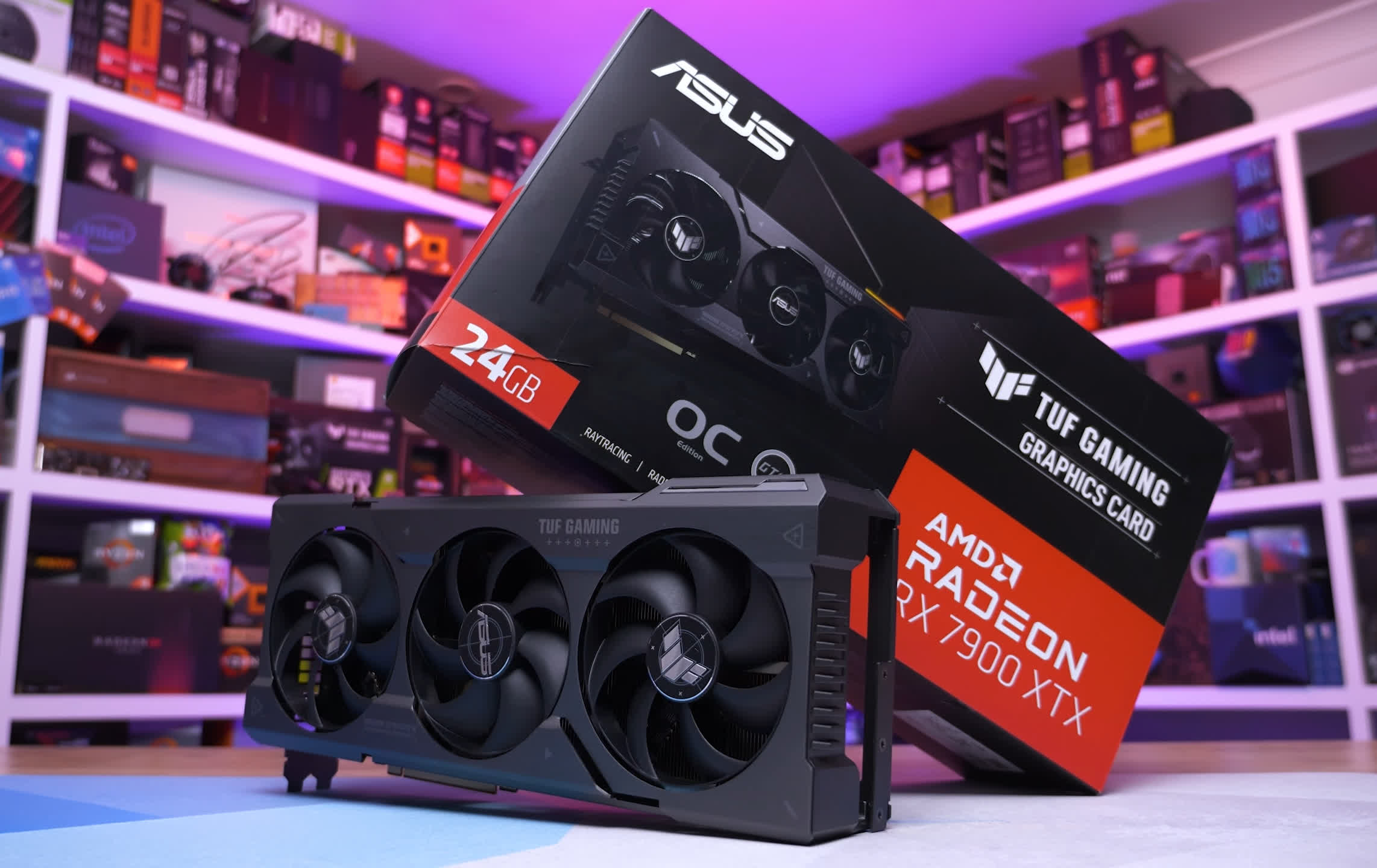
The 7900 XTX also has 50% more VRAM: 24GB versus 16GB for the 9070 XT. But right now that only matters when playing heavily modded games with UHD texture packs, running games at extreme settings, working with large 3D scenes, or using local AI models that exceed 16GB.
With ray tracing enabled, particularly in newer games, the 9070 XT generally comes out on top, sometimes by a substantial margin. Both GPUs now support FSR 4.1 upscaling, as AMD extended support to the RX 7000 series back in June. This means the 7900 XTX is no longer restricted to the lower-quality FSR 3.1 upscaler.
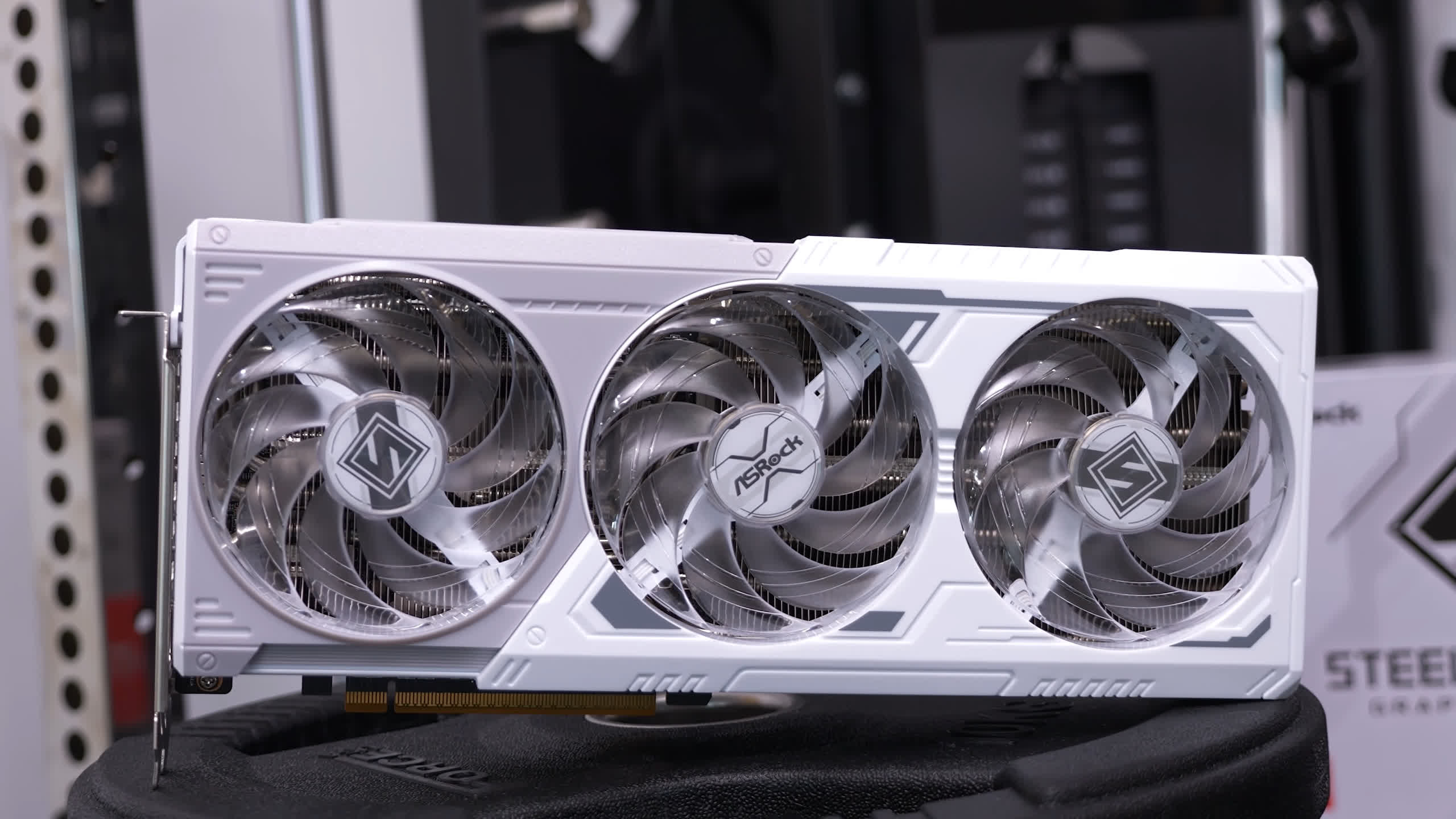
The key difference to note here is that the 9070 XT uses FP8 acceleration to run FSR 4.1 more efficiently. It also supports the newer ML frame generation and ray regeneration features in FSR Redstone. The 7900 XTX, on the other hand, runs FSR 4.1 through INT8 processing, which comes with higher overhead. It still supports older FSR frame generation, but not all the RDNA 4-exclusive Redstone features.
As an example, AMD reports roughly 1.3 ms of FSR 4.1 upscaling processing time at 4K on the 9070 XT, compared with 3.1 ms on the 7900 XTX. In short, this means the 9070 XT can deliver better performance when both GPUs use the same upscaling settings, even in games where the 7900 XTX is faster natively.
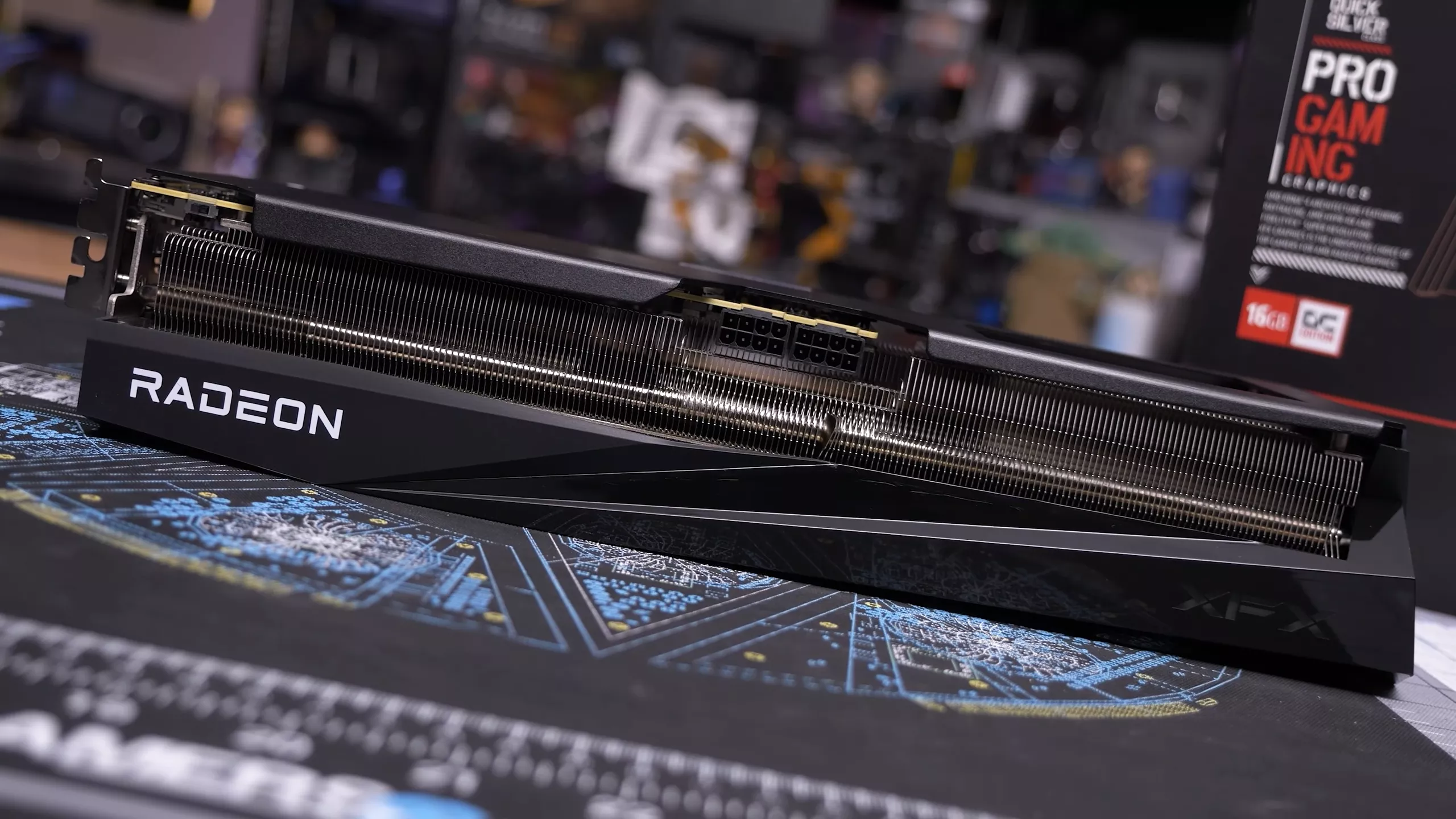
Both GPUs support AV1 encoding for streaming, though the 9070 XT also gets PCIe 5.0 support, which can be viewed as a modest future-facing benefit. That said, the 7900 XTX's PCIe 4.0 x16 interface really isn't a limitation, especially given that you're far less likely to exceed its VRAM capacity.
Pricing can vary from month to month, sometimes substantially, but as of writing the 9070 XT costs $900 in the US, or $1,250 in Australia, while secondhand 7900 XTX models are selling on eBay for between $800 and $1,100, or around $1,500 in Australia. At those prices, the 9070 XT makes far more sense for most buyers. Obviously, if you already own the 7900 XTX, upgrading to the 9070 XT would be a sidegrade at best, so don't do that.
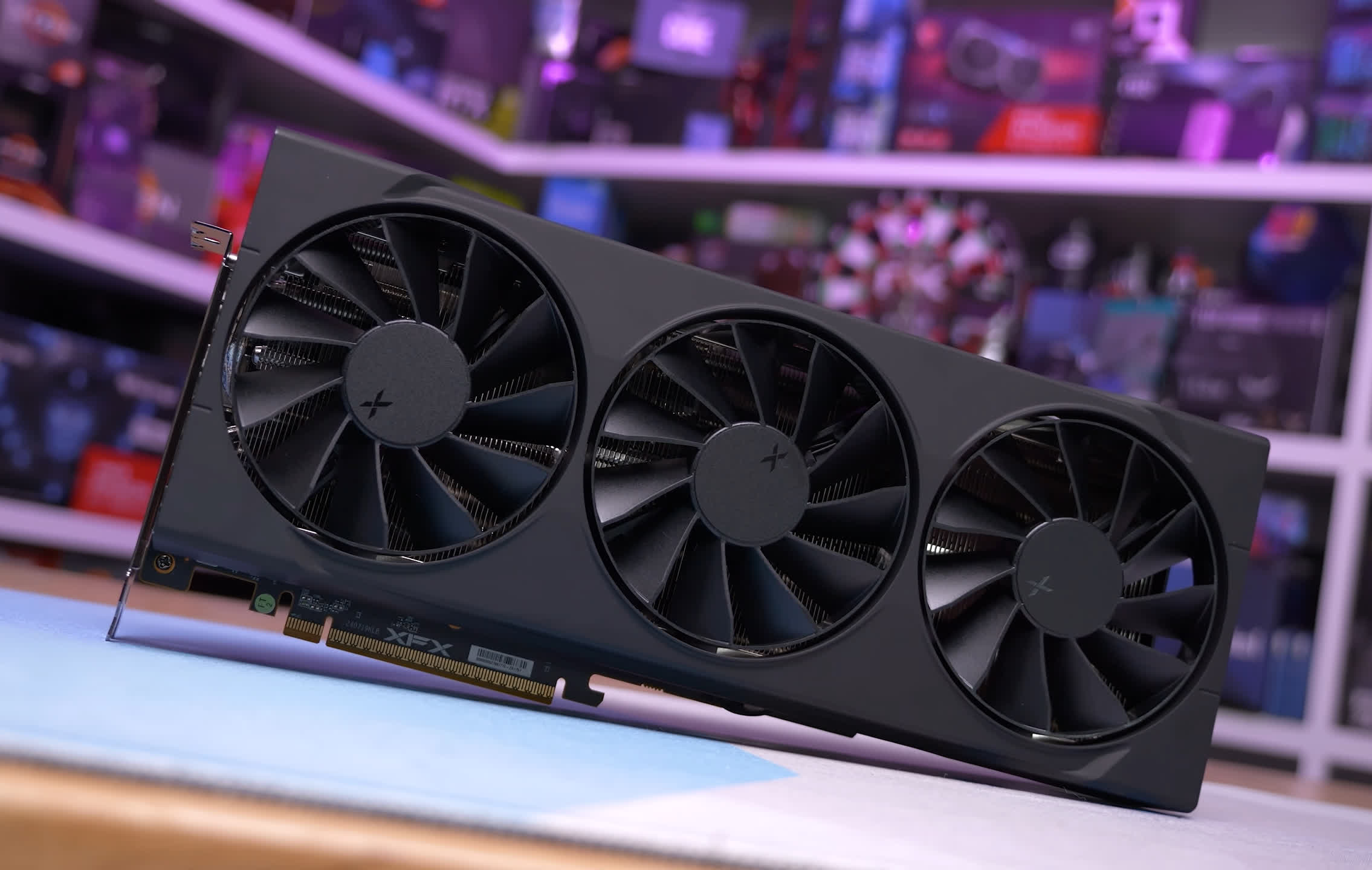
Bottom line, the 7900 XTX has continued to age well and remains highly competitive with current generation high-end GPUs. Like the 9070 XT, it has only gotten better since release through updated features such as FSR 4.1, even if AMD did take its sweet time rolling out support.