
Def. Not A Bubble: Torsten Slok, chief economist at Apollo Global Management, recently shared a scathing note on the true extent of the so-called "AI revolution." The data suggest AI's macroeconomic impact remains very limited, which could mean we are heading toward some truly interesting times in terms of financial trends and global economic outcomes.
According to Slok's Daily Spark note, AI has so far delivered zero financial payoff to corporate America outside of tech, despite the massive amount of money and hype surrounding the latest advancements in large language model research.
A few tech-related corporations are seeing noticeable returns, but the overwhelming majority of companies in the S&P 500 are seeing little to show for their generative AI or LLM efforts.
Slok said inflation-adjusted revenue per worker is rising only for the Magnificent 7, the Big Tech-heavy slice of the S&P 500 that includes Nvidia, Tesla, Amazon, Microsoft, Google/Alphabet, Apple, and Meta. Profit margins are rising for that group too. Meanwhile, the "S&P 493," as he calls the rest of the index, is flat on both revenue per worker and profit margins.
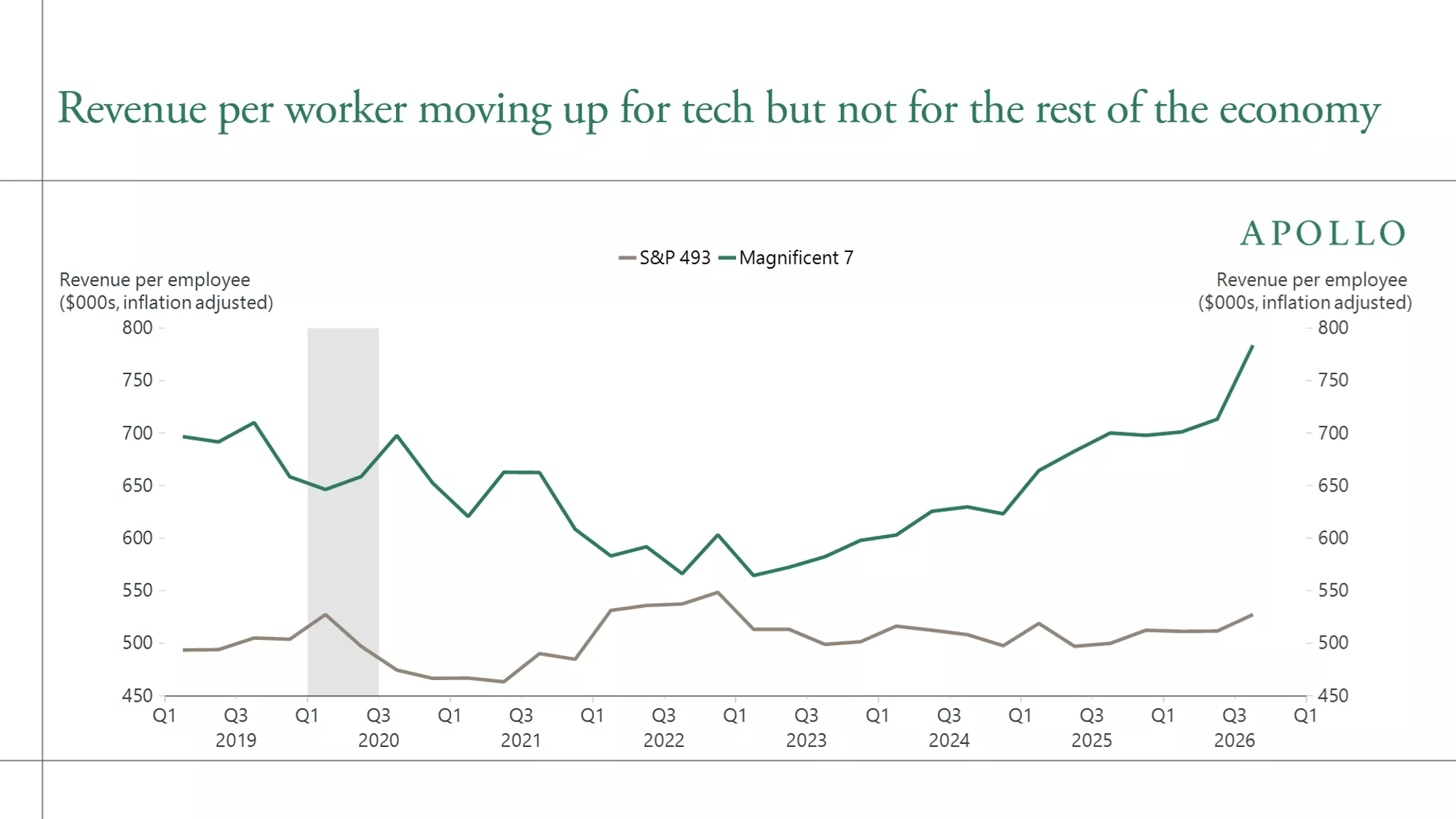
Furthermore, Apollo's economist does not see any sign that AI is boosting productivity growth. To put it simply, GenAI and LLMs are having no impact on the bottom line outside of tech. With nothing to show for it, mainstream S&P 500 companies are already pulling back on the massive sums AI requires, treating token spending as a cost that weighs on margins rather than a potential source of future growth.
Venture-backed companies keep spending more and more on AI tokens, while mainstream organizations don't need the latest models, and aren't willing to pay for them. Slok said that if AI stays confined to a small portion of the overall economy, its macroeconomic effects will be very limited.
AI models might become more and more commoditized, and tokens might eventually get "cheap" enough for revenue to grow and margins to expand. However, Slok thinks that lofty goal could be harder to achieve than it sounds. He describes AI as a powerful "calculator," but argues that businesses run on good judgment, not number crunching.

"AI does not understand accountability, trust, culture, unwritten rules, ethical trade-offs or fairness, all of which shape reputational risk and ultimately drive revenue growth and profit margins," Slok said in his post.
In his view, the AI story will ultimately be decided by the S&P 493 rather than by the Magnificent 7's financial fireworks.
Slok's firm, Apollo manages roughly $1 trillion in assets, so his read on the economy carries weight. His outlook also echoes other cautionary reports, with Gartner recently estimating that more than $3.5 trillion in AI infrastructure investment could face write-downs by the end of 2030. But not everyone shares that pessimism. Goldman Sachs economist Jan Hatzius argues that AI investment will ultimately pay off in higher productivity and economy-wide profits.