
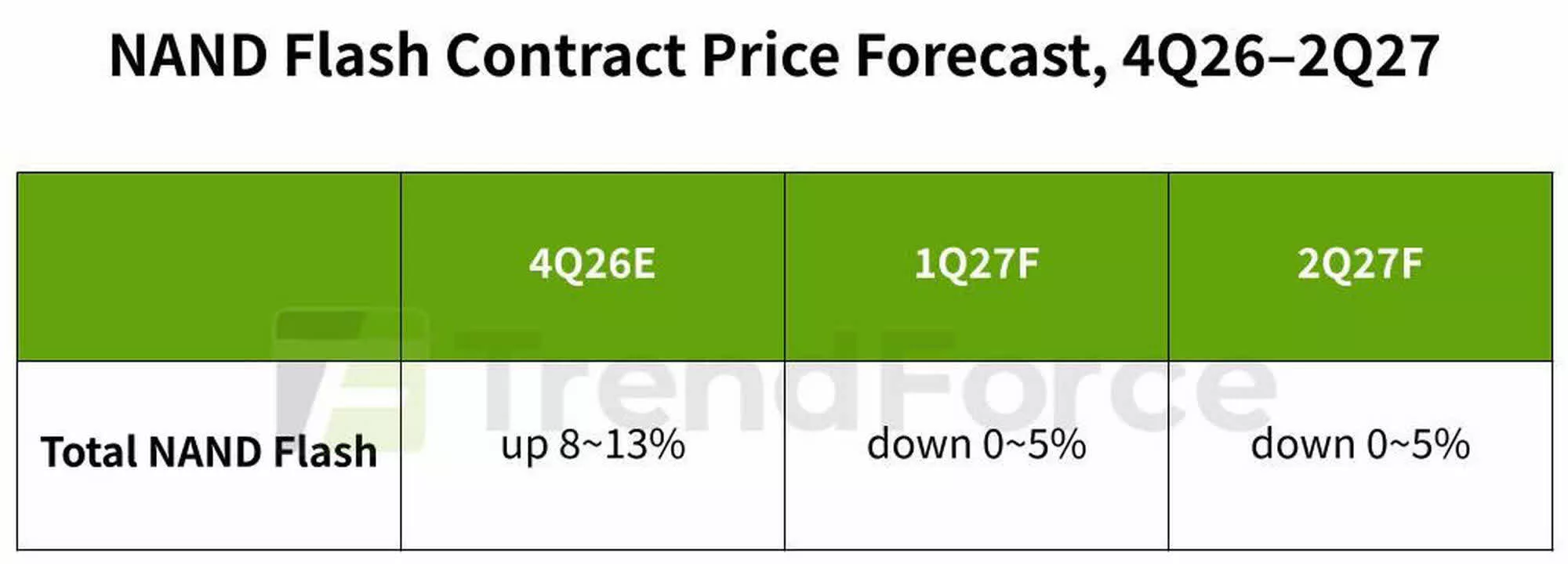
Forward-looking: NAND flash spot prices fell by around 20% over the past two weeks and could decline by a further 5% by Q2 2027 amid "a reversal in supply-demand dynamics." Contract prices were previously expected to decline in Q3 2027, but TrendForce, a market intelligence and research firm, now believes the decline could begin as early as Q2 2027. The revised outlook is driven by slowing enterprise demand in China and weakness in the global consumer electronics market.
While NAND flash prices have risen rapidly over the past year, 2027 could finally bring some relief to customers. According to TrendForce, the anticipated price correction could be attributed to two main factors: a large-scale reduction in enterprise SSD orders from Chinese cloud service providers and a marked downturn in the consumer electronics market.
The report notes that demand for enterprise SSDs from AI data centers and cloud service providers in North America will remain robust through 2027, despite the changing political landscape in the US. However, steady demand in North America will be offset by a pullback among Chinese technology companies due to GPU shortages, elevated inventories, and slower-than-expected AI monetization.
Adding to the slowdown in China, NAND flash manufacturers are also grappling with sluggish consumer demand worldwide, as steep prices have prompted many retail buyers to postpone their upgrade plans. Negative consumer sentiment and softening enterprise demand have created challenging market conditions for hardware manufacturers, resulting in oversupply and a likely price correction.
Curiously, most suppliers appear to be continuing their investments in new process nodes and increasing their use of QLC technology despite the gloomy market outlook. One of the few major exceptions is Yangtze Memory Technologies Co. (YMTC), the world's third-largest NAND flash supplier by bit shipments, which has "slightly trimmed" its expansion plans in response to changing market conditions.
The predicted price correction also appears to have already begun, with NAND spot prices reportedly declining by an average of 20% in just two weeks amid weak consumer demand. According to a Bank of America study cited by Seoul Economic Daily, prices for 512Gb wafers fell by as much as 32% quarter over quarter (QoQ) to $14.30, while 1Tb products declined by 19% to $24.90.
TrendForce states that the extent and pace of the correction in NAND flash contract prices will depend on how quickly Chinese cloud service providers can reduce their inventories and how long OEMs continue producing laptops, smartphones, and other consumer electronics with downgraded hardware specifications.
The report also notes that the speed of approvals for new data centers in the US will influence the NAND flash market outlook. However, with bipartisan opposition to data center development growing across the country, it remains unclear whether all proposed projects will receive approval from local, state, and federal authorities.