
If you're looking to upgrade the graphics card in a budget or older PC, buying a faster GPU doesn't necessarily mean you'll get better gaming performance. In fact, our testing shows that a Radeon RX 9060 XT can actually outperform the more powerful GeForce RTX 5070 when paired with a slower processor. It sounds counterintuitive, but there's a good reason for it.
Recently, we revisited Nvidia's CPU driver overhead issue and found that it can still be a problem for GeForce RTX 50 series GPUs. In that test, we compared the RTX 5070 Ti and Radeon RX 9070 XT using the Ryzen 5 5600, which admittedly is quite a slow CPU to pair with such expensive modern graphics cards.
However, as we've found in previous testing, this is an architectural issue that can affect GeForce GPUs beyond the RTX 5070 Ti. Logically, then, we should see similar behavior with something like the RTX 5060. But as they say, seeing is believing. Perhaps that's why some people dismissed our findings as a complete non-issue that wasn't worth investigating.
So this time, we're looking at more modest hardware configurations, focusing on the GeForce RTX 5060 and Radeon RX 9060 XT. We've also included the RTX 5070 to see how a more powerful GPU scales with slower processors.
It's entirely conceivable that those shopping for an RTX 5060 or RX 9060 XT have an older or lower-end PC, and right now isn't a great time to upgrade to the latest platforms using DDR5 memory.
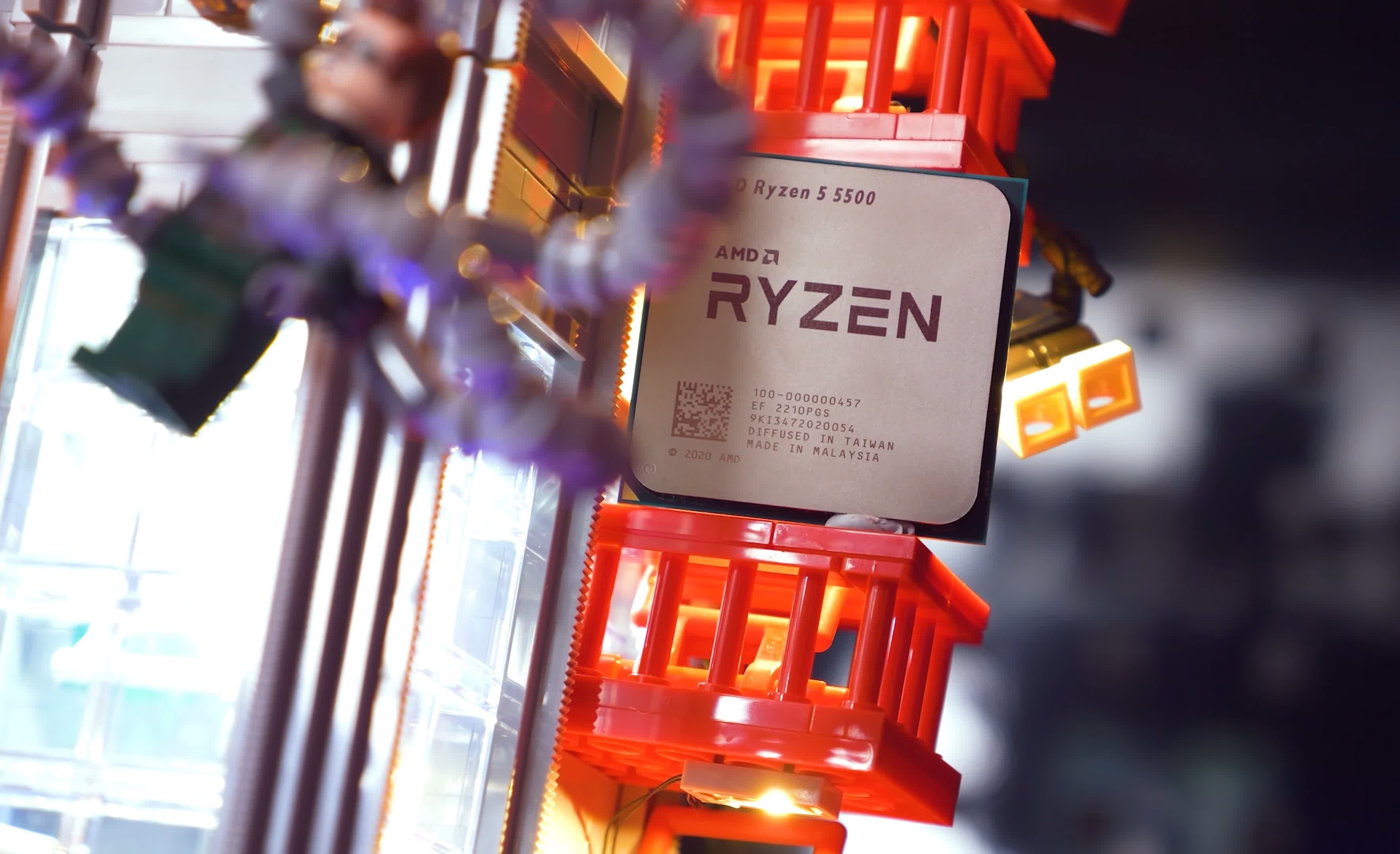
One of the most popular budget CPUs of the last few years has been the Ryzen 5 5500, much to our frustration. It's a particularly poor choice, but at around $90, it seems buyers just can't resist.
We suspect most buyers see the Ryzen 5 5600 selling for around $150 and assume the $90 Ryzen 5 5500 is almost the same thing, just a bit slower. A 40% saving certainly sounds appealing. Unfortunately, despite the similar names, they're wildly different products.
AMD Ryzen 5 5600 vs. Ryzen 5 5500
| Ryzen 5 5600 | Ryzen 5 5500 | |
|---|---|---|
| Price (MSRP) | $200 | $160 |
| Release Date | Apr 4, 2022 | |
| Cores / Threads | 6 / 12 | |
| Base Clock | 3.5 GHz | 3.6 GHz |
| Boost Clock | 4.4 GHz | 4.2 GHz |
| L3 Cache [Total] | 32 MB | 16 MB |
| Box Cooler | AMD Wraith Stealth | |
| Chiplets | 1 x CCD, 1 x I/OD | N/A (monolithic) |
| Core Config | 1 x 6 | |
| TDP | 65 W | |
Whatever the reason, the Ryzen 5 5500 has been selling like hotcakes for years, so there are plenty of them out there. That alone makes it worth including in our testing.
We have a good range of CPUs that should provide some interesting scaling data. The focus here is primarily on CPU performance, so this isn't an exhaustive CPU/GPU scaling benchmark across multiple resolutions. Instead, we're concentrating on 1080p testing to expose CPU limitations.
Then again, you could argue, and some certainly do, that 8GB GPUs like the RTX 5060 and RX 9060 XT are 1080p products anyway. We don't want to get too bogged down in the basics of CPU testing (again), so let's jump straight into the benchmark graphs.
Test System Specs
| CPU | AMD Ryzen 7 9800X3D AMD Ryzen 7 7600 |
MSI MAG X870E Tomahawk Max [BIOS 7E59v5A32] G.Skill Trident Z5 RGB 32GB DDR5-6000 CL30-38-38-96 |
| AMD Ryzen 5 5600 AMD Ryzen 5 5500 |
MSI MPG X570S Carbon MAX WiFi [BIOS 7D52v1D1] G.Skill Trident Z Neo RGB 32GB DDR4-3600 CL14-15-15-35 |
|
| Graphics Card | GeForce RTX 5070, RTX 5060 & Radeon RX 9060 XT 8GB | |
| Power Supply | Kolink Regulator Gold ATX 3.0 1200W | |
| Storage | TeamGroup T-Force Cardea A440 M.2 PCIe Gen4 NVMe SSD 4TB | |
| Operating System | Windows 11 26H2 | |
| Display Driver | Nvidia GeForce Game Ready Driver 621.01, AMD Radeon Adrenalin 26.10.2 WHQL | |
Benchmarks
War Thunder
Starting with War Thunder, it's clear that the RTX 5070 is substantially faster than the RX 9060 XT, as you'd expect. When paired with the Ryzen 7 9800X3D, it was 35% faster on average, while even the standard RTX 5060 led the budget Radeon GPU by a 10% margin. Still, using the High Quality preset at 1080p, all three GPUs managed to push over 400 fps with the 9800X3D.
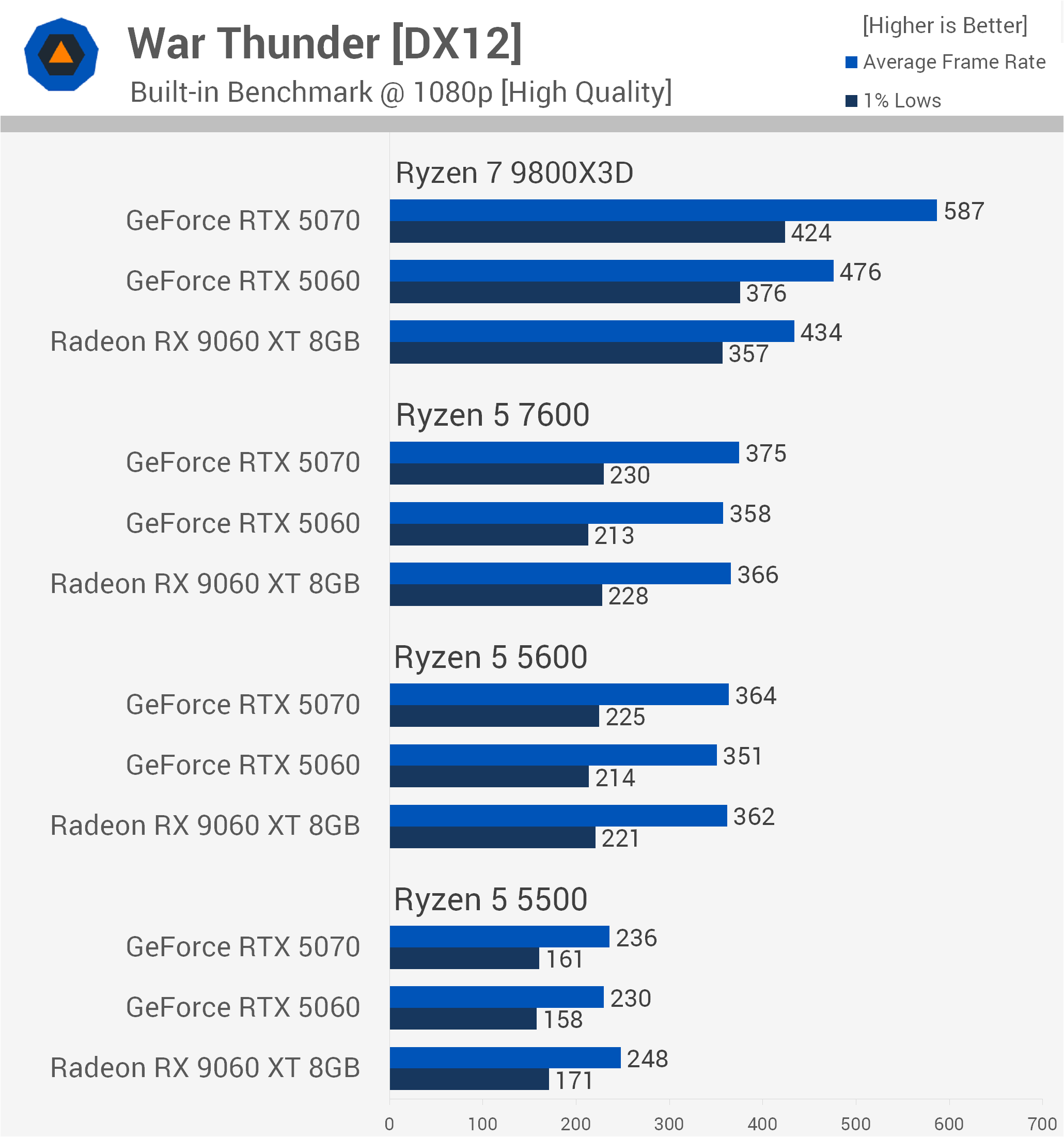
But when we step down to the Ryzen 5 7600, performance becomes much more CPU-limited, with all three GPUs delivering similar results. The RX 9060 XT was slightly faster than the RTX 5060, but Nvidia's additional CPU overhead isn't hurting the GeForce GPUs too much in this example.
Similar results were seen with the Ryzen 5 5600, but once we drop down to the 5500, the RX 9060 XT starts to enjoy a small performance advantage, beating the RTX 5060 by 8% and even the RTX 5070 by 5%.
So when heavily CPU-limited, the Radeon GPU does perform better, though only slightly in this example.
Marvel Rivals
The Marvel Rivals results are far more interesting. First, with the Ryzen 7 9800X3D, we see that the RTX 5070 is massively faster than the RX 9060 XT, offering 42% more performance. However, the Radeon GPU manages to edge out the RTX 5060 by a slim 6% margin.
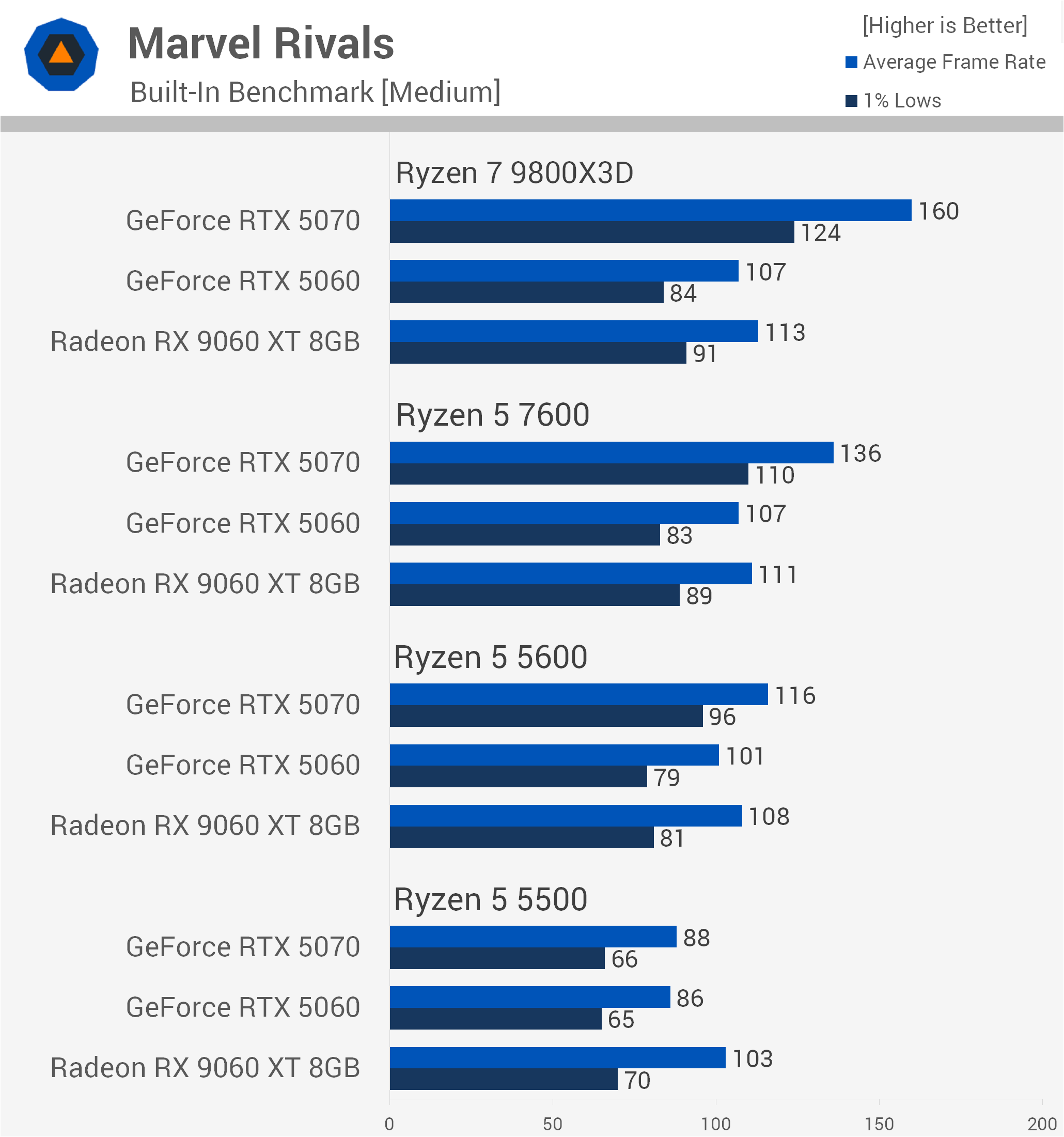
When we retest using the Ryzen 5 7600, not much changes between the RX 9060 XT and RTX 5060. In fact, the margin narrows slightly in favor of the GeForce GPU. However, the much faster RTX 5070 becomes considerably more CPU-limited, shrinking its lead over the Radeon GPU to just 23%.
Then, as we move to AM4 with the Ryzen 5 5600, the RX 9060 XT extends its lead over the RTX 5060 to 7%, while the increasingly CPU-limited RTX 5070 is now just 7% faster than the Radeon.
Up to this point, the data looks like a typical CPU bottleneck, but that starts to change with the Ryzen 5 5500. Using this low-end processor, the RX 9060 XT is now 20% faster than the RTX 5060 and, remarkably, 17% faster than the RTX 5070.
This unusual result highlights the impact of Nvidia's additional CPU overhead. Despite being a much faster GPU under normal circumstances, the RTX 5070 actually falls behind the budget Radeon when paired with a sufficiently slow processor.
Space Marine 2
Nvidia's CPU overhead issue is even more noticeable in Space Marine 2. When testing with the Ryzen 7 9800X3D, everything looks pretty normal. The RTX 5070 is by far the fastest GPU tested, rendering 127 fps, making it 21% faster than the RTX 5060 and 31% faster than the RX 9060 XT.
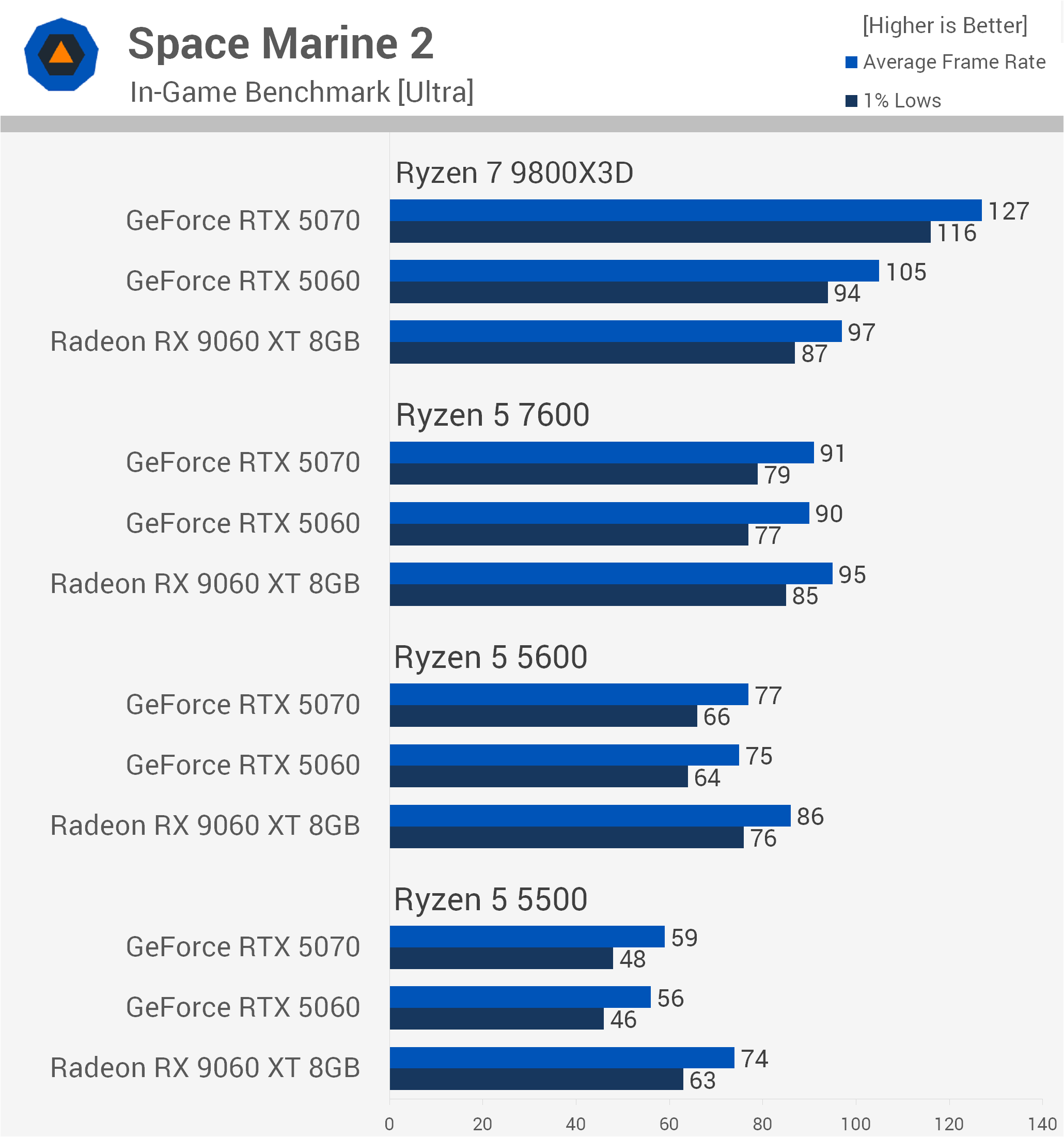
But that all changes with the Ryzen 5 7600. Performance immediately becomes CPU-limited, and the RX 9060 XT is now 6% faster than the RTX 5060 when comparing average frame rates, and 10% faster for the 1% lows. It even manages to beat the RTX 5070.
As we continue to reduce CPU performance, those margins only grow. With the Ryzen 5 5600, the RX 9060 XT is now 15% faster than the RTX 5060, or nearly 20% faster when comparing 1% lows.
But we're not done yet. With the lowly Ryzen 5 5500, the margin balloons to 32%, with a 37% improvement in 1% lows. The RTX 5070 fares slightly better than the 5060, but even so, the RX 9060 XT is still 25% faster.
Hitman World of Assassination
Hitman World of Assassination also proved highly CPU-sensitive. With the Ryzen 7 9800X3D, the RTX 5070 averaged 245 fps, with 1% lows of 128 fps. This represented a 33% advantage over the RX 9060 XT, which averaged 184 fps, while the RTX 5060 managed 181 fps.
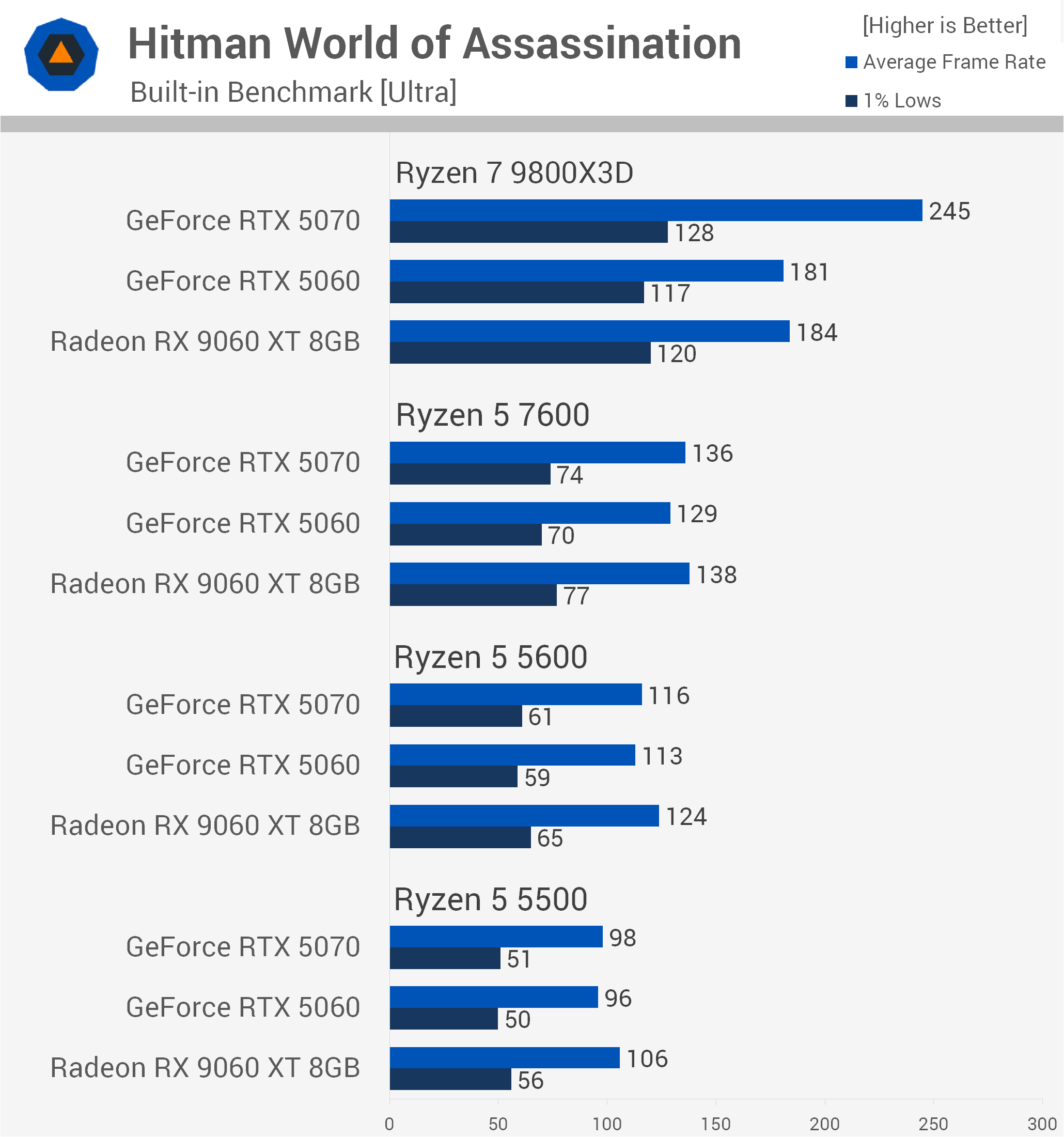
Moving to the Ryzen 5 7600 saw the RTX 5070's average frame rate drop by 44% to just 136 fps, with 1% lows falling to 74 fps. Interestingly, the RX 9060 XT pulled slightly ahead at 138 fps, while also delivering stronger 1% lows of 77 fps.
This trend continued with the Ryzen 5 5600 and 5500, where the Radeon averaged 124 and 106 fps, respectively, outperforming the RTX 5070 by approximately 7-8% in both cases.
Battlefield 6
Battlefield 6 also revealed substantial CPU bottlenecks with the Ryzen 5 processors. Starting with the Ryzen 7 9800X3D, the RTX 5070 averaged an impressive 251 fps, making it 44% faster than the RTX 5060 and 48% faster than the RX 9060 XT.
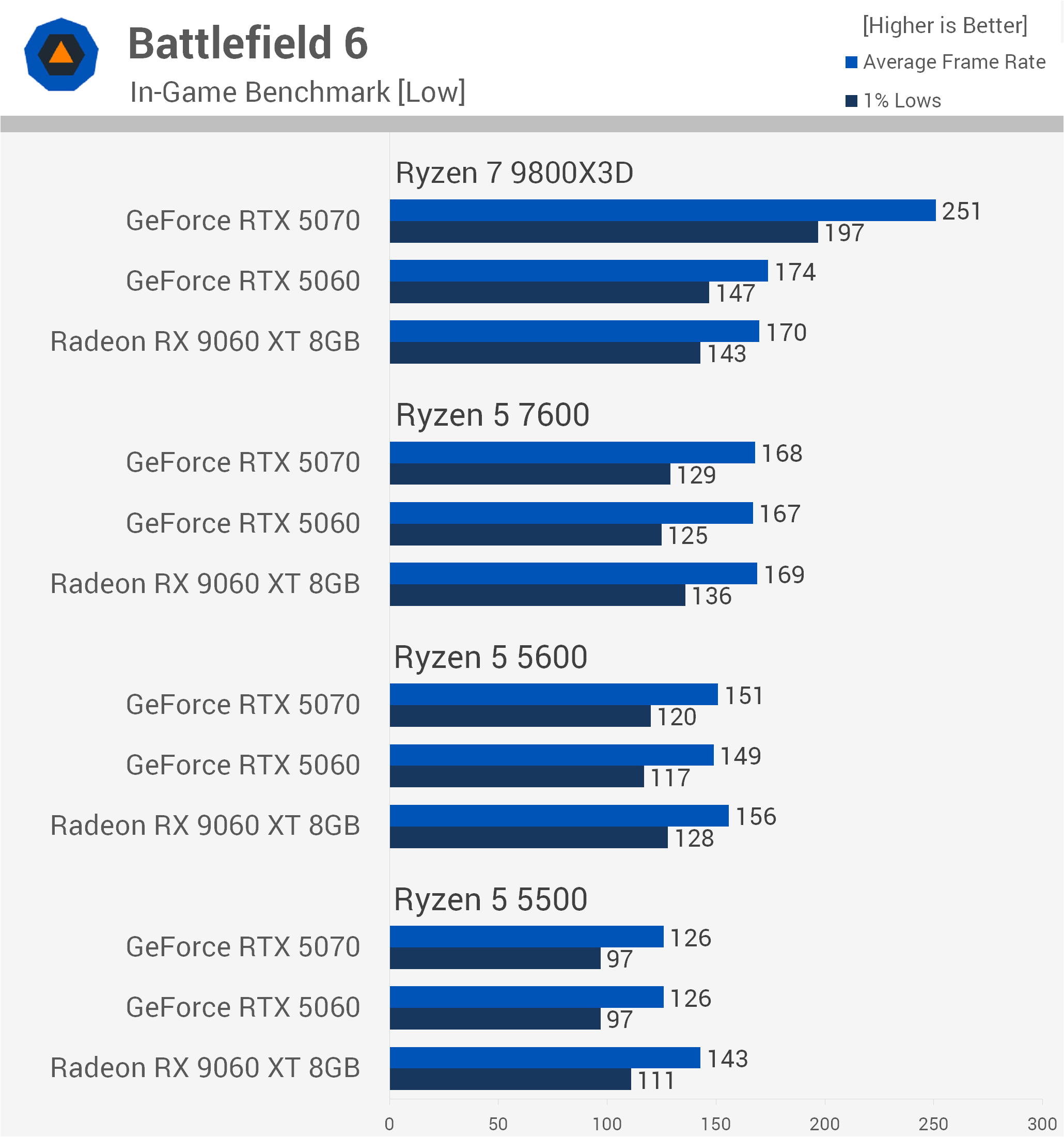
However, moving to the Ryzen 5 7600 saw that advantage disappear almost entirely, with all three GPUs averaging between 167 and 169 fps. The 1% lows were noticeably better with the Radeon GPU, though.
Similar results were seen with the Ryzen 5 5600, where the RX 9060 XT edged ahead at 156 fps, compared to 151 fps for the RTX 5070.
Interestingly, with the Ryzen 5 5500, both GeForce GPUs delivered identical results, averaging 126 fps with 1% lows of 97 fps.
The RX 9060 XT, however, was noticeably faster, averaging 143 fps with 1% lows of 111 fps. That made it 13% faster in average frame rates and 14% faster for the 1% lows, another clear example of how Nvidia's additional CPU overhead can become a disadvantage when paired with a slower processor.
Horizon Zero Dawn
Horizon Zero Dawn Remastered gives us some interesting results that don't really highlight Nvidia's CPU overhead issue. Instead, they expose a VRAM-related problem, but only for the RTX 5060, despite both the RTX 5060 and RX 9060 XT having just 8GB of VRAM.
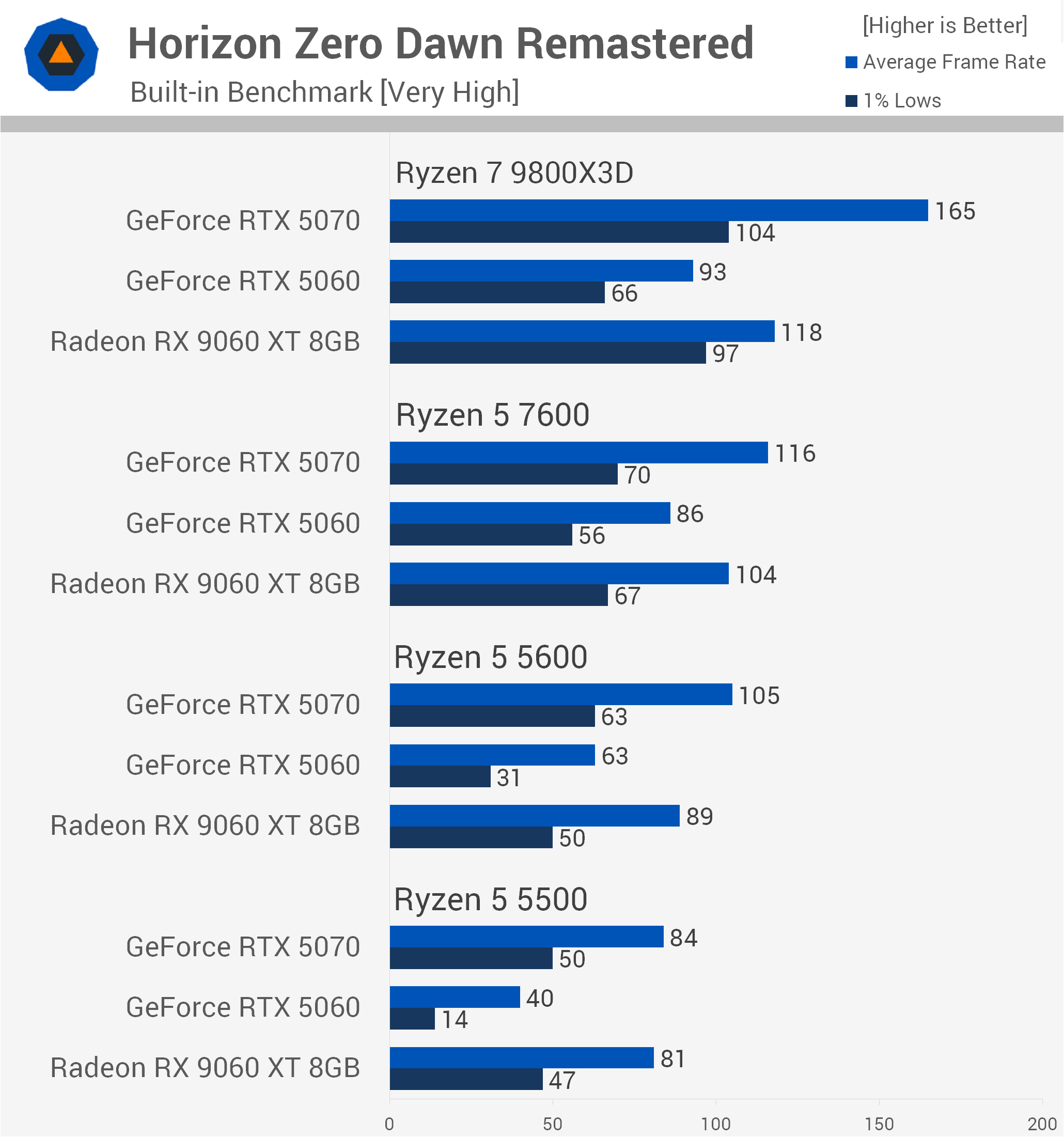
The problem for the RTX 5060 is that it features just a PCIe x8 interface, whereas the RX 9060 XT gets the full x16 bandwidth, effectively doubling the available bandwidth for transfers between the GPU and system memory. As a result, the Radeon was 27% faster with the 9800X3D, or a massive 47% faster when comparing 1% lows. That's despite the RTX 5070 beating the Radeon GPU by a 40% margin.
Dropping down to the Ryzen 5 7600 limits the RX 9060 XT more than the RTX 5060, though we're still using the same PCIe 5.0 interface and DDR5 memory.
But when we switch to the Ryzen 5 5600, we're now limited to PCIe 4.0 and DDR4 memory, and this cripples the RTX 5060. The result is particularly poor 1% lows, with the RX 9060 XT delivering up to 61% better performance.
Things get even worse for the budget GeForce GPU with the Ryzen 5 5500, which limits us to PCIe 3.0. Now the RX 9060 XT is more than twice as fast. The RTX 5060 was effectively unusable here, suffering constant stuttering and occasional pauses as data was transferred between video memory and system memory over the severely bandwidth-constrained PCIe connection.
Gears of War: E-Day
Gears of War: E-Day delivered some surprisingly consistent results, particularly with the Radeon RX 9060 XT. Regardless of whether it was paired with the Ryzen 7 9800X3D, Ryzen 5 7600, or Ryzen 5 5600, the Radeon averaged exactly 72 fps, dropping only slightly to 70 fps with the Ryzen 5 5500.
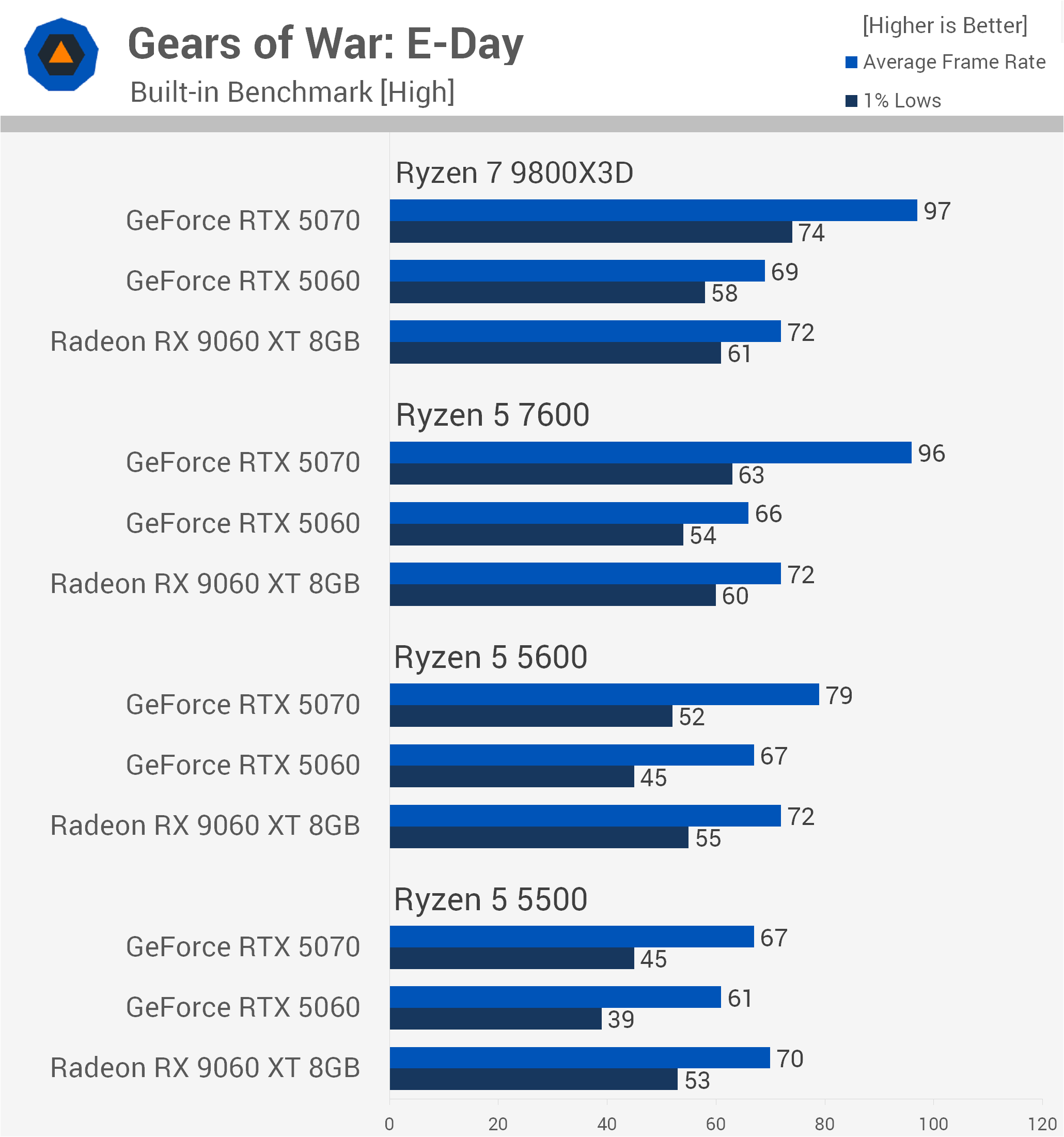
The RTX 5070 was considerably faster with the higher-end processors, averaging 97 fps with the 9800X3D and 96 fps with the Ryzen 5 7600.
However, its performance dropped to 79 fps with the Ryzen 5 5600 before falling to just 67 fps with the Ryzen 5 5500. This allowed the RX 9060 XT to pull ahead while also delivering stronger 1% lows of 53 fps compared with 45 fps, an 18% improvement. The Radeon also delivered 36% better 1% lows than the RTX 5060.
The RTX 5060 generally trailed both GPUs, although its results remained relatively consistent. Overall, the Radeon showed very little sensitivity to processor performance, while the RTX 5070 benefited noticeably from faster CPUs, as you'd expect at 1080p.
Hogwarts Legacy
Hogwarts Legacy showed some of the biggest performance differences between the processors, particularly with the RTX 5070. Paired with the Ryzen 7 9800X3D, the 12GB GeForce GPU averaged an impressive 133 fps, comfortably ahead of the RX 9060 XT at 103 fps and RTX 5060 at 99 fps.
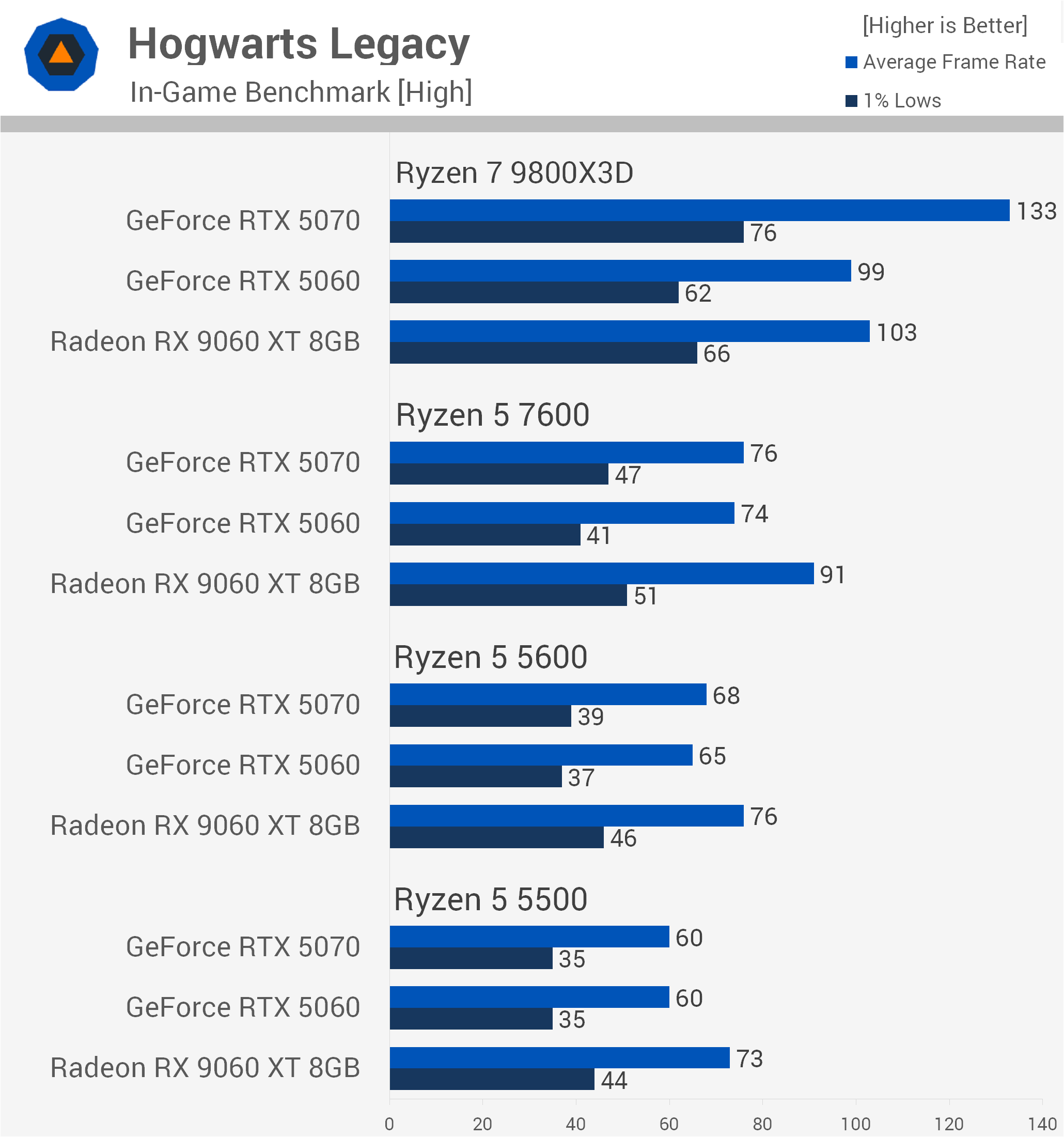
However, things changed considerably with the Ryzen 5 7600, where the RTX 5070 dropped to just 76 fps. Interestingly, the RX 9060 XT managed 91 fps, giving it a comfortable 20% performance advantage despite being the slower GPU with the 9800X3D.
The Radeon maintained this lead with the Ryzen 5 5600, averaging 76 fps compared with 68 fps for the RTX 5070. That's a 12% performance advantage over the higher-end RTX 5070 and 17% over the RTX 5060.
Then, with the Ryzen 5 5500, both GeForce cards managed just 60 fps, while the Radeon delivered 73 fps alongside stronger 1% lows of 44 fps, making it up to 26% faster. Again, this strange data is entirely a result of Nvidia CPU overhead issue.
Call of Duty: Modern Warfare 4
Modern Warfare 4 produced some interesting results, particularly for the Radeon RX 9060 XT. With the Ryzen 7 9800X3D, the RTX 5070 comfortably led the pack, averaging 237 fps, followed by the RX 9060 XT at 195 fps and RTX 5060 at 173 fps.
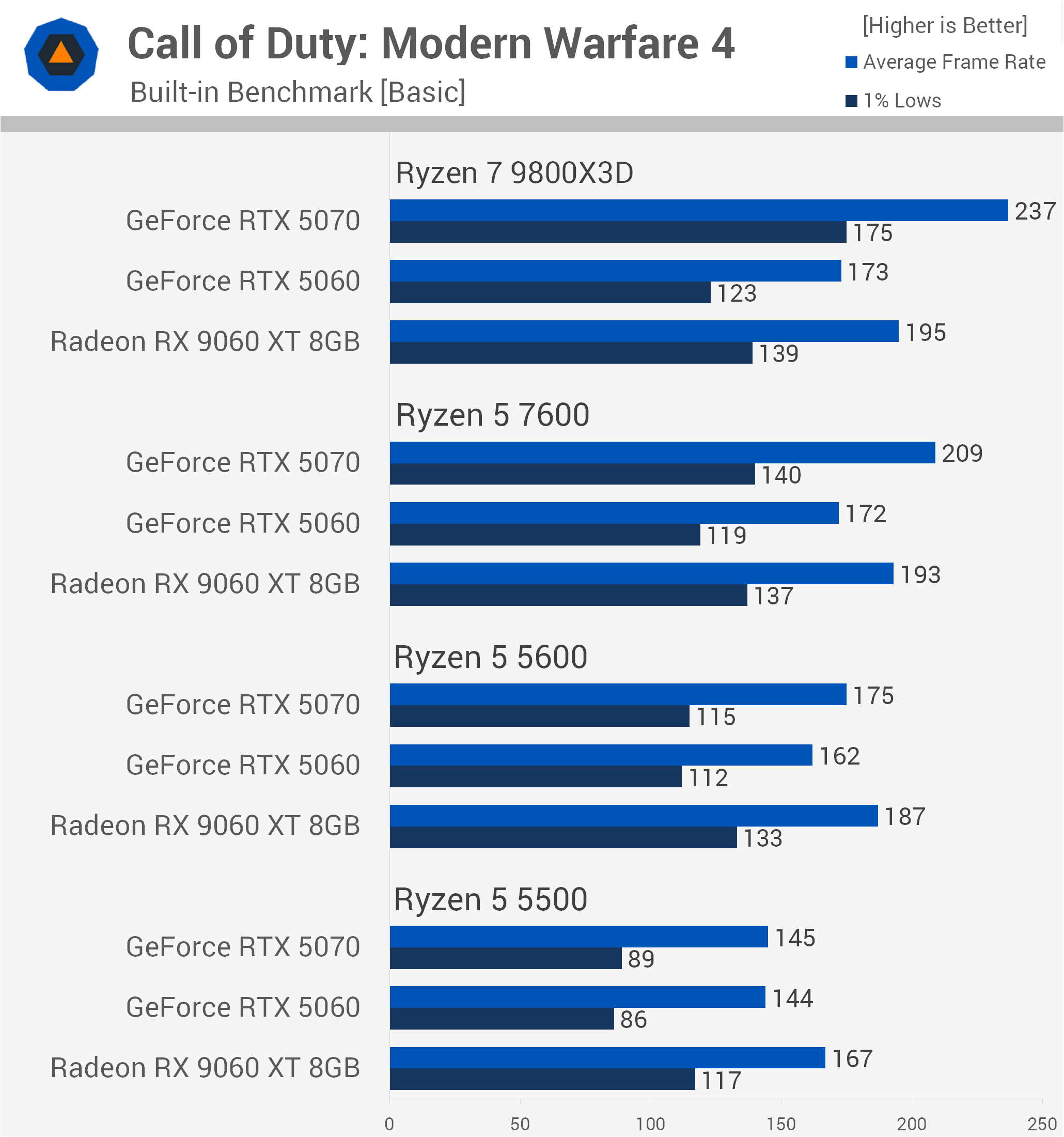
The RTX 5070 maintained its lead with the Ryzen 5 7600, although the gap narrowed to just 16 fps as performance became much more CPU-limited.
Things became more interesting with the Ryzen 5 5600, where the RX 9060 XT actually pulled ahead, averaging 187 fps compared with 175 fps for the RTX 5070. It also delivered noticeably stronger 1% lows at 133 fps, making it up to 16% faster.
This trend continued with the Ryzen 5 5500, where the RX 9060 XT averaged 167 fps, comfortably ahead of both GeForce GPUs. But it was the 1% lows that really stood out, with the Radeon delivering at least 31% better performance.
Overall, the RX 9060 XT proved remarkably consistent across the different processors, while the GeForce GPUs suffered much larger performance losses as CPU performance decreased.
Stalker 2: Heart of Chornobyl
Finally, we have Stalker 2, and once again, the results are quite interesting. The RTX 5070 comfortably led when paired with the Ryzen 7 9800X3D, averaging 120 fps compared with 86 fps for the RTX 5060 and 82 fps for the RX 9060 XT. So we're looking at a massive 46% advantage over the Radeon GPU.
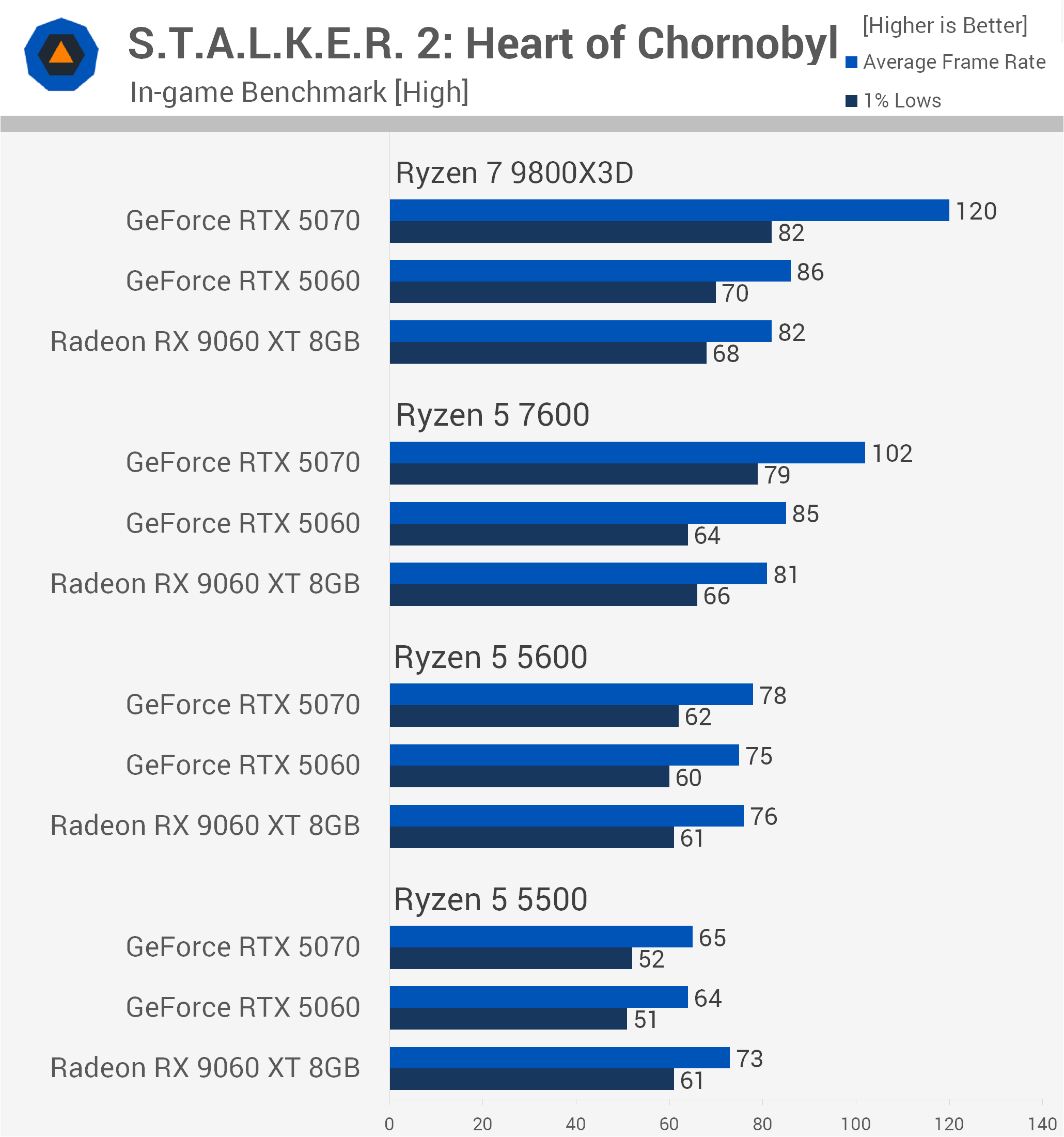
Moving down to the Ryzen 5 7600, the RTX 5070 maintained a reasonable advantage at 102 fps, although the gap between all three graphics cards narrowed considerably with the Ryzen 5 5600. Here, they delivered between 75 and 78 fps, which looks very much like a typical CPU bottleneck.
However, when we reduce CPU performance further, the RX 9060 XT actually manages to pull ahead with the Ryzen 5 5500, averaging 73 fps compared with just 65 fps for the RTX 5070. It also delivers noticeably stronger 1% lows at 61 fps compared with 52 fps.
That's a 17% improvement in 1% lows and a 12% advantage in average frame rates. Once again, we're seeing a situation where Nvidia's additional CPU overhead allows the budget Radeon to outperform a considerably more powerful GeForce GPU.
10-Game Average
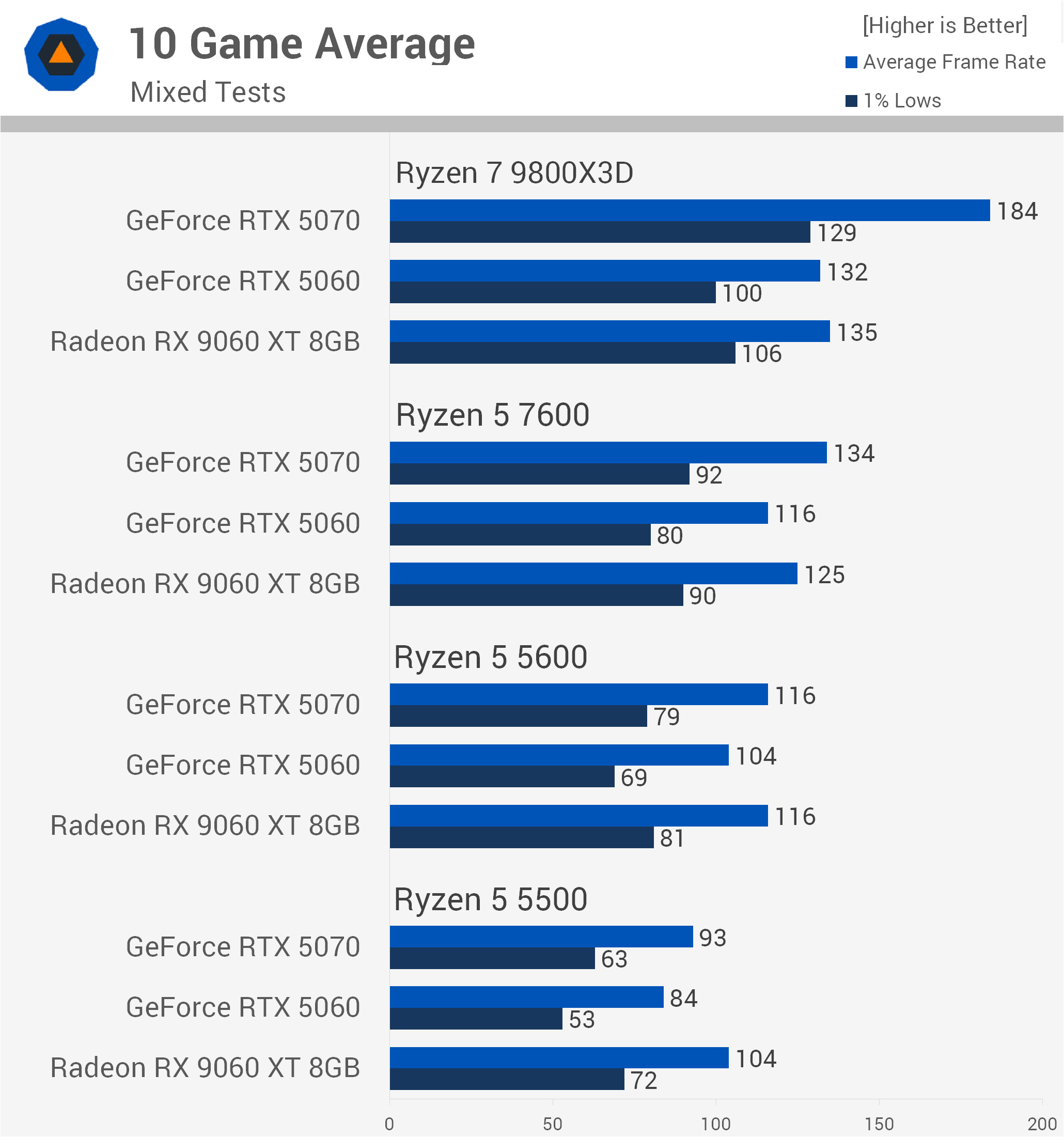
Looking at the 10-game average data, the results paint a pretty clear picture. First, as you'd expect, when not CPU-limited, the RTX 5070 is much faster than the RTX 5060 and RX 9060 XT, offering 36-39% more performance when paired with the Ryzen 7 9800X3D.
That margin is eroded to 16% over the RTX 5060 when paired with the Ryzen 5 7600, and just 7% when compared with the RX 9060 XT. This is what you'd expect to see, though, and the data is particularly relevant for those trying to maximize frame rates.
In games like Counter-Strike, Apex Legends, Valorant, and Fortnite, your CPU is often more important than your GPU, within reason, of course.
Something we noticed when comparing the Ryzen 5 7600 results with those of the 9800X3D is that the RX 9060 XT went from being just 2% faster than the RTX 5060 with the higher-end CPU to 8% faster with the Ryzen 5 processor. We also saw an even larger improvement in 1% lows.
This trend continued with the Ryzen 5 5600, where the RX 9060 XT was able to match the RTX 5070, making it up to 17% faster than the RTX 5060.
Then, with the Ryzen 5 5500, we run headfirst into Nvidia's CPU overhead issue. As we've said many times in the past, this really is a problem budget gamers need to be aware of.
Using this low-end processor, the RX 9060 XT was 36% faster than the RTX 5060 when comparing 1% lows, and 24% faster in average frame rates. That said, some of these results were skewed by the RTX 5060's limited PCIe bandwidth. However, even when comparing against the RTX 5070, we still find that the RX 9060 XT was 12% faster on average, or 14% faster when comparing 1% lows.
What We Learned: Older CPUs Change the GPU Equation
The main takeaway from all of this is that if you have a lower-end CPU that you're not ready to upgrade, you're generally better off pairing it with a Radeon GPU, such as the RX 9060 XT. It didn't take much of a reduction in CPU performance before the margins started to grow significantly in the Radeon GPU's favor.
For a typical GPU review, we'd normally aim to eliminate as many system limitations as possible, which means testing with a flagship processor such as the Ryzen 7 9800X3D. For the most part, this really is the best way to approach GPU testing, especially when comparing higher-end products like the RTX 5070.
Still, with the 9800X3D, we found the RX 9060 XT to be just 2% faster than the RTX 5060. That margin grew to 8% with the Ryzen 5 7600, which admittedly doesn't change a huge amount, but it does make the Radeon GPU more appealing.
Then, with the Ryzen 5 5600, the margin grew to 12%, a more statistically significant difference. Finally, with the Ryzen 5 5500, we were looking at a complete blowout, with the RX 9060 XT pulling ahead by a massive 24% margin. Again, though, some of that advantage was due to the 5500 being limited to PCIe 3.0.
It's worth noting that the Ryzen 5 5500 is roughly equivalent to the Ryzen 5 3600 in terms of performance, so it's not much slower than something like the Ryzen 7 3700X. This means AM4 owners with processors offering similar or lower performance will likely see better gaming results with a Radeon GPU, especially in scenarios where you're trying to maximize frame rates.
We should also clarify that this has nothing to do with AMD's Smart Access Memory technology, which is essentially Resizable BAR. That PCIe feature is unrelated to the behavior we're seeing here. Similar performance margins can also be observed when testing Intel CPUs of roughly equivalent performance.
We've seen some people claim that Nvidia's CPU overhead issue doesn't affect Intel processors. That's completely untrue, and we demonstrated this years ago. If you have an Intel CPU that delivers gaming performance similar to the Ryzen 5 5500, you're going to see comparable margins between the RTX 5060 and RX 9060 XT.
As for why we didn't include any Intel CPUs in this article, the reasons are simple: AMD has been crushing Intel in the retail CPU market for a while now, with Ryzen processors heavily outselling their Intel counterparts. As a result, a large portion of our audience is using Ryzen processors, so we're focusing on the hardware most relevant to those readers. Ideally, we would include even more data and Intel CPUs, but as it stands, adding more CPU models to the graphs would only clutter the results, making the data harder to digest without providing much additional insight.
Time is also a real factor. Each game required 36 benchmark passes to gather the data, and with 10 games, that's 360 benchmark passes in total. Adding more CPUs would only increase that workload, and as we've explained, without offering much additional value.
Bottom line, if you have an older system and want to upgrade its graphics card, a Radeon GPU is generally the better investment if your goal is to maximize frame rates. In some games, you could be looking at 20-30% better performance.