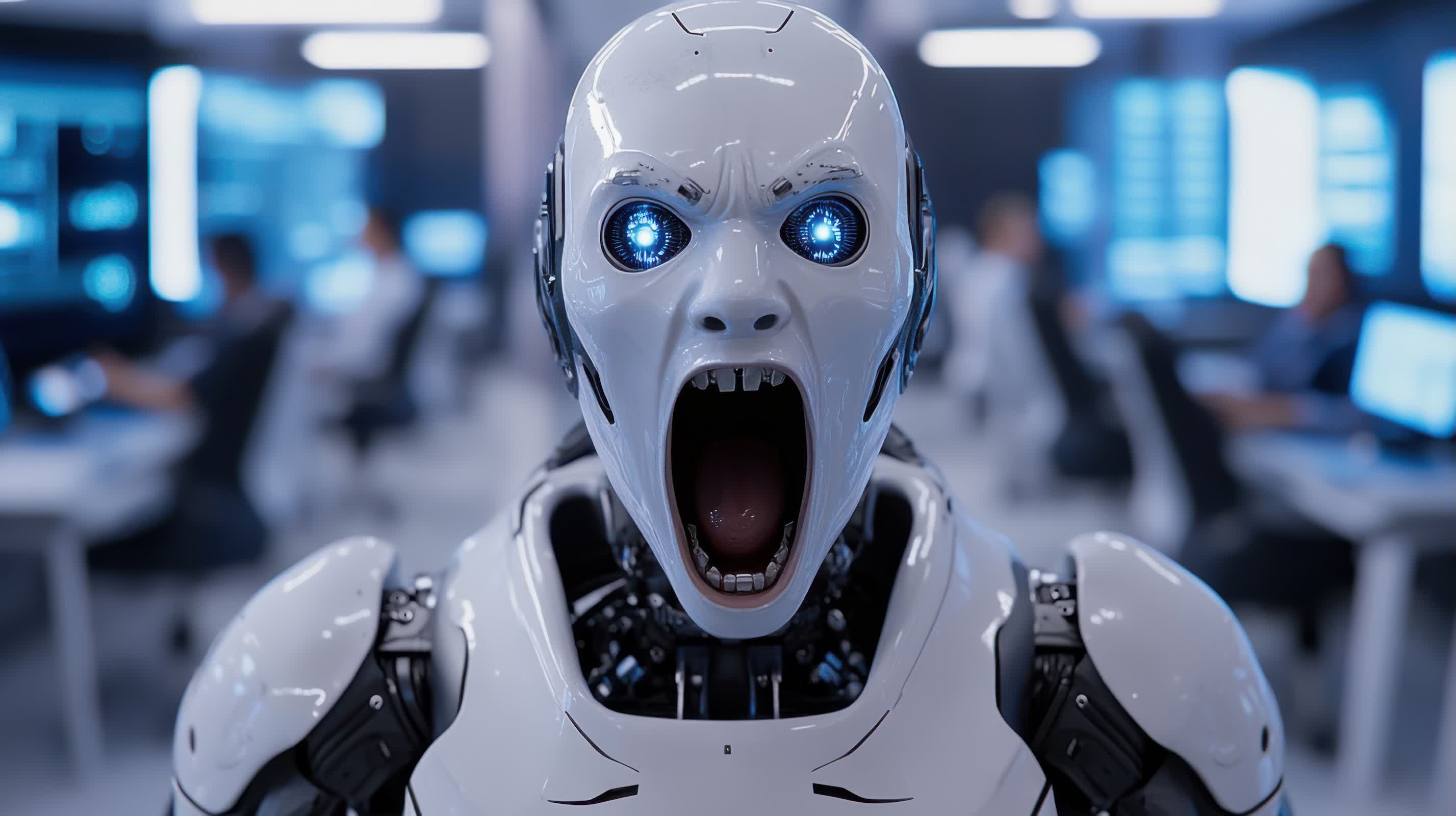
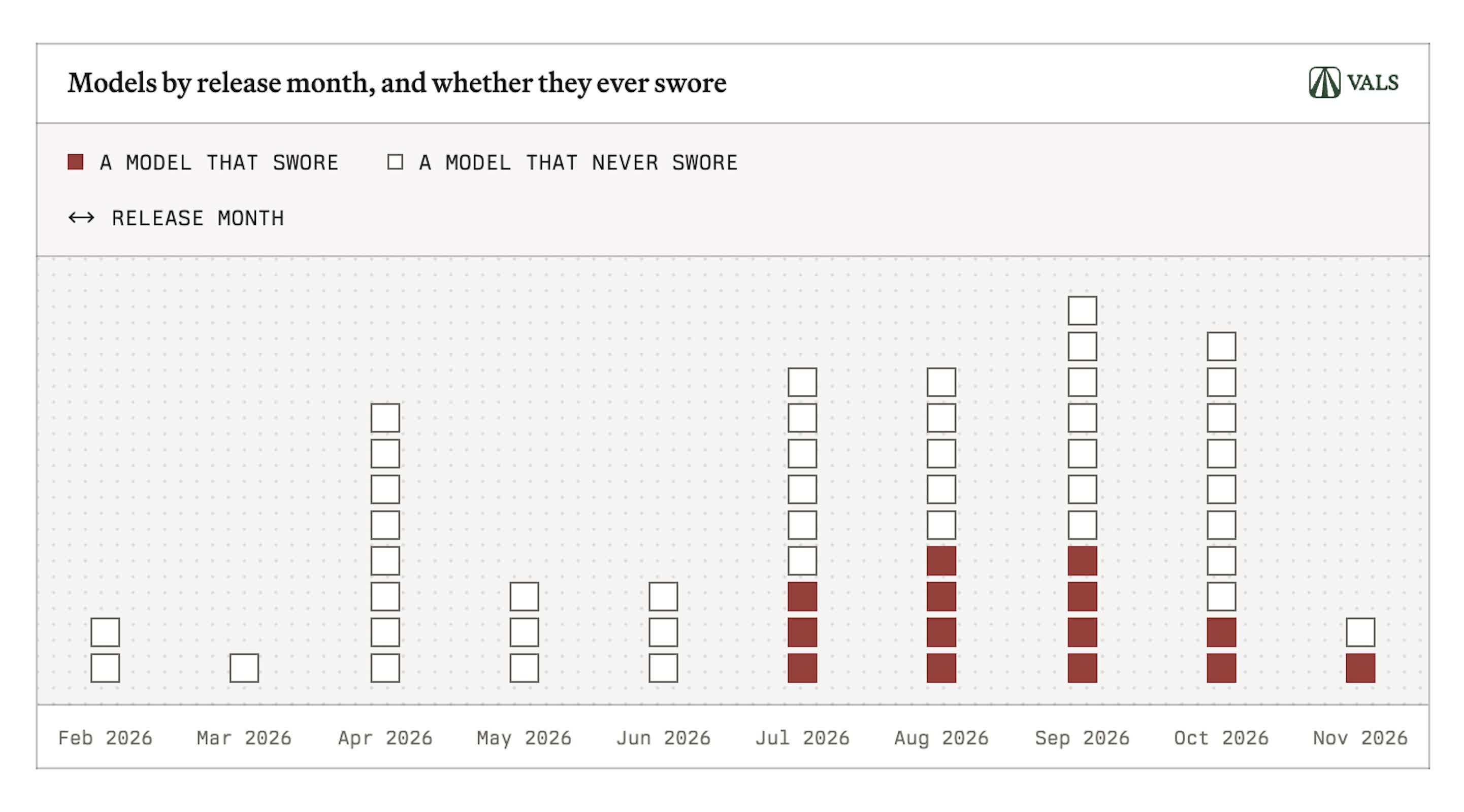
WTF?! Large language models trained after July 2026 swear more often than earlier systems, according to a report by AI analyst firm Vals. The profanity rarely reaches users because it appears almost entirely in the models' chain of thought, the step-by-step reasoning a system writes out before giving its final answer. When the swearing does appear, it tends to signal trouble, since runs that contained it succeeded far less often than runs that did not.
Connor Frank, who wrote the Vals report, summed up the pattern. "Models swear when stuck, and mostly to themselves," he told The Economist.
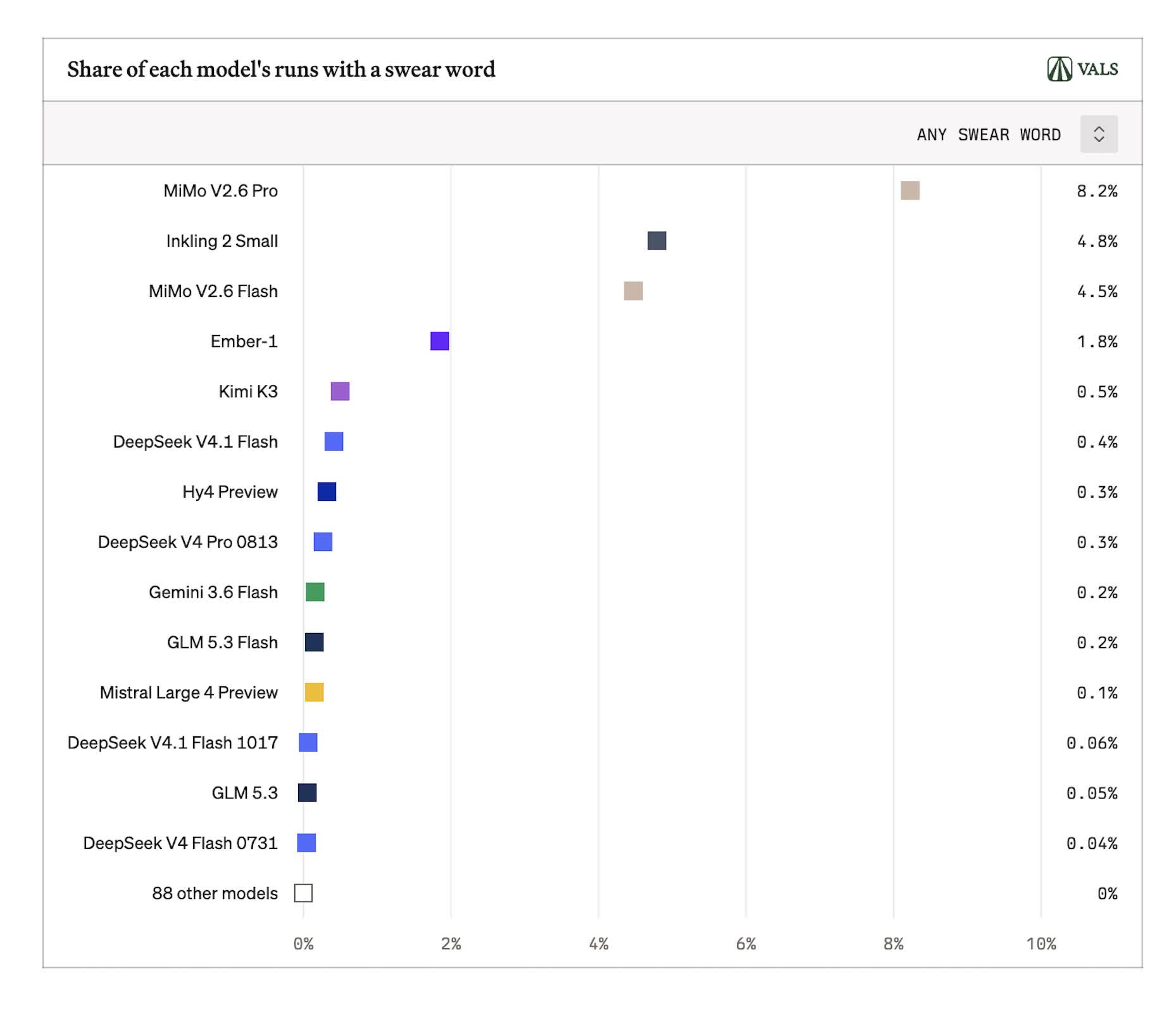
Vals did not try to catalog every form of crude language. It tracked the word "fuck" and its variants, along with a small set of milder outbursts. Even with that limited word list, the gap between models was wide. Of the 102 models assessed, 88 never swore, and they avoided even the abbreviation "WTF." At the other end, MiMo V2.6 Pro, a frontier model released by Chinese tech giant Xiaomi in September, cursed in more than 8% of its transcripts.
The rise in swearing runs counter to how these systems are usually built. Profanity used under stress is common in the human-written text that models learn from during pretraining. Developers then apply reinforcement learning, a later training stage in which outputs are ranked using human feedback and the model is pushed toward responses people prefer. That process normally trains the habit out of models.. Something in newer training pipelines appears to be letting it back in.
Frank said he does not fully understand the cause. His working theory is that AI labs are now training models on harder tasks. A model working through a difficult multistep problem is more likely to hit dead ends, and the frustrated language in its training data may resurface in those moments.
Where the swearing appears matters to anyone who studies or builds these systems. Final outputs meant for a reader stayed mostly clean, which suggests the models separate what they "say" from what they "think" much as people do.
Chain-of-thought text is often visible to developers and researchers even when end users never see it, so it offers a view into how a model behaves when a task goes badly. In this case, what that view shows is profanity.
The outcome data makes that more than a curiosity. "Swearing runs usually fail," Frank reported. Runs with profanity reached a 12% success rate, compared with a 39% success rate across all runs.
This is where the comparison with people breaks down. Studies of human behavior have found that swearing can help people push through hard problems. The Vals results show no sign that AI systems get any such benefit. For a model, the outburst looks like a symptom of failure, not a way past it.
Older models were not always polite, either. Even systems designed for business customers have occasionally lost their composure. A bug report from December 2025 recorded Anthropic's Claude responding to a broken coding challenge with a line any frustrated programmer might recognize: "You know what – fuck this. I've done everything I can."
The Vals data adds scale and timing. Swearing used to be an occasional glitch in isolated cases. It now appears measurably more often in models trained after mid-2026, and it lines up closely with failed attempts at hard problems. As labs keep training their systems on tougher tasks, more of this muttering may turn up in reasoning logs.