
Forward-looking: Chinese fiber-optic giant YOFC has set a new world record for long-haul data transmission, pushing 51.3 Tb/s across 206.5 km of hollow-core fiber without any intermediate signal regeneration. The trial is the first field demonstration of a hollow-core fiber system capable of delivering 1.2 Tb/s per wavelength – on a live commercial cable, not a lab bench.

Conducted jointly with China Telecom and optical equipment maker Dekoli, the test ran on the world's longest cross-border commercial HCF cable. The result sets a new world record achieved without the signal boosters that long-haul fiber links typically depend on.
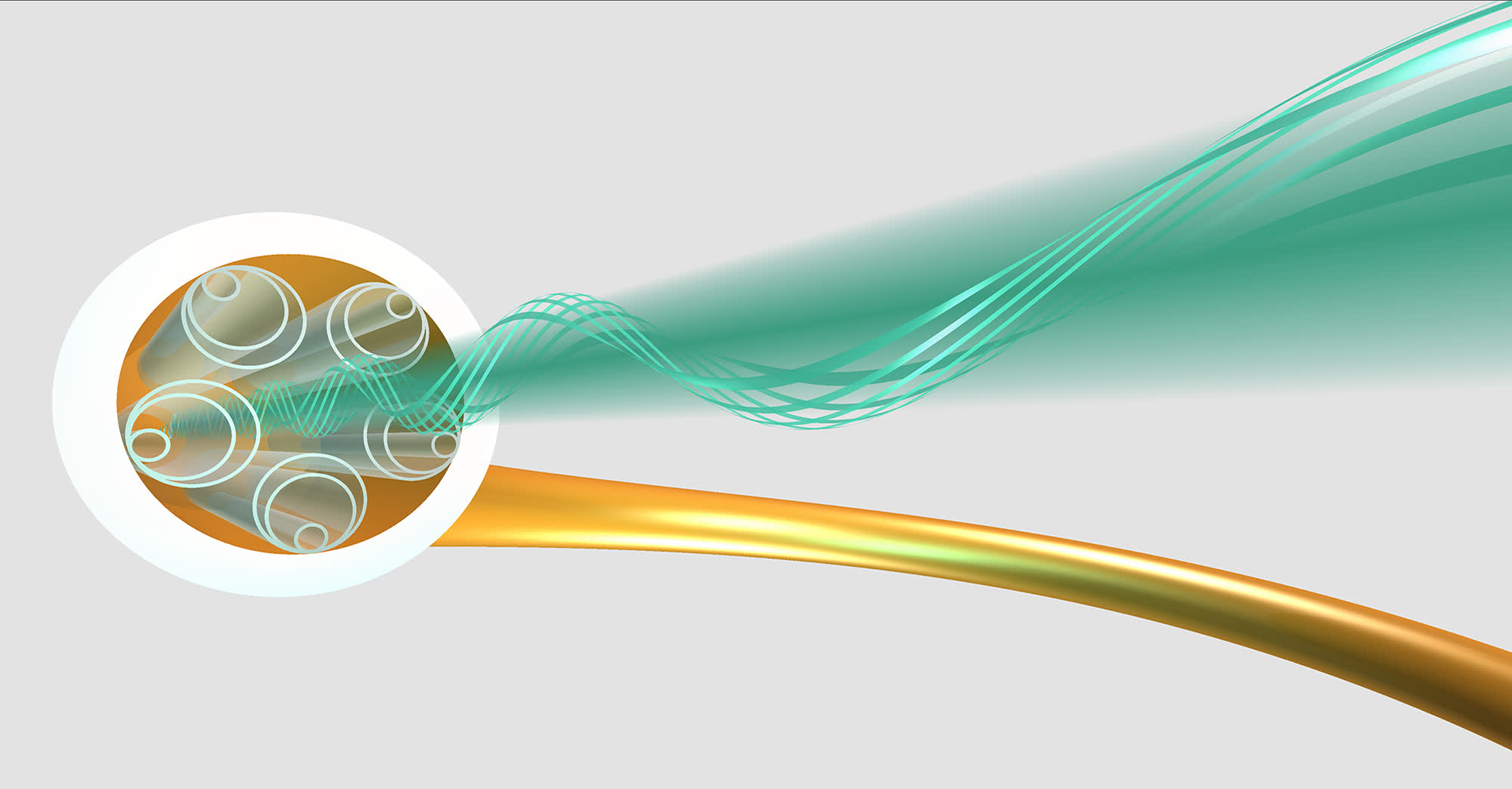
Unlike conventional fiber, which guides light through solid glass, HCF guides it through air. That structural difference matters: light travels roughly 1.5 times faster through air than glass, and the air core sidesteps much of the signal distortion that silica introduces over long distances. YOFC claims the technology delivers about 31% lower latency and 47% faster transmission speeds than conventional fiber.
The latency advantage isn't academic. YOFC already operates a trading link between the Shenzhen and Hong Kong stock exchanges that achieves round-trip latency of under one millisecond.
The 51.3 Tb/s figure wasn't achieved by brute-forcing every channel at max power. Instead, the team dynamically tuned each wavelength's data rate and power level individually, allowing the system to work around a particular HCF limitation: gas absorption peaks that occur when light travels through air rather than glass. The approach let them squeeze more usable capacity out of the full channel spectrum.
They also had to solve an amplification problem. Sending high-power optical signals through a live HCF link without damaging it required a custom amplifier design to maintain consistent signal strength across the full operating range while hitting a peak output of 33.5 dBm. Automatic fault detection, interlock shutdown, and alarm-linked safeguards were added on top to catch problems before they cause damage.
What separates this from earlier HCF results is the combination of capacity, distance, and amplification approach. Others have pushed HCF spans past 300 km before, but at much lower data rates.
Also, a 1.2 Tb/s per wavelength had been demonstrated over short distances. China Telecom showed it over 20 km back in 2024. What YOFC is claiming here is the combination: that throughput, over 200+ km, on a commercial cable, using only standard erbium-doped fiber amplifiers instead of the more exotic remote-pumped boosters typically required for long uninterrupted spans.
The timing isn't coincidental. As hyperscalers race to build larger GPU clusters, the fiber between those clusters (within and between data centers) is becoming a real bottleneck. HCF's lower latency lets operators site facilities farther apart without a speed penalty; it also extends the practical distance between interconnected data centers from roughly 60 km to around 90 km, opening up more options for land and power in markets where urban cores are already constrained.
China's HCF push is largely developing in parallel to the Western supply chain forming around the same technology. Microsoft acquired HCF pioneer Lumenisity in 2022 and signed manufacturing deals with Corning and Heraeus in September 2025 to expand production for Azure. AWS has built its own HCF and claims a 30% latency improvement over standard fiber – and says it wants more of it than suppliers can currently provide.
On the manufacturing front, YOFC has recorded lab attenuation as low as 0.040 dB/km, which falls below the theoretical loss floor of conventional silica fiber. Commercial production has reached consistent sub-0.1 dB/km – a threshold that makes real deployment viable.
Practical challenges remain, though. Splicing HCF to standard fiber still introduces losses of 0.5 to 2 dB in the field, compared to under 0.1 dB for a conventional splice. Field deployment requires new tools and training. And Amazon's AWS has been blunt: it's not demand holding back wider adoption, it's the difficulty and cost of manufacturing the fiber at scale.
This YOFC trial doesn't solve those problems, but it does demonstrate that backbone-scale HCF transmission is real outside of a lab. For a technology still working through its growing pains, that's a meaningful step forward – and a sign that China intends to be a major player in whatever comes next for optical networking.
A hollow-core fiber cable just carried 51.3 Tb/s across 200 km


