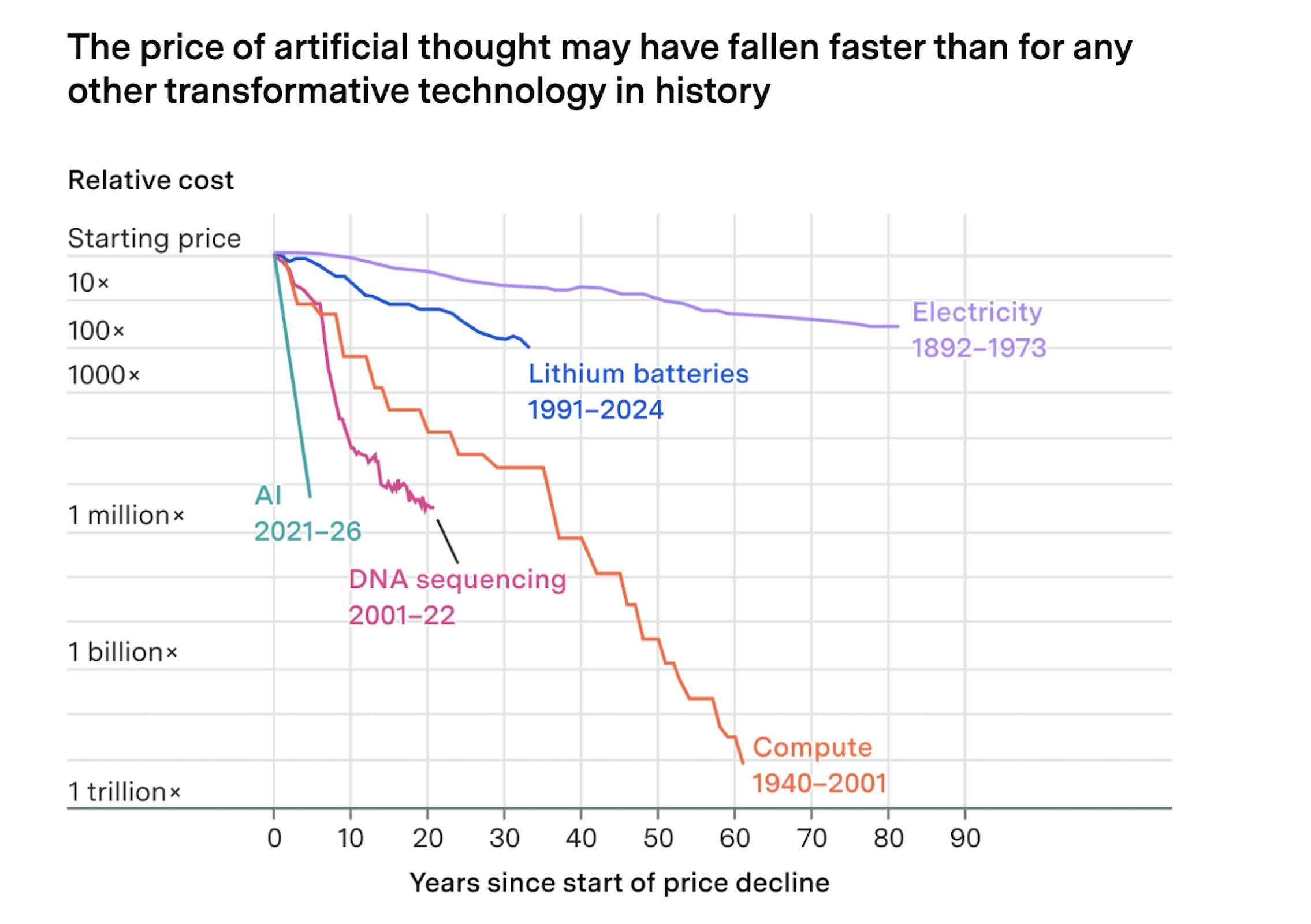
Bottom line: AI models are getting cheaper to use at a pace that could reshape the advanced software market. A report from research firm Epoch AI finds that the cost of reaching a given level of AI performance has fallen by nearly 50% per quarter, or about 13 times per year. That is a faster rate of decline than the cost curves seen in lithium-ion batteries, DNA sequencing and computing hardware. For companies building or buying AI systems, the change could make more capable models affordable for everyday use. It could also make it harder for AI developers to hold onto pricing power.

Epoch's report looks at the cost of running models that meet a set performance level on difficult benchmarks. The analysis does not measure the average price of every AI product or task. Instead, it tracks what it costs to get a model to perform at a certain standard.
Its main measure is GPQA Diamond, a multiple-choice test with graduate-level questions across scientific subjects. Epoch AI tracked the cost of models scoring at least 81.25% on the benchmark.
That approach measures more than whether models are improving: It also tracks how much it costs to achieve a certain answer quality. A newer model may be more accurate, but it may also need less computing power or fewer tokens to complete the same task. Providers may also cut prices as they deploy more efficient systems.
Epoch AI points to a sharp difference between recent OpenAI models. GPT o3, released in January 2025, achieved a 75% score on GPQA Diamond at a cost of $0.30 per question, according to the report. About a year and a half later, GPT-5.6 Luna could reportedly reach the same score for $0.0004 per question.
The difference shows why AI costs are becoming an important part of the technology story. Performance still matters, especially for coding, scientific work, enterprise research and complex agents. But model quality alone is no longer enough. The cost of delivering that quality is becoming just as important.
Epoch AI compared AI's recent cost decline with several well-known technology trends. Lithium battery costs fell by about 100 times between 1991 and 2024. Computing costs fell by hundreds of billions of times over roughly 60 years beginning in 1940. DNA sequencing also became far less expensive, although it took more than two decades for its cost curve to develop.
AI has moved faster, at least under Epoch AI's measurement. The report estimates that the cost of AI capability has fallen about four times faster than DNA sequencing and 18 times faster than lithium batteries.
There are reasons to be careful with those comparisons. The AI data begins in 2023, with earlier figures estimated using research and extrapolated trends. The compute data in the comparison ends in 2001, while electricity data ends in 1973. The data therefore does not capture every major development in computing or energy over the past two decades.
The price drops are also not consistent across all types of work. Epoch AI looked at other benchmarks involving mathematics and chess puzzles and found that the results varied. Some tasks showed steady cost improvements. Others showed long stretches with little change, followed by sudden declines.
Its Frontier Math results, for example, changed little between 2025 and 2026 before costs dropped sharply in mid-2026. That suggests there is no single AI cost curve that applies to every kind of reasoning.
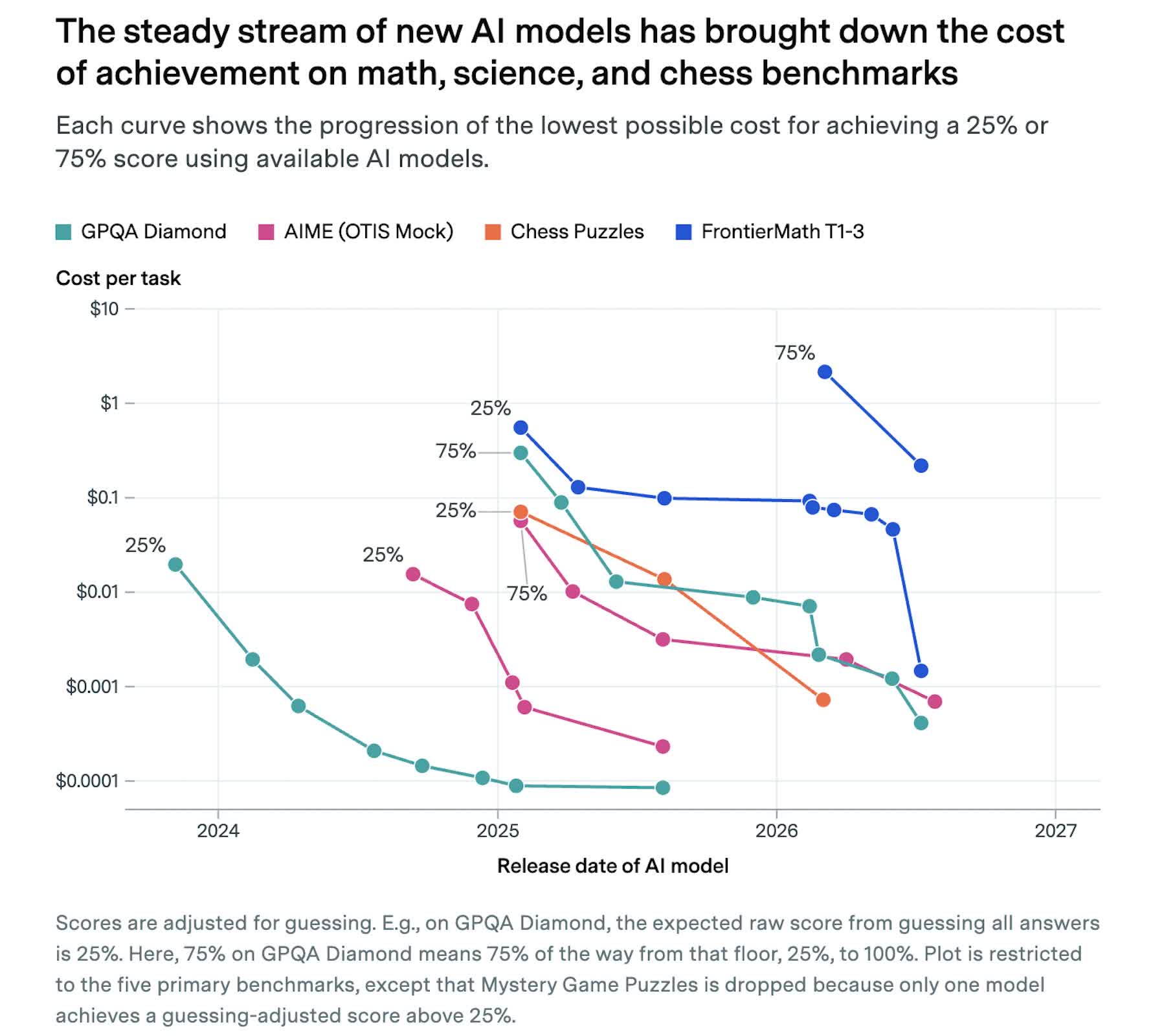
The report also found that the pace of price declines may be slowing. Across the five benchmarks it tracked, costs initially fell by 66% per quarter. Two years later, the decline had slowed to 32% per quarter.
That is still a rapid improvement. But it may reflect the growing difficulty of reducing inference costs as energy, data-center capacity and AI hardware become more expensive. Running frontier models requires large amounts of computing power, and providers cannot avoid those physical costs entirely.
Epoch AI also notes the risk of "benchmaxxing," in which developers train models to perform well on benchmarks without producing the same gains in broader real-world work. The firm used randomized elements in some tests to make this harder. Still, results from benchmarks without those protections showed steeper cost reductions, suggesting that benchmark-specific optimization may be part of the picture.
For customers, lower prices create more choices. A company may not need to pay for the newest and most expensive model if a cheaper alternative delivers similar results for its workload. That could put pressure on providers that spend heavily to build frontier systems.
But price is not the only reason companies choose an AI provider. Existing integrations, security policies, user habits and trust all matter. Switching models can require testing, changes to software and new reviews of privacy and reliability.
Even so, Epoch AI's findings point to a market where AI performance may become cheaper faster than many customers can adjust their plans. For developers, the challenge will be finding ways to build products that stay useful and profitable even as the models behind them get cheaper.
AI is getting cheaper faster than almost any technology in history


