AI tools are the "Iron Man suit" of game development, says Google Cloud exec

midian182

Posts: 11,726   +177
Staff member
A hot potato: It's another day, another executive singing the praises of AI and suggesting more people embrace the technology. This time, it's Google Cloud's gaming boss, who boldly compared AI to the Iron Man suit in that it allows people to do things they previously couldn't – like giving them more time to look for a new job, presumably.

Jack Buser, global director for games at Google Cloud, acknowledged the pushback against AI in an interview with Business Insider, but claimed the mood is starting to change.

"There will always be holdouts, just like every technological revolution, but it's becoming so common now," Buser said. "We're seeing a major shift."

Buser repeated some of what we've heard many times before when bosses are trying to justify their adoption of AI: that is speeds up work, increases productivity, and handles the boring tasks.
"It's like the Iron Man suit of armor, right? It's still you inside the suit of armor, but you're suddenly able to do things that you couldn't do before," he said.

"If you armor everybody up in your studio with suits that allow them to work more quickly and remove the drudgery, that tends to be well received after it's been implemented."

Buser added that executives of game companies need to take precautions when implementing AI tools for developers, though he urged making the technology available is important.

"Make sure that it's safe. Make sure that you take the time to work with people inside your company so that they can understand what the technology can and can't do, and what your intentions for the technology are and what they are not," he explained.

The outcry against AI in games has been louder than in most areas. Images and graphics created by generative AI is a guaranteed way to annoy people, as we saw with Black Ops 7, Anno 117, Arc Raiders, and elsewhere.
Another recent example was when The Indie Game Awards 2025 revoked Game of the Year and Debut Game awards from Clair Obscur: Expedition 33 after it was revealed that AI-generated textures shipped in the final release

Buser isn't put off by the reaction. He talked about AI making games more adaptive, personalized, and immersive. "We're looking at things like real-time game experiences," he said. That could be a reference to AI systems like Nvidia ACE, which uses gen AI so players can talk and interact with NPCs using plain speech.

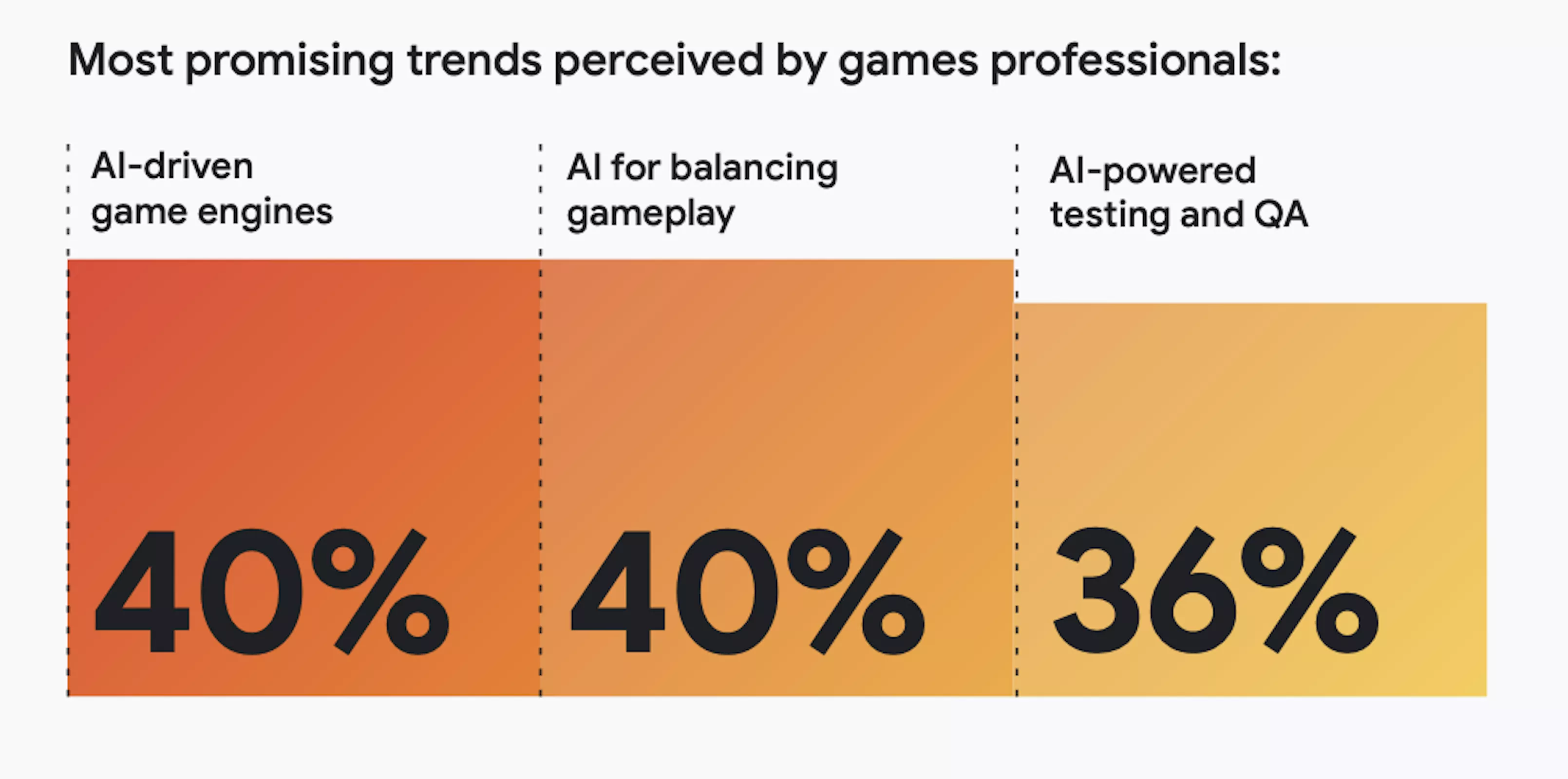
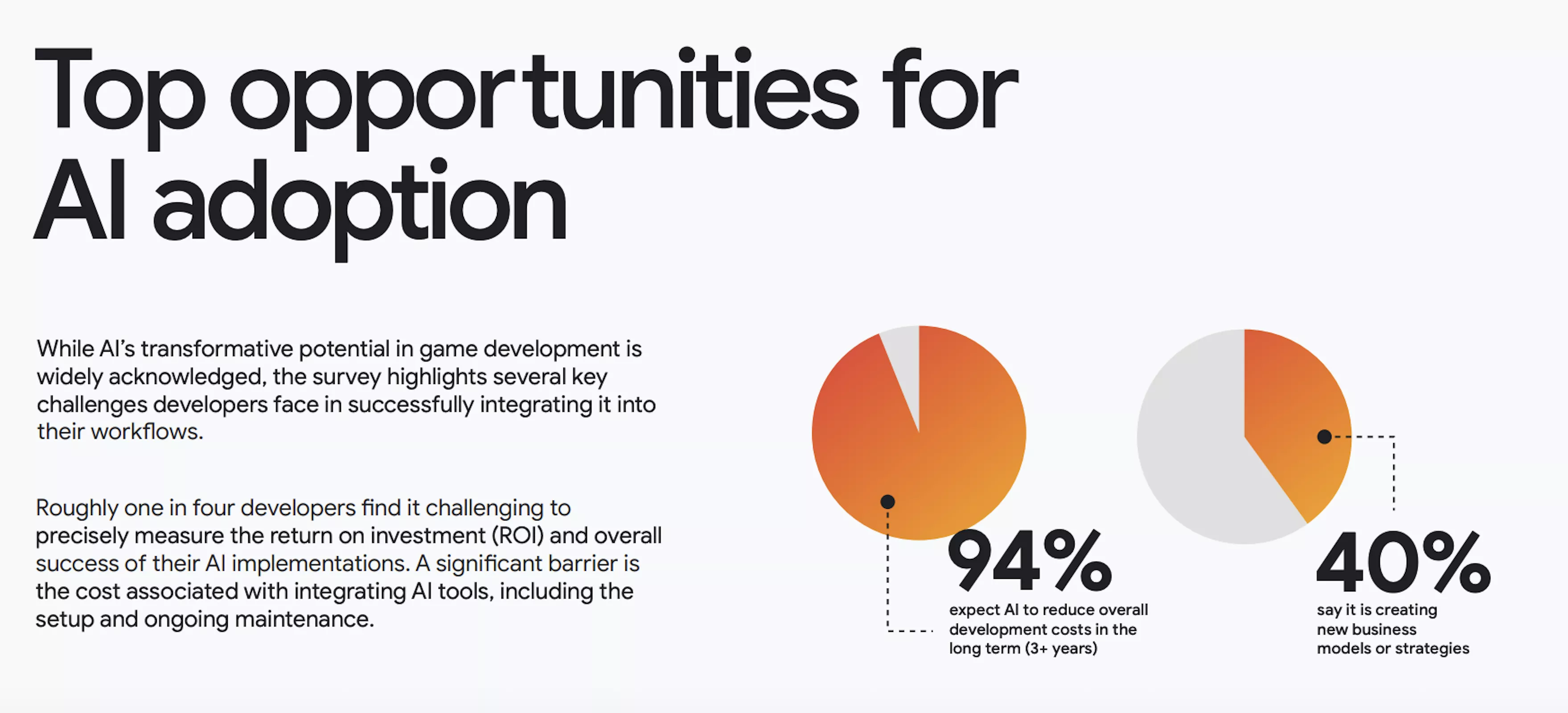
In fairness, Buser does focusing a lot on AI being used in game development. A survey from August 2025 found that 87% of developers used AI agents to handle tasks that once consumed significant portions of development cycles, while 94% believed that AI will ultimately help reduce development costs.

"2026 is where companies start to scale these efforts. Game developers who were using AI in one or two parts of their development workflow will suddenly be using it throughout their workflow," he said, before adding the slightly ominous, "You'll start to see games that are using multiple AI-based features that are affecting the player experience."

But even limiting AI to behind-the-scenes development of games is a continuous move. Concerns range from fears that AI could replace human creativity or fail to capture genuine emotion when substituting for voice actors, to plagiarism allegations and the ever-present threat of job losses.

Moreover, Buser may want to take a look at a couple of recent reports that show the majority of companies are yet to see any cost or revenue benefits from adopting AI.

Nvidia CEO Jensen Huang also complained about the negativity surrounding AI this month. Considering his company provides the hardware powering most of the industry, his opinion isn't exactly surprising.

Permalink to story:

 
I really don't understand why people are so against AI in game development. This is probably the one area where AI is truly helpful and can make a positive impact.

Let's be realistic about modern day game development:

a.) Game developers are painfully underpaid and overworked. It is without a doubt one of the worst creative white collar jobs. Having done my own couple of stints in it I would NEVER go back.

b.) About 80% of games never recover their development costs. AI gave me that statistic. I think it's low and must not include all the shovelware that shows up on steam or app stores.

c.) Despite some indie successes most of the real money in the industry is controlled by a handful of large conglomerates - EA, Sony, Microsoft, Epic, etc. None of these companies are nice.

d.) Licensing fees for game making tools (engines, software suites, etc.) can be prohibitively expensive for small teams.

AI would give small teams a huge productivity boost for a much lower cost. Environment modeling and texturing is hugely time consuming and something AI should be able to do easily. Test runs, bug detection, voice acting. On and on. AI in games is a good thing.
 
I mostly agree, but with some caveats. I use AI a lot, especially for coding. I have 20 years of software experience. I can do things now that I could never do before. It really is empowering.

However, the more I use it, the more I run into its fundamental limitations. Sometimes it feels incredible; other times it’s a nonstop, circular pain. It’s a great tool and can produce a lot of useful code, including complex multi-file implementations. But even when it looks sophisticated, it’s still limited in its ability to genuinely think and reason.

It excels when problems follow common patterns. Where it struggles is with harder problems that require deeper reasoning or connecting multiple complex ideas in a truly coherent way. It also tends to generate unnecessary code and can miss subtle logical constraints. In practice, you still need a human behind the wheel to get consistently good results.

I’ve learned you have to proof the code and not simply trust it. I did a small robot project with my teenage son, and he relied on the AI too much during the coding. The code was “mostly right” and would compile and run, but the robot didn’t work well. It wasn’t until I went through and reviewed everything, fixed the logic and math issues, that the robot behaved properly.

So, yes, the Iron Man suit is not a bad analogy. You still need a smart and educated human, but "good AI" can meaningfully amplify what that human can do.
 
Last edited:
It is a tool, which can ne good, but what I see now is enormous number of ai slop applications, vibe coding disasters, load of projects which are just a noise. I see already a lot of yt ai crap over and over. And there is a lot of ai slop games. Sure, well used ai by smart devs can help a bit in game development. But we won't even see it from layers of crap putting from mouths of teenagers beliving they are coders now...
 
c.) Despite some indie successes most of the real money in the industry is controlled by a handful of large conglomerates - EA, Sony, Microsoft, Epic, etc. None of these companies are nice.
The pendulum is starting to swing the other way.
All these companies are seeing a lot of failures (due to releasing pure slop, overly monetizing, heavy bets on live-service nonsense, going too woke or all of the above).
Examples.
EA: Dragon Age: The Veilguard
Sony: Concord
Microsoft: CoD 7
WB: Suicide Squad
Ubisoft: Everything! (AC: Shadows, Star Wars: Outlaws, etc)

d.) Licensing fees for game making tools (engines, software suites, etc.) can be prohibitively expensive for small teams.
Licensing fees on the big game engines are very fair for small new teams. If you're doing anything remotely graphically somewhat impressive there's no way that you'd do it cheaper yourself then simply just using UE5 (or similar). AI isn't going to write you a whole replacement engine, it will however be trained on a wealth of UE5 resources and do a pretty decent job in possibly helping you crank out something like Palworld.

AI would give small teams a huge productivity boost for a much lower cost. Environment modeling and texturing is hugely time consuming and something AI should be able to do easily. Test runs, bug detection, voice acting. On and on. AI in games is a good thing.
Mostly agree, it can enable a solo dev to do the work of a small team. E.g. if you can code and have a solid idea of a game but no art skills you can still have some pretty nice art and for much less than having to hire an actual artist.
Or a small team to do things previously impossible (like localization).

People are against it because we all know it's also the big companies that will use it as well and they'll use it badly. Incoherent AI written dialogues, Artwork with weird glitches etc and still expect you to pay full price.
AI = Good when you get more for less.
AI = Bad when you something worse at a higher or the same price.
 
I really don't understand why people are so against AI in game development. This is probably the one area where AI is truly helpful and can make a positive impact.

Let's be realistic about modern day game development:

a.) Game developers are painfully underpaid and overworked. It is without a doubt one of the worst creative white collar jobs. Having done my own couple of stints in it I would NEVER go back.

b.) About 80% of games never recover their development costs. AI gave me that statistic. I think it's low and must not include all the shovelware that shows up on steam or app stores.

c.) Despite some indie successes most of the real money in the industry is controlled by a handful of large conglomerates - EA, Sony, Microsoft, Epic, etc. None of these companies are nice.

d.) Licensing fees for game making tools (engines, software suites, etc.) can be prohibitively expensive for small teams.

AI would give small teams a huge productivity boost for a much lower cost. Environment modeling and texturing is hugely time consuming and something AI should be able to do easily. Test runs, bug detection, voice acting. On and on. AI in games is a good thing.
Because AI only produces slop and some of us would prefer if the industry didnt become even more ensloppified where everyone uses the same AI textures and dialog?

The gaming industry is struggling from self inflicted failures. The costs are outrageous, yet these dev houses are full of underpaid overworked employees. So where is that money going? Gamers have repeatedly shown they want good characters, good stories, and fun gameplay, so why do these developers keep doing the exact opposite?

AI will only make these things worse (and consume massive amounts of power and water, driving up our bills, in the process). People dont want that.
 
I really don't understand why people are so against AI in game development. This is probably the one area where AI is truly helpful and can make a positive impact.

Let's be realistic about modern day game development:

a.) Game developers are painfully underpaid and overworked. It is without a doubt one of the worst creative white collar jobs. Having done my own couple of stints in it I would NEVER go back.

b.) About 80% of games never recover their development costs. AI gave me that statistic. I think it's low and must not include all the shovelware that shows up on steam or app stores.

c.) Despite some indie successes most of the real money in the industry is controlled by a handful of large conglomerates - EA, Sony, Microsoft, Epic, etc. None of these companies are nice.

d.) Licensing fees for game making tools (engines, software suites, etc.) can be prohibitively expensive for small teams.

AI would give small teams a huge productivity boost for a much lower cost. Environment modeling and texturing is hugely time consuming and something AI should be able to do easily. Test runs, bug detection, voice acting. On and on. AI in games is a good thing.

- Like any tool it will be a huge benefit when it is used intelligently with consideration to its strengths and weaknesses.

However, anyone who has been on this earth for more than a day or two knows that's not how its going to be used.

MBA driven publishers are going to use AI to drive down cost at the expense of quality. So long as the reduction in cost outpaces the lost sales due to the reduction in quality, the won't care, because the only number they really care about (the profit margin) will go up.

Will it "destroy" the gaming industry? No, ofc not, but it will mean a lot more mediocre crap to sift through in order to find those diamonds in the rough.
 
Because AI only produces slop and some of us would prefer if the industry didnt become even more ensloppified where everyone uses the same AI textures and dialog?

The gaming industry is struggling from self inflicted failures. The costs are outrageous, yet these dev houses are full of underpaid overworked employees. So where is that money going? Gamers have repeatedly shown they want good characters, good stories, and fun gameplay, so why do these developers keep doing the exact opposite?

AI will only make these things worse (and consume massive amounts of power and water, driving up our bills, in the process). People dont want that.

The "slop" you speak of is when the art and work is replaced by AI. No one is saying it should be. Game devs spend so much time working on the tedious stuff and not the important work like character development and storylines. Think about mass effect andromeda. So much of the technical issues could have been solved by AI so they could focus on the stuff a human should work on. So many game devs talk about cut content or parts of the game needed love but didn't have time. AI should be used a supplement for "scaffolding" as it's called in the industry. It's just speeding things up. There's some amazing game mods for the elder scrolls that used some AI in it to speed up the process, no one seems to complain about those.
 
The survey numbers always crack me up. 87% of devs use AI, 94% think it’ll cut costs… meanwhile most companies still aren’t seeing benefits. It’s giving big blockchain will revolutionize gaming vibes.
 
Back