Amazon return scammers may be delidding CPUs, a suspected fake Ryzen suggests

Daniel Sims

Posts: 2,620   +79
Staff
In brief: Fraud involving items shipped from Amazon and other online retailers, particularly expensive PC components, has been a serious issue for years. Readers are likely already familiar with Amazon return scams involving counterfeit or swapped graphics cards and RAM, but the latest example involves a CPU swap. The deception was so subtle that only a close examination and comparison with a genuine component exposed the ruse.
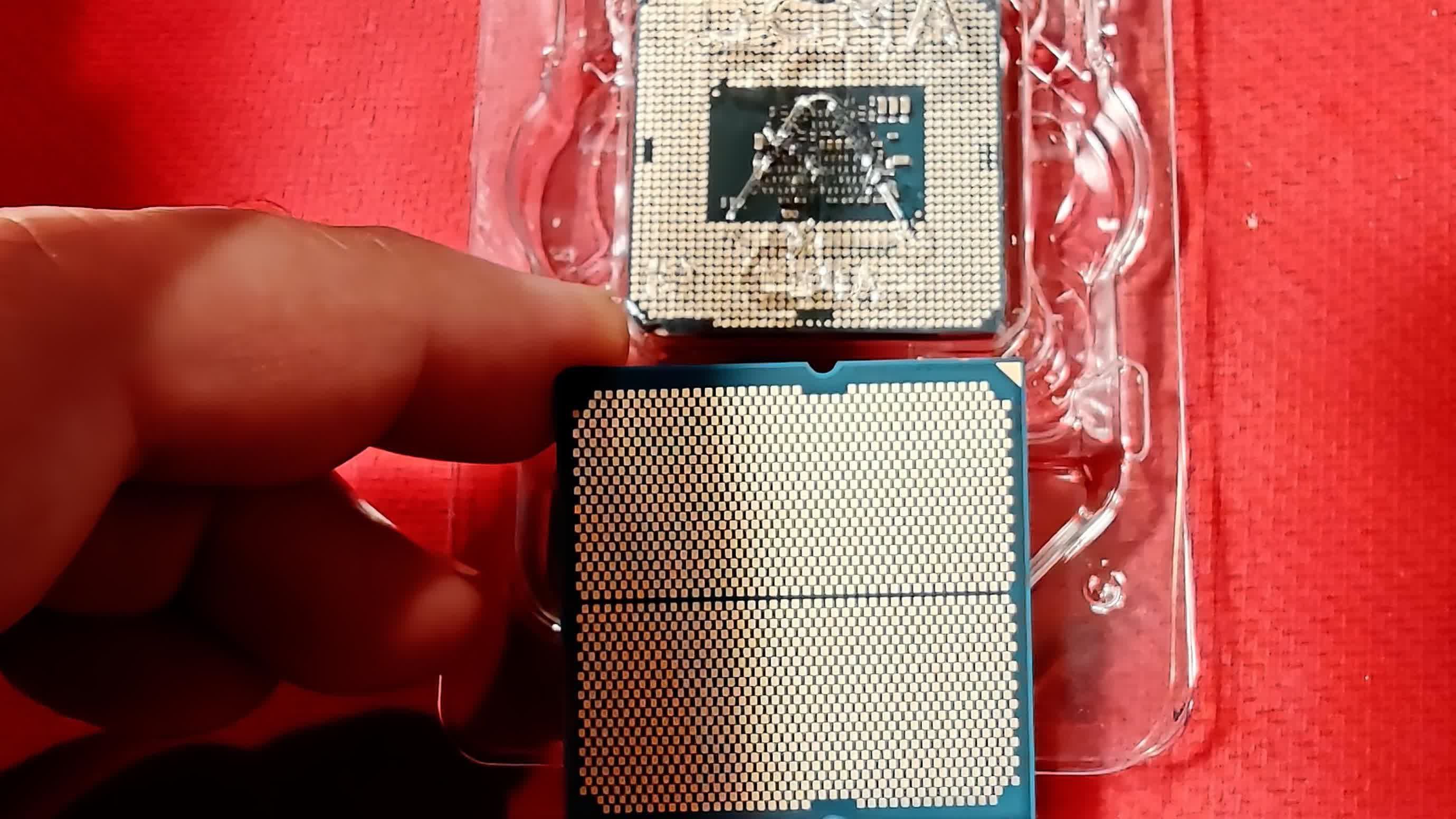
When a Redditor recently bought a second AMD Ryzen 9 9950X3D2 Dual Edition processor, he noticed conspicuous differences compared with his earlier purchase. Commenters quickly realized that a new type of Amazon return scam might be at play.

Many PC hardware scams involve third-party sellers shipping parts that look authentic to the untrained eye but either don't work at all or perform poorly because they contain counterfeit components or lack essential hardware. Graphics cards with fake or missing memory modules and GPU chips are well-known examples, as are counterfeit SSDs and RAM sticks.

Posts from the watercooling
community on Reddit

However, the Redditor who compared the two CPUs this week noted that both were sold and shipped by Amazon and arrived in sealed boxes. He noticed that they had identical labeling but very different contact layouts on the bottom.

While he initially assumed AMD had made a subtle design change, the top-rated commenter pointed out that a scammer had apparently delidded a 9950X3D2 and attached its heat spreader to an old Intel CPU. A closer look also suggests that the text on the fraudulent chip may have been reprinted.

The scammer likely purchased a genuine 9950X3D2 from Amazon and returned the fake processor to obtain a refund. Amazon then presumably resold the counterfeit CPU as new without detecting the deception. The problem has persisted for years, but Amazon does not appear to have developed a reliable solution. The National Retail Federation reported that nearly 14% of returns to American retailers in 2023 were fraudulent, resulting in an estimated $101 billion in losses.

To reduce the risk, buyers should avoid unfamiliar sellers when purchasing expensive components and record the initial unboxing while carefully inspecting the hardware for signs of tampering. Such footage can provide evidence if a dispute arises. Online databases can also provide photos of genuine products for comparison. For example, AM5 processors such as the Ryzen 9 9950X3D2 feature gold contact pads covering nearly the entire underside of the chip. By contrast, the counterfeit processor had a large gap in the center, resembling the underside of many Intel CPUs.

Permalink to story:

 
"The National Retail Federation reported that nearly 14% of returns to American retailers in 2023 were fraudulent, resulting in an estimated $101 billion in losses."
These parasites make products more expensive for us all.
Well, longer jail time would probably help.
 
"The National Retail Federation reported that nearly 14% of returns to American retailers in 2023 were fraudulent, resulting in an estimated $101 billion in losses."
These parasites make products more expensive for us all.
Well, longer jail time would probably help.
This is a consequence of products being unaffordable, not the reason for it. All the retailers are posting record profits and even just got to keep the tarrif money we've been paying.
 
A reminder that if purchased in the EU, you have a two years (sometimes more) guarantee of conformity, meaning the seller is responsible for the sale and the product (or service) bought has to work and be conform to what was sold (including the product page description from the seller, from the manufacturer, any and all communications and advertisements, or when applicable what an agent of the seller said).

If not, the seller has to fix it, replace it, or at worse refund it. Usually under a month. And without any fees or lengthy inquisitorial.

If they want to claim something to get out of it, the burden of proof if their, not the regular customer. They have to prove some shenanigan, not the other way around.

That legal guarantee can't be term-of-serviced away from you, and doesn't not diminish or impede any other contractual or commercial warranties, nor other customer protection laws.

Detail will vary in the local legal implementations, country by country, but that's the gist of it.

edit: more details here https://www.europe-consommateurs.eu/en/topics/guarantees/after-purchase/warranty/

edit 2: since we're there, another reminder that it also apply to digital products and services. The next time say a videogame makes a bait and switch, you can use this.
 
Last edited:
Makes me wonder if the increase in scams heralds the return of ye olde brick-and-mortar shops.

Curious to see this unfold.
I am not sure if he did it online or in a local store, but someone kept buying computers from Walmart and returning them after stripping them of the parts. Somehow, it went on for so long that he owed a very large sum of money when they finally noticed.
I am not sure if he bought them in a physical store, but I still highly doubt physical stores
would change anything.
I also need to note something that makes many people unhappy, which is why I am even more eager to note it, but we have gotten millions upon millions of the people from low trust societies that see no problem whatsoever in cheating and stealing. They take our trust as an invitation to steal, "learing" centers have proved it too well.
Given the number of the people that "moved in" in the last 10 years, I would not be surprised if these scams doubled or tripled.
 
Back