Amazon's robot-driven warehouses could cut fulfillment costs by $10 billion a year

midian182

Posts: 11,718   +177
Staff member
In brief: Amazon has spent years investing in robots that work in its fulfillment centers around the world. Developing and deploying these machines costs millions of dollars, but a new report claims they could save the tech giant up to $10 billion a year by 2030.
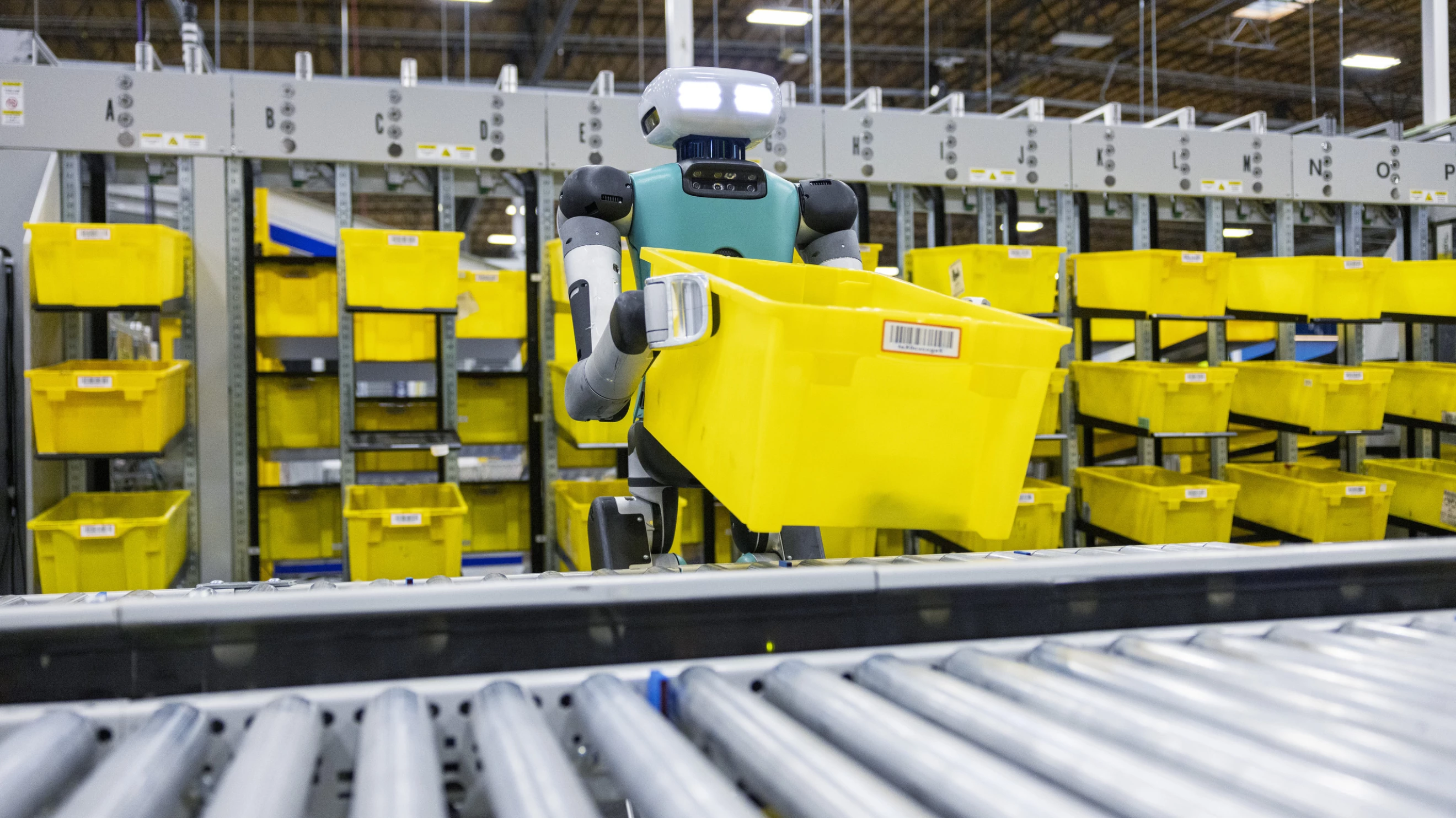
Amazon's use of robots in its fulfillment centers and warehouses goes back more than a decade, but it really started ramping up the numbers in recent times, increasing from 350,000 robots in 2021 to more than 750,000 by June 2023.

The robots perform virtually every task a human is able to do, from picking/packing and sorting items to transporting goods, inventory management, and storage, all of which make up about 60% of fulfillment costs.

As noted in a Morgan Stanley report, Amazon has developed six new significant warehouse robots in the past three years, covering almost every stage of the fulfillment process.

One of those robots is Digit. This bipedal, 5-foot 9-inch, 143-pound robot from Agility Robotics can walk forward, backward, and sideways, squat and bend, and move, grasp, and handle items using its arm/hand-like clasps.
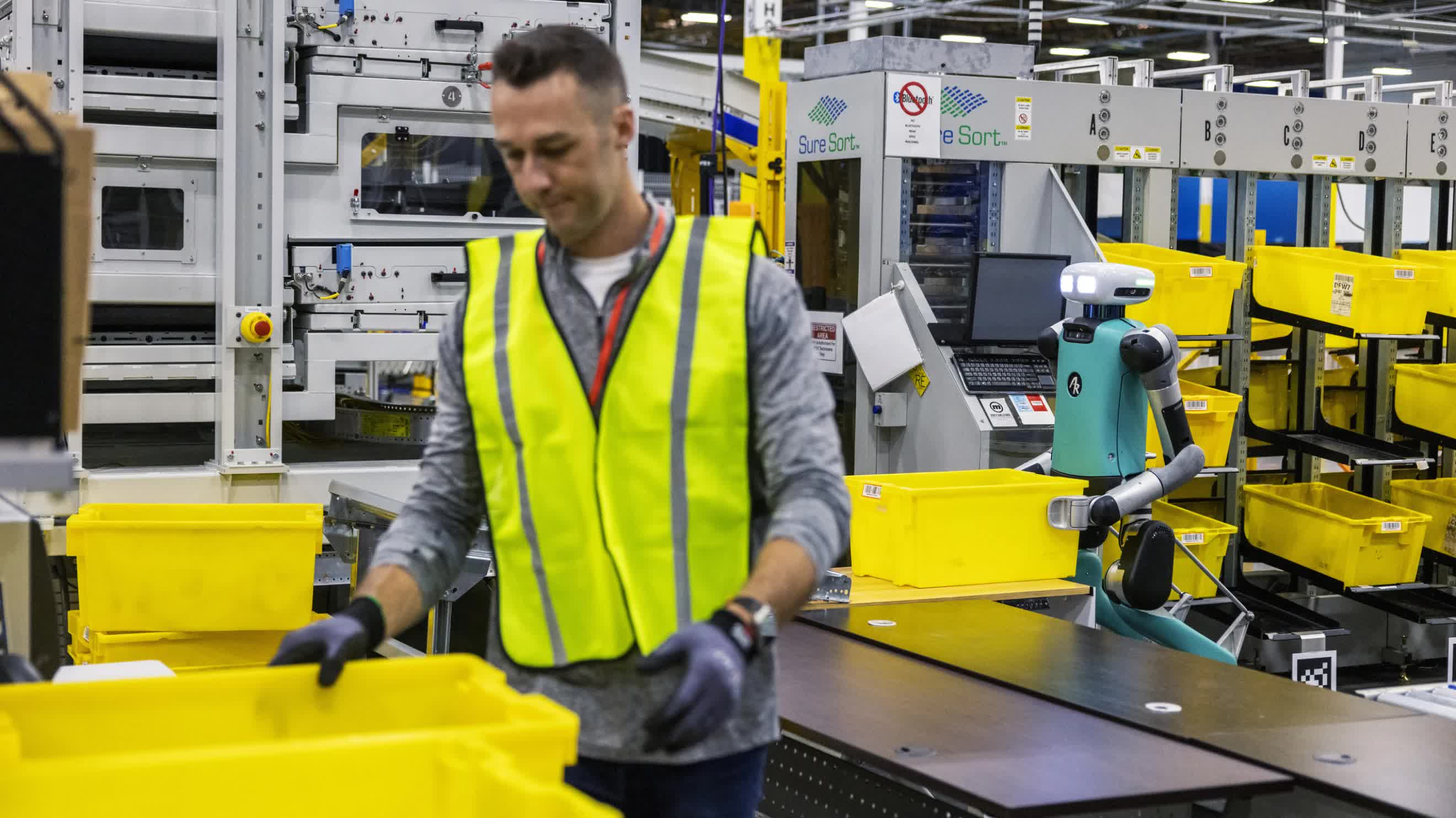
In September, Amazon opened a new fulfillment center in Shreveport, Louisiana, that was the first to include all of the company's latest robots. Morgan Stanley writes that it expects to see a 25% reduction in fulfillment costs at the site during peak periods.

According to the analyst's report, if Amazon manages to fufil 30% of orders in the US through robotic fulfillment centers by 2030, it will save $4.5 billion to $9 billion annually. Should that figure reach 40%, the total savings could exceed $10 billion per year.

Creating these futuristic locations isn't cheap. Amazon's traditional fulfillment centers cost around $200 million to develop, while the next-gen versions cost around $450 million. Even retrofitting current centers into high-tech robot-filled ones costs around $100 million. But if Morgan Stanley's predictions are accurate, the long-term savings make the spending worthwhile.

There's little mention in the report of the impact these robots will have on human jobs. Both Amazon and the machines' maker have tried to quell fears by insisting the robots are there to enhance, not replace, jobs – a statement often rolled out by companies adopting generative AI tools.

Permalink to story:

 
There's little mention in the report of the impact these robots will have on human jobs.

The impact is mentioned repeatedly: $4.5-10B/yr savings... in labor costs.

Still, these predictions are for robots doing 30-40% of shipments 5 years from now. Therefore, over the next 5 years, develop a skill greater than putting things in boxes and get a better job, or become an above average box filler and keep your job.
 
Meaning thousands of human work force will lose 10 billion dollars...in other words more people without jobs.
Technology replaces jobs and, honestly, those working conditions are terrible. We've seen this many times throughout history. Some type of technology disrupts the workforce, jobs are lost and the world moves on. Unless you've ever worked on of those warehouse jobs don't say those people are losing much. Finding a new job is simple, what fields are in demand and what pays you an appropriate amount to continue your way of life? If I hear "oh, but I don't want to do that" then I don't want to hear people complain about losing their job. No one wants to do their job, that's why you get money for doing it.

I hate my job but it pays well, however I see the writing on the wall and there is only a few more years of work left in my field due to economic reasons. So I'm training, in my spare time, for a new job in another field that pays better and has better job security. Yeah, I'd like more free time instead of going to school and working fulltime so that I can switch careers, but that's just what it takes.

If people don't want to do what it takes to get the job they want then I don't want to hear them complain when they end up with a job they don't want that doesn't pay. I had worked as a dishwasher or a tacobell before when I was between jobs because that was JUST WHAT I HAD TO DO. And while it didn't pay my bills, it made my savings last significantly longer while I was between jobs.

These jobs are miserable and people shouldn't be doing them. Replace them with robots. If the people who worked at an amazon warehouse as anything other than an "in-between" job then that's on them. I know plenty of people who have worked at amazon warehouses to support themselves while they worked on building a career, but I've also heard stories about dumb people who are like drones that expects their amazon warehouse job to be their career. I mean, I guess you can make a job like that a career if you want, but I have no idea in the world who would want that as a career.

Typically this kind of things means several years of fighting before the automation ultimately brings progress to society. Amazon will try to keep as much of that 10billion as possible, but eventually, their automation warehouse technology will spread to other companies and eventually they'll have to start lowering prices to compete with each other. Or, more realistically, inflation is such that we'll be lucky if prices don't go up
 
Meaning thousands of human work force will lose 10 billion dollars per year...in other words thousands of people without a job.
Yes, seeing through society perspective. But cost wise should these robots perform tasks as successful as their human counterparts this is definitely the way to go.

Robots don’t need sleep, they don’t get tired, they can operate 24/7 as long as there’s electricity available. I am in a job that is similar so I’m on the line for unemployment still I find this the next step in how the economy will go spin (and the world for that matter).
 
Disintegrating society usually ends up in disintegrating countries. Nukes? Ice Age mysteries are solved.
 
Meaning thousands of human work force will lose 10 billion dollars per year...in other words thousands of people without a job.
If all we care about is the number of jobs, we should destroy all bulldozers and hand out shovels to the replacement workers in the thousands of newly created jobs.

But that would make the cost of all buildings and roads go up in return for a bunch of people working hard for terrible pay. Efficiencies don't disappear from the economy. In this case, cheaper shipping means cheaper products on Amazon for everyone. Which means everyone can buy more things with the same paycheck while jobs making robots were created to replace jobs putting things in boxes.
 
If all we care about is the number of jobs, we should destroy all bulldozers and hand out shovels to the replacement workers in the thousands of newly created jobs.

But that would make the cost of all buildings and roads go up in return for a bunch of people working hard for terrible pay. Efficiencies don't disappear from the economy. In this case, cheaper shipping means cheaper products on Amazon for everyone. Which means everyone can buy more things with the same paycheck while jobs making robots were created to replace jobs putting things in boxes.
And yet each one of those bulldozers were operated by a human.....I don't see any if those robots being operated by humans.

I see you are confusing the robots helping humans in their jobs versus robots taking their jobs away.
 
Meanwhile the entire IT department I work at is replaced by Indians, everyone from Servicedesk employee to big time system administrators.

About 1000 people are being booted, to be replaced by FAR CHEAPER, people that end up working in multi-skilled environments while they only are skilled at 1 thing.

So on the one hand you have robots replacing people and on the other hand people that get paid less than welfare money to do your job in 'poor' countries.
 
And yet each one of those bulldozers were operated by a human.....I don't see any if those robots being operated by humans.

I see you are confusing the robots helping humans in their jobs versus robots taking their jobs away.
No you just are missing the person who built the robot and the person operating the robot because you apparently don't understand how robots work. Last time I checked robots have not become self aware.

You also seem to miss the fact that the bulldozer operator replaced dozens of people with shovels. That's how production technology works. I increases the productivity a each person using it so they can do the work of multiple other people. Freeing those other people up to do other work.

You realize at one point most of humanity were farmers (or hunters) just to feed humanity. Thank goodness for farming production technology letting me, you, and 98% of humanity do other jobs!
 
No you just are missing the person who built the robot and the person operating the robot because you apparently don't understand how robots work. Last time I checked robots have not become self aware.
People don't operate the robots in these fulfilment centres. The robots are just programmed to move containers around the warehouse and finally to human packers. It's pretty simple programming. I'm fairly certain that the human packer job will also disappear soon.

I guess you can say building the robots is a new job but, if you're building one robot a day, then you're taking one job away elsewhere each day. Actually you're probably taking 3 jobs each day as the robots work 24/7. The jobs being taken aren't great jobs but some folk don't have much choice. I guess they'll have even less choice going forwards.

I guess that's progress.
 
Post offices, physical banks, game stores, people at cash registers - that's a small list of jobs that has "vanished" in my country the last 20 years. One our biggest tech retailers have replaced around 80% of their warehouse workforce with automatic picking and packing machines.
We're moving into a future where alot of jobs will vanish, new jobs propping up will require a higher education and thus the general population will thrive, while people unable to pay for education will probably starve - it's a harsh world we live in, but there's no way any billionaire would rather "keep their current way of working" vs "how cheap and effective can I make this business". At some point in time we'll probably have to consider a "citizen paycheck" as there simply won't be enough jobs in the lower end of the spectrum
 
Technology replaces jobs and, honestly, those working conditions are terrible. We've seen this many times throughout history. Some type of technology disrupts the workforce, jobs are lost and the world moves on. Unless you've ever worked on of those warehouse jobs don't say those people are losing much. Finding a new job is simple, what fields are in demand and what pays you an appropriate amount to continue your way of life? If I hear "oh, but I don't want to do that" then I don't want to hear people complain about losing their job. No one wants to do their job, that's why you get money for doing it.

I hate my job but it pays well, however I see the writing on the wall and there is only a few more years of work left in my field due to economic reasons. So I'm training, in my spare time, for a new job in another field that pays better and has better job security. Yeah, I'd like more free time instead of going to school and working fulltime so that I can switch careers, but that's just what it takes.

If people don't want to do what it takes to get the job they want then I don't want to hear them complain when they end up with a job they don't want that doesn't pay. I had worked as a dishwasher or a tacobell before when I was between jobs because that was JUST WHAT I HAD TO DO. And while it didn't pay my bills, it made my savings last significantly longer while I was between jobs.

These jobs are miserable and people shouldn't be doing them. Replace them with robots. If the people who worked at an amazon warehouse as anything other than an "in-between" job then that's on them. I know plenty of people who have worked at amazon warehouses to support themselves while they worked on building a career, but I've also heard stories about dumb people who are like drones that expects their amazon warehouse job to be their career. I mean, I guess you can make a job like that a career if you want, but I have no idea in the world who would want that as a career.

Typically this kind of things means several years of fighting before the automation ultimately brings progress to society. Amazon will try to keep as much of that 10billion as possible, but eventually, their automation warehouse technology will spread to other companies and eventually they'll have to start lowering prices to compete with each other. Or, more realistically, inflation is such that we'll be lucky if prices don't go up
I agree with what you're saying. but it means people will need more education for the specialized jobs robots (currently) cannot do.
Which is priced out of reach for those same people soon to be laid off....
<sigh>
 
Well, he needs a place to get them to a level that they can build his Mars Empire. (the sooner he leaves for there, the better IMO)
 
I agree with what you're saying. but it means people will need more education for the specialized jobs robots (currently) cannot do.
Which is priced out of reach for those same people soon to be laid off....
<sigh>
Call any union hall, they're all so short staff that most will start you off as a first year apprentice(in start of an unpaid pre-apprenticeship). Our number one issue is getting people to pass a drug test. Essentially, they don't want to give up smoking weed.

If peak existence to someone is smoking week and working at Amazon, there is no helping. That's on them.

Boohoo, you're poor. Well, they didn't want to do the stuff thay society asked of them to stop being poor.
 
I feel a lot of times, we have been told that so and so will replace humans and reduce cost. But the analysis is always very flawed and misses a lot of factors. The emphasis is always on cost savings because they don't need a "warm body" to do the job. But that does not tell us,
(a) what is the investment cost for these automation, and,
(b) what is the running cost to keep these automation solutions running.
There will always be tradeoffs be it a human or robot doing the work. So I don't believe the actual cost saving (if any) is what is in the headline.
 
If our unemployment rises to over 30%, every sane person will push for 90%+ tax on anyone earning more than few millions a year.
Even better, this companies so eagerly replacing people with robots should be given 2 choices, x amount of jobs created or 90%+ tax.


Who has the most opportunities to lead us to the moment when there are drastically fewer jobs than today?
People like Bezos.
Who should fear that moment the most?
People like Bezos.
It is in their interest to replace as many people with robots that are x10 times more productive and not asking a salary.
But it should also be in their interest to constantly have new jobs openings.
Our megacorporation's should have the biggest fear of mass unemployment.
For their, and our good.
 
People don't operate the robots in these fulfilment centres. The robots are just programmed to move containers around the warehouse and finally to human packers. It's pretty simple programming. I'm fairly certain that the human packer job will also disappear soon.

I guess you can say building the robots is a new job but, if you're building one robot a day, then you're taking one job away elsewhere each day. Actually you're probably taking 3 jobs each day as the robots work 24/7. The jobs being taken aren't great jobs but some folk don't have much choice. I guess they'll have even less choice going forwards.

I guess that's progress.
And when I write a program, I don't operate it for my customers. Still a job.

Amazon offers training classes to their workers to upskill them so they can do the better jobs being created by production and logistics technology.

People always have a choice. But developing skills takes effort and time away from TV, leisure, and complaining about your bad job. One of the most significant predictors of success is time preference: Are you willing to delay gratification to get a bigger payoff in the future? Some people can't see past the next weekend or paycheck or just don't want to put in any extra work.

I have a great job now, but I also spent many years paying my own way through multiple degrees and then working my way up the ladder. I missed out on a lot of fun in those years but I wouldn't trade my life now for it.
 
Unsure why you're replying to my post. I was simply replying to your previous post that said
No you just are missing the person who built the robot and the person operating the robot because you apparently don't understand how robots work.
I was just pointing out that people don't operate these robots and that, while there are a few jobs building robots, they won't compensate for the high number of human jobs taken. I'm not against robots, I was just pointing out that what you were inferring might not be correct.
 
The whole point of replacing people with robots is to cut production costs. The savings are paid to shareholders as dividends. The shareholders who receive those dividends can stay in bed all day and live for doing nothing. There will still be sh*tty jobs left for the people who can find them. The rest will deal drugs or take up burglary to make ends meet. The American Dream?
 
Back