Amazon's latest round of layoffs hits its robotics unit

midian182

Posts: 11,708   +177
Staff member
What just happened? It seems even those people creating job-stealing robots are at risk of becoming unemployed. Amazon confirmed this week that it laid off staff across its robotics unit, with at least 100 white-collar jobs affected. It comes soon after the company laid off 30,000 people and canceled its Blue Jay warehouse robot.
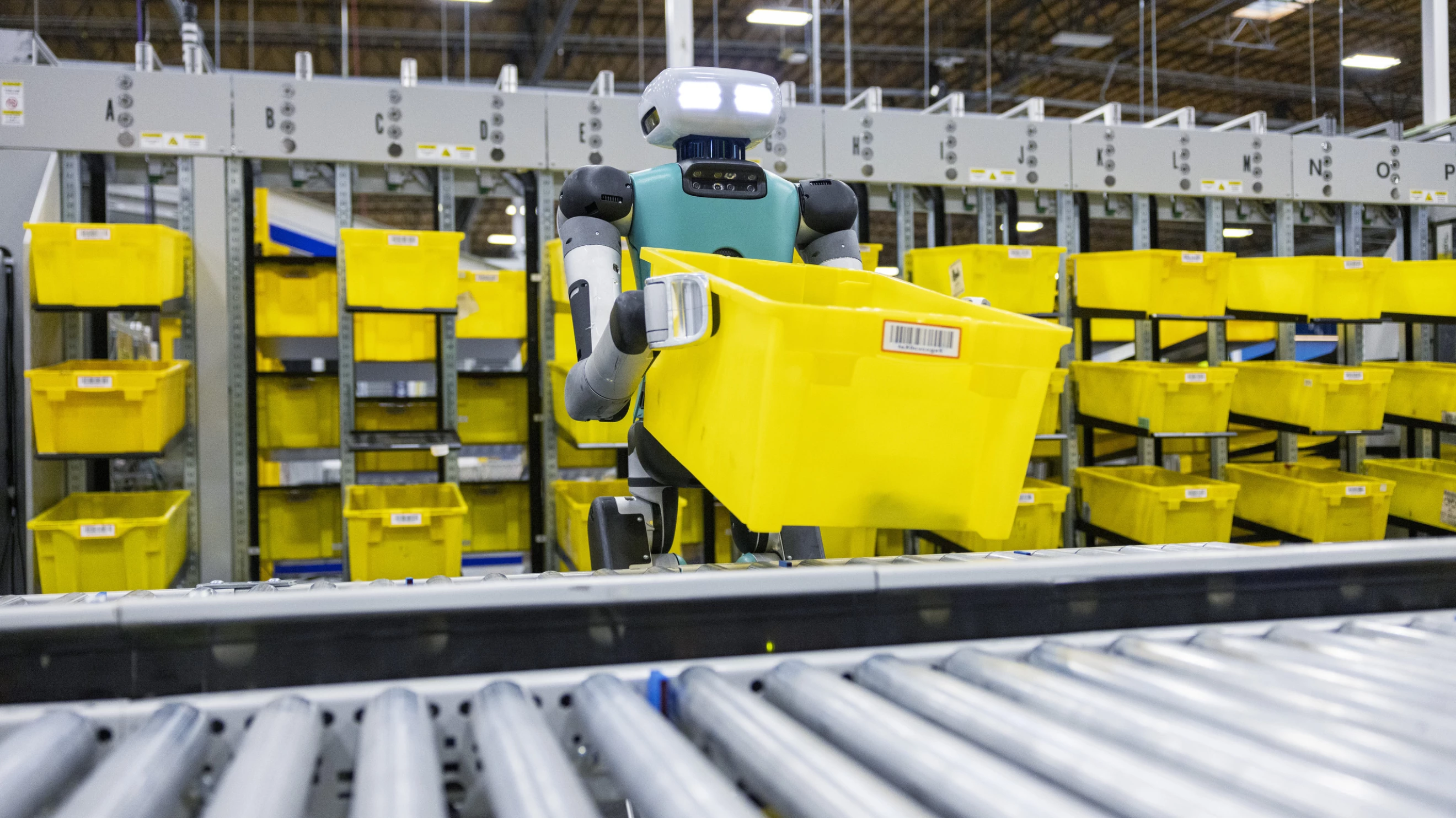
The division that was axed on Tuesday is responsible for designing robots and other conveyances, primarily in warehouses, writes Reuters.

In a message to employees seen by Business Insider, Amazon Robotics VP Scott Dresser described the changes as "difficult but necessary." He stressed that robots remain a "strategic priority" for Amazon.

In October 2025, Amazon said it would be reducing its corporate workforce by about 14,000 people in a move that it partly blamed on AI adoption – though reducing organizational layers was framed as the main cause.

Another round of layoffs was announced in January. This time, 16,000 corporate roles were cut, bringing the total since October to around 30,000, about 10% of the company's white-collar workforce. Since late 2022, Amazon has cut more than 57,000 corporate roles.

Last month, Amazon quietly shelved Blue Jay, a multi-armed robot designed to accelerate same-day deliveries, just a few months after its debut. The machine reportedly faced steep manufacturing costs and complex installation demands, particularly due to its ceiling-mounted structure.

Amazon has also closed its Fresh and Go grocery chains and made smaller job cuts in its devices and services, books, podcasts, and public relations divisions. But it certainly isn't cutting back on AI spending, which is projected to account for the bulk of its $200 billion in capital expenditures throughout 2026.

In October 2025, a report citing leaked company documents revealed that Amazon hopes its warehouse robots will fill more than 600,000 US positions it would have had to hire for by 2033. The report added that Amazon's robotics team aims to automate 75% of all operations at the company.

Amazon responded a day later with claims that robots aren't taking human jobs. Strangely, it did so while unveiling two new machines designed to take human jobs. One was Blue Jay, which obviously didn't turn out as well as expected.

Permalink to story:

 
Fortunately private enterprise is not constrained like our government used to be or teachers unions where when you have a job, you have it for life regardless of it's necessity. Why would a company keep people around they don't need? Why is it a bad thing that in order to protect your market share and bottom line you let these people go? It isn't. Of course you could give them a desk in a horrible office and let them play with staplers or better yet just let them "work" from home.
 
Kill enough jobs and eventually you won't have any customers left, either. You can hire the security guards you're going to need for a while still, but luckily we'll be able to replace those with armed AI robot drones.

At least Bezos ain't getting any poorer anytime soon.
 
I don't see a problem here. Since its 100-white collar jobs, then perhaps those jobs were totally unnecessary.
 
A 100 job layoff and the article keeps talking about tens of thousands of jobs laid off in the past... It sounds like the former was mostly an excuse to talk about the latter.
Kill enough jobs and eventually you won't have any customers left, either. You can hire the security guards you're going to need for a while still, but luckily we'll be able to replace those with armed AI robot drones.

At least Bezos ain't getting any poorer anytime soon.
Are you implying that by Amazon eliminating jobs, it'll anger customers enough to literally attack company property instead of buying from them lol? I interpret that to be a weird, unfounded warning unless you mean something else. The only thing I see in the news is Iran attacking Amazon facilities with drone strikes, but I hardly think it has to do with angry Persian customers lol.
 
Are you implying that by Amazon eliminating jobs, it'll anger customers enough to literally attack company property instead of buying from them lol? I interpret that to be a weird, unfounded warning unless you mean something else. The only thing I see in the news is Iran attacking Amazon facilities with drone strikes, but I hardly think it has to do with angry Persian customers lol.
Pretty sure the implication isnt that obscure. If you lay off enough people, people wont have jobs, or income, and will resort to theft. Wipe out 80% of the job market with AI and you will have a giant class of unemployed people who are not drug addled 60 IQ wastes of oxygen, but rational adults with critical thinking skills that have been rendered jobless b megacorporations shoving AI everywhere.

Those kinds of people are much more capable of coordinating to overthrow some drones and empty a warehouse. At some point you are going to reach critical mass of people that cant afford to live anymore.
 
Kill enough jobs and eventually you won't have any customers left, either. You can hire the security guards you're going to need for a while still, but luckily we'll be able to replace those with armed AI robot drones.

At least Bezos ain't getting any poorer anytime soon.
Security guards won't help when there is a mob of unemployed and angry people ready to take things they cannot afford :)
 
Wipe out 80% of the job market with AI and you will have a giant class of unemployed people ... rational adults with critical thinking skills that have been rendered jobless b megacorporations shoving AI everywhere.
Such fearmongering. Let's review history. 200 years ago, essentially 100% of the population worked, even children age 10 and up. The Industrial Revolution reduced that figure, and the Information Age dropped it further, down to its present level of 60% workforce participation (US, adults), and near-zero for children. Even as that occurred, standards of living soared. Why? Because the unit labor input required to produce any product dropped immensely.

In 1900, debilitating diseases caused by malnutrition were commonplace in the US. In 1940, half of middle-class families couldn't afford even one car, and the average home size was 950 sq. feet -- for families much larger than those today. In 1960, A/C and color television existed ... but most families couldn't afford them, and air travel was only for the rich.

Now roll the clock forward: how cheaply can someone afford to build, say, a new house, when it requires no more human labor than a few hours from one person to instruct the AI and robot labor force? When all the raw materials going into that home -- lumber, bricks, concrete, etc -- are also produced in the same manner? When even those AI tools and robots themselves are produced nearly autonomously?

Societal standards of living ultimately depend on a single metric: labor productivity. Any tool that allows humanity to produce more goods and services with less labor raises the living standard.
 
"In a message to employees seen by Business Insider, Amazon Robotics VP Scott Dresser described the changes as "difficult but necessary."

Aaaahhhhhhhh... my heart pumps purple piss for this poor suit who had to suffer such trauma.
 
Imagine an OTA update bricks all their robots... Then they suddenly have to employ thousands of people for at least some time.
 
Back