Europeans are starting to see US tech as a privacy risk, survey claims

midian182

Posts: 11,714   +177
Staff member
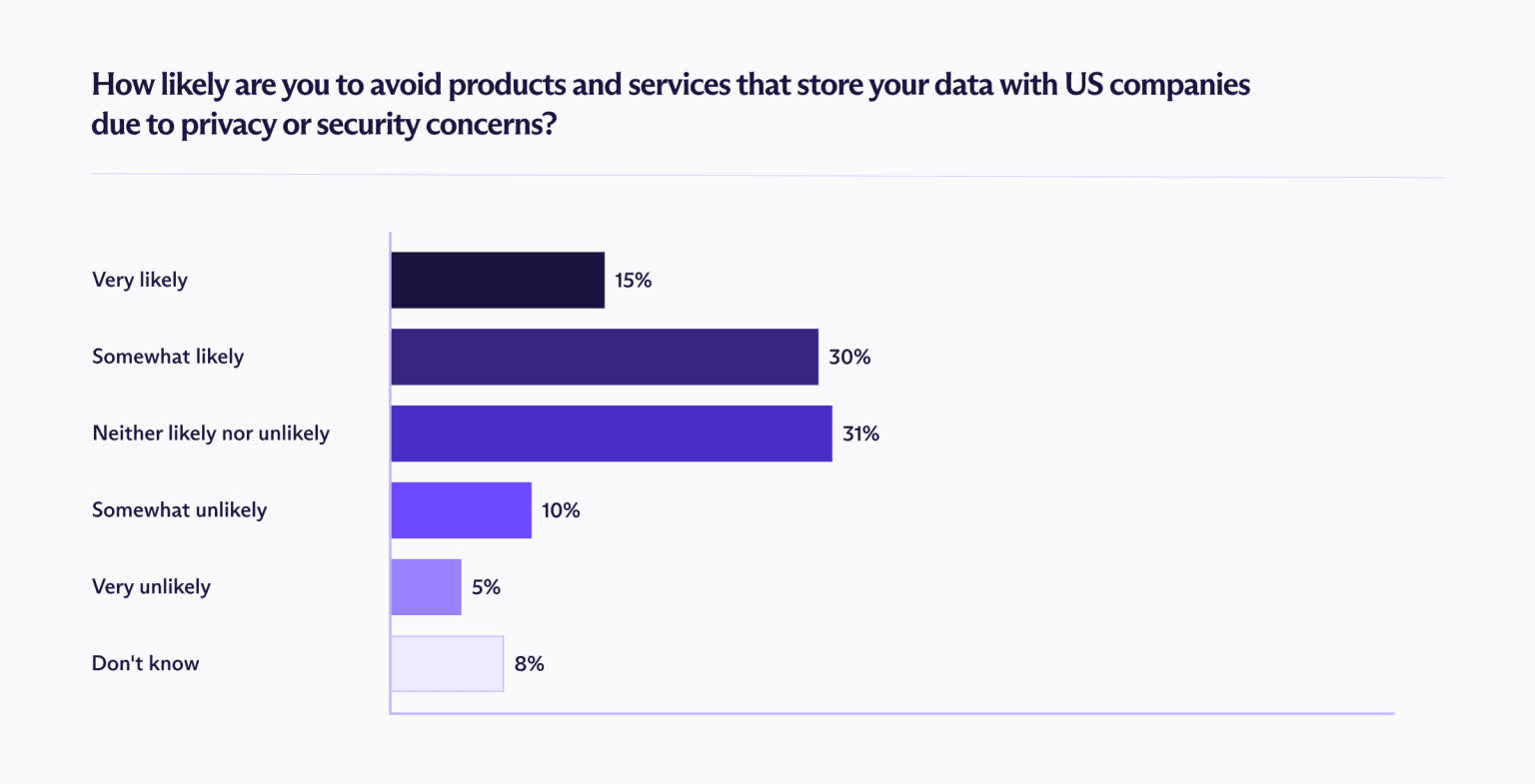
A hot potato: A new survey has illustrated Europe's growing reluctance to rely on US technology. It found that 45% of the 3,000 people surveyed in the UK, France, and Germany would actively avoid companies that store their data with US-based firms.
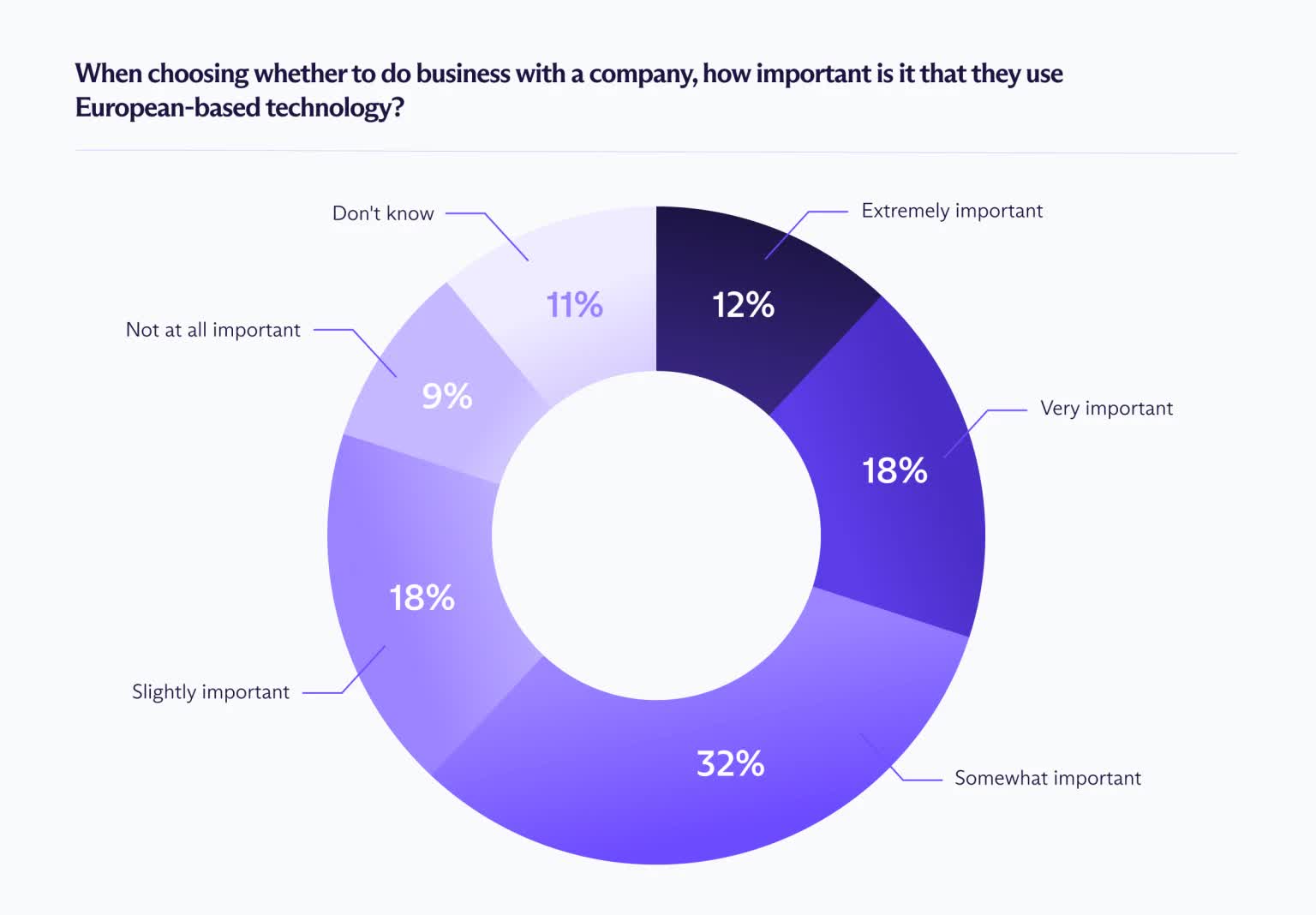
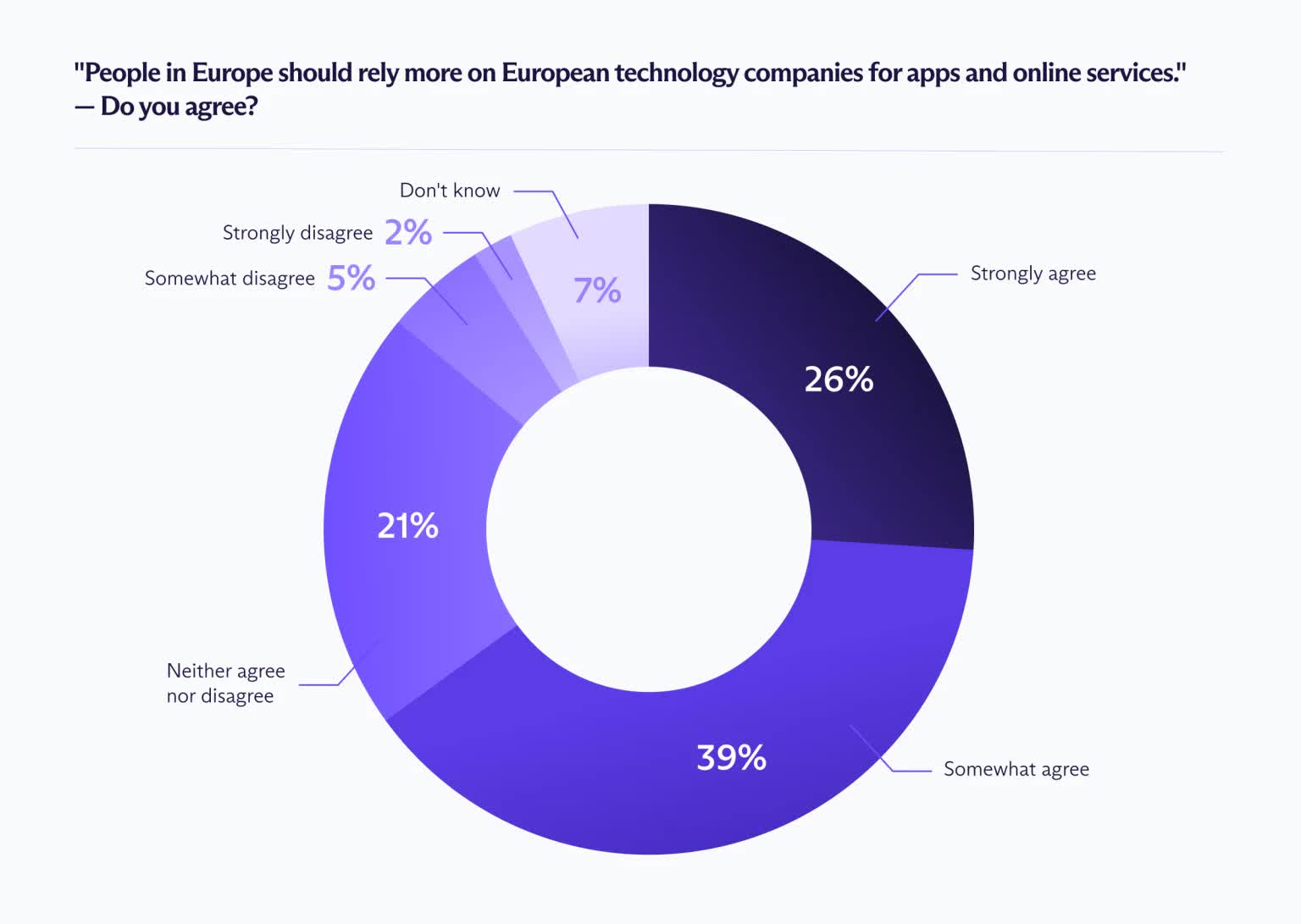
Proton's survey discovered that four out of five European consumers now consider the use of European technology a factor when deciding whether to buy from or work with a business. Almost half of those surveyed said they would avoid companies that store their data with US providers over privacy and security concerns.

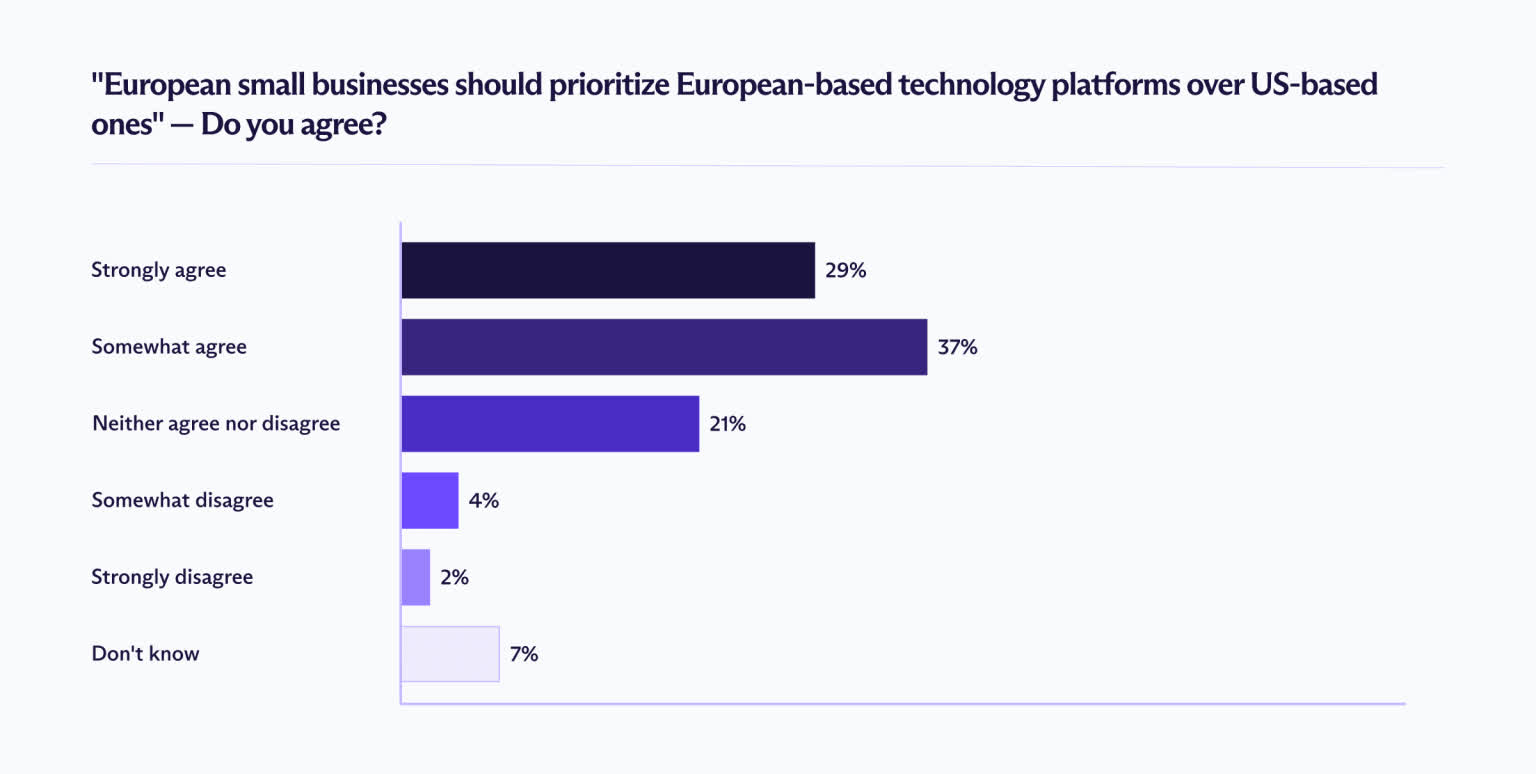
Some 65% of respondents said European small businesses should prioritize European-based tools over US alternatives, while 56% said it is more important now than a year ago that European businesses rely on local infrastructure.
Proton found that social media apps were the online services Europeans were most worried about from a data-privacy perspective, cited by 48% of respondents. This was followed by email at 46%, messaging apps at 40%, cloud storage at 38%, and browsers at 31%.
The findings suggest that choosing AWS, Microsoft 365, Google Workspace, or Meta services is no longer seen by some European customers as the best or sometimes only option. More people on the continent are worried about where their personal data might end up and who could potentially access it.

Part of that concern comes from the US Cloud Act, which allows US law enforcement agencies to demand data from American technology companies, even when it is stored in data centers outside the country.
There are legal safeguards around such requests, but the perception for many Europeans is that data stored with a US company is not truly European.

It's not just consumers who are concerned. Last month, the Netherlands blocked US enterprise services provider Kyndryl from buying Dutch cloud specialist Solvinity, which supports DigiD, the authentication platform used by citizens to access public services. Dutch officials said the decision was based on national security and public-interest risks, rather than hostility toward US companies.
Europe has also been looking at ways to restrict Microsoft, Amazon, and Google from handling sensitive government health, financial, and legal data as part of its push for digital sovereignty.

Proton, which has an obvious interest in the findings as a Swiss provider of privacy-focused services, argues that US tech dependence is becoming a commercial liability.

The firm previously claimed that 74% of publicly listed European companies rely on US-based services such as Google and Microsoft.

US platforms remain deeply integrated into European businesses, and are often very good at what they do, so dependence will not disappear overnight. But Proton's numbers suggest the privacy backlash is starting to reach ordinary customers, not just regulators and campaigners.

Permalink to story:

 
Good for the Europeans, after Trump and his schizophrenic ways on how he is running the country and world down to the ground, no country should ever trust the U.S.A
Next time read the article; you'll embarrass yourself less. The concerns here have nothing to do with Trump, but the rightful concerns of Europeans over data-sharing acts by US firms, even when that data is hosted on European servers.
 
The US Cloud Act applies to European companies too lol. If the company has any operations in the US and law enforcement with jurisdiction has probable cause that that a person of interest committed a crime, then American law enforcement can obtain a warrant, subpoena, or court order to investigate the crime. That European company would also have to turn over the necessary data to comply with US law.

I'm entirely certain that European authorities have this very capability too. Do you really think Amazon is going to refuse warrants to obtain data about a crime committed in the EU by an American visitor? As a matter of fact Amazon publishes these numbers. Compared to the US in 2025, Amazon received 34% MORE search warrants from German law enforcement (representing a population 1/4 the size of the US) and Spain issued Amazon 76% of the warrants the US did (representing a population 1/7 the size of the US): https://www.amazon.com/gp/help/customer/display.html?nodeId=GYSDRGWQ2C2CRYEF

The scale of the numbers alone could show two things. It could show how much more crime is being committed in Europe, and how much higher the bar is for American law enforcement to obtain warrants than European law enforcement. In both cases, to privacy conscious individuals it shows which place is a better place to live.
 
As an Amazon Associate we earn from qualifying purchases.
The scale of the numbers alone could show two things. It could show how much more crime is being committed in Europe, and how much higher the bar is for American law enforcement to obtain warrants than European law enforcement. In both cases, to privacy conscious individuals it shows which place is a better place to live.

It COULD show as well that EU countries investigate more. While not saying whether the investigation started based on a citizen complaint or from a government inquiry.

And I am happy that you are happy to live where you live.
 
The scale of the numbers alone could show two things.
nah, it shows much more. For example, it shows that there are nearly 30 countries within the european trade zone, all of them with their own tax regulations, sales regulations, and Amazon allow companies from one country to sell in any other. This implies much higher number of potential errors or actual tax evasion issues, to organized crime, frauds and so on.

Additionally, high levels of search and checks doesn't mean there are high number of issues. It only means law is enforced with more scrutiny. Which is rather normal if you have so many different rules in so many different countries, and comparing it to operations within a single country does not matter.

Then, there is privacy question. Why? Is this search warrant more against a single citizen than a corporate entity? Is this about clarifying sales, or spying on people? nothing you said implies privacy is compromised. Or you think the sales documents and taxes paid are affecting GDPR?

I see no information on privacy issues for individuals, at least not by comparing single country operations to a 30 countries tax management issues. You are jumping to conclusion and put it on a very strawman-like arguments.

And yeah, better place to live... from privacy point of view?
https://privacyhq.com/news/world-data-privacy-rankings-countries/
"Who are the top 5?[...]
The European Union

OK, so the European Union isn't a country. Still, its member states all have data privacy regulations that encompass GDPR with minor tailoring to the rules in areas such as national security. "

"Where is the US and Canada in the rankings?
The US may be the home to most large online organizations, but it has some of the least integrated data privacy regulations. There are currently no countrywide federal data privacy regulations in place. Instead, rules exist for specific business sectors such as the..."

so, yeah, from privacy point of view, but as well from press freedom, life expectancy, happiness level, education, ... lets say US do not make the top of any of those lists.
 
nah, it shows much more. For example, it shows that there are nearly 30 countries within the european trade zone, all of them with their own tax regulations, sales regulations, and Amazon allow companies from one country to sell in any other. This implies much higher number of potential errors or actual tax evasion issues, to organized crime, frauds and so on.

Additionally, high levels of search and checks doesn't mean there are high number of issues. It only means law is enforced with more scrutiny. Which is rather normal if you have so many different rules in so many different countries, and comparing it to operations within a single country does not matter.

Then, there is privacy question. Why? Is this search warrant more against a single citizen than a corporate entity? Is this about clarifying sales, or spying on people? nothing you said implies privacy is compromised. Or you think the sales documents and taxes paid are affecting GDPR?

I see no information on privacy issues for individuals, at least not by comparing single country operations to a 30 countries tax management issues. You are jumping to conclusion and put it on a very strawman-like arguments.

And yeah, better place to live... from privacy point of view?
https://privacyhq.com/news/world-data-privacy-rankings-countries/
"Who are the top 5?[...]
The European Union

OK, so the European Union isn't a country. Still, its member states all have data privacy regulations that encompass GDPR with minor tailoring to the rules in areas such as national security. "

"Where is the US and Canada in the rankings?
The US may be the home to most large online organizations, but it has some of the least integrated data privacy regulations. There are currently no countrywide federal data privacy regulations in place. Instead, rules exist for specific business sectors such as the..."

so, yeah, from privacy point of view, but as well from press freedom, life expectancy, happiness level, education, ... lets say US do not make the top of any of those lists.
This information is from 2024, but it shows that tax fraud per country could only be a fraction of what makes up Amazon's search order requests per country (it peaks at hundreds of investigations per country): https://www.euronews.com/my-europe/...d-the-state-of-combatting-fraud-across-the-eu

In 2025, there was a 35% increase in the number of investigations: https://delano.lu/article/vat-fraud-is-becoming-the-heart-of-european-financial-crime

It's possible that dozens search orders are issued to Amazon for every single VAT fraud investigation in Europe, but the sources mention nothing about online retail or Amazon, and the majority of these financial crimes are going to take place off of Amazon because Amazon enforces VAT.

Instead, I'm pretty sure criminal investigations make up the majority. Law enforcement is looking at what searches or purchases individuals made who they suspect was involved in any crime. In reality, probably cause for search warrants in the US is stricter than what's needed for European law enforcement, while privacy protections in the private sector in Europe are stricter: https://scholarlycommons.law.emory.edu/cgi/viewcontent.cgi?article=1103&context=elj
Emory Law said:
[T]the probable cause standard is different than
the legal rules in other countries, and generally considered stricter than non-U.S.
practice before the government can access evidence. For instance, formal
investigations under the French system provide the investigating magistrate with
broad powers to order the search of any place where one can discover objects or
data.
 
As the world is getting smaller, it is becoming more splintered. <sigh>
Rodney King: “Why can’t we all just get along?”
That line didn't work well for Jack Nicholson, either.
 
Next time read the article; you'll embarrass yourself less. The concerns here have nothing to do with Trump, but the rightful concerns of Europeans over data-sharing acts by US firms, even when that data is hosted on European servers.
where is the image of an antifa mask you assert exists? & don't upload links to sources with absolutely no credibility (foxnews, turning point usa) like you previously did.
 
Last edited:
Next time read the article; you'll embarrass yourself less. The concerns here have nothing to do with Trump, but the rightful concerns of Europeans over data-sharing acts by US firms, even when that data is hosted on European servers.

It is you the one embarrassing yourself. It's also cause of Trump that we are in this situation.
 
The US Cloud Act applies to European companies too lol. If the company has any operations in the US and law enforcement with jurisdiction has probable cause that that a person of interest committed a crime, then American law enforcement can obtain a warrant, subpoena, or court order to investigate the crime. That European company would also have to turn over the necessary data to comply with US law.

I'm entirely certain that European authorities have this very capability too. Do you really think Amazon is going to refuse warrants to obtain data about a crime committed in the EU by an American visitor? As a matter of fact Amazon publishes these numbers. Compared to the US in 2025, Amazon received 34% MORE search warrants from German law enforcement (representing a population 1/4 the size of the US) and Spain issued Amazon 76% of the warrants the US did (representing a population 1/7 the size of the US): https://www.amazon.com/gp/help/customer/display.html?nodeId=GYSDRGWQ2C2CRYEF

The scale of the numbers alone could show two things. It could show how much more crime is being committed in Europe, and how much higher the bar is for American law enforcement to obtain warrants than European law enforcement. In both cases, to privacy conscious individuals it shows which place is a better place to live.

We already know which place is better to live in. And it's not the USA.
 
As an Amazon Associate we earn from qualifying purchases.
This information is from 2024, but it shows that tax fraud per country could only be a fraction of what makes up Amazon's search order requests per country (it peaks at hundreds of investigations per country): https://www.euronews.com/my-europe/...d-the-state-of-combatting-fraud-across-the-eu

In 2025, there was a 35% increase in the number of investigations: https://delano.lu/article/vat-fraud-is-becoming-the-heart-of-european-financial-crime

It's possible that dozens search orders are issued to Amazon for every single VAT fraud investigation in Europe, but the sources mention nothing about online retail or Amazon, and the majority of these financial crimes are going to take place off of Amazon because Amazon enforces VAT.

Instead, I'm pretty sure criminal investigations make up the majority. Law enforcement is looking at what searches or purchases individuals made who they suspect was involved in any crime. In reality, probably cause for search warrants in the US is stricter than what's needed for European law enforcement, while privacy protections in the private sector in Europe are stricter: https://scholarlycommons.law.emory.edu/cgi/viewcontent.cgi?article=1103&context=elj
... but this is described in linked articles?
"Conversely, expenditure fraud – subsidies, aids and European funds – accounts for 68% of investigations, but only totals €18.67bn in estimated damage, I.e. 27% of the total."
"VAT and customs duty fraud thus appear to be a favoured vector of transnational organised crime, often associated with related offences such as money laundering or participation in a criminal organisation."

Vat, Revenue, Customs, subsidies, aids, and European funds - those are mainly not ordinary citizens issues, those are corporations, companies, businesses. There is no issue for a citizen privacy, actions taken are aimed at organized stealing from governments and from people taxes. VAT is not a simple tax, it is a chain of small fees from a product lifetime, that is why many thugs are trying to cheat on, and it is actually quite visible on papers as the countries integration and product tracking and reporting improves.

VAT fraud in the EU is prosecuted ex officio, so law enforcement are legally required to initiate an investigation as soon as they are aware of potential offense. Most of those frauds are not even possible to execute by a private person.

"Instead, I'm pretty sure criminal investigations make up the majority."
It is written in the article you linked what is the majority. Vat, Revenue, Customs, subsidies, aids, and European funds.
Criminal investigations target businesses as the mechanism used to commit VAT fraud and individuals as the actual perpetrators who face personal criminal liability. Businesses behind those will see consequences, and the people behind, like CEO and so on will be prosecuted as well if there are issues with the books or whatever. Average citizens are usually not the target of these investigations.

So, I don't agree that privacy of average citizens is affected. Additionally, those investigations are initialized when there is a clear indicators that a businesses in the tax report shows clear discrepancy in the taxes. It is very common to make vat carusel fraud (mtic), invoices forgery, and e-commerce value fraud (think about Chinese companies which pretending to have EU warehouses and sells item on Amazon from EU, bypassing tax, but in reality they did not pay the import tax - it is sold via Amazon and it is in my opinion a single and easiest target to show why Amazon investigation number has risen. 5 years ago there were mostly western brands on Amazon, now it feels like another aliexpress).

And in the end, there are differences between European countries and US law rules. But afaik US tax enforcement is extremely strict and operates on much simpler taxation rules. I see no issues for a personal privacy, and those numbers do not indicate any limitations of any average person privacy. It does indicate the number of issues on the tax level, and I am actually very happy someone is actually checking if some ciminals are trying steal my taxes.
 
Next time read the article; you'll embarrass yourself less. The concerns here have nothing to do with Trump, but the rightful concerns of Europeans over data-sharing acts by US firms, even when that data is hosted on European servers.

What you said about the article is true .

I live in the UK , it is all about Trumps recent actions . I am sure you are well aware here in Europe we are bombarded constantly that Trump is a fascist and we should hate him . The UK media has always been pro Democrat , I grew up being told every Republican leader is an ***** who only cares about the US , that's been going on since I was born.

It went down very badly when Trump was reported to have said negative things about UK troops , I cannot stress how badly that went down . You would never hear the good things he said about the UK armed forces .

Dont shoot the messenger , I would have voted Trump if I was American but without a shadow of a doubt his recent actions ( or rather how his actions were reported ) have made people dislike the US and no longer trust them.

And even though I would vote Trump if I was American he has said some really stupid damaging things .
 
... but this is described in linked articles?
"Conversely, expenditure fraud – subsidies, aids and European funds – accounts for 68% of investigations, but only totals €18.67bn in estimated damage, I.e. 27% of the total."
"VAT and customs duty fraud thus appear to be a favoured vector of transnational organised crime, often associated with related offences such as money laundering or participation in a criminal organisation."

Vat, Revenue, Customs, subsidies, aids, and European funds - those are mainly not ordinary citizens issues, those are corporations, companies, businesses. There is no issue for a citizen privacy, actions taken are aimed at organized stealing from governments and from people taxes. VAT is not a simple tax, it is a chain of small fees from a product lifetime, that is why many thugs are trying to cheat on, and it is actually quite visible on papers as the countries integration and product tracking and reporting improves.

VAT fraud in the EU is prosecuted ex officio, so law enforcement are legally required to initiate an investigation as soon as they are aware of potential offense. Most of those frauds are not even possible to execute by a private person.

"Instead, I'm pretty sure criminal investigations make up the majority."
It is written in the article you linked what is the majority. Vat, Revenue, Customs, subsidies, aids, and European funds.
Criminal investigations target businesses as the mechanism used to commit VAT fraud and individuals as the actual perpetrators who face personal criminal liability. Businesses behind those will see consequences, and the people behind, like CEO and so on will be prosecuted as well if there are issues with the books or whatever. Average citizens are usually not the target of these investigations.

So, I don't agree that privacy of average citizens is affected. Additionally, those investigations are initialized when there is a clear indicators that a businesses in the tax report shows clear discrepancy in the taxes. It is very common to make vat carusel fraud (mtic), invoices forgery, and e-commerce value fraud (think about Chinese companies which pretending to have EU warehouses and sells item on Amazon from EU, bypassing tax, but in reality they did not pay the import tax - it is sold via Amazon and it is in my opinion a single and easiest target to show why Amazon investigation number has risen. 5 years ago there were mostly western brands on Amazon, now it feels like another aliexpress).
I think you misinterpret my arguments. First, EPPO combats crimes affecting the financial interests of the European Union. Local law enforcement would target criminal actions that I refer to instead. That's going to be harder to get cumulative numbers for, but considering the EPPO has only a few to less than 200 investigations per country while Amazon reports thousands of court orders from each European country, I think these crimes make up the minority of those search orders. But I too am in full support of law enforcement doing what they need to do, I'm not suggesting enforcement is a bad thing.

What I am saying is that it's absurd to think that a European's privacy is harmed by the American government simply because that European chooses to use an American company. I was showing that clearly European governments are much more invested in this data. There are far more legal requests for Amazon's data from European governments than the American one. American law enforcement will use this data in the same way, to combat crime and only when a a legal process is followed.

I also pointed out that the bar is higher for American law enforcement to obtain a search order. That, coupled with the far fewer requests for Amazon's data (as an example) shows the one of two things I pointed out originally: either European law enforcement is more likely to submit search orders to businesses or that crime is higher there. Now you're saying the following, which supports that financial crime may indeed be higher in Europe because of the more complicated regulatory environment:
And in the end, there are differences between European countries and US law rules. But afaik US tax enforcement is extremely strict and operates on much simpler taxation rules. I see no issues for a personal privacy, and those numbers do not indicate any limitations of any average person privacy. It does indicate the number of issues on the tax level, and I am actually very happy someone is actually checking if some ciminals are trying steal my taxes.
I think there's not necessarily an issue with that, but it's a tradeoff as you say (with simplicity).
We already know which place is better to live in. And it's not the USA.
Please define "we" because you're certainly not allowed to speak for me. I would also suggest that there's no clear cut way to determine that one place is overall "better" to live in because there are tradeoffs. In terms of freedoms, I think it's definitely the US. In terms of rights, that becomes a more complicated question. Freedoms are typically defined by lack of government intervention whereas rights involve some government enforcement.
 
Back