AMD promises mainstream 4K gaming on Radeon RX 9070 series in early March

Daniel Sims

Posts: 2,469   +74
Staff
Something to look forward to: AMD has yet to release full technical specifications for its upcoming Radeon RX 9000-series graphics cards. However, the company recently revealed more about the lineup's intended performance profile and market segment. If the price is right, the new GPUs might compare favorably to Nvidia's upcoming RTX 5070 Ti, 5070, and 5060 early next month.
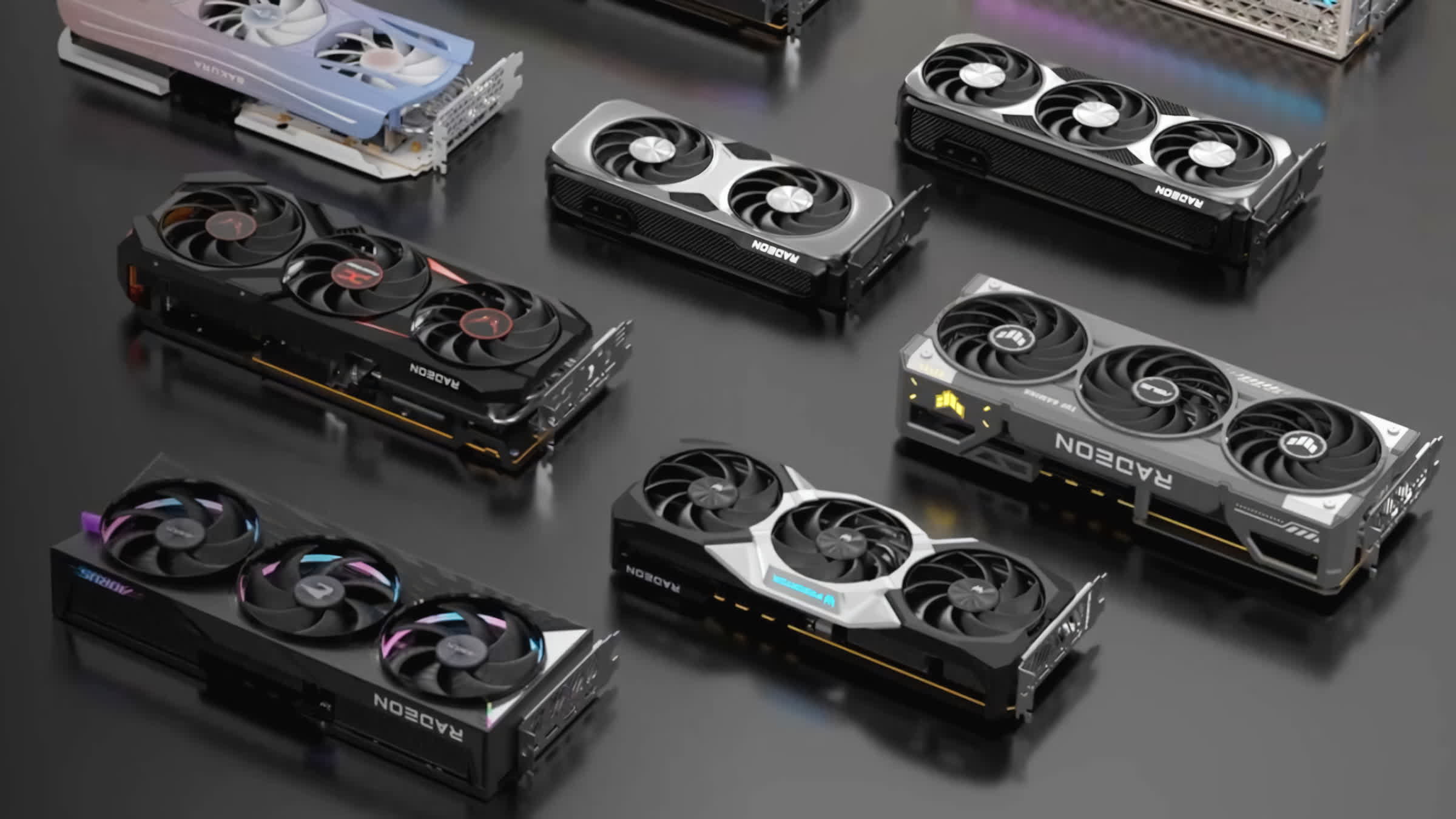
AMD CEO Lisa Su has confirmed that the company's new Radeon RX 9070 and 9070 XT GPUs will launch in early March. She indicated that the two products aim to make high-quality 4K gaming possible at mainstream prices.

During a recent fourth-quarter earnings call, Su reiterated AMD's promise that its new RDNA 4 architecture significantly improves ray tracing performance – where Radeon cards lag far behind Nvidia. AI-accelerated upscaling through FSR 4 is the lineup's other lynchpin.

Although RDNA 4's ray tracing capabilities remain untested, a CES demonstration established FSR 4's superior image quality compared to FSR 3.1. The new protocol closely resembles Nvidia DLSS and will likely be a crucial component in AMD's promise to bring high-end 4K gaming to the masses.

Mid-range products like RTX xx60 or xx70 GPUs and Radeon x700 cards typically struggle in 4K unless users significantly reduce graphics settings. They are usually promoted for 1080p and 1440p gaming. Positioning the RX 9070 and 9070 XT – deliberately named for comparison with Nvidia's xx70 GPUs – as 4K products marks a significant perspective shift.

Hardware specifications remain unclear, but the 9070 XT should be based on the Navi 48 GPU, featuring 4,096 cores, a 2.97GHz boost clock, 16 GB of GDDR6 VRAM on a 256-bit bus, and 640 GB/s of memory bandwidth. Rumors indicate that the 9070 will include 16 GB of VRAM, potentially giving it a significant advantage over the upcoming RTX 5070, which features only 12 GB of GDDR7 memory.

The 9070 came within spitting distance of the RTX 4080 Super in a Call of Duty Black Ops 6 benchmark at CES last month. More comprehensive testing will require a broader range of titles, particularly games that extensively utilize hardware-accelerated ray tracing.

AMD will price the RX 9070 and 9070 XT competitively against the $549 RTX 5070 and $749 5070 Ti. The 5070 Ti may launch on February 20, while the 5070, 5060 Ti, and 5060 should emerge later, possibly in March, like the RDNA 4 GPUs. The lower-priced RX 9060 and 9050 are also coming later this year.

Su justified Team Red's retreat from the high-end and flagship segments by describing mainstream graphics cards as the highest-volume portion of the market. Steam hardware surveys support this assertion, showing that Nvidia xx60 GPUs dominate usage statistics. AMD is expected to follow RDNA 4 with UDNA, the likely choice for the PlayStation 6, which could see the company return to the enthusiast GPU market like RDNA 2 did after the mainstream-focused RDNA 1.

Permalink to story:

 
Well, the 4090 prototype boards performed were about 10-15% slower than the boards that were actually released. I wouldn't be surprised if we see atleast a 5-10% performance boost by the time that the 9070's get released. Which, at this point, it really comes down to price an availability. What AMD should do is flood the scalpers with them to the point where the scalpers have to end up selling the cards at a loss because of how many are on the market. Scalpers often do have to sell the cards at a lost because they buy them using a credit card and half to pay it off before they start paying interest on "holding inventory"
 
I don`t see how the 5070 will be faster than the 4070 SUPER.

As it looking like, the 9070XT might be on par with a 5070 TI.

Now, if they price this thing near the MSRP of the 5070TI, AMD will lose.

If they can price it a t 550$, it will be game over for Nvidia.

If AMD is serious about doing a 70 series card, and they price their MSRP between their historical MSRPs for between 400$ (5700XT) and 480$(6700XT), then they will literally steal all the Nvidia market below the 5090.
 
I was in Microcenter at Chicago today and it looks like all the mid to high end AMD and Nvidia gpus are sold out. I wonder if it's a supply thing or not.
 
Pass. Needs more VRAM.
These cards are just as bad as the 16GB 5080's.
I think you guys are going a bit off the deep end here. 16 GB is enough to give you texture quality above that of the consoles (which have around 10 GB to 12 GB of their shared memory to use a VRAM), or similar texture quality to the consoles plus additional VRAM-consuming features like ray tracing and frame generation. It's reasonable to want more on a $1000 card like the 5080, but 16 GB is perfectly fine for 70-tier cards that cost half as much.
Current console hardware will remain the development target for the next 3/4 years until the next gen consoles come out, there is no game that will come out in that timeframe that won't run comfortably on 16 GB of VRAM.
 
I think you guys are going a bit off the deep end here. 16 GB is enough to give you texture quality above that of the consoles (which have around 10 GB to 12 GB of their shared memory to use a VRAM), or similar texture quality to the consoles plus additional VRAM-consuming features like ray tracing and frame generation. It's reasonable to want more on a $1000 card like the 5080, but 16 GB is perfectly fine for 70-tier cards that cost half as much.
Current console hardware will remain the development target for the next 3/4 years until the next gen consoles come out, there is no game that will come out in that timeframe that won't run comfortably on 16 GB of VRAM.
The 5080 is a 5070 at best and the 9070's are no different, and just as the 5080 is massively overpriced, so will the 9070's.
 
These cards are just as bad as the 16GB 5080's.
only they'll cost half as much. Probably less than half because all of NV's cards are going to me made by board partners who mark them up $200+ from MSRP.

I don't see us needing more than 16GB of VRAM any time soon even if you play at 4k. Right now we're just hitting the 12GB mark and that's mostly because developers forgot how to optimize games and that's basically the most they're allowed to use considering the specs of current gen consoles. 16gigs will start to feel "uncomfortable" on highend cards in probably 2-3 years, but AMD already said these are mid ranged cards, not high-end. Where as, the 5070 with 12GB of ram, well, that makes it basically a low end card. Even Intel is putting 10/12 gigs on their sub $300 cards now. The idea that a "$550" card will have 12 gigs on it in 2025 is absurd.

Lets be real, the 5070 is a 60 class card. Cards with 12gigs of VRAM are starting to show stuttering issues and bad 1 lows. nVidia is making a big push with frame gen, but gameplay smoothness is "felt" mostly around the 1% low mark. The greater the gap between the 1% lows and the max FPS, the worse the game feels. Framegen only increases the max FPS, not the 1% lows so games are still going to feel like crap.
 
Last edited:
only they'll cost half as much. Probably less than half because all of NV's cards are going to me made by board partners who mark them up $200+ from MSRP.

I don't see us needing more than 16GB of VRAM any time soon even if you play at 4k. Right now we're just hitting the 12GB mark and that's mostly because developers forgot how to optimize games and that's basically the most they're allowed to use considering the specs of current gen consoles. 16gigs will start to feel "uncomfortable" on highend cards in probably 2-3 years, but AMD already said these are mid ranged cards, not high-end. Where as, the 5070 with 12GB of ram, well, that makes it basically a low end card. Even Intel is putting 10/12 gigs on their sub $300 cards now. The idea that a "$550" card will have 12 gigs on it in 2025 is absurd.

Lets be real, the 5070 is a 60 class card. Cards with 12gigs of VRAM are starting to show stuttering issues and bad 1 lows. nVidia is making a big push with frame gen, but gameplay smoothness is "felt" mostly around the 1% low mark. The greater the gap between the 1% lows and the max FPS, the worse the game feels. Framegen only increases the max FPS, not the 1% lows so games are still going to feel like crap.
The price hasn't been confirmed and it's entirely speculation that he 9070's are going to cost half the 5080's and I'll remain sceptical until price has been confirmed.
 
The price hasn't been confirmed and it's entirely speculation that he 9070's are going to cost half the 5080's and I'll remain sceptical until price has been confirmed.
Unless nVidia creates an artificial GPU shortage, which they very well might, I don't think that they're going to price them above $600. They said their main goal this generation was to gain marketshare. Further, they said that the naming scheme is meant to imply that their cards are competing with nVidia's 70 class of card. It meant not only do that on performance, but also price. While price hasn't been confirmed, the $500-600 number has been thrown around a good bit. Also, AMD isn't using tons of cutting edge tech this time around. They're using a larger bus and slower ram to keep overall transfer speeds up, This has the added benefit of giving us more VRAM at a lower price.

I'll be surprised if MSRP is more then $500 and if we see partner cards more than $600-650. There are already partner cards for the 5080 being listed for $1700 and up on partner websites, I doubt we'll see a 5070 in the wild much below $700.
 
I think they will price them $50 below the competition so $700 for the 9700xt. If it performs like a $1k 5080 then a 30% less expensive alternative seems viable.
 
Well even if they price the 9070XT at 650euros MSRP, here in Spain with the tax it will be at least 790euros, adding the AIB mark up then it will be close to 900 or even 1000 xD I'll wait for another year, luckily my 3070ti still serves me well.

I do hope that AMD will price them right, for the sake of everyone.
 
I think they will price them $50 below the competition so $700 for the 9700xt. If it performs like a $1k 5080 then a 30% less expensive alternative seems viable.
Has anyone seen 1k usd 5080 availability? Seems like for every 1 at MSRP there were 20x 5080 Astrals at $1500. Although current rumors for the 5080 is more stock in 3 weeks so we might see it closer to that price when 9070s drop.
 
Pass. Needs more VRAM.

My take pretty much.

Having done 6800XT and 7900XTX, at 3440x1440 primarily. Both costing around half of similarly premium 3080/4080 respectively at the time bought and for months around.
The former was actually pushing close to it's 16Gb within a year of launch, while the latter is enough extra (50+ fps uplift at 3440x1440) that it uses a little less VRAM to achieve the same perf fps:res in the same games as the former so 24Gb is unlikely to get taxed at all, even at 4K, before better performing and priced cards (hopefully) come about.

But... even if the purported improvements to RT/upscaling are there I'm wary of that 16Gb. 20Gb, which imo is what the 4080 should've had (nm the 5080) certainly at the price premium it held for a year before the Super revisions... yeah, that'd be more reassuring. Tbh it should've been something AMD could add quite easily given past instances of healthy VRAM caps being a thing.

What I wouldn't want to see is AMD leaning as hard on RT/upscaling/FG as Nvidia clearly are... especially if any progress in said tech for them is still unproven. It's been raster and what makes it happen being more important for me that's kept AMD as first choice for two gens... well, that and very fair pricing. That's even if RT/upscaling etc etc might be the future (though neither work well so far without a decent degree of raster anyway) that future is a long way off both ubiquity and affordability yet if Nvidia have any say about it.
 
You what?

The year is currently 2025.
Bottom tier cards should have 16GB VRAM.
Mid should be 24GB VRAM.
Upper mid should be 32GB VRAM.
Flagship should be 48GB.
Late generation monster should be 64GB VRAM.

I've been through countless hardware refreah cycles. The only thing growing recently in any significant capacity is the architecture and the price. The 1070 launched almost a decade ago with 8GB. One thing they've done very well at selling us is excuses.

These are my opinions.
 
I don`t see how the 5070 will be faster than the 4070 SUPER.

As it looking like, the 9070XT might be on par with a 5070 TI.

Now, if they price this thing near the MSRP of the 5070TI, AMD will lose.

If they can price it a t 550$, it will be game over for Nvidia.

If AMD is serious about doing a 70 series card, and they price their MSRP between their historical MSRPs for between 400$ (5700XT) and 480$(6700XT), then they will literally steal all the Nvidia market below the 5090.

The 5070 has some larger increases in specs compared to the 4080 -> 5080 however.

+33% VRAM bandwidth, +33% L2 cache size, +15% transistors, +27% pixel fill rate and +50W TGP.

I’m anticipating the 5070 will benefit more from the VRAM bandwidth than the 5080; which was also a smaller 26% uplift. And, moving from 200-250 watts, compared to 320-360, will likely mean a fairly substantial increase in boost clocks despite it being +37 MHz on paper.

Doesn’t negate the decreases from 4070 super core configurations…Worst case it slots between the 4070/super. Best case it edges out the super by a small margin. That is my prediction.

Essentially all the 4070/super stock is gone now meaning Nvidia won’t have to compete with itself if the performance is lackluster comparatively. The $550 MSRP is technically a discount, so it may actually provide a slight improvement is price/performance…must wait and see if AIB cards hit that price point though.
 
Back