AMD Ryzen AI Halo mini PC is coming in June with 128GB of unified memory and a focus on local AI workloads

DragonSlayer101

Posts: 983   +14
Staff
Forward-looking: AMD is reportedly set to launch its Ryzen AI Halo mini PC in June. Unveiled at CES 2026 in January, the device is designed as an AI developer platform optimized for applications such as LM Studio, ComfyUI, and Visual Studio Code. According to Reddit user 1ncehost, the Halo mini PC was showcased at AMD's recent AI DevDay event in San Francisco by the company's senior vice president and general manager, Jack Huynh.
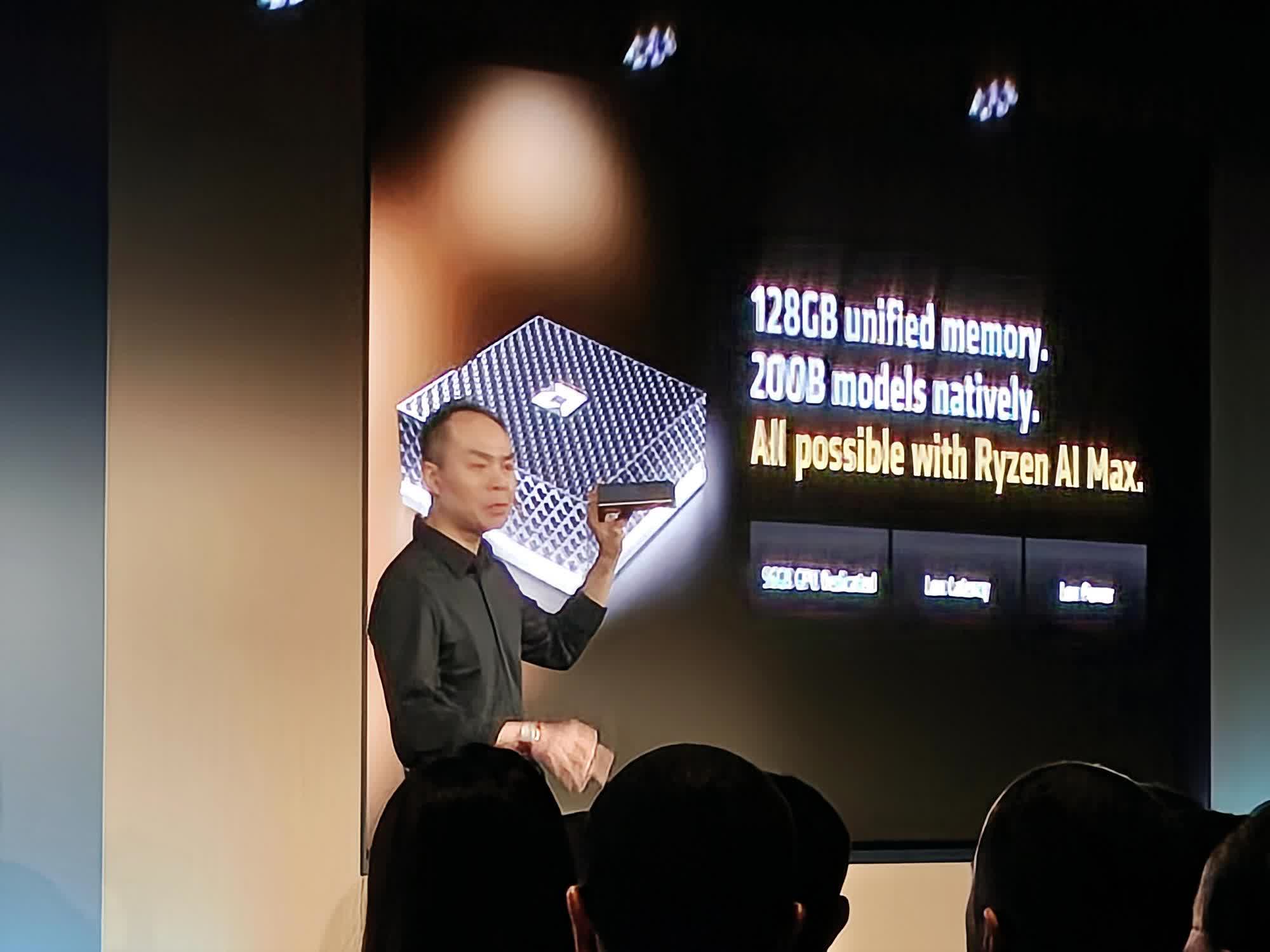
The Redditor, who claims to have attended the event, posted photos of Huynh holding the device on stage, along with what appear to be key specifications displayed on a background screen. Huynh reportedly confirmed that the Halo will launch in June, but did not provide any details on pricing.
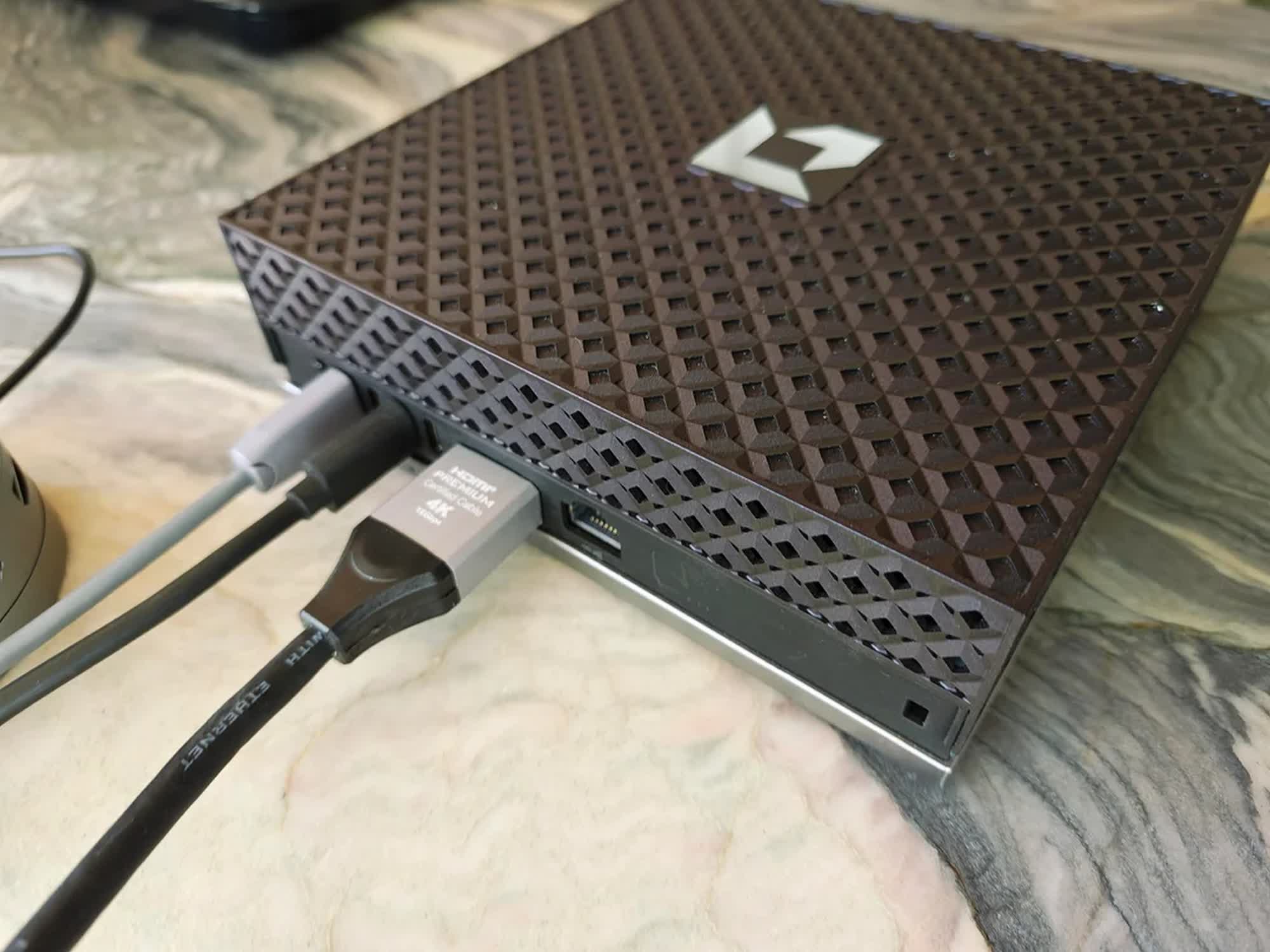
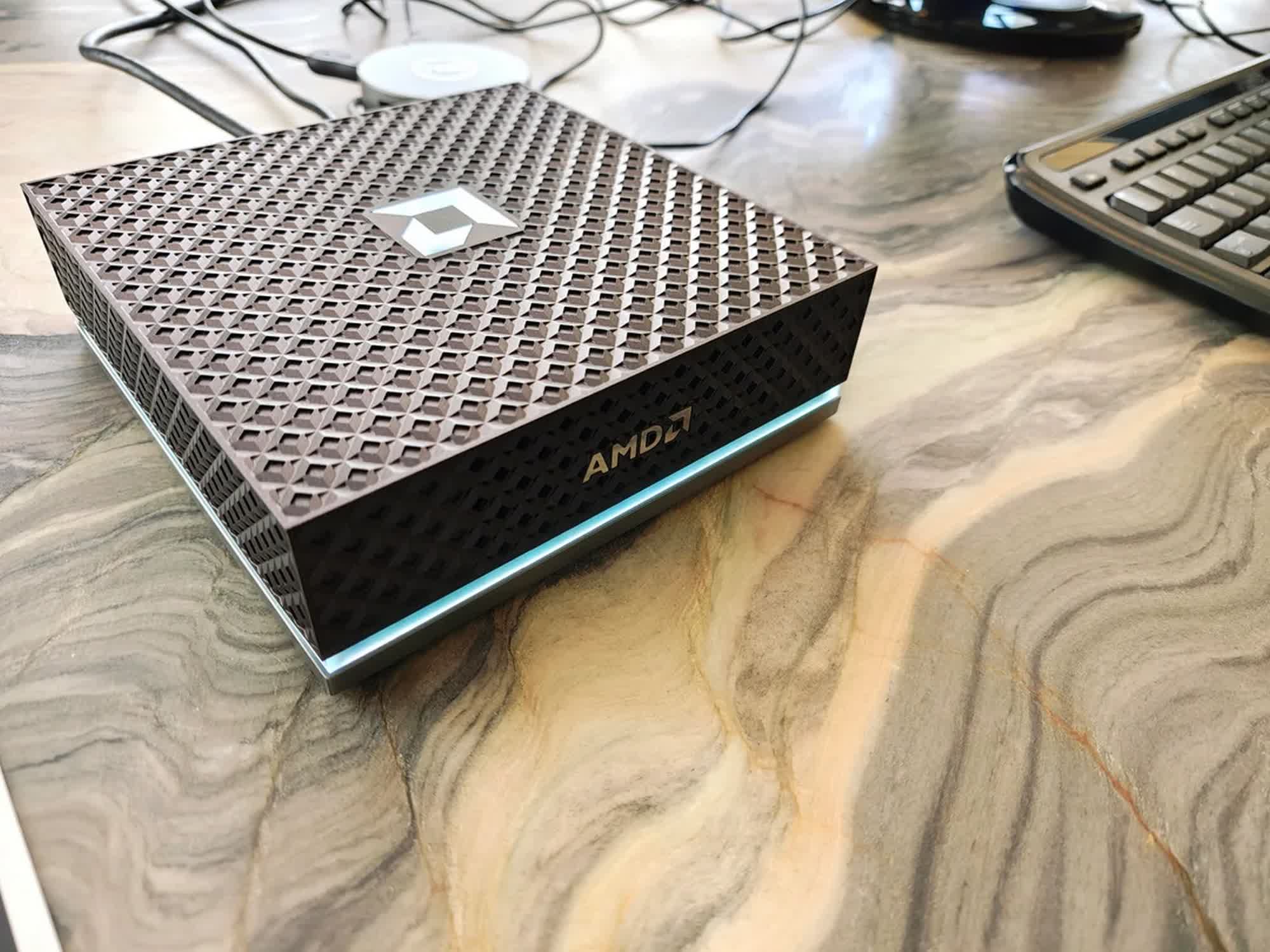
Based on information provided by Huynh, the Halo will be powered by the Ryzen AI Max+ 395, the flagship SoC in AMD's Strix Halo lineup. The chip already ships in several high-performance Copilot+ laptops and mini PCs from a range of OEMs, including Asus, HP, and Acer. The demo unit used on stage was configured with 128GB of unified memory, ran Ubuntu, and included a programmable RGB light strip on the front.

The Ryzen AI Max+ 395 features 16 Zen 5 CPU cores and 32 threads, running at a base clock of 3GHz with boost speeds of up to 5.1GHz. It integrates a Radeon 8060S RDNA 3.5 integrated GPU with 40 compute units, along with an XDNA 2 NPU delivering 50 TOPS of AI compute. The chip includes 64MB of L3 cache and has a default TDP of 55W. It supports 256-bit LPDDR5X memory at up to 8,000 MT/s with a quad-channel interface and is manufactured by TSMC on its 4 nm process node.
It is worth noting that mini PCs powered by the Ryzen AI Max+ 395 are already available for purchase online. For example, the GMKtec EVO-X2, featuring 96GB of LPDDR5X RAM and 2TB of storage, is currently listed on Amazon for $2,349. In comparison, the Nvidia DGX Spark is listed at $4,699 for the top-end configuration with 128GB of RAM and 4TB of storage.

AMD's impending foray into the mini PC market is receiving a mixed response from potential customers. Some are questioning whether there is sufficient demand for a first-party AMD mini PC, while others believe the company should have launched the device last year, shortly after the Strix Halo announcement. However, some commentators have noted that additional competition could eventually force third-party vendors to lower prices, potentially benefiting consumers.

Image credit: 1ncehost

Permalink to story:

 
I have been saying for awhile that AI will move away from the cloud and become a home appliance. I have been run many different models locally for about a year now, but I'm a weirdo with a home lab. But there too many privacy concerns with cloud AI. It isn't that hard to remote into my AI when I'm away and in a few years I think there will be services that set this up for the lay person like how you can access your networked security cameras from your phone
 
I have been saying for awhile that AI will move away from the cloud and become a home appliance. I have been run many different models locally for about a year now, but I'm a weirdo with a home lab. But there too many privacy concerns with cloud AI. It isn't that hard to remote into my AI when I'm away and in a few years I think there will be services that set this up for the lay person like how you can access your networked security cameras from your phone
To do.....what, exactly? Make queries you could just Google?

Because any task beyond that runs pathetically slow even on far more powerful desktops.
 
In five years it will belong in a museum while my tower will have been eating its lunch and simultaneously gaming. This is a dumb box for people who don't know any better.
 
...128GB of unified memory...
That's a lot of RAM, but it's also a lot of "unified" RAM (meaning soldered-on). Just like with Apple Macbooks. As much as that might be, that's all it will ever be.
AMD's impending foray into the mini PC market is receiving a mixed response from potential customers.
It's so very plainly not for the average consumer; the target audience is "developers".

Why didn't AMD make this product last year? Because they are 'playing it safe" right now. They didn't want to make a first-party mini pc, until they were certain there was demand for it. As soon as Mac Minis started flying off the shelf, they knew they had to sell product. Same reason they are calling their entire current-gen line Ryzen AI: to signal to the market that, "this isn't just any old chip, this is an AI-focused chip." Good naming schemes are timeless, bad naming schemes are immediately dated. Guess what this is...

Someday, when sanity has returned to the world and AI no longer commands billion-dollar valuations―based on hype and nothing else―the PC market is going to look back on AMD's historical usage of the word "AI" in their product lineup as a clown show, an "of-the-times marketing stunt". It sounds like a good idea, to an SEO-driven marketing executive, but it's so obviously a "right now" product. It's like the word's worst rendition of a joke that was already on the way out 10 years ago.

In a word, it's "cringe". This entire situation is "cringe".
 
Last edited:
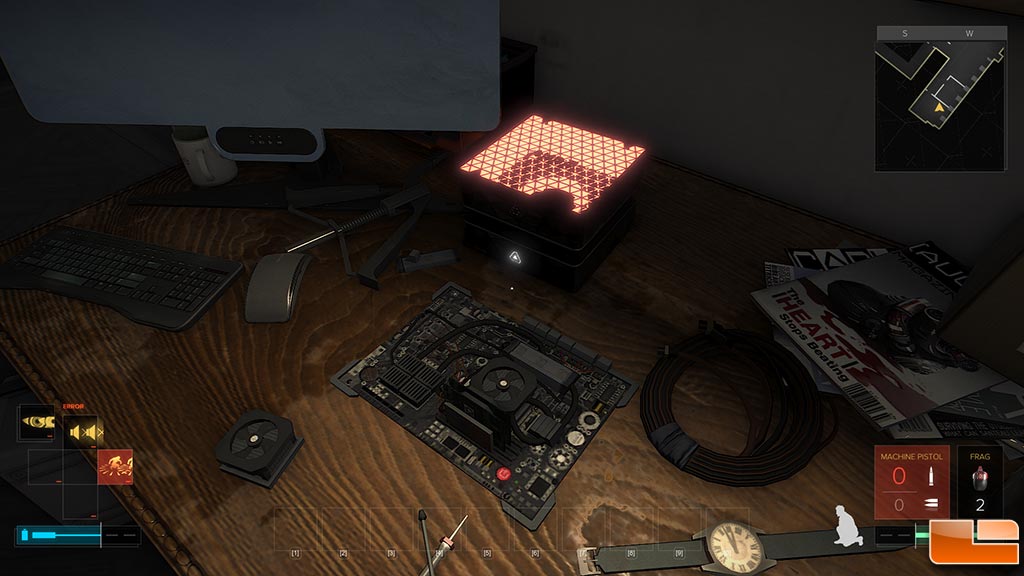
They've already produced thing like this, project quantum iirc, Adam Jensen had one in Prague
DXMD-amd-pc.jpg


Anybody know what's happened to that "project quantum"?
 
I have been saying for awhile that AI will move away from the cloud and become a home appliance. I have been run many different models locally for about a year now, but I'm a weirdo with a home lab. But there too many privacy concerns with cloud AI. It isn't that hard to remote into my AI when I'm away and in a few years I think there will be services that set this up for the lay person like how you can access your networked security cameras from your phone

Our GPU's have been able to do local AI for ages. I run all my Topaz AI plugins locally on the GPU. Adobe is milking customers by forcing them to use cloud for even trivial stuff that uses up limited credits despite having cpu, npu and gou that can all do AI.
 
Unless you own a supercomputer, there is no such thing as "local AI". Its the biggest tech scam that almost no one knows about. An "AI PC" is nothing but a jumped-up terminal that does a little preprocessing for the back-end AI system. And those systems still require server farms and will for many years.
 
To do.....what, exactly? Make queries you could just Google?

Because any task beyond that runs pathetically slow even on far more powerful desktops.

This strix halo mini PC launching in 2026 with 15 cores and 32 threads (lol techspot has really gone downhill, or should I say the AI writing these articles is clearly one of the cheaper models). Is not high performance.

I have a framework box with 128gb ram and I can run qwen 3.6 27b q8.0 full context pretty easily (only takes about 46gb of the 96gb usable ram), but the strix halo only has ~250gb/sec memory bandwidth (similar to the dgx spark) which means it can only run this particular model (good enough to do real world coding) at 10 tokens per second.

Not setting the world on fire, not quite fast enough for local development.

But I have access to a NVIDIA a6000 with 48gb ram, pretty slow with only about 600gb/second bandwidth runs the same model at 20tokens per second, which is the slowest you'd want it to be, but still be very usable.

Any Blackwell card will perform at about 40 tokens per second because they have roughly double the 600gb/sec memory bandwidth, and 40 is positively fast.

Local coding is absolutely possible, and maybe not as performance, it is free.

The qwens can also look at and use images in their prompts, so I've been doing OCR like work with them. (Having them read cursive handwriting from some old notebooks from the 70s almost as well as Geminis free models, transcribe bank statements with context.).

Actual programming is here, fully local.

(Quick shorthand for model speed divide memory bandwidth by active tokens is a quick estimate for speed, 250 GB/second divided by 27b for qwen 27b, is about 10.

The old qwen3.5 122b a17 had 17 active Params per token, which meant when it was running on my strix halo box it got about 20 tokens (250 / 17).

Local models at these sizes are powerful. And the strix halo can generate usable speeds with them.

(I spoke I'll of 10 tokens per second, but it's usable IF the quality is there).
 
Unless you own a supercomputer, there is no such thing as "local AI". Its the biggest tech scam that almost no one knows about. An "AI PC" is nothing but a jumped-up terminal that does a little preprocessing for the back-end AI system. And those systems still require server farms and will for many years.

Nonsense, qwen 3.6 27b runs on this strix halo using about 45gb of memory at 10ntokens per second.

Not blowing the barn doors off speed, but good enough for real work if you do something else while waiting for it to finish/ask a question.
 
Unless you own a supercomputer, there is no such thing as "local AI". Its the biggest tech scam that almost no one knows about. An "AI PC" is nothing but a jumped-up terminal that does a little preprocessing for the back-end AI system. And those systems still require server farms and will for many years.
please, if you know nothing about a topic don't claim to be an expert, Gemma 4 and Qwen 3.6 benchmark well above their weight. an RTX5090 can run proper AI locally with a suitable harness to contain context limitations, its no scam, you are uneducated.
 
Back