AMD's $900 Ryzen 9 9950X3D2 is selling despite mixed value arguments

Skye Jacobs

Posts: 1,991   +58
Staff
In a nutshell: Demand for high-end desktop CPUs is showing a familiar pattern: technical merit is only part of the equation. Early retail data suggests AMD's latest flagship, the Ryzen 9 9950X3D2 Dual Edition, is attracting interest despite modest generational gains and a steep price. The processor briefly cracked Amazon's top 10 best-selling CPUs shortly after launch, and while it has since slipped to #22, it remains ahead of many mainstream Ryzen and Intel offerings.
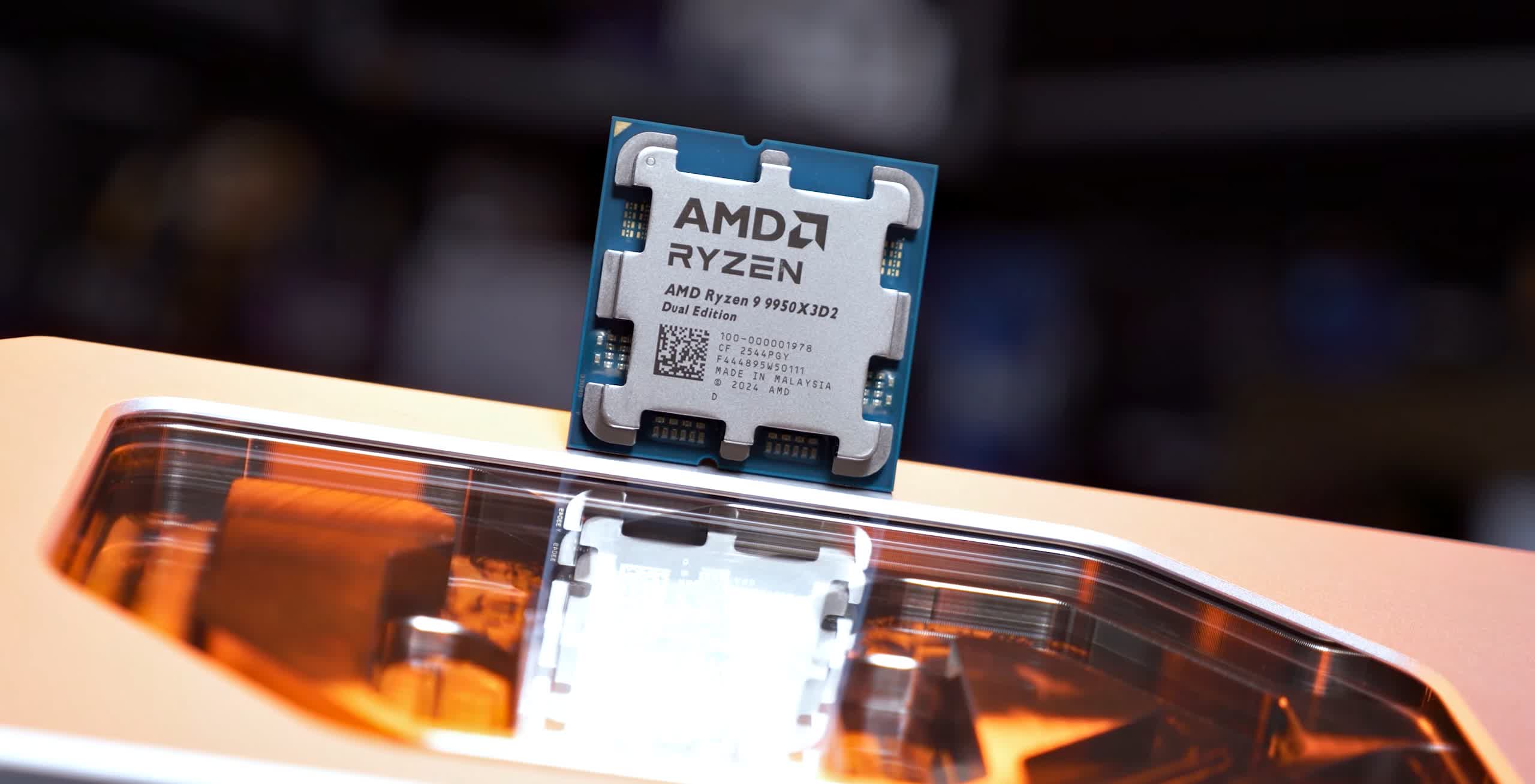
The Ryzen 9 9950X3D2 carries an $899 price tag, $200 above the prior flagship. From a technical standpoint, it builds on AMD's 3D V-Cache architecture, which has consistently driven strong gaming performance across recent generations. Independent reviews, however, make it clear that performance gains over the Ryzen 9 9950X3D are limited, particularly in gaming workloads where results remain largely similar. The pattern echoes the incremental uplift seen when the Ryzen 7 9850X3D succeeded the 9800X3D.

Even so, the broader sales landscape underscores the continued dominance of X3D-equipped processors. Multiple chips using AMD's vertically stacked cache design hold top positions in Amazon's rankings, including the AMD Ryzen 7 9800X3D, AMD Ryzen 7 9850X3D, AMD Ryzen 9 9950X3D, and AMD Ryzen 7 7800X3D. The 9800X3D in particular remains difficult to displace, widely seen as a standout for its balance of price and gaming performance.

The 9950X3D2 offers modest gains in productivity and professional workloads over its predecessor, though those improvements look relatively small given the higher cost. Buyers are still showing up, reflecting how enthusiasts often gravitate toward flagships over pure value, especially when a product introduces a first-of-its-kind feature such as dual-stacked 3D V-Cache on both CCDs. As our review found, that distinction matters more in productivity workloads than in gaming, but novelty alone can help drive early demand.

A similar dynamic is visible in GPUs, where products like the Nvidia GeForce RTX 5090 continue to sell despite retail prices exceeding twice their launch levels (arguably more and more to data centers than gamers). In both cases, demand is driven in part by those who prioritize access to top-tier components regardless of cost.

Intel, meanwhile, is seeing a somewhat different trajectory in the same retail rankings, though signs of improvement are emerging. Even with the 9950X3D2 falling back from its brief top-10 appearance, Intel's latest Core Ultra 200S Plus lineup has gained more visibility than earlier Arrow Lake launches. The top Intel entry, the Intel Core Ultra 7 270K Plus, now sits at #10, putting it back into direct competition near the top of Amazon's bestseller list.

That processor features a 24-core, 24-thread configuration similar to the higher-end Intel Core Ultra 9 285K, while delivering stronger gaming performance within Intel's current stack and offering a more favorable price-to-performance ratio than AMD's 9950X3D2.

Despite that progress, Intel has yet to match AMD's broader sales momentum across the rankings, where multiple X3D processors continue to occupy leading positions. According to AMD executive Robert Hallock, software optimizations could narrow performance gaps between rivals. For now, the consumer CPU market remains tilted toward AMD, particularly in segments where gaming performance is a primary driver.

Looking ahead, Intel's next opportunity to shift that balance may come with Intel Nova Lake, expected before the end of 2026. Until then, early sales data suggest AMD's flagship positioning continues to shape buying behavior, even when generational gains are incremental.

If anything, the Ryzen 9 9950X3D2's early top 20 debut may reinforce a more nuanced point: early enthusiast demand can be strong even when long-term momentum depends on whether premium pricing is backed by broader practical advantages. That is precisely where the chip remains under debate.

Permalink to story:

 
Not a surprise that it is selling well enough; there are always a decent number of people who just have to have the best of any given product, even if its only the best by a marginal amount. Plus there are a few HEDT workloads where it does get a useful performance boost.
 
Hey, if you have a use for it, more power to you! Meanwhile, my Ryzen 7700X still does everything I need it to do. The same goes for my brother who has a 7800X3D—it does everything he needs it to do.
 
If you're trying to save money in specific workloads then it can make sense over a threadripper, especially if you like to game. It does game better than a threadripper. I can't imagine they made that many of them so selling well may be subjective
 
They can price it 5000 dollars (yes, 5k bucks) and people will still buy the hell out of it. Even when its 1% faster in gaming (or usually 1% slower) and perhaps 1-2% faster or the same in work loads. Typically, from what I have seen. People have more money than brainz.

Even 5090 is a more logical purchase lol. That one actually offers huge stuff for both work and gaming. Like next gen performance. Stuff you might (probably wont) see in a RTX 6080. Ofc, might be another 5080.. slower than 4090 so yeah. Then 6090 will remain undefeated even after 3-4 years.
 
There's no surprise, as a poor man's TR it would be snapped up by those building a workstation on a budget. As Phoronix has shown there is quite a bit of productivity software that thrives on cache and can offer big jumps in performance over regular X3D model.
 
The 9950X3D2 performs markedly better, than everything else comparable, on local agentic AI workloads. You'd have to invest in a server/workstation grade platform to get better. So I wouldn't be surprised if that's garnering sales.
 
There's no surprise, as a poor man's TR it would be snapped up by those building a workstation on a budget. As Phoronix has shown there is quite a bit of productivity software that thrives on cache and can offer big jumps in performance over regular X3D model.

Except, this is not a poor mans TR. This is a top tier gaming CPU that still has incredible application performance for other stuff than gaming. A solid hybrid chip.

TR has terrible gaming performance in comparison. Not meant for gaming and pretty mediocre for gaming. Especially quad CCD chips has massive inter CCD latency that lowers gaming perf even more than dual CCD chips.

If you don't care about gaming, 9950X exist as a "poor mans TR" solution and if your workloads don't benefit from bigger cache anyway, getting the 9950X3D/9950X3D2 will be pointless and waste of money anyway.

Many applications like the extra cache, nothing new really, which is why TR and EPYC has X3D options, however, some workloads don't benefit from it at all, so depends on usecase.

9950X3D and 9950X3D2 is pointless for people that solely play games and don't need the extra cores for actual work. Literally waste of money and power. You will also need better cooling.

9800X3D / 9850X3D is the nobrainer top gaming chip. Single CCD, no scheduling issues, no inter CCD latency just 8 fast p-cores doing what they need to do and in games you won't need more anyway. It will be lighting fast in regular applications / tasks that regular users do on their system as well. No compromise. This is the big difference between 7800X3D and 9800X3D series - Massive increased application perf due to vastly higher clockspeeds with OC unlocked on top.

9950X3D2 and 9850X3D is the "new and refreshed" models, and 9850X3D will beat the bigger one in 99 out of 100 games for sure, while sucking half the power on average.

You can get 9850X3D performance from any 9800X3D by just enabling PBO. Same chip, no cherrypicked dies, no difference. 9800X3D and 9850X3D is identical silicon. The 9850X3D just runs slightly faster out of the box but any 9800X3D will run the same clocks.

I have teste both several times and own a 9800X3D running 5.5 GHz all core. eCLK OC.

9800X3D with PBO/UV = At least 5.4 GHz on all cores. That is the same or higher than the all core boost of a stock 9850X3D.

The only reason 9850X3D launched, is because AMD saw that any and all 9800X3D will run 5.4 all-core, which is exactly what 9850X3D does.

And beause Intel refreshed Arrow Lake with higher clocks too.
 
Last edited:
Daffy duck is spot on. There is many high-performance computing workloads that have a big uplift in performance just because of the 3D V-cache stacked on each chiplet. One can totally ignore the gaming and very much benefit from buying purely for HPC workloads. Buying an equivalent TR/EPYC setup will be far more expensive. The 9950X3D2 is the first AM4 solution that can get the same uplift.
 
Daffy duck is spot on. There is many high-performance computing workloads that have a big uplift in performance just because of the 3D V-cache stacked on each chiplet. One can totally ignore the gaming and very much benefit from buying purely for HPC workloads. Buying an equivalent TR/EPYC setup will be far more expensive. The 9950X3D2 is the first AM4 solution that can get the same uplift.

Define many? Very few niche workloads when looing at the reviews. 3D cache is great for gaming but most 2D workloads don't benefit much or at all but sure, some do. Still niche and especially niche in this consumer space, which AM5 is. TRX50 is HEDT.

Most people that have these workload demands typically don't settle with 16C but sure, there is some very special and very specific workloads that scale very well with 3D cache still performance is not night vs day compared to 9950X3D which is vastly cheaper. They are very close in most stuff.

TRX50 boards are not that expensive and CPUs like 9960X and 9970C with 24C and 32C exist here, RAM prices is the biggest problem really, if you want 128-256GB or more, which you typically will for a proper HEDT setup.

I think 9950X3D2 mostly sells to gamers that think 16C/32T will make a difference however 9850X3D is faster in pretty much all games and is close to half the price, uses half the power, requires less cooling.

I have a feeling that 9950X3D with PBO performs pretty much identical to 9950X3D2 just like 9800X3D with PBO is on par with 9850X3D and when you enable PBO on the refreshed models, the gain is very small.

9800X3D and 9850X3D is pretty much identical silicon. No cherrypicked dies. No nothing. Just higher stock clocks that any 9800X3D will match when talking all-core clocks. 9850X3D have 5.4 GHz all core boost. 9800X3D have 5.2 all core but easily do 5.4 minimum as well.

AMD never markeded 9950X3D or 9950X3D2 for gaming. They are hybrid CPUs that retain top tier gaming performance while having top tier application performance. Best of both worlds really.
 
Last edited:
Back