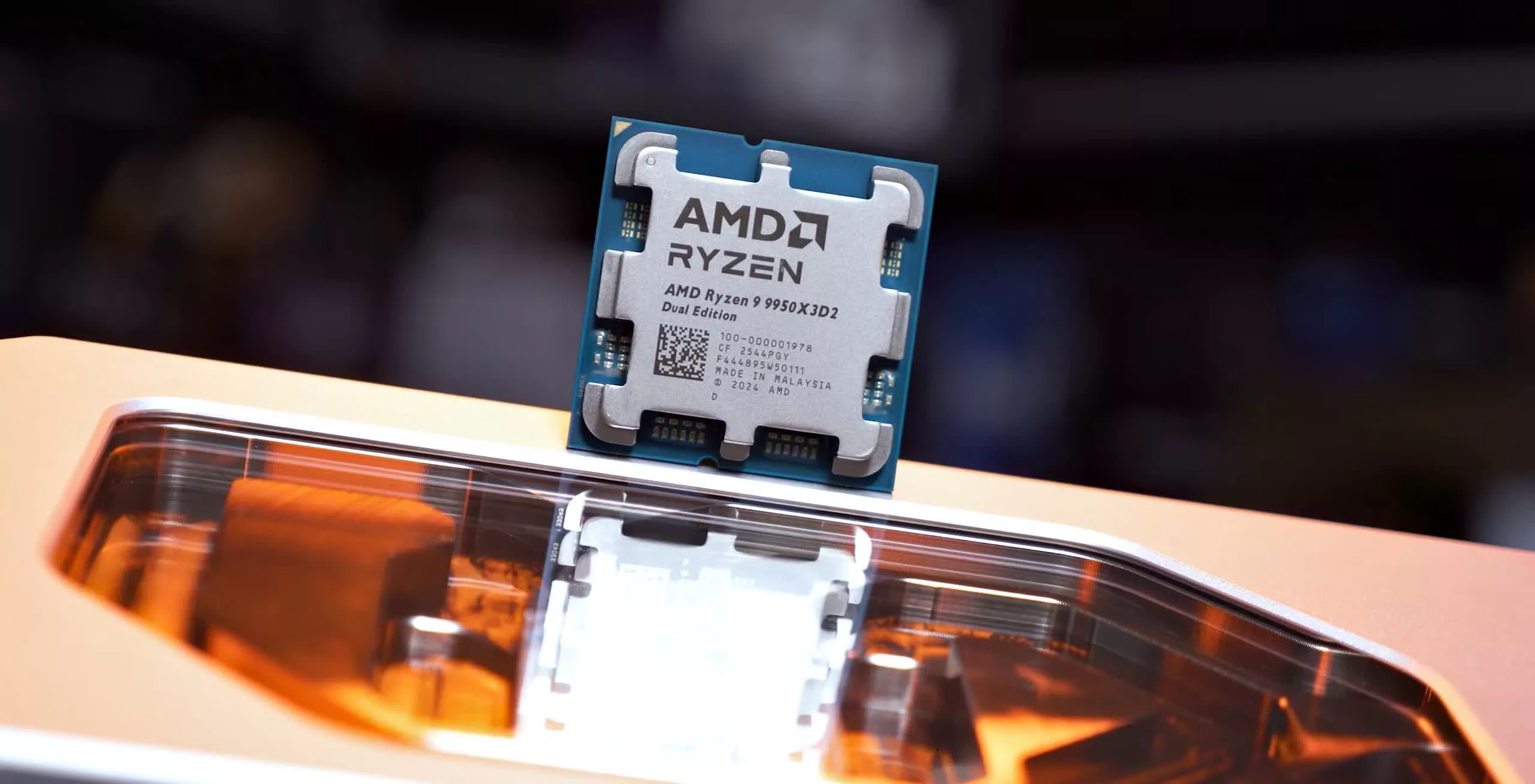
In a nutshell: Demand for high-end desktop CPUs is showing a familiar pattern: technical merit is only part of the equation. Early retail data suggests AMD's latest flagship, the Ryzen 9 9950X3D2 Dual Edition, is attracting interest despite modest generational gains and a steep price. The processor briefly cracked Amazon's top 10 best-selling CPUs shortly after launch, and while it has since slipped to #22, it remains ahead of many mainstream Ryzen and Intel offerings.
The Ryzen 9 9950X3D2 carries an $899 price tag, $200 above the prior flagship. From a technical standpoint, it builds on AMD's 3D V-Cache architecture, which has consistently driven strong gaming performance across recent generations. Independent reviews, however, make it clear that performance gains over the Ryzen 9 9950X3D are limited, particularly in gaming workloads where results remain largely similar. The pattern echoes the incremental uplift seen when the Ryzen 7 9850X3D succeeded the 9800X3D.
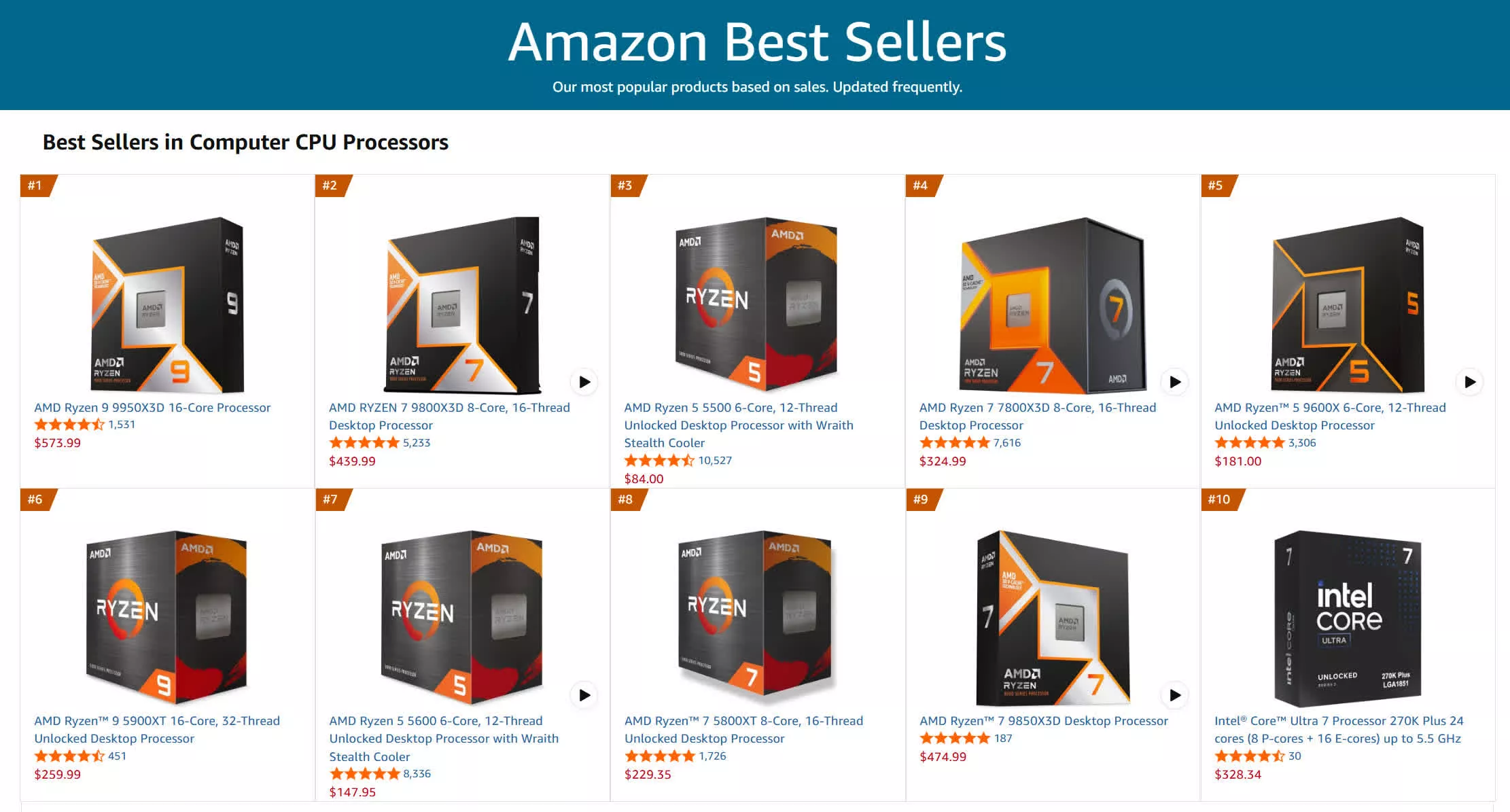
Even so, the broader sales landscape underscores the continued dominance of X3D-equipped processors. Multiple chips using AMD's vertically stacked cache design hold top positions in Amazon's rankings, including the AMD Ryzen 7 9800X3D, AMD Ryzen 7 9850X3D, AMD Ryzen 9 9950X3D, and AMD Ryzen 7 7800X3D. The 9800X3D in particular remains difficult to displace, widely seen as a standout for its balance of price and gaming performance.
The 9950X3D2 offers modest gains in productivity and professional workloads over its predecessor, though those improvements look relatively small given the higher cost. Buyers are still showing up, reflecting how enthusiasts often gravitate toward flagships over pure value, especially when a product introduces a first-of-its-kind feature such as dual-stacked 3D V-Cache on both CCDs. As our review found, that distinction matters more in productivity workloads than in gaming, but novelty alone can help drive early demand.
A similar dynamic is visible in GPUs, where products like the Nvidia GeForce RTX 5090 continue to sell despite retail prices exceeding twice their launch levels (arguably more and more to data centers than gamers). In both cases, demand is driven in part by those who prioritize access to top-tier components regardless of cost.

Intel, meanwhile, is seeing a somewhat different trajectory in the same retail rankings, though signs of improvement are emerging. Even with the 9950X3D2 falling back from its brief top-10 appearance, Intel's latest Core Ultra 200S Plus lineup has gained more visibility than earlier Arrow Lake launches. The top Intel entry, the Intel Core Ultra 7 270K Plus, now sits at #10, putting it back into direct competition near the top of Amazon's bestseller list.
That processor features a 24-core, 24-thread configuration similar to the higher-end Intel Core Ultra 9 285K, while delivering stronger gaming performance within Intel's current stack and offering a more favorable price-to-performance ratio than AMD's 9950X3D2.
Despite that progress, Intel has yet to match AMD's broader sales momentum across the rankings, where multiple X3D processors continue to occupy leading positions. According to AMD executive Robert Hallock, software optimizations could narrow performance gaps between rivals. For now, the consumer CPU market remains tilted toward AMD, particularly in segments where gaming performance is a primary driver.
Looking ahead, Intel's next opportunity to shift that balance may come with Intel Nova Lake, expected before the end of 2026. Until then, early sales data suggest AMD's flagship positioning continues to shape buying behavior, even when generational gains are incremental.
If anything, the Ryzen 9 9950X3D2's early top 20 debut may reinforce a more nuanced point: early enthusiast demand can be strong even when long-term momentum depends on whether premium pricing is backed by broader practical advantages. That is precisely where the chip remains under debate.