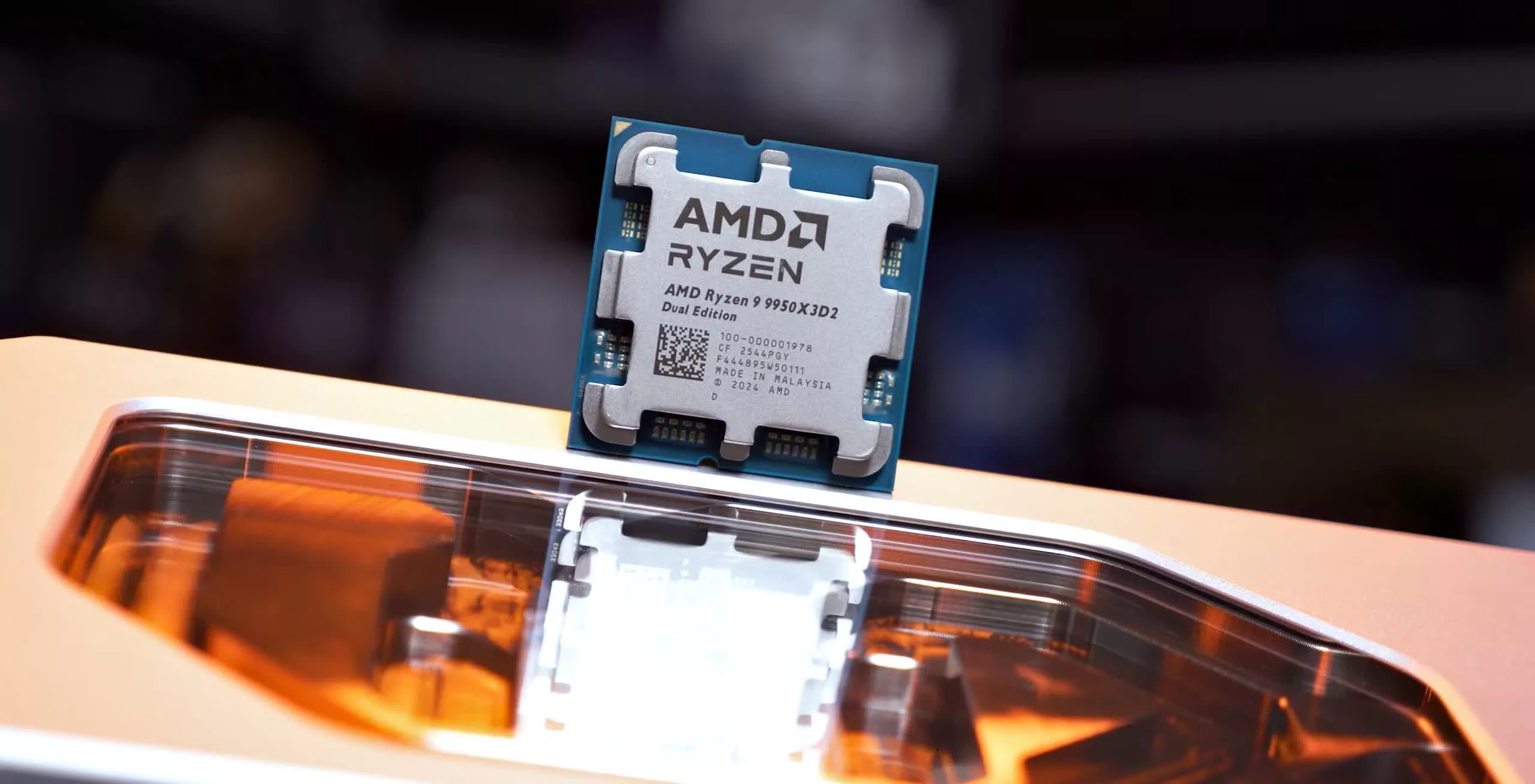
AMD has finally done what enthusiasts have been asking for, for years now. They have released a dual CCD processor with AMD 3D V-Cache on both 8-core CCDs, a symmetrical 16-core, 32-thread 3D V-Cache part. But is it as impressive as those who have been asking for it had hoped? Today, we are going to find out.
A quick bit of history first. Back in early 2022, AMD impressed countless gamers with the introduction of its first 3D V-Cache part, the 5800X3D. While there were higher core count parts on the AM4 socket such as the Ryzen 9 5900X and 5950X, the 5800X3D became the socket's premier gaming processor, as those higher core count models never received a 3D V-Cache version.

Then came the AM5 platform in late 2022, though it took another five months for the first Zen 4 3D V-Cache parts to arrive. In a somewhat unusual move, AMD led with the dual CCD models, the 7900X3D and 7950X3D. Some claimed this was an attempt to push early adopters toward the more expensive 7950X3D at $700, rather than waiting a few months for the 7800X3D at $450. Whatever the reasoning, it was an odd choice to lead with dual CCD models while holding back the version gamers were most interested in.
The 7950X3D and the cut-down 12-core 7900X3D were interesting because they marked the first time a dual CCD Ryzen CPU adopted AMD's 3D V-Cache technology, though there was a catch.

AMD chose to feature 64 MB of 3D V-Cache on only one of the two CCDs. The standard configuration for the 7950X included 32 MB of L3 cache per CCD, for a total of 64 MB. Had AMD equipped both CCDs with 3D V-Cache, the total would have reached 192 MB. Instead, with just one CCD enhanced, total L3 cache capacity was limited to 128 MB.
This asymmetrical layout introduced scheduling challenges, an issue already present with dual CCD Ryzen processors. The 7950X3D did not avoid this. In our day-one review, we found that disabling the CCD without 3D V-Cache could dramatically improve gaming performance, boosting frame rates by 8% in Horizon Zero Dawn, 18% in Shadow of the Tomb Raider, and 25% in Rainbow Six Extraction.
There was, however, an advantage to this design. Adding the 3D V-Cache layer introduced thermal challenges. While it enabled much larger cache sizes, it also created a thermal barrier, as heat generated by the cores had to pass through the cache die before reaching the integrated heat spreader. This required lower voltage and clock speeds to prevent overheating.

As a result, the cores without the additional cache could clock higher, typically by 450 to 500MHz. While the second CCD could reach as high as 5.7 GHz, the primary 3D V-Cache CCD usually topped out around 5.2 GHz.
The idea was that applications not benefiting from the extra L3 cache would run on the higher clocked CCD, while cache-sensitive workloads such as gaming would run on the primary CCD. In general, this worked, but not always. As noted earlier, when scheduling failed, performance regressions could occur.
After the arrival of the 7800X3D and its strong gaming performance, discussion shifted toward whether the 7950X3D was the right approach. Many questioned if AMD would have been better off with a symmetrical design featuring 3D V-Cache on both CCDs. While there were technical reasons preventing this at the time, demand for such a design persisted.

Two years later, AMD released the Zen 5-based 9950X3D, which largely repeated the 7950X3D approach. This was disappointing for some, though less problematic given that Windows scheduling for dual CCD processors had improved significantly.
Unlike Zen 3 and Zen 4, which used first-generation 3D V-Cache, the Zen 5 models, including the 9950X3D, 9900X3D, and 9800X3D, introduced a second-gen design. Instead of stacking the cache above the cores, the new design places it below. This seemingly small change made a significant difference. With the L3 cache beneath the cores, the cores could make direct contact with the integrated heat spreader, reducing thermal resistance by 46%.
This change meant that cores with access to the additional cache were no longer clocked up to 500MHz lower than those in the adjacent CCD. Instead, the gap was reduced to around 150 to 200MHz, with near parity in all-core workloads. As a result, calls for a fully symmetrical dual 3D V-Cache design intensified.

For a time, AMD did not pursue this approach. That has now changed. The new Ryzen 9 9950X3D2 Dual Edition processor is the first CPU to feature dual AMD 3D V-Cache technology, delivering a massive 192 MB of total L3 cache. It also introduces a new asking price of $900, which, we have to say, seems very unreasonable.
Ryzen 9 9950X3D2 Dual Edition Specs
| Model | 9950X3D2 Dual Edition | 9950X3D | 9950X | 9800X3D |
|---|---|---|---|---|
| Price MSRP [$US] | $900 | $700 | $650 | $480 |
| Release Date | April 22, 2026 | March 12, 2025 | August 15, 2024 | November 7, 2024 |
| Cores / Threads | 16 / 32 | 8 / 16 | ||
| Base Clock | 4.3 GHz | 4.7 GHz | ||
| Boost Clock | 5.6 GHz | 5.7 GHz | 5.2 GHz | |
| L3 Cache [Total] | 192 MB | 128 MB | 64 MB | 96 MB |
| Box Cooler | N/A | |||
| Chiplets | 2 x CCD, 1 x I/OD | 1 x CCD, 1 x I/OD | ||
| Core Config | 2 x 8 | 1 x 8 | ||
| TDP | 200 W | 170 W | 120 W | |
The original 9950X3D launched with an MSRP of $700 and can now be found for around $660. That was reasonable when competing against the $610 Core Ultra 9 285K. Today, however, the Core Ultra 7 270K Plus can be purchased for $350, with an intended price closer to $300. In productivity workloads, the 270K Plus rivals the 9950X3D in many applications. While the Ryzen processor is generally faster for gaming, the Intel chip remains very capable.
This makes AMD's move to increase the flagship price to $900 particularly aggressive. So what do you get for nearly a 30% price increase over the original 9950X3D? A second 3D V-Cache-enabled CCD, along with a modest 100 MHz reduction in maximum boost clock and an increase in TDP from 170W to 200W.

AMD claims up to 7% gains in rendering, AI, and simulation workloads in certain applications, while overall productivity improves by around 3%. In other words, the gains will hardly blow your socks off for an almost 30% price hike.
More notably, gaming performance is expected to remain unchanged compared to the original 9950X3D. This makes sense as most games don't require more than eight Zen 5 cores with 3D V-Cache, and even if they did the latency penalty when communicating between dies would hurt gaming performance.
But before drawing any firm conclusions about the 9950X3D2, we should run our own tests. So let's get to it.
Test System Specs
| CPU Motherboard Memory |
AMD Ryzen 9000 Series AMD Ryzen 7000 Series |
Gigabyte X670E Aorus Master [BIOS F34b] G.Skill Trident Z5 RGB 32GB DDR5-6000 CL30-38-38-96 Windows 11 24H2 |
| AMD Ryzen 5000 Series | MSI MPG X570S Carbon MAX WiFi [BIOS 7D52v1B1] G.Skill Ripjaws V Series 32GB DDR4-3600 CL14-15-15-35 Windows 11 24H2 |
|
| Intel Core Ultra 200S [Intel Default Profile] |
Asus ROG Maximus Z890 Hero [BIOS 1501] G.Skill Trident Z5 CK 32GB DDR5-8200 CL40-52-52-131 CUDIMM Windows 11 23H2 [24H2 slower] |
|
| Intel 12th, 13th & 14th [Intel Default Profile] |
MSI MPG Z790 Carbon WiFi [BIOS 7D89v1E] G.Skill Trident Z5 RGB 32GB DDR5-7200 CL34-45-45-115 Windows 11 24H2 |
|
| Graphics Card | Asus ROG Strix RTX 4090 OC Edition | |
| Power Supply | Kolink Regulator Gold ATX 3.0 1200W | |
| Storage | TeamGroup T-Force Cardea A440 M.2 PCIe Gen4 NVMe SSD 4TB | |
| Display Driver | GeForce Game Ready Driver 572.70 WHQL | |
Application Benchmarks
All-core Cinebench Workload
Before jumping into the bar graphs, here is a quick look at how the 9950X3D2 behaves under a heavy all-core workload. We observed an average core clock frequency of 5.2 GHz, resulting in a peak CPU temperature of 89°C, and this is with a 360mm AIO installed. Under a single-core load, the CPU clocked as high as 5.6 GHz, peaking at 58°C.

Cinebench 2026 Multi
Here are the Cinebench scores and again, hold onto those socks, the 9950X3D2 is, drum roll please, 4% faster than the original 9950X3D, which was 8% faster than the plain old 9950X. Worryingly for AMD, that also means it is just 3% faster than the 270K Plus, and at current pricing it is set to cost 157% more. That is the kind of math that would only make sense to an OpenAI accountant.

Cinebench 2026 Single
Then we have the single-core score, and here we are looking at roughly a 0.5% gain over the original model, making it 5% slower than the 270K Plus, which is not a great look.

Blender
The good news is that AMD's claim of up to 7% better rendering performance holds up. In Blender, the 9950X3D2 was exactly 7% faster than the original version and 13% faster than the standard 9950X, while also leading the 270K Plus by a reasonable 21% margin. Still not 157%, but 21% is a lot better than the 3% we saw in Cinebench.

7-Zip Compression
Moving on to the 7-Zip file manager compression test, the new dual CCD model is 4% faster than the original and just 7% faster than the 270K Plus. So it is the fastest desktop CPU in this workload, just not by nearly enough to justify the asking price.

7-Zip Decompression
The decompression gains are even weaker. Here, the 9950X3D2 is just 2% faster than the original model, though it was much faster than the 270K Plus, leading by a 31% margin.

Photoshop
The extra L3 cache does boost performance in Photoshop by a few percent, delivering a 2% gain over the 9950X3D, while being 26% faster than the 270K Plus. So AMD maintains a commanding lead over Intel in this application.

Premiere
We are also looking at a modest 2% uplift in Premiere Pro, which is enough to see the 9950X3D2 match the standard 9950X, making it just 3% faster than the 270K Plus.

Shader Compilation
Finally, a quick look at shader compilation time, and interestingly the 9950X3D2 was slightly slower than the original model, taking 4% longer to build shaders. We have not yet updated this test with the 270K Plus, but based on what we are seeing here from the 285K, it should be faster than AMD's 16-core models.

Gaming Benchmarks
Rainbow Six Siege X
Time for the gaming results, and we are going to gloss over most of these graphs as the results are not terribly interesting. In Rainbow Six Siege, for example, the 9950X3D2 was up to 2% slower than the original model and 4% slower than the 9800X3D, though it was still 24% faster than the 270K Plus.

Battlefield 6
Battlefield 6 tells a similar story. The 9950X3D2 trailed the original model slightly, though overall performance was effectively the same.

Arc Raiders
The Arc Raiders results are a little different. This game does show more run to run variance given that it is online only, though the data here is based on a three run average. The 9950X3D2 was 4% faster than the 9950X3D at both tested quality settings, allowing it to closely match the 9800X3D.

Borderlands 4
Performance in Borderlands 4 was very similar to the original model. In fact, it was virtually identical across both quality presets, making it up to 13% faster than the 270K Plus when comparing 1% lows using the medium preset.

Marvel Rivals
We are seeing the same thing in Marvel Rivals. The new dual CCD model delivered essentially identical performance to the original single CCD version, making both a frame or two faster than the 9800X3D.

Baldur's Gate 3
Like the 9800X3D and 9950X3D, performance in Baldur's Gate 3 from the new dual CCD model is excellent, but also unchanged, so no improvements here either.

Cyberpunk 2077: Phantom Liberty
It is the same situation in Cyberpunk 2077: Phantom Liberty. The 9950X3D2 matched the performance of the original model, though that still made it almost 40% faster than the 270K Plus when using the medium quality settings.

Counter-Strike 2
As expected, performance in Counter-Strike 2 is not improved either, and this is hardly a game that requires or benefits from a 16-core Zen 5 processor.

Space Marine 2
Space Marine 2 is a CPU limited, CPU heavy game, but it does not benefit from the additional cores, so performance remains unchanged compared to the 9950X3D and 9800X3D.

Mafia: The Old Country
The 9950X3D2 is also only able to match the 9800X3D and 9950X3D in Mafia: The Old Country, making it up to 6% faster than the 270K Plus.

Assetto Corsa Competizione
Unexpectedly, we did see a 5% performance boost in ACC using the medium settings, though the more GPU limited Epic preset reduced that margin to just 2%.

Spider-Man 2
The Spider-Man 2 results are more of the same. Once again, the new dual CCD model matched the original, making it up to 35% faster than the 270K Plus.

Horizon Zero Dawn Remastered
Interestingly, the 9950X3D2 was up to 7% faster than the 9950X3D in Horizon Zero Dawn Remastered when using the very high settings, and then 5% faster with the medium preset. It also beat the 270K Plus by an impressive 30% margin in this title.

The Last of Us Part II Remastered
Finally, we have The Last of Us Part II Remastered, and as expected, the dual CCD model matched the performance of the original single CCD version. So, we guess, case closed.

14 Game Average
AMD was right when it said "same performance." The 9950X3D2 delivered essentially the same gaming performance as the 9950X3D. Well, it was a frame faster, and let us tell you, that is a bloody expensive frame.

Power Consumption
Something we have not touched on yet is power usage, and this is one of the key drawbacks.
As noted earlier, the TDP has increased from 170 W to 200 W, but in our testing we saw an additional 60 W being pulled across the EPS12V rails. That increased total CPU power draw by 27% for just a 4% performance gain. So the 9950X3D2 really throws efficiency out the window, consuming almost as much power as the 14900K, which is not a great result.


Thankfully, power usage when gaming is much more reasonable, with the CPU using slightly less power than the 9950X3D, albeit for slightly lower performance.

We are also seeing slightly lower power consumption compared to the 9950X3D in Space Marine 2, and again performance was marginally lower in this example.

Then in Spider-Man 2, power usage increased by 6% compared to the 9950X3D, and here the 9950X3D2 was 2% faster.
Cost Per Frame
Productivity
Before wrapping up the graphs, here is a look at the cost per sample per minute in Blender, giving us a clearer idea of what the 9950X3D2 offers productivity users in terms of value. It is certainly better value for productivity when compared to the 9800X3D, which is a very expensive but highly specialized gaming processor.

As expected, it is considerably worse value than the original 9950X3D, increasing the cost per sample by 27%. The real problem for AMD is that the 9950X3D2 costs 113% more than the 270K Plus.
Meanwhile, the 9950X and 9900X cost around 40% more than the 270K Plus, and even if we assume a $310 7900X could match the performance of the 9900X in this workload, it would still be about 10% worse value than the 270K Plus.
Gaming

As for gaming, this won't take long. The 9950X3D2 is the worst value high-end CPU for gaming, and nothing else comes close. The cost per frame compared to the 270K Plus is 111% higher and 36% higher than the 9950X3D. So for gaming, it simply offers very poor value.
AMD Built It, But Few Should Buy It
When we first heard that AMD was preparing a dual CCD Zen 5 processor with 3D V-Cache on both dies, we discussed it on the HUB podcast. That discussion did not last long though, as we couldn't come up with a compelling reason for why such a product should exist, other than it would be cool to see.
And that's the 9950X3D2 in a nutshell. It does not need to exist, but we are kind of glad that it does.
Like the 9850X3D, it is an inoffensive product. You do not have to buy it, and it does not change the current landscape. The 9950X3D has not been replaced, nor has the 9950X or any of the other Zen 5 processors. That said, where the 9850X3D MSRP was very reasonable, coming in just 4% above the 9800X3D for roughly 4% more performance, who really cares, and even at retail, with the 9800X3D slightly discounted, the updated version carries less than a 10% premium.
The 9950X3D2, on the other hand, is very poor value. There is more to it than a simple factory overclock, but even so, the additional L3 cache did not amount to much in our testing, certainly not enough to justify a 30% price hike.

Even so, it has not replaced the 9950X3D, and it has not pushed up the price of that part. If you choose to ignore the 9950X3D2, nothing changes, which is why we find it largely inoffensive to consumers. We see it more as an additional option that very few of you should seriously consider. It is a halo product that will mainly appeal to those who enjoy bragging about their hardware.
We did find it amusing that the 9950X3D2 was announced shortly after Intel's 200 Plus series arrived, almost as if it was a counterpunch. But no, that's not at all the case. The Ryzen is a more powerful and more capable CPU overall, but at roughly three times the price, it is not particularly compelling.

The closest thing AMD has to competing directly with the 270K Plus right now is the Ryzen 9 7900X, which can be found for around $320. Although we did not include that part in this review, the 9900X was tested. For gaming, the 270K Plus is on average 14% faster when comparing 1% lows. In a core-heavy workload such as Blender, the Intel part is 24% faster, 20% faster in 7-Zip, and 41% faster in Cinebench.
The 9950X3D2 does nothing to change the broader conversation. If you have money to burn, sure it is a neat CPU, but if you are trying to maximize value, it will not be of interest. As things stand, the 270K Plus remains the best option for those focused on productivity value. It is significantly better than everything else, even if it's selling a tad above it's advertised $300 MSRP.

In Blender, it offers ~30% better value than the 9950X and 9900X, and about 40% better value than the 9950X3D. You are saving roughly $170 compared to the 9950X for similar performance, and that saving effectively covers the cost of a Z890 motherboard, making platform longevity concerns less relevant.
Of course, if high-end gaming is your primary focus, then none of these CPUs make much sense. You will be better served by the 7800X3D, 9800X3D, or 9850X3D. As things stand today, Intel leads for productivity, AMD leads for gaming, and that is going to do it for this review.