AMD's Threadripper Pro 9995WX will set you back $11,699, touts 26% speed boost

Daniel Sims

Posts: 2,480   +76
Staff
Something to look forward to: AMD has confirmed pricing for the Ryzen Threadripper 9000 Pro series, which launches next week. As expected, these workstation CPUs aren't cheap – all but the lowest tier cost hundreds more than their predecessors. The company is targeting professionals who need top-tier performance and are willing to pay for it.
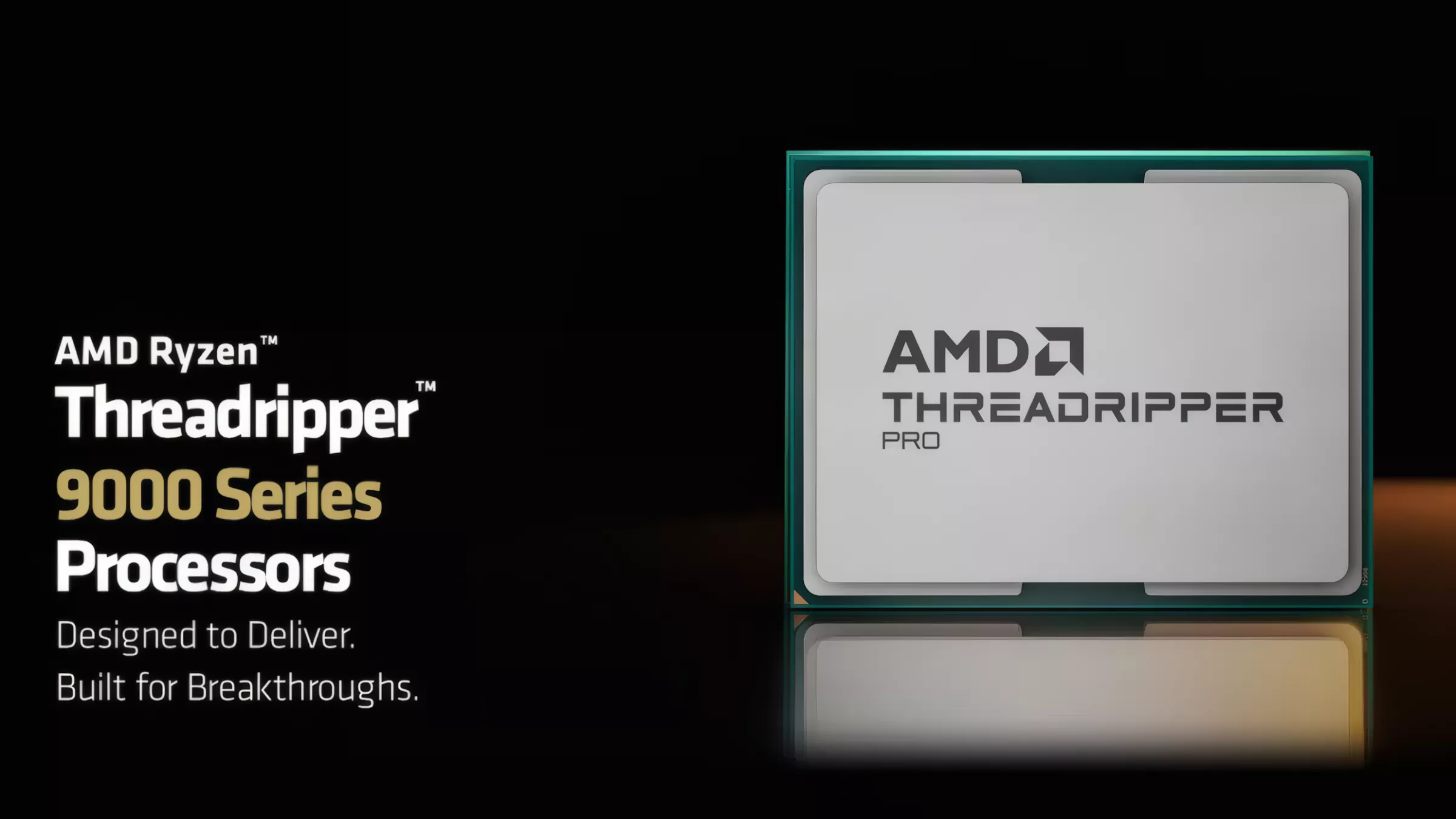
AMD will launch five new Ryzen Threadripper Pro HEDT processors on Wednesday, July 23. The shift to the Zen 5 architecture and a more advanced 4nm process marks a generational leap over the 5nm Zen 4, with significant performance improvements expected in threaded workloads.

Four of the Threadripper Pro 9000 CPUs cost more than the 2023 Pro 7000 models. The 96-core, 192-thread flagship 9995WX stands out with a $1,700 jump, priced at $11,699 versus the 7995WX's $10,000. The price gap narrows with lower-tier models, but all are at least $250 more expensive than their predecessors.
The exception is the cheapest Zen 5 Pro model, the 16-core, 32-thread 9955WX, which got a $250 price cut compared to the 7955WX despite similar specs and likely better performance. However, the next-gen Threadripper Pro lineup drops the 12-core, 24-thread model, so 7945WX owners looking to upgrade must move to a pricier option.

All Threadripper 9000 Pro CPUs feature a 5.4 GHz boost clock, base speeds between 2.5 and 4.5 GHz, and a 350W TDP. They support up to 2TB of DDR5-6400 RDIMM RAM across eight channels, AVX-512 instructions, and up to 128 PCIe 5.0 lanes. The non-Pro variants – still awaiting pricing and release details – are limited to 1TB of RAM on four channels and 80 PCIe 5.0 lanes.

Processor Cores/Threads Boost/Base Frequency L3 Cache TDP MSRP (USD)
TR Pro 9995WX 96 / 192 Up to 5.4 / 2.5 GHz 384MB 350W $11,699
TR Pro 9985WX 64 / 128 Up to 5.4 / 3.2 GHz 256MB 350W $7,999
TR Pro 9975WX 32 / 64 Up to 5.4 / 4.0 GHz 128MB 350W $4,099
TR Pro 9965WX 24 / 48 Up to 5.4 / 4.2 GHz 128MB 350W $2,899
TR Pro 9955WX 16 / 32 Up to 5.4 / 4.5 GHz 64MB 350W $1,649

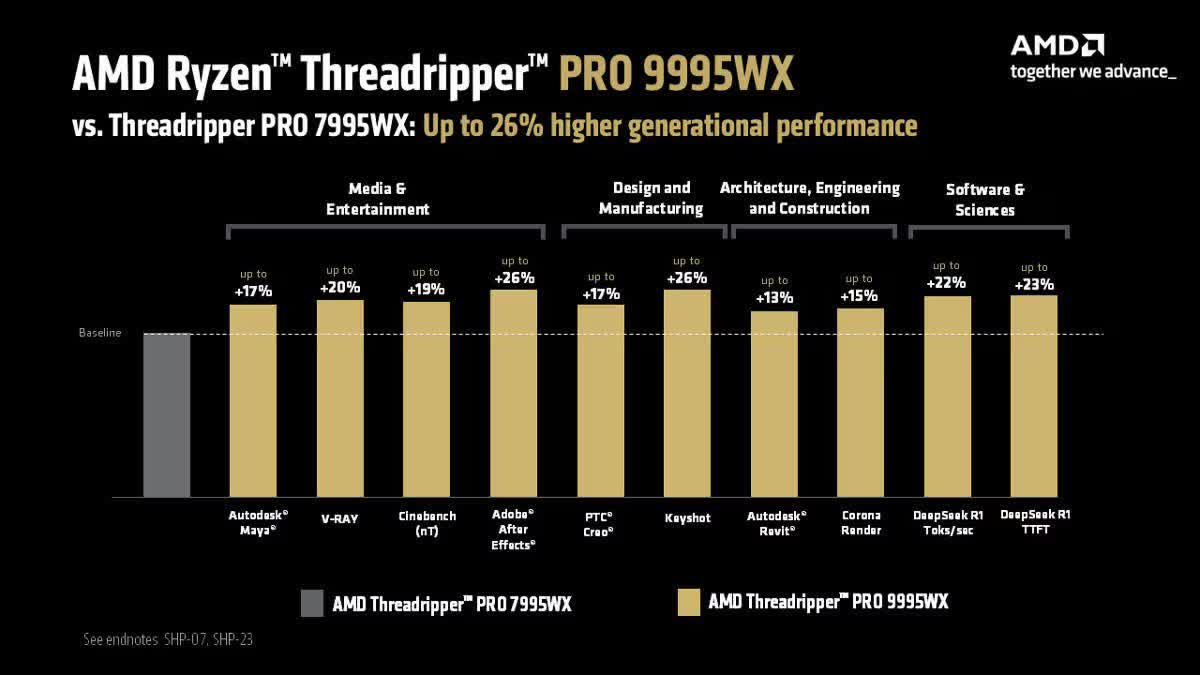
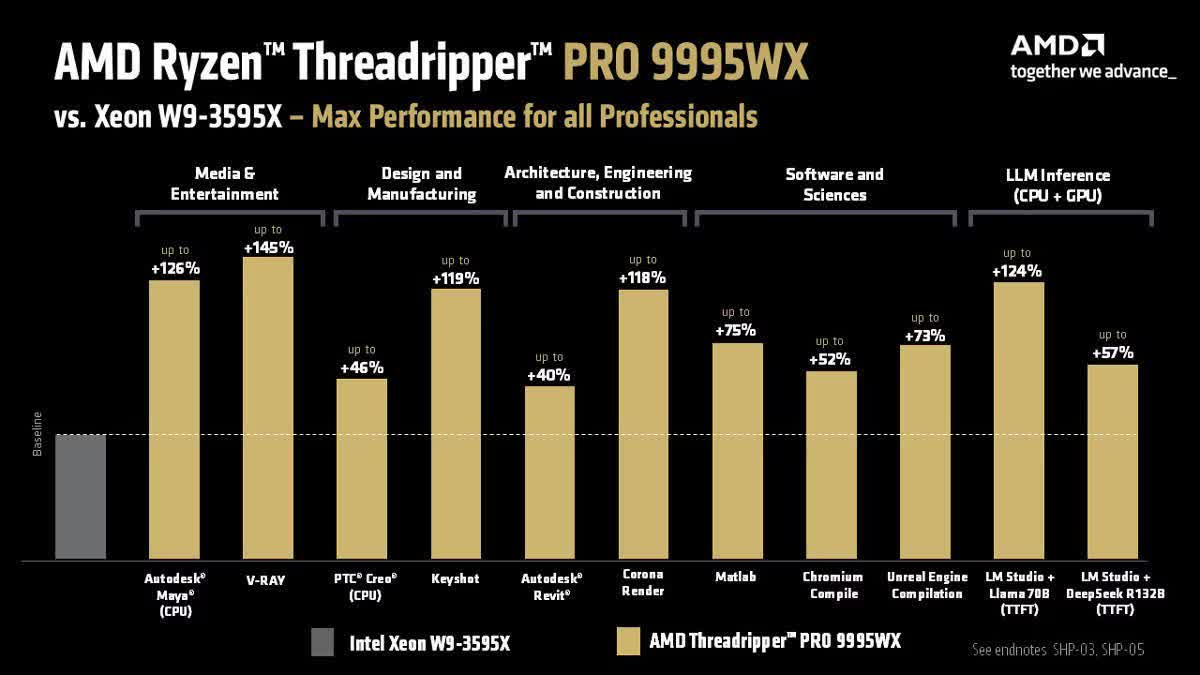
AMD claims the new lineup delivers a 16-percent IPC uplift and a 25-percent improvement in the SPECworkstation 4.0 AI and ML benchmark over the Threadripper Pro 7000. The 9995WX beats its predecessor by around 26 percent. AMD also says it outperforms Intel's rival chips by 40 percent in Chaos V-Ray, 20 percent in Keyshot, 78 percent in Adobe After Effects, and 49 percent in a DeepSeek R1 32B context-based prompting inference test.

The Threadripper Pro 9000 CPUs will be available for DIY builders and in pre-built workstations from Dell, HP, Lenovo, Supermicro, and other OEMs starting July 23.

Permalink to story:

 
Who exactly is buying these? Like what applications specifically? I can never seem to get that answer. Its way too much for anything my company would provide and wouldn't really benefit our clients over considerably cheaper TR or Xeon parts that we supply. The only thing that we need lots and lots of cores for is virtualization. But we run into other barriers with VMs, you can have all the cores in the world but if all the VMs are sharing the same NIC you have a limitation there. Same with the GPU. So im curious as to who is spending this sort of cash on CPUs and what benefit they get out of it to make it worth the money?
 
Who exactly is buying these? Like what applications specifically? I can never seem to get that answer. Its way too much for anything my company would provide and wouldn't really benefit our clients over considerably cheaper TR or Xeon parts that we supply. The only thing that we need lots and lots of cores for is virtualization. But we run into other barriers with VMs, you can have all the cores in the world but if all the VMs are sharing the same NIC you have a limitation there. Same with the GPU. So im curious as to who is spending this sort of cash on CPUs and what benefit they get out of it to make it worth the money?
If you’re rendering video, it’s awesome… also great for LLMs…
 
If you’re rendering video, it’s awesome… also great for LLMs…
I use a threadripper at work - nothing crazy (just the 5945WX 12 core). The number of PCIE lanes plus 8 channel RAM means it is great for prototyping database schemas and shifting large datasets around. In the cloud this kind of work gets expensive quickly (especially when you do anything to the data). Be a few years before I can get it updated to the above though. At home I'm still using a skylake X machine, the PCIE lanes are great for multiple NVME drives. PCs are not only for gaming (it is nice though to be able to game as well).
 
Who exactly is buying these? Like what applications specifically? I can never seem to get that answer. Its way too much for anything my company would provide and wouldn't really benefit our clients over considerably cheaper TR or Xeon parts that we supply. The only thing that we need lots and lots of cores for is virtualization. But we run into other barriers with VMs, you can have all the cores in the world but if all the VMs are sharing the same NIC you have a limitation there. Same with the GPU. So im curious as to who is spending this sort of cash on CPUs and what benefit they get out of it to make it worth the money?

Anyone who has a software that can scale well with how many cores you throw at it, and can financially justify the purchase of those puppies.

Examples include video and CG. You be surprised that there are a lot of workloads that are done exclusively in CPUs.

Or scientific work, like physics simulation for gases, fluids, solids, etc. The more precise you want the simulation, more points of the event you have to simulate. A example of a free software used for this stuff is OpenFoam.

All of that is niche stuff, but there are people willing to fit the bill to get it done faster than it would have been on consumer hardware.
 
Last edited:
Who exactly is buying these? Like what applications specifically? I can never seem to get that answer. Its way too much for anything my company would provide and wouldn't really benefit our clients over considerably cheaper TR or Xeon parts that we supply. The only thing that we need lots and lots of cores for is virtualization. But we run into other barriers with VMs, you can have all the cores in the world but if all the VMs are sharing the same NIC you have a limitation there. Same with the GPU. So im curious as to who is spending this sort of cash on CPUs and what benefit they get out of it to make it worth the money?
The AMD Threadripper Pro 9995WX is designed for extreme workstation performance. Here are its top 5 uses:
* 3D Rendering and Animation: Its high core and thread count (96 cores, 192 threads) make it exceptionally fast for rendering complex 3D scenes, visual effects (VFX), and high-resolution animations, significantly reducing processing times for artists and studios.
* AI/Machine Learning Development & Inference: With its support for numerous PCIe 5.0 lanes and powerful multi-core processing, it's ideal for local AI fine-tuning, training machine learning models, and running demanding AI inference tasks, often in conjunction with multiple high-end GPUs.
* Scientific and Engineering Simulations: Researchers and engineers use it for computationally intensive simulations in fields like fluid dynamics (CFD), structural analysis, scientific research, and complex data modeling, where large datasets and intricate calculations are common.
* Video Editing and Post-Production: Professionals working with high-resolution video (e.g., 8K) and complex post-production workflows benefit from its ability to handle multiple video streams, apply numerous effects, and perform real-time playback without performance bottlenecks.
* Software Development and Compilation: Developers working on large codebases can drastically reduce compile times, speeding up the development cycle. It's also excellent for running multiple virtual machines simultaneously for testing and development environments.
 
Both of those are far more efficient on a gpu, a high core count doesn't give you much advantage for rendering or ai training or ai inference.
Depends on the program... and a Threadripper gives you enough PCI lanes to have 2 (or more) GPUs as well as numerous SSDs
 
Back