An electric air taxi just flew from JFK to Manhattan in under 10 minutes

Skye Jacobs

Posts: 2,012   +59
Staff
Forward-looking: Joby Aviation has begun a series of real-world flight tests in New York City, placing its electric vertical takeoff and landing aircraft in one of the most complex urban airspaces in the US as it works toward commercial approval. The company is conducting 10 days of demonstration flights focused on operational performance rather than passenger service. The tests are designed to evaluate how the aircraft performs on real-world routes between airports and city heliports.
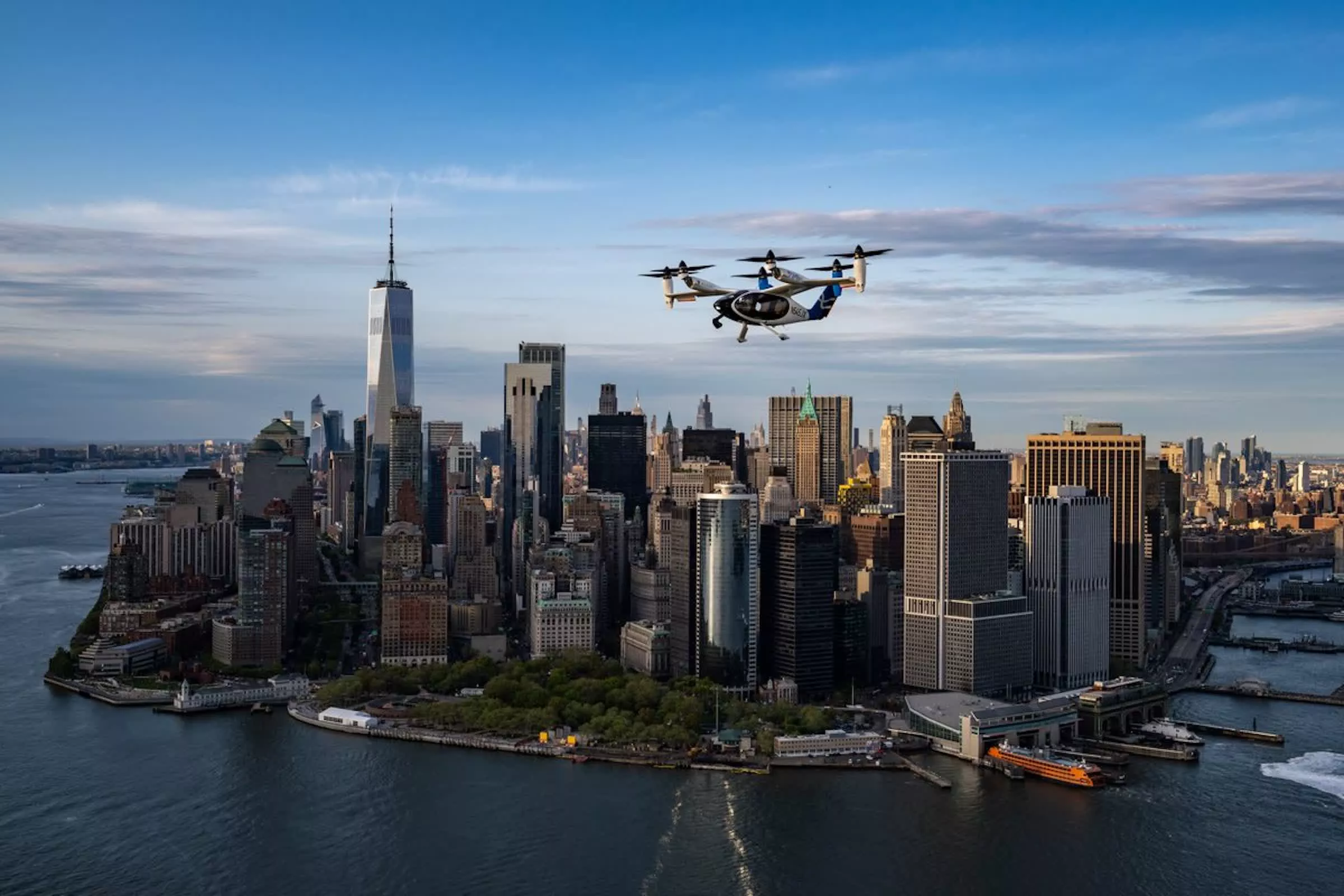
In early demonstrations, Joby flew from JFK Airport to heliports in Lower Manhattan and Midtown in under 10 minutes. The route, which can take significantly longer by car depending on traffic, is a key use case for the company's proposed urban air mobility network.

Joby's aircraft is designed for short urban trips using electric power. It can take off and land vertically, eliminating the need for a runway and allowing it to operate from smaller heliport-like facilities. The company positions it as a quieter, lower-emission alternative to traditional helicopters.

The New York flights are part of the FAA's eVTOL Integration Pilot Program, which aims to accelerate certification and deployment. Testing in major cities allows the FAA and companies to evaluate how these aircraft operate alongside existing air traffic, infrastructure, and regulations.

Joby remains in the final stages of FAA certification, a process that has become one of the main bottlenecks for the broader air taxi sector. The company had previously targeted a 2025 launch, but that timeline has since slipped.

The flights follow piloted demonstrations in the San Francisco Bay Area in March, bringing testing into a busier urban environment. Each phase is intended to validate different aspects of the system, from aircraft performance to routing logistics and integration with existing aviation infrastructure.

If certification proceeds as expected, Joby plans to begin passenger operations in the second half of 2026, with initial service targeted at New York, Texas, and Florida. The company's strategy points to a phased rollout focused on high-density, high-traffic corridors where time savings could justify the cost of early adoption.

For now, the New York flights remain a technical demonstration rather than a commercial service. However, they represent a critical step in moving eVTOL aircraft from prototype and pilot programs into regulated airspace, where they will ultimately need to operate at scale.

Permalink to story:

 
Not needing fuel is a plus, today/
Also, imagine if it is also a lot easier to pilot (or not needing a pilot at all?)
It could be a lot cheaper as a taxi compared to helis.
 
I wonder what happens if a motor fails, a battery spontaneously combusts, or a bird hits one of the propellers, these vehicles likely aren't tested to be safe like a normal airplane or helicopter.
 
I wonder what happens if a motor fails, a battery spontaneously combusts, or a bird hits one of the propellers, these vehicles likely aren't tested to be safe like a normal airplane or helicopter.
It has enough blades to survive getting one blade damaged, most likely.
Regarding overall safety, commercial planes have a lot of moving parts
, but they are still very reliable. These drone taxis have a lot fewer parts,
and they have a great potential to become even safer than planes and helicopters.
And there is no surprise that China is rushing this industry; it can offer amazing comfort for traveling in big cities.
 
I wonder what happens if a motor fails, a battery spontaneously combusts, or a bird hits one of the propellers, these vehicles likely aren't tested to be safe like a normal airplane or helicopter.
Amazingly enough, it wasn't just you that thought of safety. The taxi has six rotors and can still fly if two fail. Each rotor has two independent motors, and the taxi has four independent battery packs, and is capable of flying (though with reduced range) even if 3 of the 4 fail.
 
Oh! But there is no fuel! It's good for the planet.
Well, even if they use solar to charge it, there was still a ton (well, more than a ton) of material
that was dug up out of the ground to obtain the materials to make the solar panels, not to mention
the batteries, which will need to be replaced along with the solar panels.
Everyone thinks solar/wind are "clean" but they aren't in the long run.
 
Oh! But there is no fuel! It's good for the planet.
Well, even if they use solar to charge it, there was still a ton (well, more than a ton) of material
that was dug up out of the ground to obtain the materials to make the solar panels, not to mention
the batteries, which will need to be replaced along with the solar panels.
Everyone thinks solar/wind are "clean" but they aren't in the long run.

Boomer speak for, I dont know what Im talking about. Keep parroting those oil company talking points.
 
Oh! But there is no fuel! It's good for the planet.
Well, even if they use solar to charge it, there was still a ton (well, more than a ton) of material
that was dug up out of the ground to obtain the materials to make the solar panels, not to mention
the batteries, which will need to be replaced along with the solar panels.
Everyone thinks solar/wind are "clean" but they aren't in the long run.
Can't image a more tone deft and ignorant comment. What does being in the ground have to do with anything? You think oil is pulled out of the air? What is the difference between the pollution produced by the entire process to find and pull oil out of the ground and getting energy from it and building renewable energy generators and batteries? You think there aren't any consumables with ICE cars and planes?


Can't image a more tone deft and ignorant comment. What does being in the ground have to do with anything? You think oil is pulled out of the air?
Eh? Oil being pulled from the ground is a net energy win -- that's the entire point, in fact. But the enormous quantities of steel, copper, aluminum concrete, rare earths, and others require vast amounts of energy inputs to mine and refine.

In fact, though it's no longer true for newer wind turbines, for many years, wind mills were a net energy loss for the economy ... it took more energy to produce the materials used in their construction than they generated over their lifetime.

What is the difference between the pollution produced by the entire process to find and pull oil out of the ground
See above. While petroleum produced from sources like tar sands is a bit different, oil from places like Saudi Arabia has near-zero lifting costs. There are still places in the world where oil is so plentiful it literally seeps out of the ground.

(Incidentally, that's one of the great ironies of California banning oil due to fears of "oil spills". In places like Catalina, Ventura, Santa Barbara, they'd actually have less oil on their beaches if they pumped to reduce subterranean pressure.)
 
Last edited:
Can't image a more tone deft and ignorant comment. What does being in the ground have to do with anything? You think oil is pulled out of the air? What is the difference between the pollution produced by the entire process to find and pull oil out of the ground and getting energy from it and building renewable energy generators and batteries? You think there aren't any consumables with ICE cars and planes?
LOL, boy! Calm down! Oil, minerals for batteries/solar panels/wind all COME OUT OF THE GROUND! The nice thing about oil is it isn't finite like a lot of people assumed. It isn't "fossil" fuel that runs out. Oil is created from the remains of dead organisms, primarily plankton and algae, that accumulate on the ocean floor and mix with sediments. So it continues to be produced.
Granted, we are probably pulling it out of the ground faster than it is being created, but we still have hundreds of years of oil, coal, gas. In time, perhaps the "flux capacitor" will be created or some other "space age" thing will be discovered that we can utilize for energy.
We missed BIG TIME when everyone went nuts getting rid of nuclear. "Oh but three mile island, Chernobyl, Fukushima!!!
Well, with TMI, that was a human issue, but it showed the safety features worked!
As for Chernobyl, that was a poorly designed & built graphite reactor.
As for Fukushima, the ldiot that put the backup reactor where they did should have been punished!
 
I wonder what happens if a motor fails, a battery spontaneously combusts, or a bird hits one of the propellers, these vehicles likely aren't tested to be safe like a normal airplane or helicopter.

Each rotor has 2x motors for safety. The motors connect to different battery packs. 2x rotors can completely fail - it will still land safely. These batteries go through much more safety screening and monitoring than batteries you are familiar with. Helicopters can only compete on range and lifting weight, nothing else.
 
It has enough blades to survive getting one blade damaged, most likely.
Regarding overall safety, commercial planes have a lot of moving parts
, but they are still very reliable. These drone taxis have a lot fewer parts,
and they have a great potential to become even safer than planes and helicopters.
And there is no surprise that China is rushing this industry; it can offer amazing comfort for traveling in big cities.
As long as the FAA doesn't have a passenger/safety equation where the failure rate allowable goes up in relation to the smaller number of potential people killed. When a commercial plane crashes, it hurts the whole commercial airline industry, but when a small jet or private plane crashes, the fallout is negligible. The entire industry was very, very sensitive to this at its dawn, but it seems to have become more desensitized to this as time has gone on, hence the Boeing kerfuffle. I want to see this succeed so that in the future, it is available to a larger swath of the population, which is often the projection of luxury services, but poor safety expectations would certainly torpedo this hope.
 
Each rotor has 2x motors for safety. The motors connect to different battery packs. 2x rotors can completely fail - it will still land safely. These batteries go through much more safety screening and monitoring than batteries you are familiar with. Helicopters can only compete on range and lifting weight, nothing else.
That all sounds awesome, but how does the failure rate compare to a passenger jet, 10 -9 per flight hour?
 
Imagine the noise of one of these bad boys, like a drone x1000.
They will be very quiet. I know because it is one of the public's main concerns, and the engineers are working hard to make them much quieter. In 5 years, if there are no major crashes, these air taxis could put out of job a lot of helicopter pilots, or more likely, small heli companies.
 
Back