
Facepalm: It's only been a few days since a survey showed more than half of CEOs admit to seeing no significant financial benefit from AI. Now, another report has come to the same conclusion, and, once again, it tries to put a positive spin on the results.

Earlier this week, PwC published its latest Global CEO survey, which covers 4,454 Chief Executive Officers across 95 countries and territories. According to the results, 56% of Chief Executive Officers say embracing AI still hasn't produced any cost or revenue benefits for their businesses.
Now, global professional services network Deloitte has published its State of AI in the Enterprise report. The headline finding mirrors that found by PwC: 74% of organizations hope to grow revenue through their AI initiatives, but only a fifth have already done so.
Like PwC, Deloitte claims that things will improve. It writes that the numbers suggest AI is on the verge of breaking out and delivering a wide range of benefits that go beyond productivity and efficiency improvements. That's the only one of the six benefits most respondents (66%) say AI is providing today, though it doesn't seem to be having an effect on their bottom lines, strangely.
Breaking down the benefit figures, only 20% of organizations say AI is increasing revenue today, while 40% say it is reducing costs. That's similar to the PwC report, in which just 26% of CEOs said AI was lowering costs and a mere third said revenue had increased.
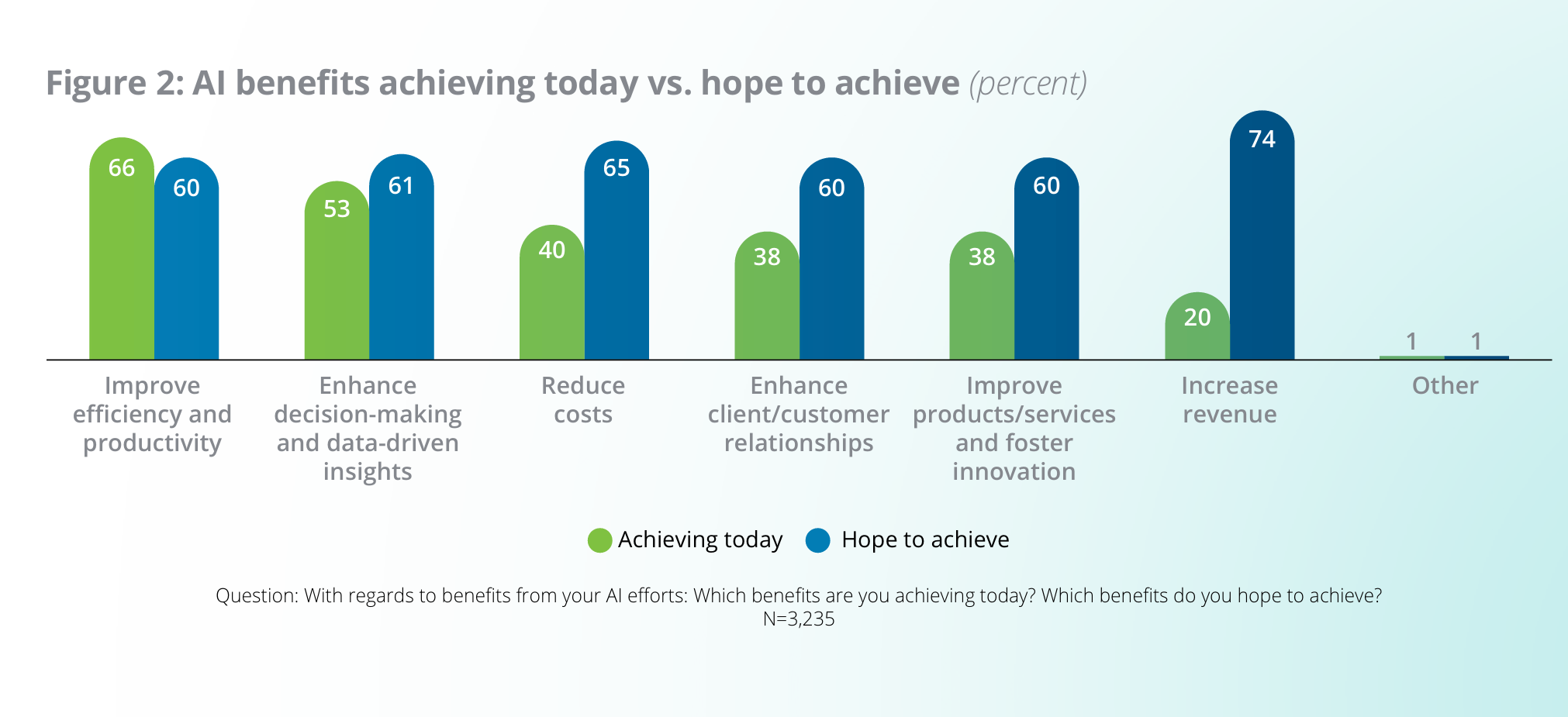
Deloitte notes that a large percentage of organizations do hope to achieve increased revenue and reduced costs through AI, but wishful thinking counts for little.
"Success with AI isn't just about boosting efficiency or even growing revenue," the report says. "It's about achieving strategic differentiation and a lasting competitive edge in the marketplace." That's assuming the organizations don't go broke from wasting money on non-revenue-increasing AI.
But a lack of success isn't stopping companies from increasing their investment in the technology. 60% of participants said their workers now have access to sanctioned AI tools, up from fewer than 40% a year ago. However, fewer than 60% of those with access said they use AI as part of their daily workflow. Again, the report paints this as AI's productivity and innovative potential being "untapped."
Companies showing just how highly they value their workers
Concerns about AI causing job losses will likely be exacerbated by the report. 36% of businesses surveyed expect at least 10 percent of their jobs to be fully automated this year, while a massive 82% say at least 10% of their jobs will be fully automated within three years. The better news for employees is that 84% of respondents have not redesigned jobs or the nature of work itself around AI capabilities – at least not yet.
The report generously describes worker sentiment toward AI as "mixed but cautiously positive." While 13% of non-technical workers are highly enthusiastic about AI and are proactively seeking to use it, and 55% are at least open to exploring it, 21% prefer not to use AI but will do so if required, and 4% actively distrust and avoid it.
The report is the second one that paints a picture of AI failing to live up to the hype, especially when it comes to improving businesses' finances, but still insists that things will change soon enough. Given that many believe the AI bubble is the only thing keeping the US economy together, a lot of companies will hope that's true.
Another report shows most companies aren't making more money from AI


