Apple A19 Pro's single-core benchmarks beat the Snapdragon 8 Elite and Ryzen 9 9950X

DragonSlayer101

Posts: 953   +13
Staff
In a nutshell: The day after Apple unveiled the iPhone 17 series at an event in California, all four devices in the lineup appeared on Geekbench, giving us our first look at the performance potential of the new A19 and A19 Pro chips. The listings indicate a respectable improvement in single-core performance over their predecessors, though the multi-core scores appear somewhat underwhelming.
Starting with the A19 Pro, Apple's flagship SoC in the iPhone 17 Pro Max scored 3,895 points in the single-core test and 9,746 points in the multi-core test on Geekbench 6. These figures represent a 10 – 15 percent improvement over the A18 Pro's 3,479 single-core and 8,568 multi-core scores.

The A19 Pro's single-core score is also a striking 36 percent higher than Qualcomm's Snapdragon 8 Elite at 2,862 points. It even outperforms Apple's own M4 SoC by over five percent and AMD's Ryzen 9 9950X by about 11 percent in single-core performance.

Multi-core results, however, tell a more modest story. The A19 Pro delivers only about a 2-3 percent gain over the 8 Elite's 9,461 points and still lags well behind the massive multi-core scores achieved by desktop-class processors from Apple, Intel, and AMD.

On the GPU side, the A19 Pro's performance looks even more impressive. The six-cluster chip scored 45,657 points – 37 percent faster than the A18 Pro – and nearly matches the GPU performance of Apple's own M2 and M3 SoCs.

As for the iPhone 17's standard A19 chip, it achieved 3,608 points in the single-core test and 8,810 in the multi-core test. These results are roughly seven percent higher than the A18 chip in the base iPhone 16, which scored 3,377 and 8,362 points respectively.

If accurate, these benchmarks indicate a modest but noticeable performance uplift across the iPhone 17 lineup, though probably not enough to justify an immediate upgrade for most users.

It's worth noting that Geekbench results can be spoofed, and there's no way to verify the authenticity of these listings. While they likely provide an early look at Apple's latest mobile chips, the results should be taken with a grain of salt for now.

Permalink to story:

 
Apple always has the highest benchmarks in the mobile sector.

They are also made for specific hardware whereas Snapdragon has to work with multiple models…

Still, Apple IS the best you can get in the mobile performance area… it’s up to users if they decide the performance is worth the extra cost and being locked into Apple’s ecosystem.
 
Obviously Apple won’t do great in multicore scores, they only have 6 cores and 4 are e cores. The snapdragon has 8 cores and none of them are efficiency cores
 
Source: trust me bro?
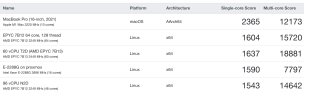
geekbenchLOL.jpeg

You really think a M1 max macbook is only ~17% slower in multithreading capability than a 48 core Epyc CPU? Do you have any examples of software running as fast on an iphone chip as a 9950x?

I could go find more, but I think the point is made. When you cross arch and OS, geekbench's results are terribly unreliable.
 
Source: trust me bro?

No, no need. To see how screwed Geekbench is, you need look no further than it's AMD and Intel comparisons a few years back. Geekbench heavily weighted AVX-512, when there was very little software for it, to give Intel a commanding lead over AMD chips. When Intel removed it, all of the sudden AVX-512 was no big deal.
And a few years before that, when AMD caught Intel flat footed on core counts, Geekbench proudly rigged the numbers again, stating ;more cores don't really count since not all the software uses them.

Geekbench is a huge joke.

You also might notice that when Techspot does CPU reviews, for some reason, Geekbench isn't used.
 
Last edited:
I wonder why if it's so good, Apple would only compare it to A15 in their slides. Improvements over A18 Pro are small in most cases so they ignored that comparison entirely. Not saying anything against it, as they are a great SoC but using geekbench across different OS and taking it seriosuly!

This is why I miss Anandtech.
 
I'm not sure how comparable are geekbench results between platforms and how well they reflect real life performance. I very much doubt both of them.
They say it is cross platform and that it uses real life workloads.
From what I can see it runs very small jobs 1-3s in single thread and maybe less than 1s on multithread tests with longer pauses between jobs. So very short, bursty workloads.
The more concerning thing is that it shows no memory impact whatsoever. Some of the multithreaded tests seem to only load 2 cores (coincidence?). running it in parallel with other small tasks, music streaming, an android emulator, does not seem to affect the score.
 
I wonder why if it's so good, Apple would only compare it to A15 in their slides. Improvements over A18 Pro are small in most cases so they ignored that comparison entirely. Not saying anything against it, as they are a great SoC but using geekbench across different OS and taking it seriosuly!

This is why I miss Anandtech.
Why would they compare it to last years in slides? People aren’t upgrading from the 16 to the 17, numbers from phones 2-5 years ago are more relevant. If you really want those numbers you can find them.
 
I'm not sure how comparable are geekbench results between platforms and how well they reflect real life performance. I very much doubt both of them.
They say it is cross platform and that it uses real life workloads.
From what I can see it runs very small jobs 1-3s in single thread and maybe less than 1s on multithread tests with longer pauses between jobs. So very short, bursty workloads.
The more concerning thing is that it shows no memory impact whatsoever. Some of the multithreaded tests seem to only load 2 cores (coincidence?). running it in parallel with other small tasks, music streaming, an android emulator, does not seem to affect the score.
I would say most workloads are short and bursty and lightly threaded. If you want numbers for a specific task rather than basic compute there are benchmarks for that.
 
I'd hope it could beat a Ryzen 9950X on TSMC N4P (part of N5-class), a full lithography node behind A19 Pro. Apple actually intended this A19 Pro design to use TSMC N2B, so it was actually backported to N3P once entire N2 lineup was delayed to 2026 (or late 2025). As the expected increase in density was absent, Apple was keen to avoid direct comparisons to A18 Pro on N3E.

Performance between the two nodes is around 5% favoring N3P, though N3P also improves power savings and density a smidge. If N3P chip runs at 10% lower power than N3E (iso clocks and such), you can also use that 10% savings to improve short-burst performance, like single-core operation. This may be what Apple did along with vapor chamber cooler, especially since thermals were already a limiting factor in repeated runs.

- My 15 Pro Max has overheated so many times, but at least iOS 26 adds an adaptive power mode. Its help text states that it reduces high drain on battery over long periods, but that's really code for: we need to reduce total SoC power on long running operations to prevent more overheating messes.
 
Last edited:
I'd hope it could beat a Ryzen 9950X on TSMC N4P (part of N5-class), a full lithography node behind A19 Pro. Apple actually intended this A19 Pro design to use TSMC N2B, so it was actually backported to N3P once entire N2 lineup was delayed to 2026 (or late 2025). As the expected increase in density was absent, Apple was keen to avoid direct comparisons to A18 Pro on N3E.

Performance between the two nodes is around 5% favoring N3P, though N3P also improves power savings and density a smidge. If N3P chip runs at 10% lower power than N3E (iso clocks and such), you can also use that 10% savings to improve short-burst performance, like single-core operation. This may be what Apple did along with vapor chamber cooler, especially since thermals were already a limiting factor in repeated runs.

- My 15 Pro Max has overheated so many times, but at least iOS 26 adds an adaptive power mode. Its help text states that it reduces high drain on battery over long periods, but that's really code for: we need to reduce total SoC power on long running operations to prevent more overheating messes.
However you’re comparing a 10W part to a 150W part. I would expect with all the extra power the 9950X sucks up it would beat a mobile chip
 
However you’re comparing a 10W part to a 150W part. I would expect with all the extra power the 9950X sucks up it would beat a mobile chip
Single thread chiplet power consumption on Ryzen 9950X is very small. Also good to remember Ryzen has no integrated (and non-expandable) memory.
 
Single thread chiplet power consumption on Ryzen 9950X is very small. Also good to remember Ryzen has no integrated (and non-expandable) memory.
“Very small” is still at least a 10x on what the A19 will be pulling. The entire A18 Pro SoC only pulls 11.5W which is all 6 cores and the GPU lit up and the 9950X pulls 31W on a single core.
 
“Very small” is still at least a 10x on what the A19 will be pulling. The entire A18 Pro SoC only pulls 11.5W which is all 6 cores and the GPU lit up and the 9950X pulls 31W on a single core.
I said chiplet power consumption on sincle core. That is only few watts maximum. FYI Ryzen 9950X is not designed on single core power consumption in mind. Your comparison is simply invalid. Take AMD monolithic CPUs or APUs for better comparison.
 
I said chiplet power consumption on sincle core. That is only few watts maximum. FYI Ryzen 9950X is not designed on single core power consumption in mind. Your comparison is simply invalid. Take AMD monolithic CPUs or APUs for better comparison.
Why are you changing the parameters now? The conversation is about the 9950X. Also AMDs APUs have worse single threaded performance vs their main line counterparts at the same power
 
Why are you changing the parameters now? The conversation is about the 9950X. Also AMDs APUs have worse single threaded performance vs their main line counterparts at the same power
I'm changing because comparing power consumption between cut down server CPU and mobile CPU is ultimately pointless. No-one cares at all.
 
I'm changing because comparing power consumption between cut down server CPU and mobile CPU is ultimately pointless. No-one cares at all.
Um… it’s not a cut down server CPU, a threadripper is a cut down server CPU. Ryzen is desktop, threadripper is HEDT and Epyc is sever.

Point is the mobile CPU has better single threaded performance than a top of the line desktop chip whilst using a fraction of the power. It also bodes well for apples M series chips and the desktop variants, specifically the Max and Ultra SKU which are actually designed to compete with desktop x86 chips, that is why people care.
 
Um… it’s not a cut down server CPU, a threadripper is a cut down server CPU. Ryzen is desktop, threadripper is HEDT and Epyc is sever.
🤦‍♀️

EPYCs use chiplets. Threadrippers use chiplets. Ryzen 9950X use chiplets.

AMD embedded chips / mobile chips / APUs do NOT use chiplets.
Point is the mobile CPU has better single threaded performance than a top of the line desktop chip whilst using a fraction of the power. It also bodes well for apples M series chips and the desktop variants, specifically the Max and Ultra SKU which are actually designed to compete with desktop x86 chips, that is why people care.
You can take basically any mobile chip and get much lower power consumption than desktop chip. This "single thread performance" is based on some stupid Geekbench that is not metric in any way.

And again, if power consumption is issue, then use something designed for low power consumption. Like mobile/laptop chips...
 
🤦‍♀️

EPYCs use chiplets. Threadrippers use chiplets. Ryzen 9950X use chiplets.

AMD embedded chips / mobile chips / APUs do NOT use chiplets.

You can take basically any mobile chip and get much lower power consumption than desktop chip. This "single thread performance" is based on some stupid Geekbench that is not metric in any way.

And again, if power consumption is issue, then use something designed for low power consumption. Like mobile/laptop chips...
Yet they’re different products because there’s more to their design than the base architecture. An epyc processor is not just a scaled up Ryzen cpu. Just because they all use Zen chiplets doesn’t means they’re the same thing.

I guess Cinebench is also useless then I guess?

You’re not getting the point. The M series is based off of the A series. The M series typically bumps up single core performance by about 5-10% and considering the M4 already destroys the 9000 series in single core that’s a promising thing for next gen Mac studios and pros that have M chips on the same generation as the A19. If the A series is now beating the latest from AMD in single core what’s going to happen with the M series which is allowed a higher power budget.
 
Yet they’re different products because there’s more to their design than the base architecture. An epyc processor is not just a scaled up Ryzen cpu. Just because they all use Zen chiplets doesn’t means they’re the same thing.
Epyc is scaled up Ryzen. And Ryzen is scaled down Epyc. Only difference between Epyc and Ryzen is amount of chiplets (depends on model) and depending on model) different IO die. There are even Epyc CPUs for AM5, and those have Same IO die AND Same chiplets that Ryzen use. So yes, Ryzen is scaled down Epyc or even exactly same thing with different name).

I guess Cinebench is also useless then I guess?

You’re not getting the point. The M series is based off of the A series. The M series typically bumps up single core performance by about 5-10% and considering the M4 already destroys the 9000 series in single core that’s a promising thing for next gen Mac studios and pros that have M chips on the same generation as the A19. If the A series is now beating the latest from AMD in single core what’s going to happen with the M series which is allowed a higher power budget.
I'm getting the point. You are first comparing server CPU against mobile CPU for power consumption. Then you try to ignore fact that mobile chip has embedded (and non-expandable) memory and server CPU does not.

There is absolutely nothing special about Apple CPUs, outside integrated DRAM that makes impossible to expand memory. That is reason AMD and Intel reserves that solution for other than laptops or desktops.
 
Back