Apple and AMD now each hold about 20% of the laptop CPU market

Daniel Sims

Posts: 2,422   +73
Staff
Winners & losers: Sales charts have long shown that AMD is steadily siphoning Intel's CPU market share. However, recent analysis indicates that Apple's transition toward in-house Arm-based processors has compounded the effect, and the Cupertino giant's notebook CPUs are now nearly as successful as Team Red's.
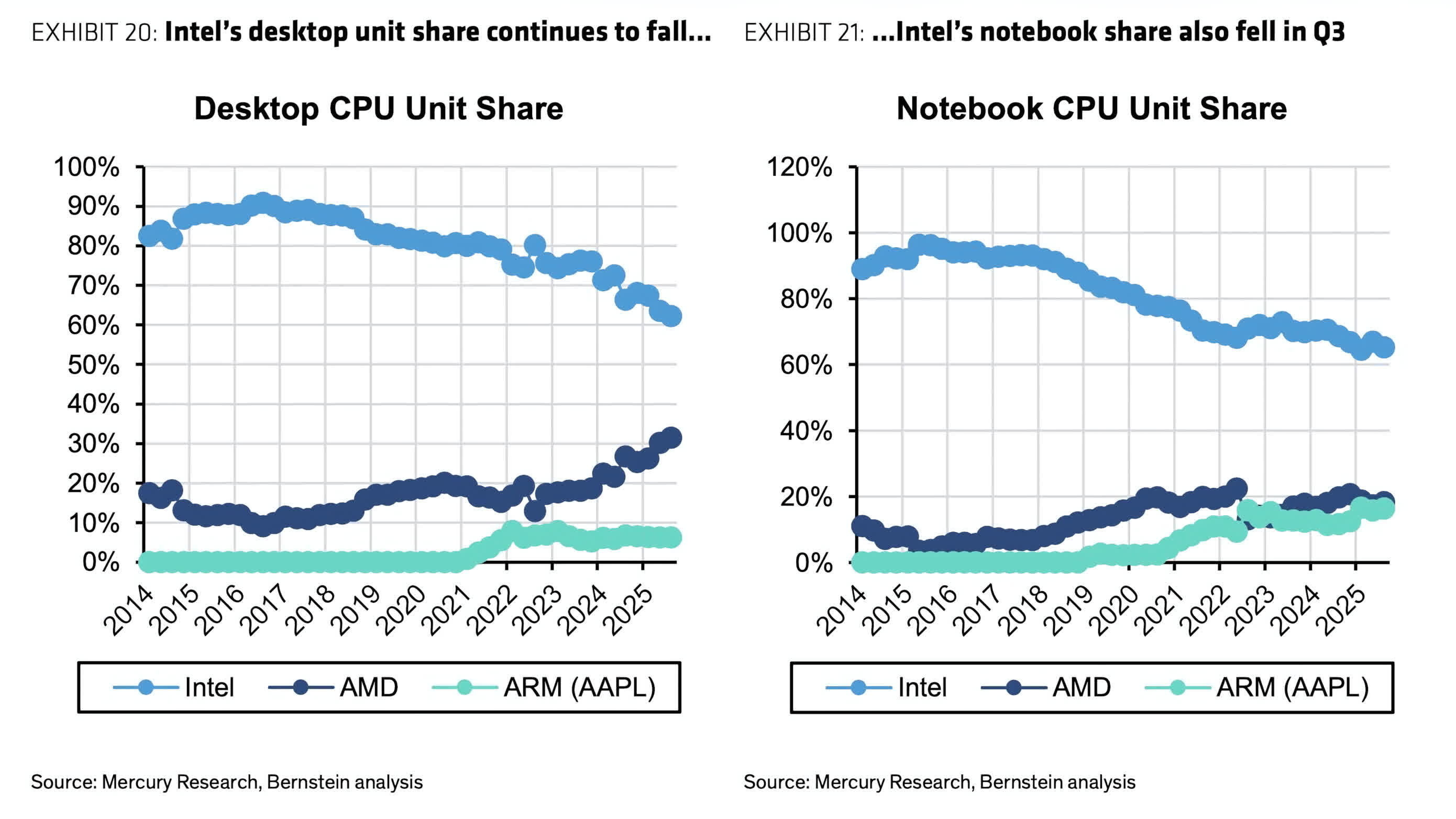
According to recent data from Mercury Research and Bernstein Research obtained by Citrini Research, Apple's laptop CPU market share has reached approximately 20%, matching AMD's. Combined, the two companies have dragged Intel's share down by over 20% since 2018. A similar situation has occurred in the desktop sector, although AMD's impact there is significantly more pronounced than Apple's.

Before 2018, Intel sold roughly 90% of desktop CPUs and over 80% of notebook CPUs. Although the company still commands a 60% market share in both segments, AMD has been chipping away at them since it introduced its Zen processors in 2017. Apple's decision to shift away from Intel chips to design its own has accelerated Chipzilla's decline.

AMD's desktop CPU market share growth intensified in 2022, when it began introducing its fourth-generation Zen processors to compete with Intel's Alder Lake and Raptor Lake. Amid controversy stemming from stability issues, Intel's consumer CPUs have been described as stagnant, with no response to AMD's successful 3D V-Cache technology. Fifth-generation Zen chips have almost entirely dominated recent sales charts, and AMD's CPUs now account for more than 40% of Steam users.

Meanwhile, Apple's M-Series processors have occupied a stable 10% of the desktop market since the company introduced the M2 line in 2022. The number likely represents the portion of desktop users who had always preferred Macs as they gradually retired their Intel models.

In contrast, MacBook sales appear to be increasing, contributing to a sharper downturn in the notebook market for Intel. Chipzilla's recently released Core Ultra 3 series (Panther Lake) processors, the first fabricated on its 2nm-class 14A node, aim to resist intensifying competition from AMD's new Ryzen AI 400 lineup and Apple's M5.

While Apple currently represents virtually the entire Arm CPU market in Mercury's latest data, future reports might show an impact from emerging players such as Qualcomm and Nvidia. Qualcomm launched a series of chips for Arm-based Windows laptops in 2024, and Nvidia is expected to follow suit soon. However, user enthusiasm for the emerging platform remains unclear.

Permalink to story:

 
And soon Nvidias N1/N1X will eat marketshare too. ARM generally eats marketshare even in the servermarket.

Intel faces alot of competition these days and Nova Lake will be very important for Intel. Sadly there is a RAM crisis on top.

Both Intel and AMD probably needs ARM alternatives in the coming years.
 
Apple's shipments have not noticeable increased. From 2019 to 2024, they have remained around 9.5-10% of all laptop shipments per year.

This graph merely shows the retiring of intel models being replaced with ARM models, not some significant increase in Apple ownership.
 
Apple's shipments have not noticeable increased. From 2019 to 2024, they have remained around 9.5-10% of all laptop shipments per year.

This graph merely shows the retiring of intel models being replaced with ARM models, not some significant increase in Apple ownership.

True, market share is an imperfect metric. But then, nearly all metrics, in a vacuum, fail to give a truly meaningful picture of things.
 
Both Intel and AMD probably needs ARM alternatives in the coming years.
Do they?
ARM vs x86 makes little difference when it comes to efficiency. Nothing stopping AMD/Intel from making a soc with everything and the kitchen sink like Apple does. 95% of the efficiency gains without any of the compatibility problems.

It would be funny if Intel and AMD joined forces to push RISC though, standardize some accelerators for common use cases. Make a push for the mobile market to get rid of ARMs market dominance there.
 
Do they?
ARM vs x86 makes little difference when it comes to efficiency. Nothing stopping AMD/Intel from making a soc with everything and the kitchen sink like Apple does. 95% of the efficiency gains without any of the compatibility problems.

It would be funny if Intel and AMD joined forces to push RISC though, standardize some accelerators for common use cases. Make a push for the mobile market to get rid of ARMs market dominance there.
Most of Apple's efficiency comes from Asics and seamless integration between hardware and software.


@Topic. Apple has always had this market share.
 
Do they?
ARM vs x86 makes little difference when it comes to efficiency. Nothing stopping AMD/Intel from making a soc with everything and the kitchen sink like Apple does. 95% of the efficiency gains without any of the compatibility problems.

It would be funny if Intel and AMD joined forces to push RISC though, standardize some accelerators for common use cases. Make a push for the mobile market to get rid of ARMs market dominance there.
ARM is more efficient, especially when apps/games are optimized for ARM.

You know ARM is gaining server marketshare too right? ARM gains marketshare everywhere, every market, x86 is under pressure in several markets

x86 needs e-cores to even come close.

Intel and AMD already joined forces to make x86 relevant vs ARM, they feel the pressure. Yet they still spend R&D funds on ARM tech, so they won't be caught with their pants down

Nvidia will release N1/N1X soon. ARM + RTX (5070 level)
Snapdragon based Windows laptops, would also be relevant if price was better, they are pretty good, just like Apple, which have massive succes with own ARM based chips as well

Intel has already showcased reference an ARM based SOC with Xe GPU
AMD also have Sound Wave, ARM based APU with RDNA 3.5

If you think ARM has no future, I have bad news
 
Last edited:
ARM is more efficient, especially when apps/games are optimized for ARM.
The difference is very minor. For desktop use irrelevant even.
For laptop use it's a nice bonus, but if things have to be emulated or just the graphics part of the SOC not having mature drivers it's a whole lot less efficient. As for the graphics part, that won't apply to NVIDIA's impending ARM release.

You know ARM is gaining server marketshare too right? ARM gains marketshare everywhere, every market, x86 is under pressure in several markets
Arm scales 'down' a lot better, if you need many weaker cores which is sometimes the case in servers it's a better pick.

Intel and AMD already joined forces to make x86 relevant vs ARM, they feel the pressure. Yet they still spend R&D funds on ARM tech, so they won't be caught with their pants down
Never put all your eggs in one basket, it's the smart thing to do. They both also spend R&D on RISC-V (heck afaik they even use it for some micro controller level stuff).

Snapdragon based Windows laptops, would also be relevant if price was better, they are pretty good, just like Apple, which have massive succes with own ARM based chips as well
But the price isn't better. They make for an interesting alternative and if they want marketshare they should compete on price but they don't.

If you think ARM has no future, I have bad news
Depending on how the company acts it should have a future. But ARM ironically keeps shooting themselves in the FOOT by how they behave making all the big players that are invested in it have RISC-V side projects. Just in case ARM takes it one step too far (keeping them at an ARMs-length as it were).
Okay, enough wordplay

For desktop I don't see much of a future unless NVIDIA just artificially creates a demand by selling graphics cards at ever increasing prices whilst simultaneously selling desktop SOCs at much better prices for the same performance. (Or more likely, just completely stop selling graphics cards that aren't simply badly binned AI-SKUs which would probably mean no 50s,60s,70ss class cards whatsoever).
For laptop, if they can get emulation to work as efficiently as Apple has ARM/X86 can co-exist.
For server they already have a market and the more we're moving towards consolidating towards a mostly Google/Meta/Amazon/Microsoft landscape on that end the more successful they'll likely be (they can play around with ARM themselves, but they can't play around with x86 [due to licensing]).

--

The point I was making is that the architecture part of the equation has a relatively small impact on the efficiency (unless scaling all the way down to many low performance cores). Most of the efficiency gains come from putting everything on the soc or much closer to it compared to x86 where we historically have things modular so that we can add our PCI-E devices and RAM etc.

imo the biggest *****s are AMD, they have had all the cards to make kickass gaming SOCs which would have allowed for tiny, power efficient, cost effective gaming PCs and handhelds but they kept putting in minimum effort. They could have done that what they do for consoles for the regular market but they never invested heavily in it and always half-assed it. Now NVIDIA will show them how they should have done it - just on ARM
 
The difference is very minor. For desktop use irrelevant even.
For laptop use it's a nice bonus, but if things have to be emulated or just the graphics part of the SOC not having mature drivers it's a whole lot less efficient. As for the graphics part, that won't apply to NVIDIA's impending ARM release.


Arm scales 'down' a lot better, if you need many weaker cores which is sometimes the case in servers it's a better pick.


Never put all your eggs in one basket, it's the smart thing to do. They both also spend R&D on RISC-V (heck afaik they even use it for some micro controller level stuff).


But the price isn't better. They make for an interesting alternative and if they want marketshare they should compete on price but they don't.


Depending on how the company acts it should have a future. But ARM ironically keeps shooting themselves in the FOOT by how they behave making all the big players that are invested in it have RISC-V side projects. Just in case ARM takes it one step too far (keeping them at an ARMs-length as it were).
Okay, enough wordplay

For desktop I don't see much of a future unless NVIDIA just artificially creates a demand by selling graphics cards at ever increasing prices whilst simultaneously selling desktop SOCs at much better prices for the same performance. (Or more likely, just completely stop selling graphics cards that aren't simply badly binned AI-SKUs which would probably mean no 50s,60s,70ss class cards whatsoever).
For laptop, if they can get emulation to work as efficiently as Apple has ARM/X86 can co-exist.
For server they already have a market and the more we're moving towards consolidating towards a mostly Google/Meta/Amazon/Microsoft landscape on that end the more successful they'll likely be (they can play around with ARM themselves, but they can't play around with x86 [due to licensing]).

--

The point I was making is that the architecture part of the equation has a relatively small impact on the efficiency (unless scaling all the way down to many low performance cores). Most of the efficiency gains come from putting everything on the soc or much closer to it compared to x86 where we historically have things modular so that we can add our PCI-E devices and RAM etc.

imo the biggest *****s are AMD, they have had all the cards to make kickass gaming SOCs which would have allowed for tiny, power efficient, cost effective gaming PCs and handhelds but they kept putting in minimum effort. They could have done that what they do for consoles for the regular market but they never invested heavily in it and always half-assed it. Now NVIDIA will show them how they should have done it - just on ARM
Yeah agree

I think AMD will make better APUs soon. Especially when Nvidia N1 series hit.

If AMD could make some APU with X3D CPU cores (6-8 P-Cores + RDNA 4+ (for FSR 4 support, with the power of a 9060 XT or 9070 NON-XT minimum) I think it will sell in huge numbers I think but probably be too much to ask before they use TSMC 3nm or better

However, looking at the Steam Machine specs, this is probably too hard/expensive to do "yet"

I find it strange Steam Machine only gets RDNA 3, with no FSR 4 support - hopefully it will be some custom variant which can do FSR 4 anyway (hopefully not by FP8 emulation)

It is insane to release a "console" / pc that will rely heavily on upscaling, but with no FSR 4 support.

I have a Radeon 9070 in my HTPC and the difference between FSR 3.1 and 4 is day vs night. I never used FSR 1/2/3 due to visual quality. FSR 4 is fine tho.
 
Last edited:
If AMD could make some APU with X3D CPU cores (6-8 P-Cores + RDNA 4+ (for FSR 4 support, with the power of a 9060 XT or 9070 NON-XT minimum) I think it will sell in huge numbers I think but probably be too much to ask before they use TSMC 3nm or better
It seems so obvious to me.
They were the first with both an x86 license and good graphics. They were the first with tiles, they were the first with X3D cache, their infinity cache seems great at offsetting low bandwidth memory.

Now throw all these ideas together. Have the latest generation of CPU and GPU tech. Make a proper tiled soc - CPU, GPU, use X3D for the infinity cache or stick a tile on there that's memory. If DDR5 isn't sufficient just do it like the steam deck and have a reference design where memory (the faster the better) is used for both CPU and GPU.

Have at least 2 versions, one targeting 60 class performance with 6 cores but imo if 4 can be done much cheaper it's an option. That can service basically the entire handheld and laptop segment. Then have a bigger, better certain with 8 cores and as much performance as possible without hitting deminishing returns on the price too hard. That can serve laptops and desktops and if the RAM can scale up without affecting the clock speeds probably a whole bunch of AI bros and AI developers. I'm confident this could have been done at prices much lower than we currently have for more modular hardware.
They should have started on this at least 2 years ago and then both Intel and NVIDIA would get sidelined from entire market segments.

Sadly AMD is AMD and has done surprisingly little since their big Zen moment. They should have used the momentum to put all their strengths together and try to push Nvidia out of the low end market segment which they clearly have had little interest in.
 
It seems so obvious to me.
They were the first with both an x86 license and good graphics. They were the first with tiles, they were the first with X3D cache, their infinity cache seems great at offsetting low bandwidth memory.

Now throw all these ideas together. Have the latest generation of CPU and GPU tech. Make a proper tiled soc - CPU, GPU, use X3D for the infinity cache or stick a tile on there that's memory. If DDR5 isn't sufficient just do it like the steam deck and have a reference design where memory (the faster the better) is used for both CPU and GPU.

Have at least 2 versions, one targeting 60 class performance with 6 cores but imo if 4 can be done much cheaper it's an option. That can service basically the entire handheld and laptop segment. Then have a bigger, better certain with 8 cores and as much performance as possible without hitting deminishing returns on the price too hard. That can serve laptops and desktops and if the RAM can scale up without affecting the clock speeds probably a whole bunch of AI bros and AI developers. I'm confident this could have been done at prices much lower than we currently have for more modular hardware.
They should have started on this at least 2 years ago and then both Intel and NVIDIA would get sidelined from entire market segments.

Sadly AMD is AMD and has done surprisingly little since their big Zen moment. They should have used the momentum to put all their strengths together and try to push Nvidia out of the low end market segment which they clearly have had little interest in.
Yeah I think AMD is too limited because of TSMCs output.

AMD don't want to push consumer graphics, because it eats away at their CPU/APU output, which is limited at TSMC.

Pretty much every top brand, Nvidia, AMD, Apple hell even Intel now, is pretty much depending on TSMC

We need that Intel 18A/14A alternative
 
Back