AMD keeps gaining on Intel in servers, but desktop PCs tell a different story

midian182

Posts: 11,708   +177
Staff member
What just happened? AMD has hit another x86 CPU milestone, with Mercury Research figures showing the company now holds 38.1% of overall market revenue. That sounds like another win for Team Red, especially given its huge gains in servers, but there is a surprising caveat: AMD actually lost ground in desktop PCs during the first quarter.
Mercury Research's Q1 2026 numbers show AMD reaching 46.2% of x86 server CPU revenue, a new record for the company. Its server unit share climbed to 33.2%, underlining how Epyc continues to gain traction in cloud, enterprise, and AI infrastructure deployments.

The gap between revenue share and unit share also suggests AMD is doing especially well in higher-value server chips, rather than simply shipping more lower-cost parts.

That helps explain why AMD's overall x86 revenue share keeps climbing. The company has spent years eating into Intel's most profitable markets, and the AI boom has only made high-core-count, high-margin server processors more important. Intel still leads the x86 server market overall, but AMD is now much closer than it has been at any point in the modern Epyc era.
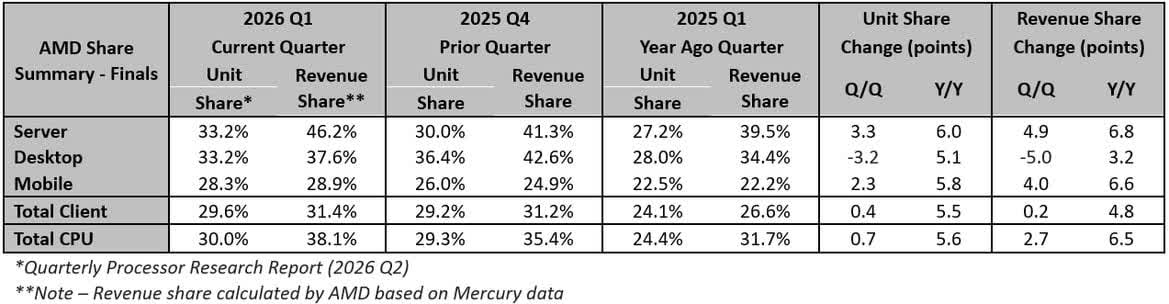
Client CPUs were more of a mixed bag. AMD's overall client unit share rose to 29.6%, up from 29.2% in Q4 2025 and 24.1% a year earlier. That still leaves Intel with 70.4% of the consumer PC market, but the year-over-year direction is clear.

The gap between revenue share and unit share also suggests AMD is doing especially well in higher-value server chips, rather than simply shipping more lower-cost parts.

The desktop PC segment is where the numbers falter. AMD's desktop unit share fell to 33.2% in Q1, down from a record 36.4% in the previous quarter. Desktop revenue share also slipped to 37.6%, down from around 42.5% in Q4. Those are still strong results compared with the same period last year, when AMD held 28% of desktop unit share, but the QoQ decline stands out.

Laptops were a much brighter spot for Lisa Su's firm. AMD's mobile unit share rose to 28.3%, while mobile revenue share reached 28.9%, both up sequentially. That suggests the company is finally pushing further into a market where Intel has traditionally dominated.

The figures also contrast with the latest Steam survey, where AMD's CPU gains among participants stalled rather than reversed. Participants using AMD CPUs rose by just 0.01% in April, leaving it around 11% behind Intel after more than a year of steady progress. Steam is not a market-share report, of course, though the timing is interesting: gamers still love AMD's X3D chips, but Intel's Core Ultra 200 Plus arrived in March to rave reviews.

Permalink to story:

 
Personally, instead of raising their prices beyond those of Intel in the enthusiast CPU market, AMD should price their CPUs below that of similar models from Intel. Why? Why not? I bet that AMD would sell more processors that way even if their CPUs perform worse than similar Intel models.

As an enthusiast partial to AMD, I'm growing tired of the constant race to the top of pricing between AMD and Intel.

That said, I get it! If you have the better processor, that/those processor(s) are worthy of higher prices, but higher prices dissuade enthusiasts from buying those processors and will push them toward processors from the competition that are priced lower even if the lower priced processors do not perform as well.

If you want enthusiasts to buy your processors, offer them unbeatable value/pricing over the competition and stop playing "market" games. Please your customers, not your shareholders and shareholder pleasure will surely follow.
 
Personally, instead of raising their prices beyond those of Intel in the enthusiast CPU market, AMD should price their CPUs below that of similar models from Intel. Why? Why not? I bet that AMD would sell more processors that way even if their CPUs perform worse than similar Intel models.

I think they're basically selling everything they have... so they'll price them as high as possible :(

As an enthusiast partial to AMD, I'm growing tired of the constant race to the top of pricing between AMD and Intel.

Agreed - alas, I'm sure both companies don't care what we think and are concerned about the bottom line.

That said, I get it! If you have the better processor, that/those processor(s) are worthy of higher prices, but higher prices dissuade enthusiasts from buying those processors and will push them toward processors from the competition that are priced lower even if the lower priced processors do not perform as well.

I wish that was true... it WOULD be in a "normal" world, but with so many shortages, people are snapping up everything they can get... it's a seller's dream - and a buyer's nightmare.

If you want enthusiasts to buy your processors, offer them unbeatable value/pricing over the competition and stop playing "market" games. Please your customers, not your shareholders and shareholder pleasure will surely follow.
This is true in the long run - alas, companies are far more concerned with the next quarter's earnings - assuming (often rightly), that the future won't be their problem anyways...
 
Personally, instead of raising their prices beyond those of Intel in the enthusiast CPU market, AMD should price their CPUs below that of similar models from Intel. Why? Why not? I bet that AMD would sell more processors that way even if their CPUs perform worse than similar Intel models.

As an enthusiast partial to AMD, I'm growing tired of the constant race to the top of pricing between AMD and Intel.

That said, I get it! If you have the better processor, that/those processor(s) are worthy of higher prices, but higher prices dissuade enthusiasts from buying those processors and will push them toward processors from the competition that are priced lower even if the lower priced processors do not perform as well.

If you want enthusiasts to buy your processors, offer them unbeatable value/pricing over the competition and stop playing "market" games. Please your customers, not your shareholders and shareholder pleasure will surely follow.
They make more per mm^2 selling to the Enterprise market than they do to gamers. And we are kinda stuck with AM5 right now for probably another generation which kinda sucks outside of gaming. You basically have to go threadripper of you want to do anything other than gaming due to the PCI limitation. With m.2 as popular as it is AM6 is going to need at least 32 PCie lanes that are fully accessable by the user.

I'm probably the odd one out in these forums, but the main reason I'm still rocking a 5800X3D in my desktop and 5900Xs in the rack is that AM5 doesn't really offer much outside of gaming. If RAM wasn't stupid expensive I would have probably went with a 9800X3D by now, but those 5900xs have a few more years in the rack
 
They make more per mm^2 selling to the Enterprise market than they do to gamers. And we are kinda stuck with AM5 right now for probably another generation which kinda sucks outside of gaming. You basically have to go threadripper of you want to do anything other than gaming due to the PCI limitation. With m.2 as popular as it is AM6 is going to need at least 32 PCie lanes that are fully accessable by the user.

I'm probably the odd one out in these forums, but the main reason I'm still rocking a 5800X3D in my desktop and 5900Xs in the rack is that AM5 doesn't really offer much outside of gaming. If RAM wasn't stupid expensive I would have probably went with a 9800X3D by now, but those 5900xs have a few more years in the rack
Well, if rumours are true, Intel next gen LGA1954 socket CPU will have same PCIe config that AM5 has (PCIe 5.0 x16 + 2*PCIe 5.0 x4 (for storage) + PCIe 5.0 x4 (for chipset).

Even Intel does not want to offer more than 28 lanes on CPU. Easy explanation: desktop users may use chipset lanes for M.2 and if they really need more, then they either sacrifice some lanes from video card or buy HEDT platform.

Pretty funny you say AM5 does not offer much outside gaming when Ryzen 9000 series is pretty much biggest improvement outside gaming between two generations on this century " (y) (Y)" Ability to run AVX512 code without clock speed deficit easily grants high double digit performance benefits with just recompiling.
 
Some people in position to buy or recommend PC buy still have prejudice against AMD. Recently I came to a checklist of items to install a equipment at work, and it asked specifically for a old Intel (i7 with DDR3...) CPU. I installed it provisionally on a more modern AMD system and the equipment's program run just fine.

I then recommended a cheap AMD mini-desktop for a buy but my coworker refused, because the checklist was asking for a Intel one. Then she send a e-mail for the seller about system configuration, and a representative insisted it must be a Intel PC, because "a AMD couldn't run it". I then offered to show her the program working just fine on a Ryzen 5 APU, and she simply refused to see it (typical woman when they cannot accept they are wrong...). The actual manufacturer's website just asked for a PC with Windows 10 or 11, and the program even had a version for Android, so it was super light to run.

Long story short she finally caved, because the newer configuration with a Intel CPU and a Nvidia GPU the representative was insisting on, was a total overkill and about 3x the price the config I was recommending.
 
Does Intel list their margin percentage on desktop CPUs? They obviously were selling the 265k near the $500 mark for a reason. I think the 270k and 250k were done for just the reason the article is written, to show Intel can still make processors you want to buy and claw back desktop market share.
What I don't get is how they can make a better chip, more cores, still using TSMC and paying them, and sell it for about half price? It's kind of like building additional fabs, you have to price the products to make a profit at least. Doesn't matter how many cpus you can sell if you loose money on every one.

Dose anyone know if 18A fab(s) are running at capacity? If not, why are they not using them for their own chips first?
 
Dose anyone know if 18A fab(s) are running at capacity? If not, why are they not using them for their own chips first?
Pretty sure those fabs don't have the yield rates that TSMC's do... Hard to find concrete data as it's not something they'd want people to know if true.
 
They make more per mm^2 selling to the Enterprise market than they do to gamers. And we are kinda stuck with AM5 right now for probably another generation which kinda sucks outside of gaming. You basically have to go threadripper of you want to do anything other than gaming due to the PCI limitation. With m.2 as popular as it is AM6 is going to need at least 32 PCie lanes that are fully accessable by the user.

I'm probably the odd one out in these forums, but the main reason I'm still rocking a 5800X3D in my desktop and 5900Xs in the rack is that AM5 doesn't really offer much outside of gaming. If RAM wasn't stupid expensive I would have probably went with a 9800X3D by now, but those 5900xs have a few more years in the rack
If you need to run multiple pcie devices at once, then you need to buy the platform that supports it. That's threadripper.

Consumer cpus can run 2 ssds at full bandwidth or 4-5 with shared bandwidth, and a full GPU. They don't need anything else anymore.

If cost of threadripper is an issue, guess what would happen if you put threadripper pcie lane count on socket am6? That's right, price would go UP. For something 99% do not need.
 
Personally, instead of raising their prices beyond those of Intel in the enthusiast CPU market, AMD should price their CPUs below that of similar models from Intel. Why? Why not? I bet that AMD would sell more processors that way even if their CPUs perform worse than similar Intel models.

As an enthusiast partial to AMD, I'm growing tired of the constant race to the top of pricing between AMD and Intel.

That said, I get it! If you have the better processor, that/those processor(s) are worthy of higher prices, but higher prices dissuade enthusiasts from buying those processors and will push them toward processors from the competition that are priced lower even if the lower priced processors do not perform as well.

If you want enthusiasts to buy your processors, offer them unbeatable value/pricing over the competition and stop playing "market" games. Please your customers, not your shareholders and shareholder pleasure will surely follow.
Yeah, they should price their superior products below the competitor's, because "why not", that makes a lot of sense.

Not.
 
Chiming in with minor facts not everyone's aware of:

The people who run Intel and AMD are vultures that intend to use their customers' money for smoking cuban sigars in the back of their hyperexpensive cars while brushing their teeth with Dom Perignon. Which they do.

Sure the products are useful, but the people involved are not your friends.

Want one of those people in a good mood? Say the word "fanboys" to them for a moment of hilarity and smiles.

Hope this helps. Probably won't, hahaha.
It would not surprise me to learn there are people who buy these products in order to support one of these companies while 'hurting' the other.
 
The revenue vs unit share gap in servers is the big stat here. AMD isn't just winning slots... they're winning the expensive slots.

When hyperscalers are choosing your highest-core-count parts over Intel's, that's a completely different kind of market share than selling more $100 Ryzen 3 chips.
 
The Steam survey having AMD at ~11% behind Intel while Mercury shows AMD at 33% desktop unit share is one of those beautiful reminders that Steam users are not "PC users" but a more specific slice of enthusiast gamers.
 
Back