What just happened? Astronomers have identified what may be the largest black hole ever discovered – one with a mass 36 billion times that of our Sun. Located at the center of the Cosmic Horseshoe galaxy, roughly 5 billion light-years from Earth, this colossal black hole is nearly 10,000 times more massive than the one at the heart of our own Milky Way.
Scientists from the University of Portsmouth and the Federal University of Rio Grande do Sul in Brazil collaborated on the study, which was published in the Monthly Notices of the Royal Astronomical Society.
The Cosmic Horseshoe galaxy is remarkable for its immense mass, which bends light from an even more distant galaxy. This phenomenon, known as an Einstein ring, is what inspired the galaxy's name.
Researchers believe that supermassive black holes of this size are typically found in the largest galaxies in the universe, known as fossil group galaxies – remnants of several smaller galaxies that have merged over time. The Cosmic Horseshoe is the sole bright galaxy remaining in its group, suggesting it has consumed others in the past.
To measure the black hole's mass, astronomers used two techniques. The first, gravitational lensing, examines how the galaxy's gravity bends passing light. The second, stellar kinematics, analyzes the speed and movement patterns of stars near the black hole.
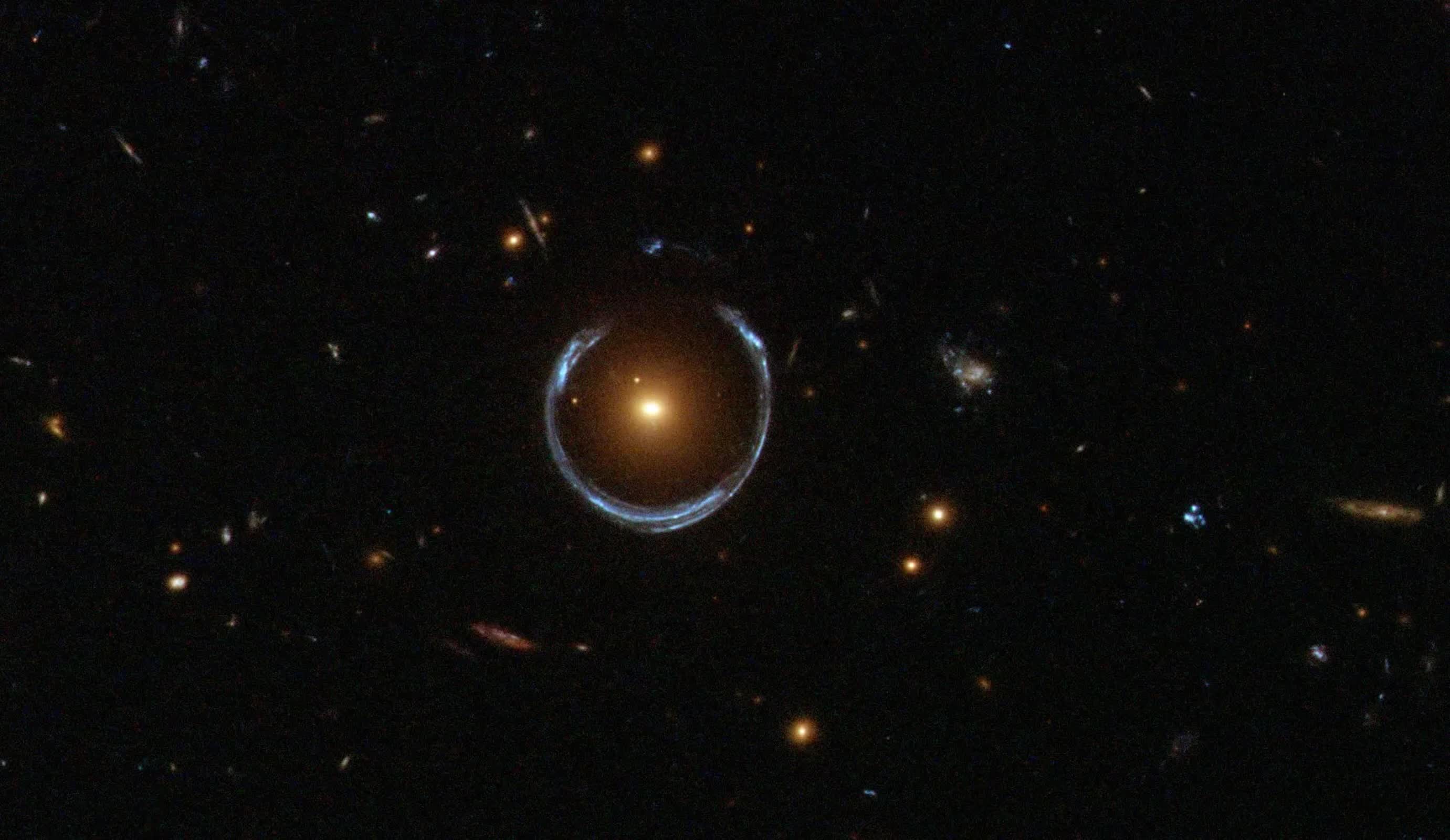
The Cosmic Horseshoe, one of the best examples of an Einstein Ring, is a lensed galaxy formed by the precise alignment of two galaxies.
Usually, tracking the movement of stars is the most reliable way to measure a black hole's mass, but this method becomes less effective for very distant galaxies. By combining stellar kinematics with gravitational lensing, the team was able to measure the mass of the black hole much farther away than is typically possible.
"This is amongst the top 10 most massive black holes ever discovered, and quite possibly the most massive," said Professor Thomas Collett from the University of Portsmouth, one of the paper's authors.
Collett explained that most methods for weighing black holes are indirect and often uncertain, so scientists rarely know exactly which is the biggest. "However, we've got much more certainty about the mass of this black hole thanks to our new method," he said.
The black hole is currently dormant, meaning it is not actively feeding on new material – making its discovery even more remarkable. "This discovery was made for a dormant black hole – one that isn't actively accreting material at the time of observation," said lead researcher Carlos Melo from UFRGS. "Its detection relied purely on its immense gravitational pull and the effect it has on its surroundings."
Melo noted that their approach could help scientists uncover and measure other hidden, ultramassive black holes across the universe, even when those black holes are silent.
The team believes the black hole in the Cosmic Horseshoe grew to its extreme size through a series of galaxy mergers. In such systems, galaxies – and the black holes at their centers – combine over time, eventually forming a single ultramassive black hole.
"It is likely that all of the supermassive black holes originally in the companion galaxies have now merged to form the ultramassive black hole we have detected," Collett said. "We're seeing the end state of galaxy formation and the end state of black hole formation."
This discovery reveals a black hole near the theoretical upper limit for mass and demonstrates a powerful new way to find others like it. The team now plans to use their method with data from the European Space Agency's Euclid telescope to search for more hidden giants and study how such black holes shape the growth and evolution of galaxies.
Astronomers spot black hole 36 billion times the mass of the Sun


 that skim through the surface of a blue supergiant ~ SGU S2E19
