California tests smart freeway that could make drivers wait four minutes to merge

midian182

Posts: 11,708   +177
Staff member
In a nutshell: Nobody likes a freeway that's so congested it resembles a parking lot. The usual solution is to widen the road, but that comes with huge costs and lengthy disruptions. In California, transportation officials are piloting a much cheaper option: a "smart freeway" that uses an algorithm to control the flow of cars and offer suggested speeds.
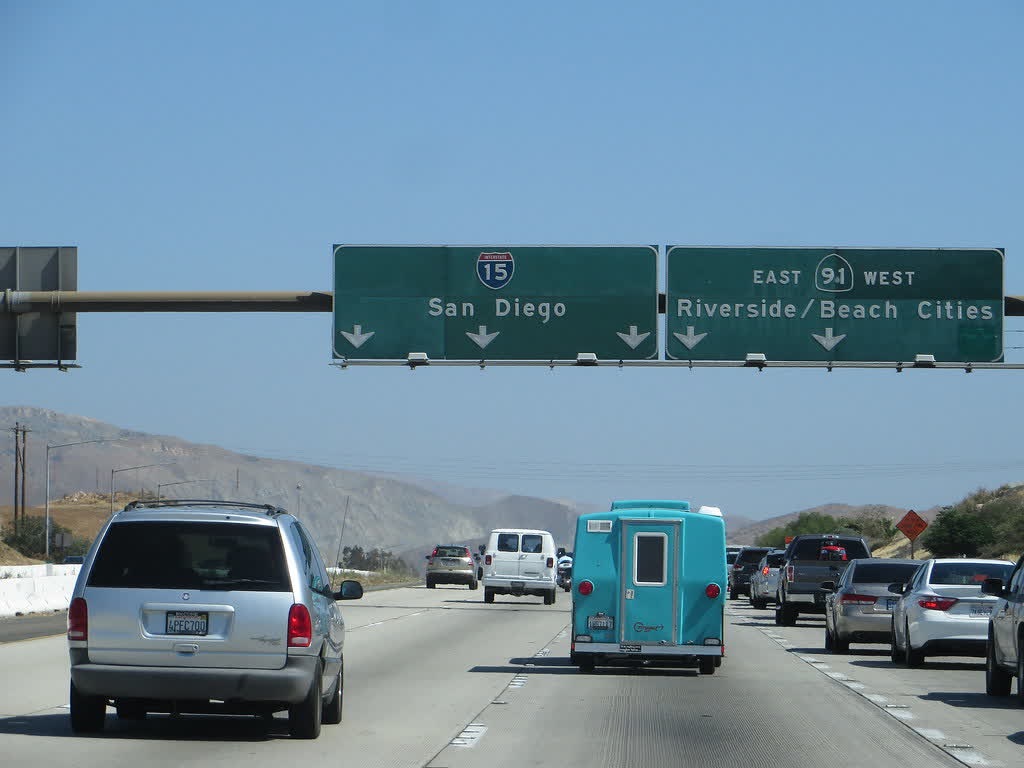
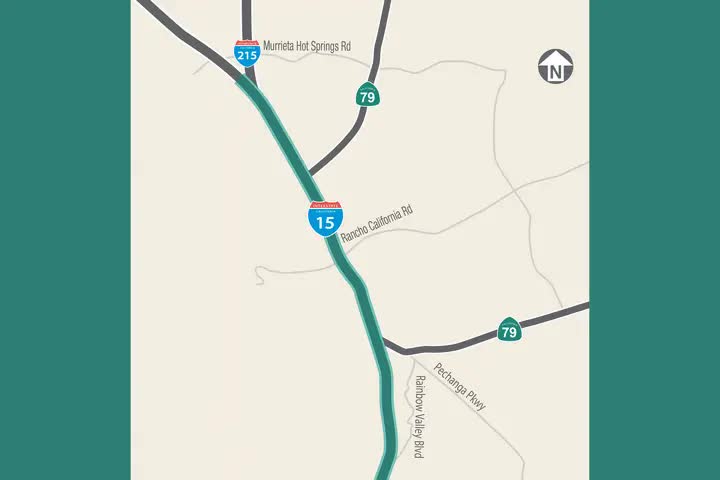
The Riverside County Transportation Commission launched the smart freeway on an eight-mile stretch of the northbound lanes of Interstate 15 in Temecula on June 1.

SFGate reports that three on-ramp meters at Temecula Parkway, Rancho California Road, and Winchester Road are now managed by an algorithm. Unlike typical ramp meters, which operate on short fixed cycles, these determine when vehicles should be allowed to enter the freeway. That means drivers could end up waiting four minutes or more before being allowed to merge into traffic.

While four minutes is a lot longer than a few seconds, transportation officials believe the system will improve traffic flow and reduce stop-and-go traffic. Ultimately, this should reduce the amount of time people spend on the freeway, allowing them to reach their destination faster than they would with traditional on-ramp meters.
The project cost $33 million and will run for two years. Riverside County Transportation Commission spokesperson David Knudsen told SFGate that if the pilot is successful, it will be deployed elsewhere in the county and could make its way to other traffic choke points in California.

"This system is a lot less expensive than trying to build new lanes, and so the idea here is let's make the system that we have work better," Knudsen said.

It's noted that the stretch of freeway that connects Temecula at the Riverside/San Diego County line to the Interstate 215 interchange in Murrieta is notorious. It's only a 10-minute drive – if there were no traffic – but during afternoon peak periods, drivers can spend 25 to 45 minutes traveling through this section.

There are understandable concerns that this could be seen as AI being used to control something potentially dangerous, but Knudsen emphasized that the system is not managed by artificial intelligence. Instead, it uses advanced sensors in the roadway to monitor real-time traffic conditions and make adjustments.

"The intent is to create a consistent flow of traffic on the freeway system, and the coordinated ramp metering among the three on-ramps […] will help do that," Knudsen explained.

This isn't the first use of smart freeways. Similar smart freeway technology was introduced in Australia in 2020. It was also used on Interstate 25 in Denver and other freeways across the state. The results appear promising, too: in Australia, travel times fell between 35% and 65%, and they were down around 20% in Denver.

Image credit: Ken Lund

Permalink to story:

 
Click baity as hell

""That means drivers could end up waiting four minutes or more before being allowed to merge into traffic.""

""COULD"" .. not will .. and in peak traffic where you CAN'T merge for 10 minutes anyways there no difference.
 
The problem is that like most ideas to fix things, they haven't bothered to look at the root cause. I've seen more problems from people cutting people off to get over and drivers going 30mph under the speed limit (spaced across all lanes and distances) while on their cell phones. Let not even get into the courtesy (slower traffic on the left, lack of turn signals, road rage, Indy 500 drivers) that was supposed to be taught to drivers, that now is a distant memory.

Bottom line is that you can delay on ramp entry for 30 min, and it won't solve the problem of "every man for himself" that has taken over the highway system.
 
Click baity as hell

""That means drivers could end up waiting four minutes or more before being allowed to merge into traffic.""

""COULD"" .. not will .. and in peak traffic where you CAN'T merge for 10 minutes anyways there no difference.
I mean, if it works, take the facts at face value

Right now, the worst case trip is reportedly 45 minutes, and the best case is 10 minutes. If holding people on the ramp for ~5 minutes gets you the best case 100% of the time, that is still a net win at 15 minutes of travel time. If it "only" gets you a 30 minute trip with a 5 minute ramp delay, that is still a win.

So we'll see how this experiment goes. It sounds like all they did was add some extra sensors to the existing system, wire it all together, and are going to be playing with some algorithms to control the signals. If it works, it will be a lot faster to expand and deploy this system than adding lanes to a highway.
 
Transportation Agency: "Look how much better freeway traffic got."
Drivers: "Look how much worst surface street traffic got."

Drivers might be able to make up for a 5 minute meter wait time on a 30+ minute freeway trip, but a lot of cars will find it faster to make shorter trips on surface streets. This experiment looks like bad science: "We got great results by measuring the wrong thing."
 
Why are people waiting on the on ramp? you are supposed to speed up and match the speed of traffic, not cause more of it. Unless theres traffic to begin with, then I digress.
Ticks me off when I'm coming down an onramp and someone is STOPPED waiting to merge. 🤬
 
Wonder if people are AVOIDING it and finding a different route...LOL


The results appear promising, too: in Australia, travel times fell between 35% and 65%, and they were down around 20% in Denver.
 
Not knocking the idea ahead of time as it might very well work but America's road (car) infrastructure is just a mess from top to bottom.

Obligatory notjustbikes link:
 
Why are people waiting on the on ramp? you are supposed to speed up and match the speed of traffic, not cause more of it. Unless theres traffic to begin with, then I digress.

Because in congested areas, we have meters (signal lights) at the end of the on-ramp that slow entry onto an already congested freeway. You stop at the signal and wait for it to turn green for your turn to merge in.

What you're describing assumes the traffic is moving at freeway speed, and yes, you should merge at freeway speed and not anything lower. Some people have death wishes merging in and in front of 18-wheelers at 40mph. Step on the accelerator pedal and find a gap.
 
Why are people waiting on the on ramp? you are supposed to speed up and match the speed of traffic, not cause more of it. Unless theres traffic to begin with, then I digress.

Because in congested areas, we have meters (signal lights) at the end of the on-ramp that slow entry onto an already congested freeway. You stop at the signal and wait for it to turn green for your turn to merge in.

What you're describing assumes the traffic is moving at freeway speed, and yes, you should merge at freeway speed and not anything lower. Some people have questionable wishes merging in and in front of 18-wheelers at 40mph. Step on the accelerator pedal earlier and find a gap.
 
How is this different than the ramp-meter detection that Caltrans has been using for decades?
An excellent question. Current systems either perform a rough guess as to congestion, or worse, simply turn on these systems at specific times of day. This system will analyze local traffic patterns in real time, then control access car-by-car to prevent congestion.
 
CA the worst highway system in the country. They need more lanes they don't need a high speed train to nowhere

What about Floriduh, or red states don't show up on your negative radar??

Tampa, Orlando, Ft Lauderdale and Miami AND all the highways leading to them will put CA to shame!!
Even the small town where I live. The republican city council is in bed with developers for years now and it has been so built up till it's almost Lauderdale on Gulf!! Feh.
 
What about Floriduh, or red states don't show up on your negative radar??
None of those states spent $20B on a high speed rail system, without even managing to build one single mile of rail.

In fact, 4 of the 5 worst cities in the US for traffic congestion are in Blue states: 2 so bad they're among the top 5 worst in the entire world.
 
None of those states spent $20B on a high speed rail system, without even managing to build one single mile of rail.

In fact, 4 of the 5 worst cities in the US for traffic congestion are in Blue states: 2 so bad they're among the top 5 worst in the entire world.
Interesting, sounds like more people wanna live in "blue" states.
 
Interesting, sounds like more people wanna live in "blue" states.
You couldn't possibly be more wrong. Blue states like NY and California are the only states in the country losing population, as millions flee these hell-holes for high-growth states like TX and FL.
 
35-65% reduction in travel times in Australia and they buried it in the second-to-last paragraph. The lede is that this thing actually works.
 
What about Floriduh, or red states don't show up on your negative radar??

Tampa, Orlando, Ft Lauderdale and Miami AND all the highways leading to them will put CA to shame!!
Even the small town where I live. The republican city council is in bed with developers for years now and it has been so built up till it's almost Lauderdale on Gulf!! Feh.
No
 
Back