The big picture: Famed Canadian overclocker Salty Croissant has set a new world record in memory overclocking, pushing DDR5 memory to 6,510 MHz. This corresponds to an astonishing speed of 13,020 MT/s, far exceeding the performance of any commercially available memory modules.
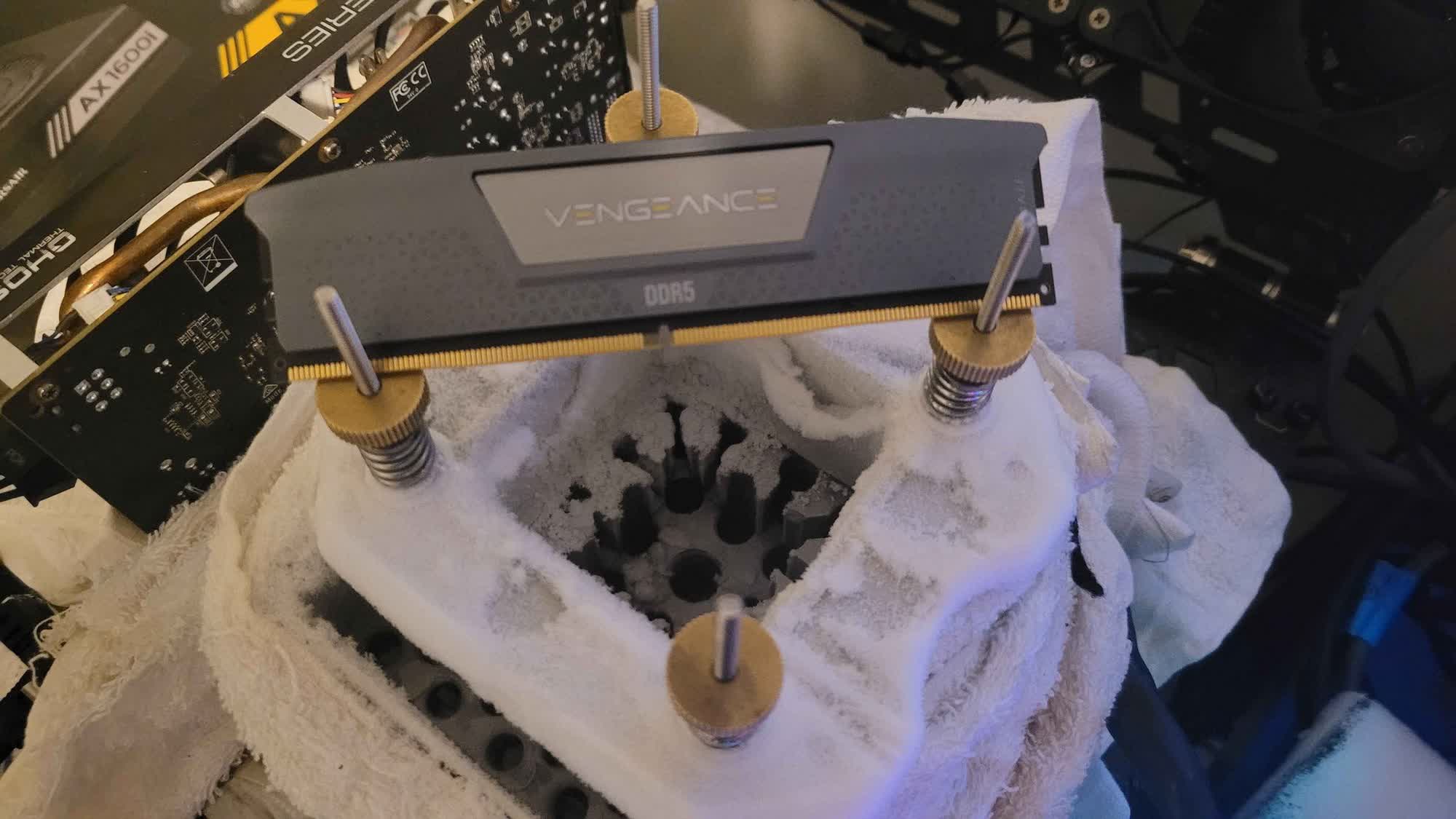
The record was achieved using a single 24GB Corsair Vengeance module with a default speed of 7,500 MT/s. The system was powered by an Intel Core Ultra 7 265K CPU on Gigabyte's flagship Z890 AORUS Tachyon ICE motherboard, specifically designed for extreme CPU and memory overclocking.
Before Croissant became the first to surpass the 13,000 MT/s barrier, the record stood at 12,872.2 MT/s, set on the Asus ROG Maximus Z890 APEX motherboard. The previous record for the Gigabyte Z890 AORUS Tachyon ICE was 12,752 MT/s, achieved by renowned overclocker HiCookie in March.
It is worth noting that the officially validated world record frequency remains 12,920.2 MT/s, not 13,020 MT/s. However, Croissant has posted a CPU-Z screenshot to support his claim of breaking the 13,000 MT/s threshold.
We just might see it yes pic.twitter.com/ARHyjt8E8s
– Madness! (@Madness727) September 23, 2025
The screenshot shows that the memory timings had to be loosened to 68-128-128-256-1500-2T to achieve the new world record. These timings – particularly the CAS latency of 68 – are far from ideal for most real-world applications, including gaming. However, it is nearly impossible to push memory modules to their absolute limits without significantly loosening the timings.
Other details about the system used to set the record remain unknown, including the type of cooling employed to manage thermals. Extreme overclocking setups typically use liquid nitrogen, so it is reasonable to assume that this test bench also relied on the same method to push the DDR5 memory to its limits.
Extreme overclocks are proof-of-concept demonstrations, showing what is possible under specific conditions, and are often unsuitable for practical applications. High memory overclocks frequently require disabling CPU cores, making such test systems neither stable nor practical for general users.
While the new world record is certainly impressive, it is unlikely to have an impact on PC users. No manufacturer is expected to release factory-made memory modules capable of such extreme frequencies, meaning these achievements will remain a niche pursuit for professional overclockers and PC enthusiasts for the foreseeable future.
DDR5 shatters overclocking barrier to hit 13,020 MT/s in new world record


