Der8auer tests PC chimney effect, dropping CPU temps by 19°C with a 110cm 3D-printed tower

zohaibahd

Posts: 986   +19
Staff
Crystal ball: Some pieces of PC building advice have circulated so long that nobody bothers checking them anymore. One is the chimney effect: the claim that a case works like a flue, and that pointing your top fans outward gives hot air a natural boost on the way up. German overclocker der8auer decided the best way to test it was to actually build one.

Building one meant understanding what a chimney actually does, which isn't quite what the forum posts assume. Hot air rising is just convection, and it happens around anything warm. A chimney works because that rising air is trapped inside a tall channel, so as it climbs it drags cool air in behind it through the bottom. The taller the channel, the harder it pulls.

A normal case doesn't have much height to work with. der8auer ran the math on a case 55 cm tall, assuming a 20°C room and a 40°C interior, and landed on 0.4 Pascal. He compares that to the pressure you'd feel under a layer of water four hundredths of a millimeter deep – thinner than a human hair.

Since that's functionally nothing, he went hunting for height. His test rig ran a custom water loop around a Ryzen 7 9800X3D, capped at a constant 100 watts so the heat entering the loop stayed the same throughout.

The 240 mm radiator had no fans attached and sat propped up off the bench so air could reach it from below. After an hour and twenty minutes, the water settled at 61.5°C, and fog blown underneath drifted around the fins instead of through them.

Onto that stalled radiator, der8auer began stacking 3D-printed PLA shrouds. The first was only 10 cm and still shaved off half a degree, which he admits he didn't expect. A 20 cm section brought the tower to 30 cm total, and between the two the loop gave up around five degrees over the next half hour while the room temperature never moved.
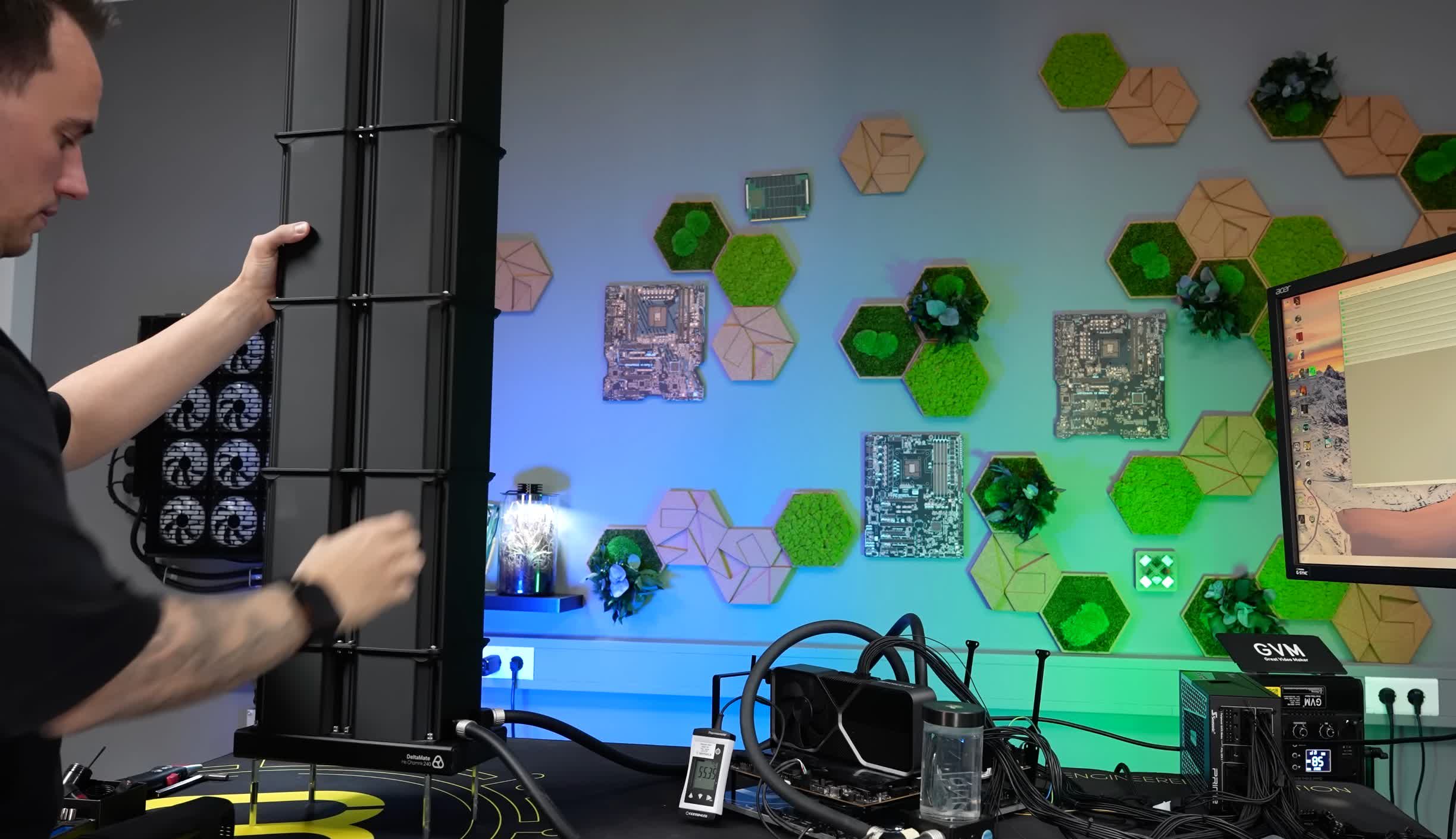
Then came the big one: an 80 cm block of four sections that brought the whole assembly to 110 cm and nearly reached his ceiling. Water temps fell below 55°C before he'd finished bolting it together, hitting 50°C within five minutes. This time the fog got visibly pulled up through the radiator, exactly as if fans were running above it.

Those water numbers matter for what they do to the chip underneath. The Ryzen had been peaking above 90°C with the radiator bare; HWiNFO put it at 71°C once the tower was standing, a swing of nearly 19 degrees with no fan moving air anywhere.

Turns out, to no one's surprise, fans are still the sensible option, as der8auer himself concludes. They chase the same pressure difference without demanding a full meter of vertical clearance above your desk.

Der8auer previously converted a $7,000 RTX 5090 Lightning Z to custom water cooling.

Permalink to story:

 
Woah, hold Your horses, Mr. Ahmed. As I was many times painfully reminded in the past, this is an American-centric site. No International System of Units, or They will shred You in the comment section.

110cm is how many bananas? What is °C?

;-)
 
Woah, hold Your horses, Mr. Ahmed. As I was many times painfully reminded in the past, this is an American-centric site. No International System of Units, or They will shred You in the comment section.

110cm is how many bananas? What is °C?

;-)
He would had to do a convertion and that could cause a nervous breakdown ;)
 
The chimney of the future, not part of you trying to warm the house up but instead for cooling the PC.
Who's going to start selling actual chimney sized radiators ;)
 
Woah, hold Your horses, Mr. Ahmed. As I was many times painfully reminded in the past, this is an American-centric site. No International System of Units, or They will shred You in the comment section.
The UK can gloat a bit over their use of the SI system. The rest of Europe, however, essentially had no factories or industrial system remaining after WW2, and thus converting to a new system of units was effectively cost free. It's rather like a young child being proud their hair grew back thicker, after having their head shaved due to lice.
 
I might actually take a 1M tower over active cooling tbh, Hate the noise of fans. Once it is stood on the floor next to the desk would you really notice it that much ?

It's also very nice to read an article with understandable units of measure, I'm sure the few other people who use this system will also appreciate it.
 
and they still don't today
Dude, while the vile attack on European factories? Your own factories are mostly assembly lines for Eastern European and Asian parts, designed in Germany and South Korea. Not to mention ASML that manufactures lithography machines from parts made everywhere (including some from US). It's a global market, and US/EU are loosing with subsidized, dumping priced Chinese junk.
 
So if I'm understanding Zo's awkwardly worded "gave up around five degrees"...

0 cm 61.5 c
10 cm 61 c
30 cm 56 c
80 cm 50 c

I find the 30 cm result more interesting than the 80 cm.
Yeah, I would expect the air flow to eventually stall out if you made the tower too tall. Gases still experience head loss, even with a fan. A fanless system exploiting convection is no exception.

I kind of want someone to repeat this test, but with 5cm steps, and no skipping steps. Then plot the steady-state CPU temps. I bet they hit diminishing returns somewhere between 30-50cm, and see temps start to either completely bottom out or even slowly creep back up around 100cm.

I also kind of want to see the test repeated with a 'regular' case. In-take on the bottom; exhaust on the top; front, back and sides blocked. Then stack a chimney on the top. It would be less about passive cooling of a radiator at that point, and more about whether getting the heat to the 'top' of the room would make a difference in case temps (or room temps)
 
Dude, while the vile attack on European factories? Your own factories are mostly assembly lines for Eastern European and Asian parts, designed in Germany and South Korea. Not to mention ASML that manufactures lithography machines from parts made everywhere (including some from US). It's a global market, and US/EU are loosing with subsidized, dumping priced Chinese junk.
Another ill informed post. The USA is reshoring industry at a fast pace. Europe is not. Globalism benefits very few Americans and Europeans unless you are at the top of the chain. I want real work for the citizens not a check from the government while drinking Ouzo
 
There is a chimney myth?

Chimneys have been tech so long that it is hardly ever seen as tech, it goes back to when someone millennia ago decided having heating in a home was good and that smoke was not.

The physics are well known, including that as opposed to what the article suggest, when hot air rises cooler air replaces that hot air. Having a chimney just focuses the effect, which will then mean air moving faster and there is of course a balance of heat and chimney height, size and shape to have the best result. Insulating the chimney to keep heat from escaping as it goes through the chimney optimizes the function, as does making sure the interior is smooth so there isn't drag..
 
Another ill informed post. The USA is reshoring industry at a fast pace. Europe is not. Globalism benefits very few Americans and Europeans unless you are at the top of the chain. I want real work for the citizens not a check from the government while drinking Ouzo
I did some research and concluded if you are expecting a broad-based, nationwide manufacuring resurgence where local factories open in every mid-sized town, that simply isn't happening. What is being built is highly concentrated, heavily subsidized fortress of elite technology. Many of which are being supported by government investment or contracts, which is the only way manufacturing can be built in the US.

Tariffs on products not made in the US only hurt domestic manufacturing, because it makes the cost of doing business higher. The cost to build factories is exponentially higher than paying tariffs.

When I lived in Germany so many things I bought was made there. Nearly everything in the hardware store was made in Germany as one example.
 
I did some research and concluded if you are expecting a broad-based, nationwide manufacuring resurgence where local factories open in every mid-sized town, that simply isn't happening. What is being built is highly concentrated, heavily subsidized fortress of elite technology. Many of which are being supported by government investment or contracts, which is the only way manufacturing can be built in the US.

Tariffs on products not made in the US only hurt domestic manufacturing, because it makes the cost of doing business higher. The cost to build factories is exponentially higher than paying tariffs.

When I lived in Germany so many things I bought was made there. Nearly everything in the hardware store was made in Germany as one example.
Germany dependent on the USA for their very existence. They want the USA to fund their defense against Russia yet buy Russian oil. I don't want to hear about the great German engineering. They can make junk as well as anyone. They engineered their tanks so well they could only be fixed at the factory
 
Back