DriftGuard update lets Xbox gamers fix stick drift without replacing controllers

Skye Jacobs

Posts: 2,010   +58
Staff
Highly anticipated: For years, controller stick drift has been one of those problems gamers just learn to live with – or, more often, replace their way out of. Once recalibration and cleaning stop working, the usual outcome is to buy a new controller or attempt a repair that may not even solve the issue. A recent update to the third-party tool DriftGuard could finally give Xbox owners a way to break that cycle.
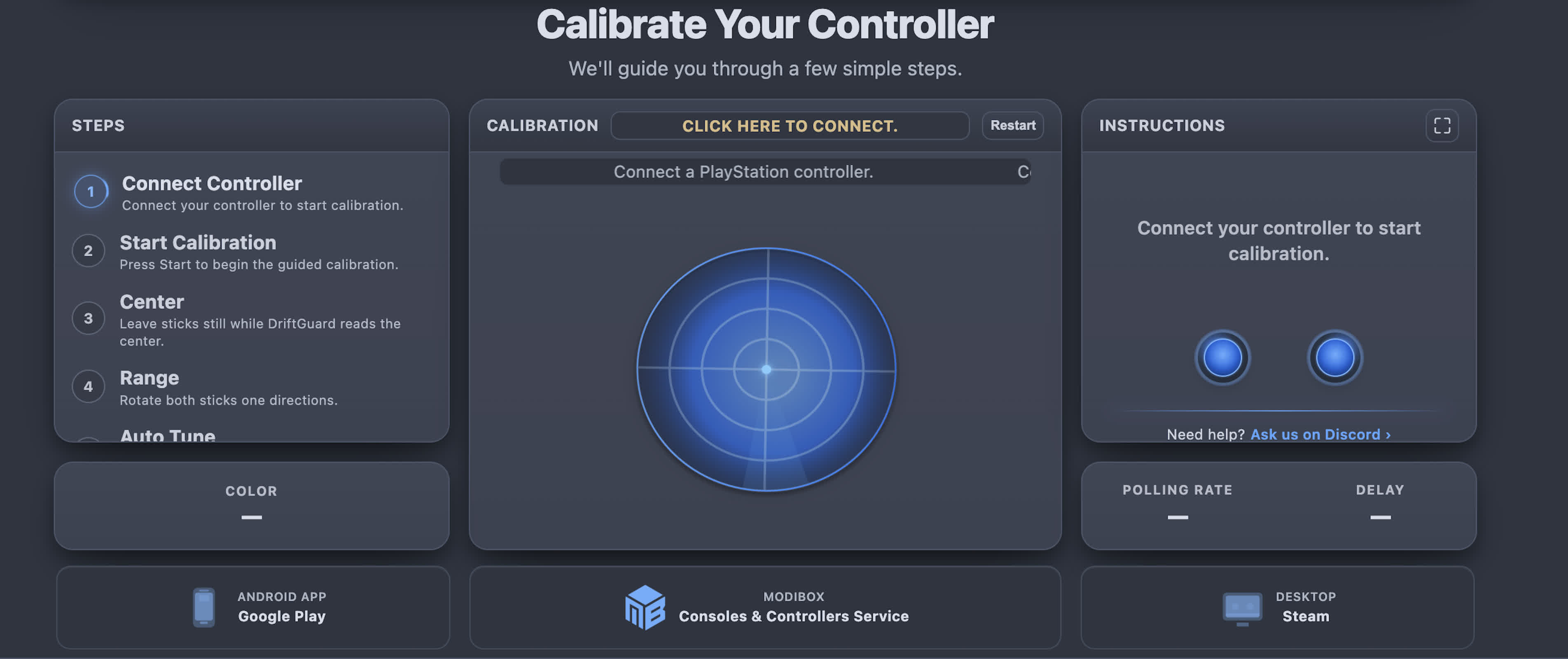
DriftGuard first gained attention in 2024 for its work with PlayStation controllers, offering deeper calibration tools than Sony provides out of the box. Until now, DriftGuard has been far less useful on Xbox hardware because of restrictions on how calibration data is stored and accessed.

That appears to have changed. In a post announcing the update, DriftGuard developer @modyfikator89 said the team has "unlocked ultimate manual and automatic joystick calibration for any Xbox controller." It's a broad claim, but the message suggests calibration now happens at the hardware level rather than being limited to basic software tweaks.

The key difference is where and how DriftGuard applies its changes. Instead of relying on temporary software corrections, the tool writes calibration data directly to the controller's internal memory. That means the adjustments persist at the hardware level and aren't undone by standard firmware updates. In practical terms, once the calibration is set, it sticks.

The update is said to work across multiple generations of Xbox controllers, from Xbox 360 models through Xbox One and Series S/X, including Elite variants. Both wired and wireless controllers are supported. As @modyfikator89 put it in a follow-up, "Every Xbox controller can be calibrated."

That kind of blanket support contrasts with Microsoft's own calibration tool, which is limited to newer wireless controllers and the Elite Series 2. Even then, the results can be hit or miss, especially when drift is caused by gradual wear rather than an obvious hardware failure.

Stick drift itself is usually tied to wear in the joystick's internal components, particularly the potentiometers that track movement. Dust and debris can make things worse, but over time, even well-maintained controllers can start to show signs of drift. At that point, software fixes tend to fall short, leaving replacement as the default option.

DriftGuard doesn't claim to fix physically damaged hardware, and it likely won't. But early use suggests it can detect calibration issues that other tools miss, particularly when the problem isn't severe enough to warrant a full teardown yet still affects gameplay.

The updated Xbox functionality is expected to reach the Steam version within "a week or even less," while a free browser-based version is already available. That gives users a way to test whether recalibration can extend their controller's lifespan before spending money on a replacement.
More broadly, the update points to something that hasn't been common in the console space: meaningful, low-level control over peripheral hardware. Controllers have typically been locked into manufacturer-defined limits, with little room for user intervention beyond basic settings.

Permalink to story:

 
Saw this last week. Nice to know.
And then at the least, I know a few people that have PS5 controllers with unusable stick drift they can try to "fix" with this.
 
This isn't a fix, it's a workaround.

The best fix is to boycott controllers that use potentiometers. Unfortunately, in 2026 this means all "official" controllers by Microsoft, Sony and Nintendo.

Only buy controllers that use hall effect sticks.
 
This isn't really a fix, it's at best mitigating how overpriced Xbox controllers with potentiometer sticks that wear out and eventually fail.

There are $30-40 controllers with TMR or hall effect sticks that will last longer than an official Xbox controller.
 
I was kind of wondering if these controllers used potentiometers or had switched to some sort of solid state type unit that didn't have wipers running back & forth over a carbon sheet. Wear & tear, dust...LOL in the old days with stereos and what not they would cause a crackling sound and the volume would vary.
 
I was kind of wondering if these controllers used potentiometers or had switched to some sort of solid state type unit that didn't have wipers running back & forth over a carbon sheet. Wear & tear, dust...LOL in the old days with stereos and what not they would cause a crackling sound and the volume would vary.

This superior "solid state" tech exists. They're called hall effect sticks, and are as precise and accurate as potentiometer sticks, while being much more durable and reliable, and also immune to stick drift issues (Hall effect sticks use semiconductors and magnets. When the magnets on the joystick are moved they generate a voltage in the semiconductors).

For some reason, the major players (Microsoft, Nintendo, Sony, Logitech) have always refused to adopt hall effect technology, with a few exceptions. The Sega Dreamcast controller was the first gamepad to use hall effect sticks. Sony also used hall effect sticks on the PS3 controllers (Sixaxis/DualShock 3), but returned to using potentiometers since the DualShock 4.

However since around 2020, Chinese third-party gamepad manufacturers started releasing models with hall effect sticks. Nowadays they are everywhere, for some brands most (or all?) models in their lineup use hall effect sticks. Brands like 8BitDo and GameSir have entry level models with hall effect analog sticks (some higher end models also use hall effect technology on the triggers) and can be purchased pretty cheap. Despite this, Microsoft, Sony, Nintendo and Logitech keep their heads buried in the sand and insist on making potentiometer-based controllers.

If I was a conspiracy theorist, I'd say the resistance to embracing hall effect technology by the major companies is because it helps them sell more controllers. I also don't think potentiometer sticks are a bad technology in itself, the problem is manufacturers using lower-quality parts designed to fail after 1-5 years of use, since last decade. Funny how controllers with analog sticks for 5th gen and 6th gen consoles (also early Xbox 360 controllers built during the 2000s), all used potentiometers and we never heard of stick drift issues.
 
Good, it'll let folks squeeze a bit more life out of their controllers before they completely fail and have to be physically repaired or tossed.

It will be more likely to be used because it will follow the controller rather than following the device/needing calibration every time something changes.

Not a *fix* but still a positive step to get more mileage out of something people already own.
 
This superior "solid state" tech exists. They're called hall effect sticks, and are as precise and accurate as potentiometer sticks, while being much more durable and reliable, and also immune to stick drift issues (Hall effect sticks use semiconductors and magnets. When the magnets on the joystick are moved they generate a voltage in the semiconductors).

For some reason, the major players (Microsoft, Nintendo, Sony, Logitech) have always refused to adopt hall effect technology, with a few exceptions. The Sega Dreamcast controller was the first gamepad to use hall effect sticks. Sony also used hall effect sticks on the PS3 controllers (Sixaxis/DualShock 3), but returned to using potentiometers since the DualShock 4.

However since around 2020, Chinese third-party gamepad manufacturers started releasing models with hall effect sticks. Nowadays they are everywhere, for some brands most (or all?) models in their lineup use hall effect sticks. Brands like 8BitDo and GameSir have entry level models with hall effect analog sticks (some higher end models also use hall effect technology on the triggers) and can be purchased pretty cheap. Despite this, Microsoft, Sony, Nintendo and Logitech keep their heads buried in the sand and insist on making potentiometer-based controllers.

If I was a conspiracy theorist, I'd say the resistance to embracing hall effect technology by the major companies is because it helps them sell more controllers. I also don't think potentiometer sticks are a bad technology in itself, the problem is manufacturers using lower-quality parts designed to fail after 1-5 years of use, since last decade. Funny how controllers with analog sticks for 5th gen and 6th gen consoles (also early Xbox 360 controllers built during the 2000s), all used potentiometers and we never heard of stick drift issues.

<< I've dealt with Hall effect motors for decades. We have PLL motors that have hall effect sensors that monitor the rotational speed of the motor for timing. Used in photocopiers to keep the speed between different parts of the machine in sync so when toner is transferred to the paper, it's stable and won't be the wrong size, stretched, blurry etc.
Kind of figured after all these years they would come up with something more stable than a "pot". Wish I had a dollar for all of those old controllers back in the day that I either blew out with forced air, replaced the pots etc. Or for friends of mine, glued stuff back together with epoxy after "somehow they were damaged". ;)
 
Back