Bottom line: Elon Musk's artificial intelligence company, xAI, is investing billions of dollars to secure computing power and engineering talent as it accelerates development of software intended to power future humanoid robots. Newly reviewed financial documents obtained by Bloomberg show that the company's rapid expansion is generating heavy losses, but also sharp revenue gains and increasingly ambitious technical goals.
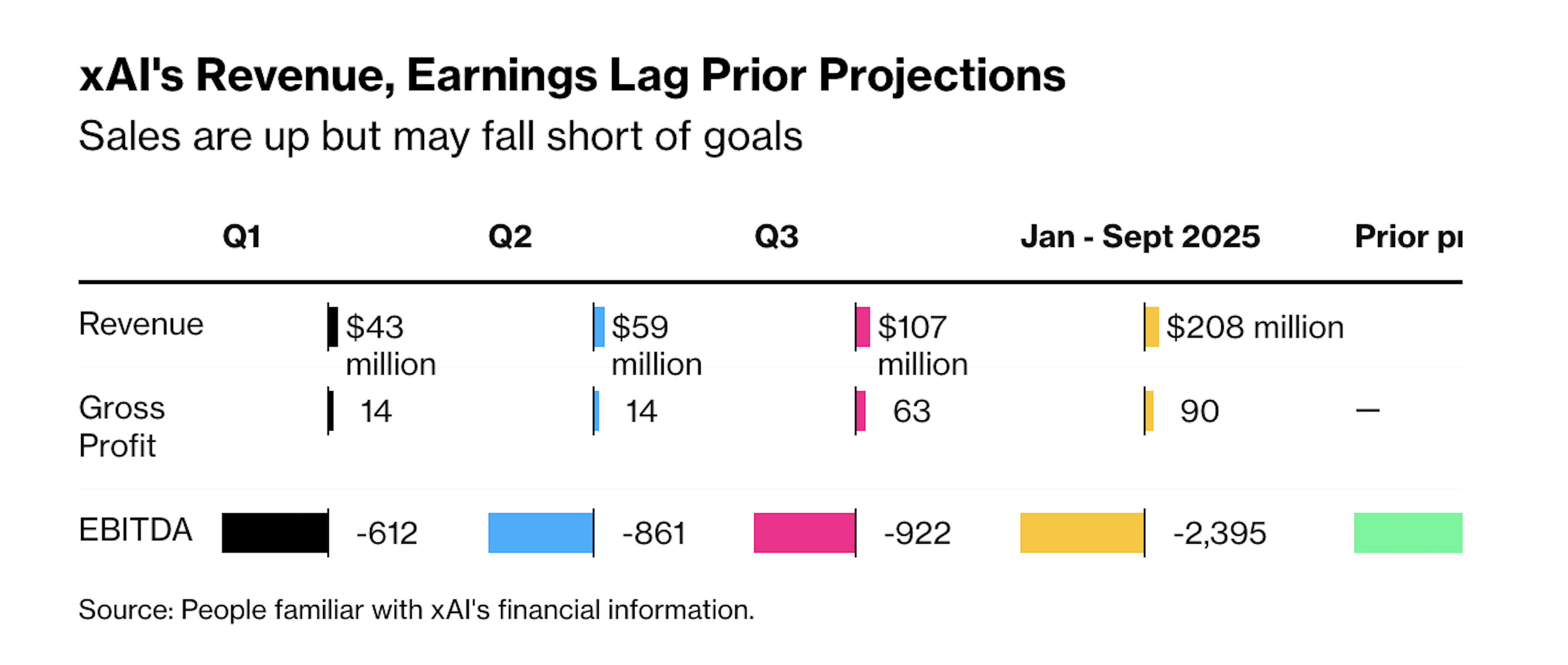
For the September 2025 quarter, xAI reported a net loss of $1.46 billion, up from $1 billion earlier in the year. The company burned through $7.8 billion in cash during the first nine months alone, driven by heavy spending on data centers, Nvidia GPU purchases, and compensation tied to AI talent recruitment. Despite the red ink, xAI nearly doubled its quarterly revenue to $107 million.
Executives told investors that xAI's current priority is deploying resources toward advanced AI agents and the supporting software infrastructure under an internal initiative known as Macrohard.
The project, described as an AI-only software platform, is expected to underpin what Musk envisions as a self-sufficient intelligence system – one that could eventually control humanoid robots such as Tesla's Optimus.
That ambition hinges on compute scale. xAI has invested hundreds of millions of dollars into its Colossus data center complex in Memphis, Tennessee, which runs on Tesla Megapack batteries and uses Nvidia-based hardware clusters. The facility is being expanded across three buildings, pushing its computing capacity close to 2 gigawatts, making it one of the largest private AI sites currently under construction worldwide.
The company is working with partners including Valor Equity Partners, Apollo Global Management, and Nvidia to fund and provision its infrastructure through structured financing arrangements.
The Memphis buildout is central to the firm's plan to reach what internal documents call "escape velocity" – Musk's recurring term for ventures that achieve rapid, self-sustaining growth once scaling begins. According to people familiar with the company's operations, xAI's monthly outlay remains below $1 billion, giving it roughly a year of runway based on its most recent cash infusion.
That cushion follows a $20 billion equity round that closed in early 2026, backed by Nvidia, Valor, and the Qatar Investment Authority, and valuing xAI at $230 billion. The company has now raised more than $40 billion in total equity since its founding.
Internally, Musk has aligned xAI's technology roadmap with his broader corporate ecosystem. The firm's chatbot, Grok – powered by xAI's models – is integrated into X and Tesla vehicles. SpaceX has also invested in xAI, while Tesla's potential participation remains unresolved. A proposal for the automaker to take a stake in xAI failed to win shareholder approval last November, though Tesla's board continues to explore alternative options.
Financial filings show that xAI recorded $63 million in gross profit in the September quarter, up sharply from $14 million in the prior quarter, even as its EBITDA loss widened to $2.4 billion through September. The company had previously projected a $2.2 billion loss for the full year.
That surge reflects both mounting infrastructure costs and an aggressive hiring strategy, with nearly $160 million paid out in stock-based compensation through the third quarter of 2025.
xAI has yet to disclose its full-year results, which executives have privately described as "positive." With deep capital reserves and an expanding partnership pipeline, the company appears positioned to sustain rapid expansion through 2026 as it seeks to evolve from a chatbot developer into a vertically integrated intelligence platform.
Image credit: Bloomberg
Elon Musk's AI startup is losing billions – and building something huge


