Eye tests could detect incurable Alzheimer's disease decades before onset

Himanshu Arora

Posts: 902   +7
Staff

A new research has revealed that certain biological changes in the retina and lens of the eye may help predict Alzheimer 10-20 years before its onset. The findings were presented at the Alzheimer’s Association International Conference in Copenhagen on Sunday.

Alzheimer's disease (AD), the most common form of dementia, currently affects more than 5 million Americans, and an estimated 35 million people worldwide. These numbers are expected to rise significantly in the next couple of decades.

The disease is caused by a build-up of a protein called beta-amyloid in the brain. The build-up adversely affects hippocampus, the section of our brains involved in memory formation.

At present, Alzheimer is detected through spinal taps or PET scans, that are not only invasive, but also expensive and not readily available. But Scientists at Australia's CSIRO are working on a new diagnostic technique that relies on a simple eye test that checks for the presence of the protein.

"What makes it unique is that the retina is actually an extension of the brain and so we think that a lot of the pathology that is occurring in the brain may also be occurring in the retina," said Dr. James Galvin, who works as a neurologist at New York University Langone Medical Center.

Around 200 volunteers, who participated in the trial, were given a dietary supplement containing curcumin, which binds to the beta-amyloid proteins in the retina and appears fluorescent in certain conditions, allowing doctors to spot the proteins with a simple eye test.
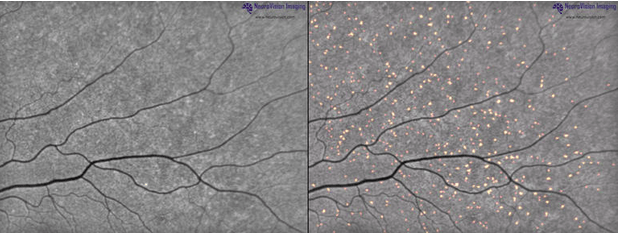
eye alzheimer test disease

Preliminary results on 40 participants showed that the test picked up every participant who had Alzheimer, and correctly identified more than 80 percent of those who did not.

Aside from eye tests, researchers are also focusing on smell, as the ability to identify different smells becomes impaired relatively early in the disease process.

Permalink to story.

 
I'm not sure I'd like to know that I was going to get "incurable" Alzheimer's in 10-20 years. Be almost like knowing the day you'll die.
 
Neat. Next up a cure :)

Also, if I or a loved one was going to get Alzheimer's I'd like to know. Then I could plan out my life post-memory to make sure everything is taken care of financially and legally to lessen the burden (on loves ones, friends, society, etc. etc.) when the time comes to pass. If I'm going to be old and without memory, may as well make sure the memories others have of me are relatively decent ones.
 
Neat. Next up a cure :)

Also, if I or a loved one was going to get Alzheimer's I'd like to know. Then I could plan out my life post-memory to make sure everything is taken care of financially and legally to lessen the burden (on loves ones, friends, society, etc. etc.) when the time comes to pass. If I'm going to be old and without memory, may as well make sure the memories others have of me are relatively decent ones.

Although I wholeheartedly agree with your fundamental point, having seen the effects of Alzheimer's first hand, the scramble play sounds much more appealing than strategically anticipating the doom timer.
 
Also, if I or a loved one was going to get Alzheimer's I'd like to know. Then I could plan out my life post-memory to make sure everything is taken care of financially and legally to lessen the burden (on loves ones, friends, society, etc. etc.) when the time comes to pass. If I'm going to be old and without memory, may as well make sure the memories others have of me are relatively decent ones.
Sounds like plans that everyone should already be doing regardless of the potential for a disease, Alzheimer or otherwise.
 
Of course you want to know the earlier you get treatment and make diet changes the better.
 
Of course you want to know the earlier you get treatment and make diet changes the better.

Or you could just adopt a healthy lifestyle long before it's ever an issue, as @mks067 suggested.
 
Why do you want to spend money on diseases before you even have them Isn't medicare already $45 trillion in debt?
 
Or you could just adopt a healthy lifestyle long before it's ever an issue, as @mks067 suggested.
A healthy lifestyle and preventative medicine are 2 different things, google the disease and maybe you will understand. Or any disease.
 
"preventative medicine"
I for one don't believe there is such a thing. And I also believe the attempt at trying causes problems.
 
"preventative medicine"
I for one don't believe there is such a thing. And I also believe the attempt at trying causes problems.
Okay, but are you saying you don't brush or floss your teeth? Are you one of those who doesn't believe in vaccinations too? I'm not judging you, just asking.
 
Are you one of those who doesn't believe in vaccinations too? I'm not judging you, just asking.
I'm saying everything has an unforeseen side effect. Side effects that change genetics and will carry on for generations.

I'm appalled at the fact that we live in a free country but yet it is law that our kids must attend school and before they do they must also have vaccination shots before attending public schools. Turns out we are not so free after all are we! There is no telling what kind of side effects we introduce to our kids before they even start school. How many times have you heard the phrase don't fix it unless it is broken? That is unless you want to risk breaking it.
 
Folic acid, vitamin B12, vitamin D, magnesium, and fish oil are believed to preserve and improve brain health. Studies of vitamin E, ginkgo biloba, coenzyme Q10, and turmeric have yielded less conclusive results, but may also be beneficial in the prevention or delay of Alzheimer’s and dementia symptoms.

Found that in like 10 seconds, how stupid do you have to be to not want to know about and begin combating such a terrible disease early on.

Activities involving multiple tasks or requiring communication, interaction, and organization offer the greatest protection. Set aside time each day to stimulate your brain. Cross-training with these brain-boosting activities will help keep you mentally sharp:

  • Learn something new. Study a foreign language, learn sign language, practice a musical instrument, read the newspaper or a good book, or take up a new hobby. The greater the novelty and challenge, the larger the deposit in your brain reserves.
  • Practice memorization. Start with something short, progressing to something a little more involved, such as the 50 U.S. state capitals. Create rhymes and patterns to strengthen your memory connections.
  • Enjoy strategy games, puzzles, and riddles. Brain teasers and strategy games provide a great mental workout and build your capacity to form and retain cognitive associations. Do a crossword puzzle, play board games or cards, or work word and number games, such as Scrabble or Sudoku.
  • Practice the 5 W’s.Observe and report like a crime detective. Keep a “Who, What, Where, When, and Why” list of your daily experiences. Capturing visual details keeps your neurons firing.
  • Follow the road less traveled. Take a new route, eat with your non-dominant hand, rearrange your computer file system. Vary your habits regularly to create new brain pathways.
 
I'm a student medicine, so let me tell you a little about something called "epigenetics".
When you are born you have certain genetic information, like what color your eyes will be, and there is also information about how probable you will develop a disease. Now, epigenetics is about how can your environment affect your genetics. For example, practically all you relatives have hypertension, so that means you're gonna have it too? Mmm, maybe. Then, is there anything I can do to prevent it? Of course! If you have a lifestyle as healthy as possible, you can stop the disease from developing. You have to exercise regularly and eat healthy. Something similar happens with Alzheimer. In genetics there's something called "multifactorial heritage". Alzheimer, hypertension, diabetes and a lot more disease enter this category. What does it mean? That even if you have the "genes" to get the disease, there is only 2-4% of probability that you get it. Then why a lot of people have them? Epigenetics. Even if you don't have the genes, you might develop the disease, because the environment and your lifestyle are more important.
 
Back