
Forward-looking: Following the recent completion of specifications for PCIe 7.0, the PCI Special Interest Group (PCI-SIG) has already begun work on the next generation. While consumer PCs typically lag several years behind the latest iterations of the connection protocol, consortium members can now get an early look at upcoming technology that will impact AI, data centers, and other high-end IT workloads.

Members of PCI-SIG can now access the 0.3 draft specification for PCIe 8.0, the first official description of the upcoming protocol's objectives. Continuing the steady rate of advancement seen over the past several years, PCIe 8.0 is expected to deliver eight times the bandwidth available to today's cutting-edge PC components. However, consumers won't see this new standard in action for several years.
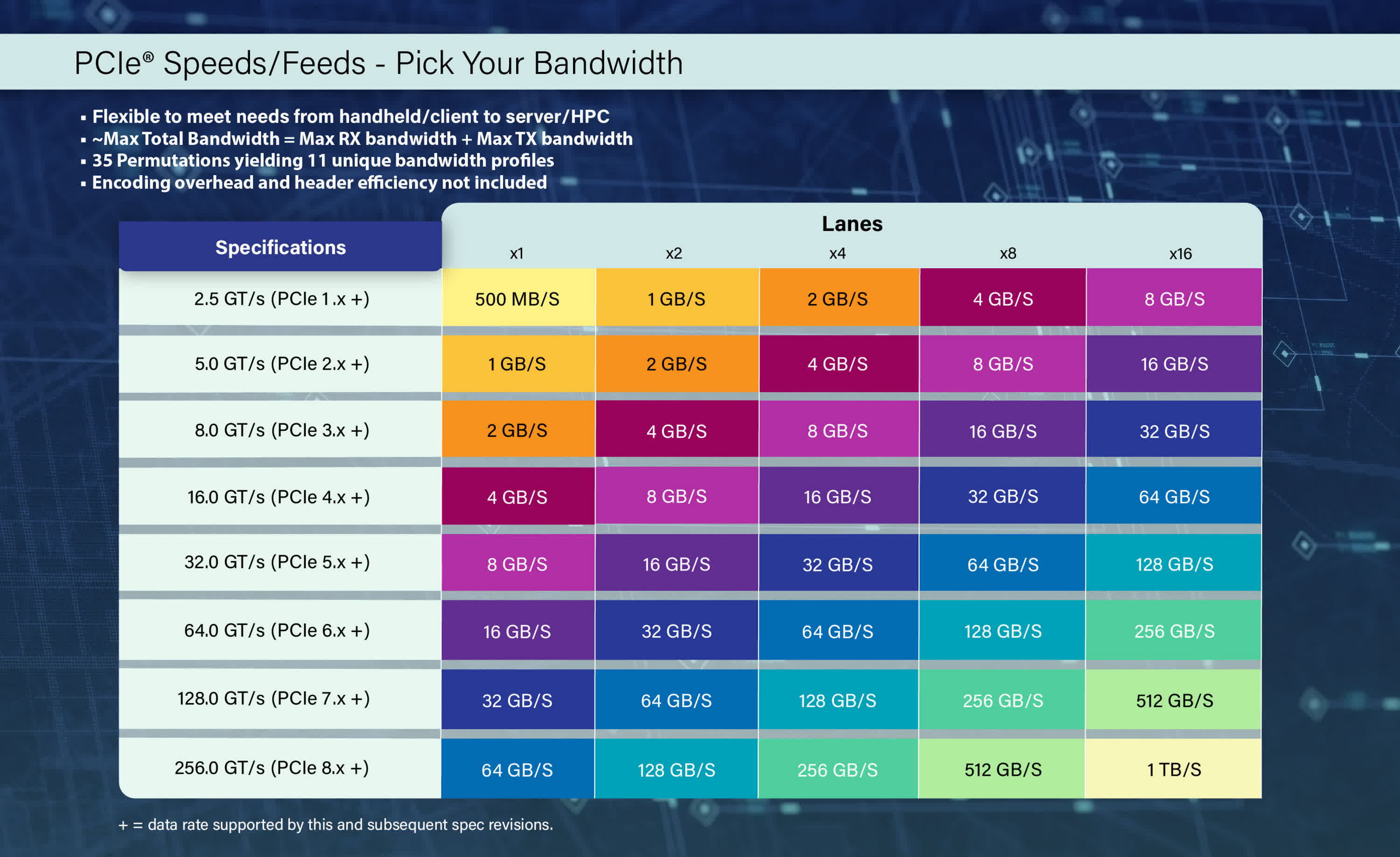
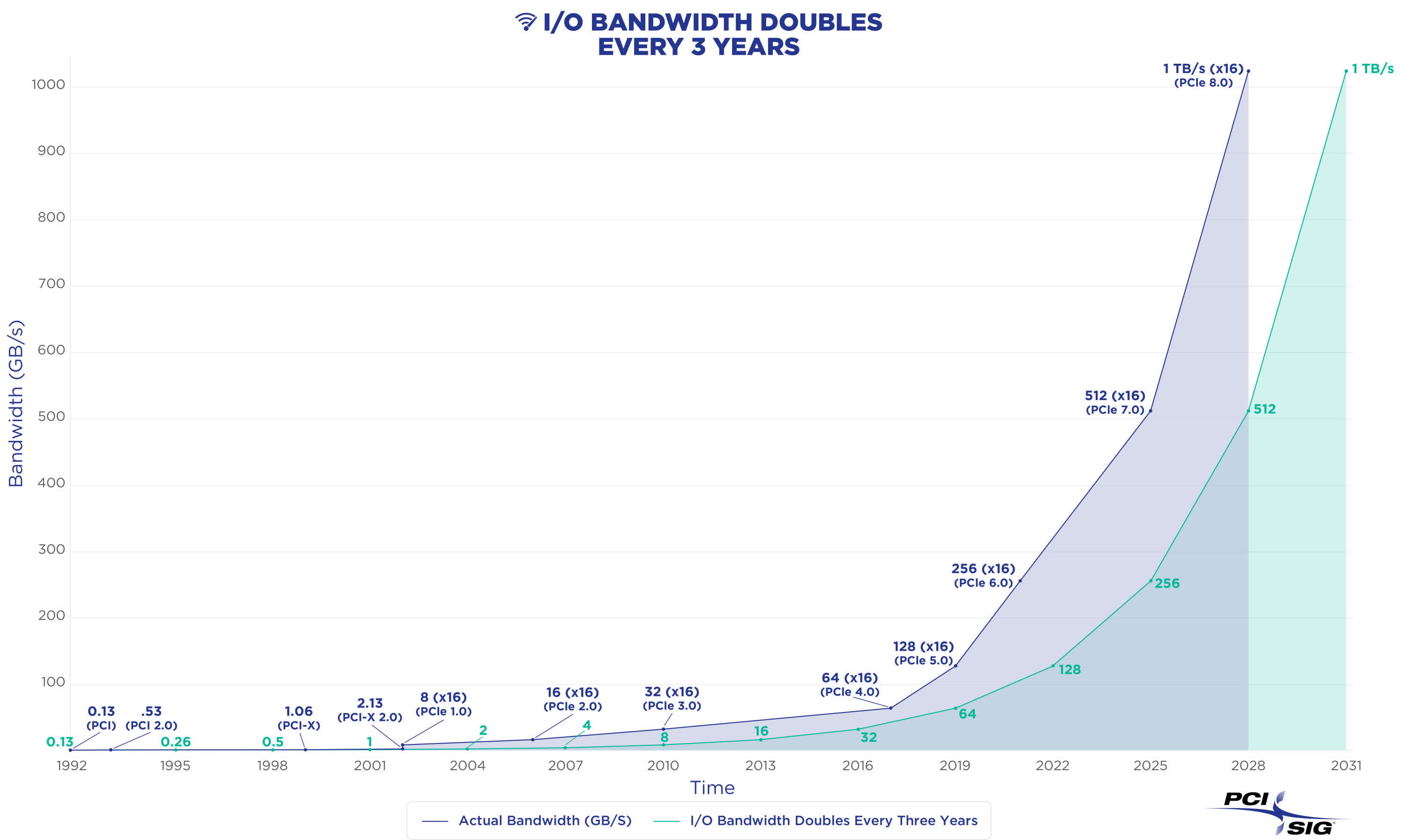
The primary goal of PCIe 8.0 is to continue the trend of doubling total bandwidth with each new generation. The pattern has held from PCIe versions 1.0 through 7.0, and the consortium is confident that 8.0 will be no different.
Click to enlarge
The primary goal of PCIe 8.0 is to continue the trend of doubling total bandwidth with each new generation.
Most consumer PCs currently use PCIe 3.0 or 4.0, which support 8 and 16 gigatransfers per second (GT/s), enabling 32 GB/s and 64 GB/s of bandwidth on x16 lanes, respectively. The latest SSDs and graphics cards support PCIe 5.0, which reaches 32 GT/s and up to 128 GB/s. Many PCIe 5.0-compatible SSDs now achieve read speeds exceeding 10 GB/s.
The consortium released the final specs for PCIe 6.0, which enables 64 GT/s and up to 256 GB/s of bandwidth, in early 2022. Testing for the first SSDs to utilize the protocol only began earlier this year, with a Micron storage expansion card reaching an incredible 30.25 GB/s.
PCIe 7.0, which doubles those figures again to 128 GT/s and 512 GB/s, only recently reached its final specification. A live compliance program for PCIe 7.0 is scheduled for 2028, and a detailed FAQ was released earlier this month.
Also read: The Inner Workings of PCI Express
If development stays on track, the 1.0 specification for PCIe 8.0 could also arrive by 2028. At 256 GT/s, the upcoming protocol has the potential to break the terabyte-per-second barrier on x16 lanes with bi-directional connections.
Click to enlarge
Pathfinding for PCIe 8.0 development involves several additional objectives. Achieving faster speeds may require exploring optical connector technologies, while still meeting latency targets and maintaining reliability. Developers also aim to reduce power consumption and ensure backward compatibility with earlier PCIe versions.
PCI-SIG expects PCIe 8.0 to play a vital role in supporting demanding workloads such as AI, machine learning, edge computing, quantum computing, hyperscale data centers, as well as military, aerospace, and automotive applications.
First PCIe 8.0 draft spec released, promising blistering 1 TB/s bandwidth


