PCIe has doubled bandwidth every generation for two decades, PCIe 8.0 is on track to do it again at 1TB/s

Daniel Sims

Posts: 2,469   +74
Staff
Looking ahead: Development of the next generation of PCIe connector technology has reached a new milestone. The PCI Special Interest Group (PCI-SIG) has released an updated outline of its plans to continue the upgrade cadence it has maintained for two decades. Although PCIe 8.0 is not scheduled for completion before 2028, it could offer eight times the bandwidth of today's fastest motherboard components.

Manufacturers can now review the 0.5 draft specification for PCIe 8.0. The spec aims to increase bandwidth significantly while reducing power consumption.

PCIe is the technology that connects expansion cards installed on PC motherboards. The constant need for higher bandwidth became apparent when 3D accelerator cards (the predecessors to modern GPUs) became popular. NVMe SSDs also leverage PCIe to achieve higher transfer speeds than older SSDs and hard drives that used SATA cables. Each new PCIe generation typically doubles the available bandwidth for NVMe SSDs.
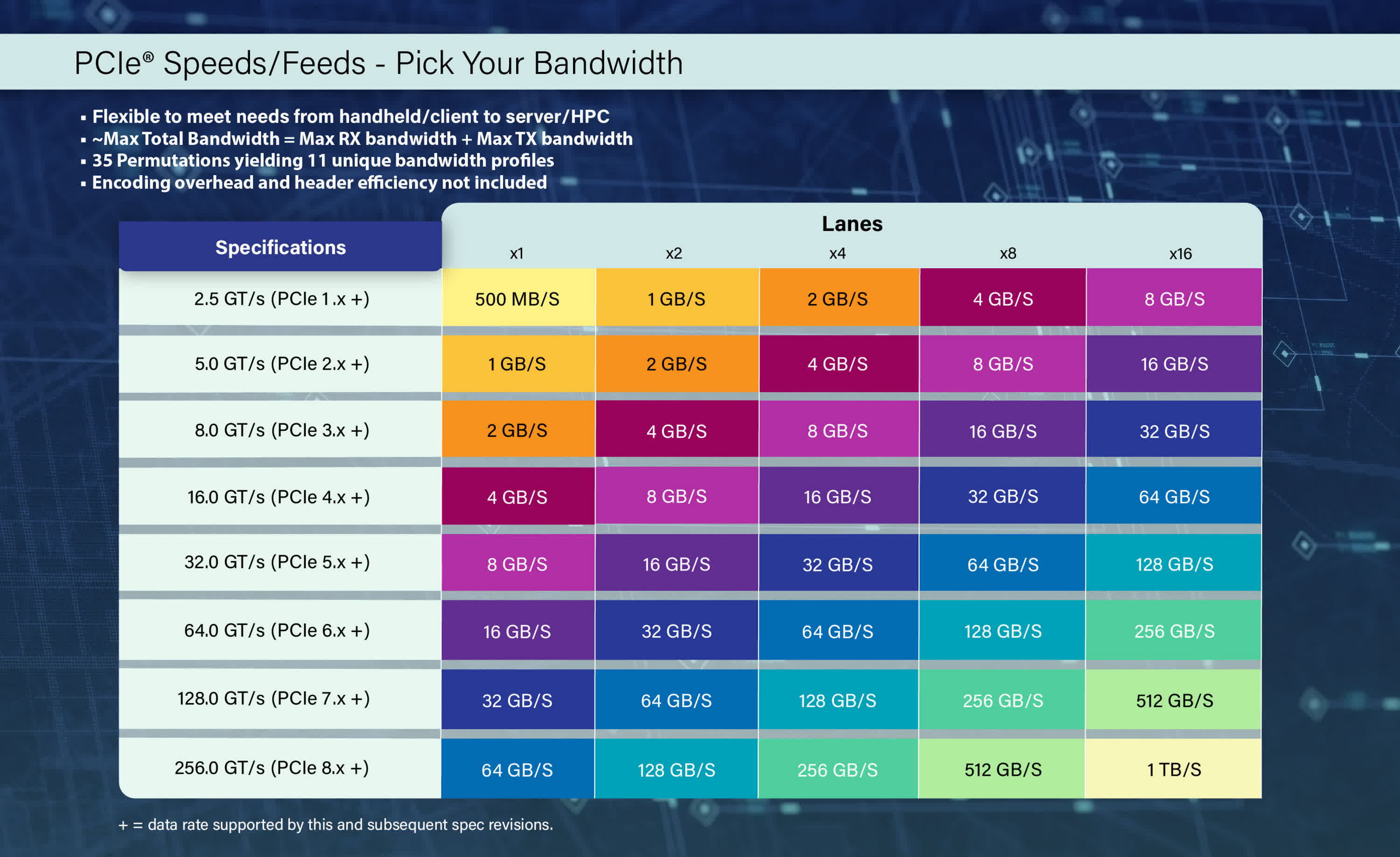
The new specification is the first draft release that outlines all of PCIe 8.0's technical goals. The primary aim is to deliver a raw bitrate of 256 GT/s, enabling 1 TB/s of bidirectional bandwidth while in x16 configuration.

Achieving this goal would keep PCIe on track to double its bandwidth with each generation since PCIe 1.0. The latest PCIe 8.0 draft specification is ahead of schedule, so PCI-SIG remains confident that the final specification will arrive before the end of 2028. It will likely appear first in enterprise applications such as AI, data centers, machine learning, edge computing, aerospace, and automotives.

Must Read: The Inner Workings of PCI Express

For most consumer devices in 2026, PCIe 3.0 (capable of 32 GB/s) and 4.0 (64 GB/s) remain sufficient, with PCIe 5.0 (128 GB/s) representing the cutting edge. While some PCIe 5.0 SSDs can achieve read speeds of around 14 GB/s, Micron recently unveiled an enterprise PCIe 6.0 drive that reaches 28 GB/s. Meanwhile, PCIe 7.0's final specification emerged last year.

Investigating new connector technology is another primary goal for PCIe 8.0. The last few generations have pushed up against the limits of traditional copper cabling, prompting manufacturers to explore fiber-based alternatives. Additional aims include maintaining latency standards, enhancing protocols to increase bandwidth even further, minimizing power consumption, and ensuring backward compatibility with earlier PCIe generations.

Permalink to story:

 
24 lanes on "low end" platforms isn't enough. Maybe on low end motherboards, that's fine, but AM5 on a x70 class motherboard should be able to have at least 32 lanes. Higher bandwidth lanes help, but signal integrity on gen5 can easily become an issue already and I don't see it getting any better on gen 6,7 or 8.
 
24 lanes on "low end" platforms isn't enough. Maybe on low end motherboards, that's fine, but AM5 on a x70 class motherboard should be able to have at least 32 lanes. Higher bandwidth lanes help, but signal integrity on gen5 can easily become an issue already and I don't see it getting any better on gen 6,7 or 8.
What do consumer platforms need it for? 16 for the GPU, which 99% of the time is complete overkill unless you run out of VRAM, 4 for the primary SSD, and 4 for the chipset, which then feeds USB and subsequent SSDs.

If more bandwidth is needed, you have Threadripper, part of that high cost is the additional PCIe lanes.

There is a small overlap of prosumers that can find uses for more PCIe lanes beyond e-peen, but dont need full blown professional setups like Xeons. Problem is that market isnt big enough to justify making a significantly more expensive platform for.
 
How much does this depend on memory bandwidth? As of now, DDR5 6000 MT/s in dual channel doesn't even match PCIe 5.0x16, so are these higher bandwidths only useful for direct transfer between SSD, CPU and GPU, bypassing DRAM? I'm assuming DDR6 will exceed this and make PCIe 6.0 reasonable but 7.0 and 8.0 seem very forward thinking unless consumer quad channel DDR5 and 6 become a standard outside of Strix Halo.
 
How much does this depend on memory bandwidth? As of now, DDR5 6000 MT/s in dual channel doesn't even match PCIe 5.0x16, so are these higher bandwidths only useful for direct transfer between SSD, CPU and GPU, bypassing DRAM?

I'm assuming DDR6 will exceed this and make PCIe 6.0 reasonable but 7.0 and 8.0 seem very forward thinking unless consumer quad channel DDR5 and 6 become a standard outside of Strix Halo.
 
How much does this depend on memory bandwidth? As of now, DDR5 6000 MT/s in dual channel doesn't even match PCIe 5.0x16, so are these higher bandwidths only useful for direct transfer between SSD, CPU and GPU, bypassing DRAM? I'm assuming DDR6 will exceed this and make PCIe 6.0 reasonable but 7.0 and 8.0 seem very forward thinking unless consumer quad channel DDR5 and 6 become a standard outside of Strix Halo.
Ddr5 with two memory sticks, 128 but bus, at 6000 mt will provide 96GB of bandwidth per second hypothetical. (6000*128/8)

Pcie 5 tops out at 64GB/s
 
How much does this depend on memory bandwidth? As of now, DDR5 6000 MT/s in dual channel doesn't even match PCIe 5.0x16, so are these higher bandwidths only useful for direct transfer between SSD, CPU and GPU, bypassing DRAM?

I'm assuming DDR6 will exceed this and make PCIe 6.0 reasonable but 7.0 and 8.0 seem very forward thinking unless consumer quad channel DDR5 and 6 become a standard outside of Strix Halo.
These new PCIe revisions aren't made for the consumer market, they're made for enterprise where you have platforms with 8/12/16 memory channels, and/or large clusters of PCIe devices communicating with each other, so they'll take as much bandwidth as you can give them. That's the same reason why NVLink exists.
For consumers this means nothing, even PCIe 4.0 will be enough for most people for the next decade, and you'll see essentially zero benefit going above PCIe 5.0. Consumer markets have no incentive to keep up with PCIe revisions.
 
These new PCIe revisions aren't made for the consumer market, they're made for enterprise where you have platforms with 8/12/16 memory channels, and/or large clusters of PCIe devices communicating with each other, so they'll take as much bandwidth as you can give them. That's the same reason why NVLink exists.
For consumers this means nothing, even PCIe 4.0 will be enough for most people for the next decade, and you'll see essentially zero benefit going above PCIe 5.0. Consumer markets have no incentive to keep up with PCIe revisions.
I'm heavy into a/v editing and anything pcie has ever been has always been more than enough. What they are doing now, unless you are like a very serious gamer with big money invested and bet on outcomes, is for most consumers overkill, I mean serious overkill. Maybe DOD or some Universities or Medical institutions might benefit, and they have mainframes and supercomputers.
 
The random access speed of PCIe 5.0 NVMe drives is not yet impressive, but advertising always mentions the sequential access speed.
 
PCI-E standards may be finalised in 2028 but won't even appear in commercial applications before 2035 at best. PCI-E 6.0 only just starting to appear in commercial arena, PCI-E 7 5 years away.
 
How much does this depend on memory bandwidth? As of now, DDR5 6000 MT/s in dual channel doesn't even match PCIe 5.0x16, so are these higher bandwidths only useful for direct transfer between SSD, CPU and GPU, bypassing DRAM?

I'm assuming DDR6 will exceed this and make PCIe 6.0 reasonable but 7.0 and 8.0 seem very forward thinking unless consumer quad channel DDR5 and 6 become a standard outside of Strix Halo.
All this hype about computer speeds. You who are reasonable must agree that the pesent day pc of any kind or os or whatever goes far above the necessities of the average consumer. Just a ploy by manufacturers and advertisers to make more money, just like a Lamborgini will fly at about 200 mph when it's really not necessary. Just think about the fact that all this costs us valuable mineral resources to produce the electricity to run them. Not to mention the fact that your typical cable or satellite bill contains the bundle for 57 channels or more when you use maybe only five or six. Then you can think of the entire world lighting up the neon skies in every city in the world with which about at least 60% is really unnecessary, just advertising to make money. All of this consumes valuable mineral resources to produce the energy to run the show. And then there's entertainment, sports venues and everything we do just to have a good time. Being as it is mother nature is already on the wane, what will we do when she is gone being finite the way she is. You can't draw blood from a turnip if you ain't got no turnip to draw blood from
.
"57 channels and nothings on"
Bruce Springsteen

Xenon Nights

Xenon nights are fading fast
Your mama told you it wouldn't last

Had a good time all the while
With bodies floating in the Nile

No one hears what they really know
And please don't say I told you so

Mark Fuller
 
Last edited:
Back