Ford's upcoming $30,000 EV truck leans on efficiency instead of a massive battery pack

Skye Jacobs

Posts: 2,030   +59
Staff
First look: Ford is rebuilding its electric vehicle strategy around a mid-size pickup that has yet to be unveiled but is already prompting a wholesale rethinking of batteries, wiring, aerodynamics, and manufacturing within the company. The truck will be the first model built on Ford's Universal Electric Vehicle (UEV) platform, a dedicated EV architecture designed to hit a target price of about $30,000 by optimizing efficiency rather than simply increasing battery capacity.
In a technical briefing that included Car and Driver, Ford's advanced EV group detailed how the platform abandons compromises inherited from internal-combustion vehicles in favor of a tightly integrated set of technologies: structural lithium iron phosphate (LFP) battery packs, a 48-volt zonal electrical system, in-house power electronics, large unicastings, and a strong emphasis on aerodynamics.

The first UEV-based truck, due in 2027, is designed to deliver more range per kilowatt-hour than any mid-size pickup currently on the market.

The UEV platform is dedicated solely to battery-electric powertrains. Eliminating the need to package engines, transmissions, and conventional crash structures frees up volume for passengers and cargo, while allowing the underbody to be organized around a structural battery pack.

Ford says the mid-size pickup will combine a front trunk and traditional bed with cabin space exceeding that of a 2025 Toyota RAV4, with the flat floor and integrated battery pack maximizing interior volume.

The battery system is central to the platform's cost and performance strategy. Ford is using prismatic LFP cells, which are 20 – 30 percent cheaper per kilowatt-hour than many nickel-rich chemistries, and the battery pack itself serves as a structural component of the vehicle.
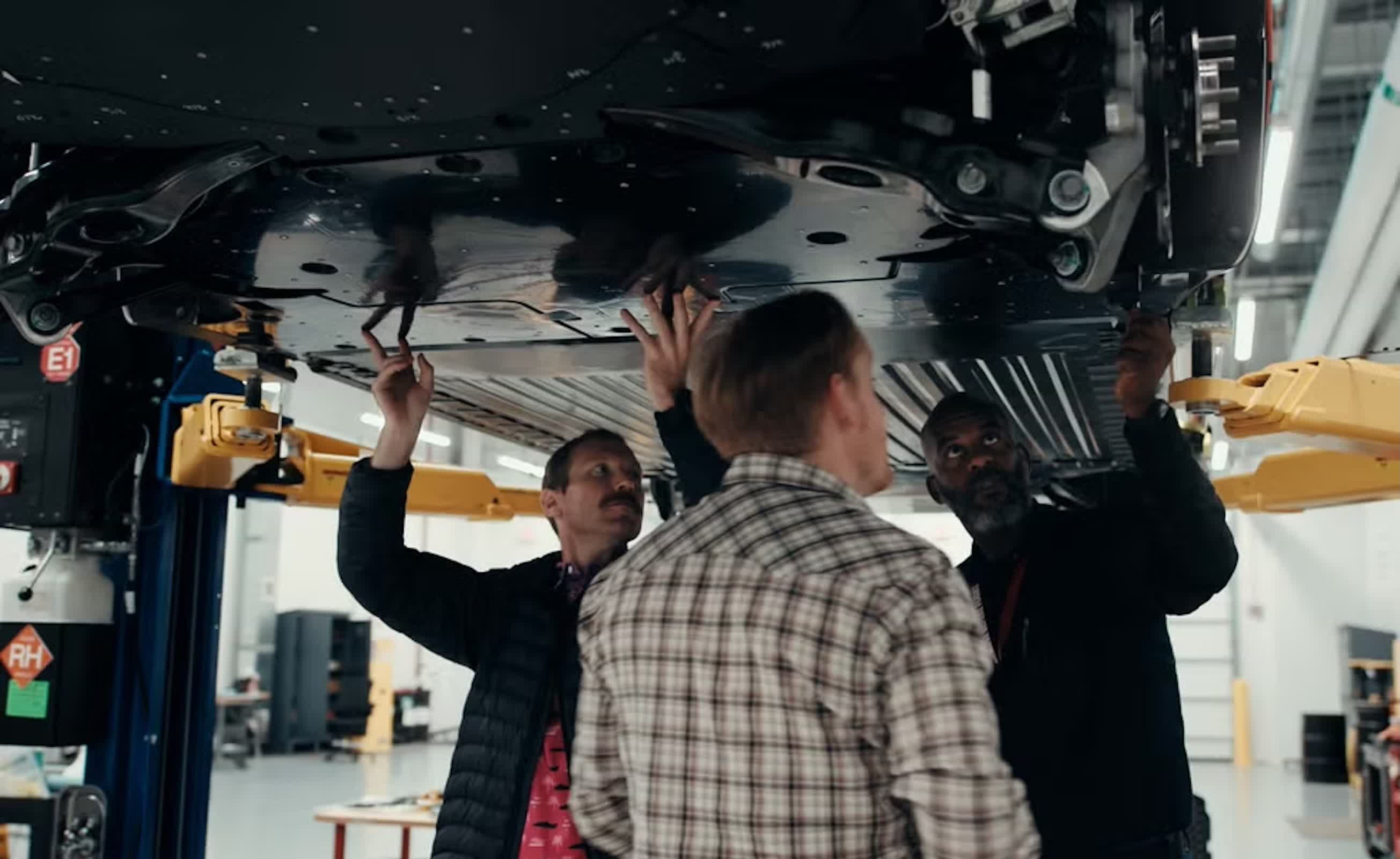
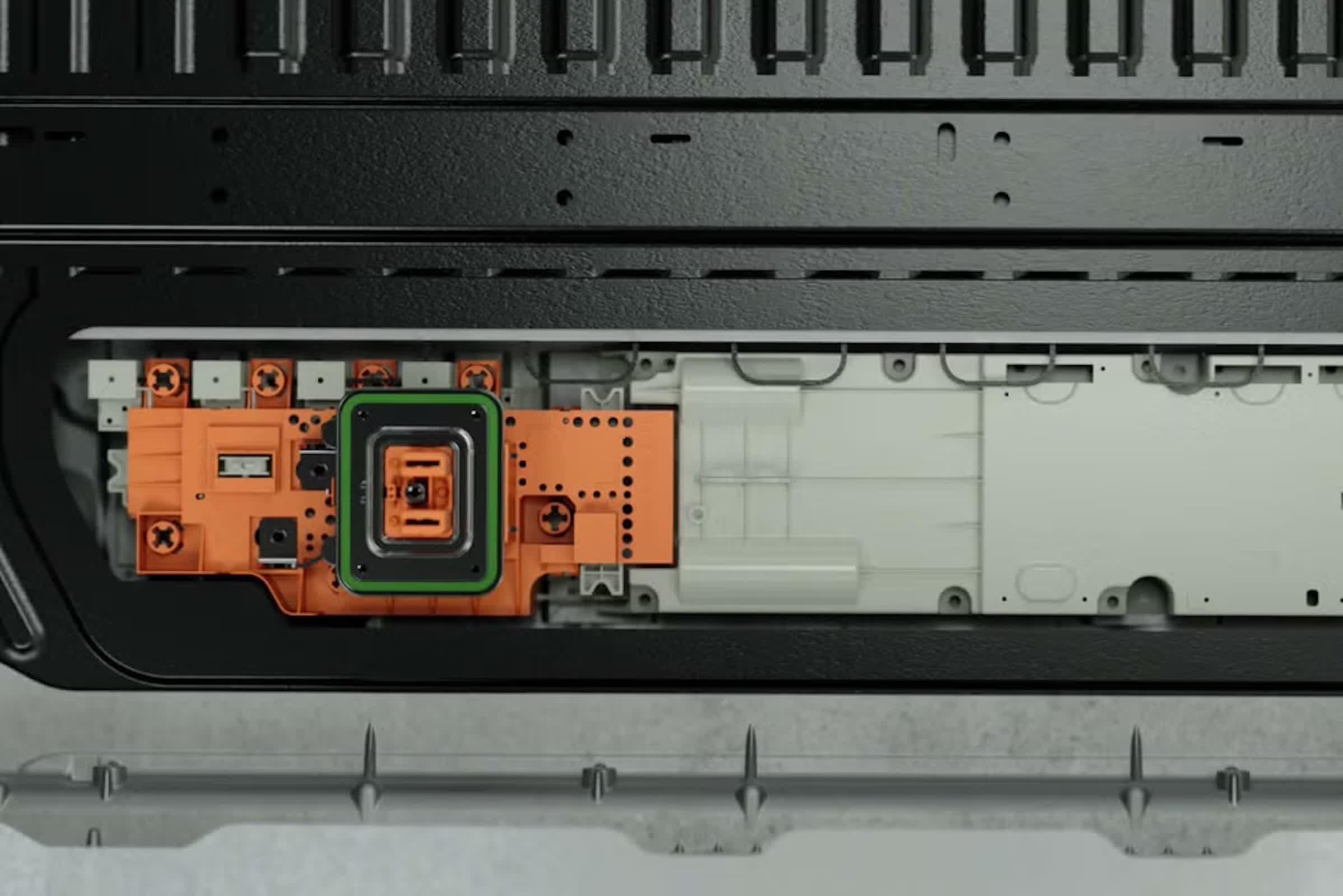
Cells are integrated directly into the underbody, and a multi-layer flexible circuit board manages low- and high-voltage connections, thermal sensing, and module monitoring. This design replaces a web of bus bars and wiring with a single integrated element, reducing weight and simplifying assembly as well as cooling interfaces.

Ford has also engineered the UEV platform to accommodate alternative battery chemistries and formats, allowing future cells with different energy densities or performance profiles to be adopted without redesigning the fundamental structure. The company projects that the resulting truck design could deliver roughly 50 more miles – or about 15 percent – of range from the same battery capacity compared with today's lowest-drag mid-size pickups, a claim currently being validated in on-road testing.

Traditional vehicles rely on dozens of supplier-sourced control units with dedicated wiring, but Ford's UEV platform replaces them with a zonal architecture built around five in-house compute modules that manage most of the truck's functions. These modules communicate over automotive Ethernet, reducing the need for separate signal and control lines throughout the vehicle.

Ford is also introducing its first 48-volt power system for key vehicle functions while retaining 12-volt rails for accessories such as lighting and audio. Basic physics drives the shift to 48 volts: for the same power, a higher voltage reduces current, and resistive heating in conductors scales with the square of the current. This allows for smaller-gauge copper, lower heat buildup, and reduced weight – particularly when combined with a zonal layout that shortens the distance between power sources and loads.

Ford says the UEV truck's wiring harness will be roughly 4,000 feet shorter and 22 pounds lighter than the harness in the original Mustang Mach-E, and it will no longer require oven heating to bend into place during assembly.

The company is also rethinking how power flows through the vehicle. Rather than sourcing inverters, onboard chargers, and other high-voltage components individually, Ford is designing its own power-electronics and energy-management hardware and software. Central to this approach is the E-box, a compact unit that consolidates roles typically split across multiple components.

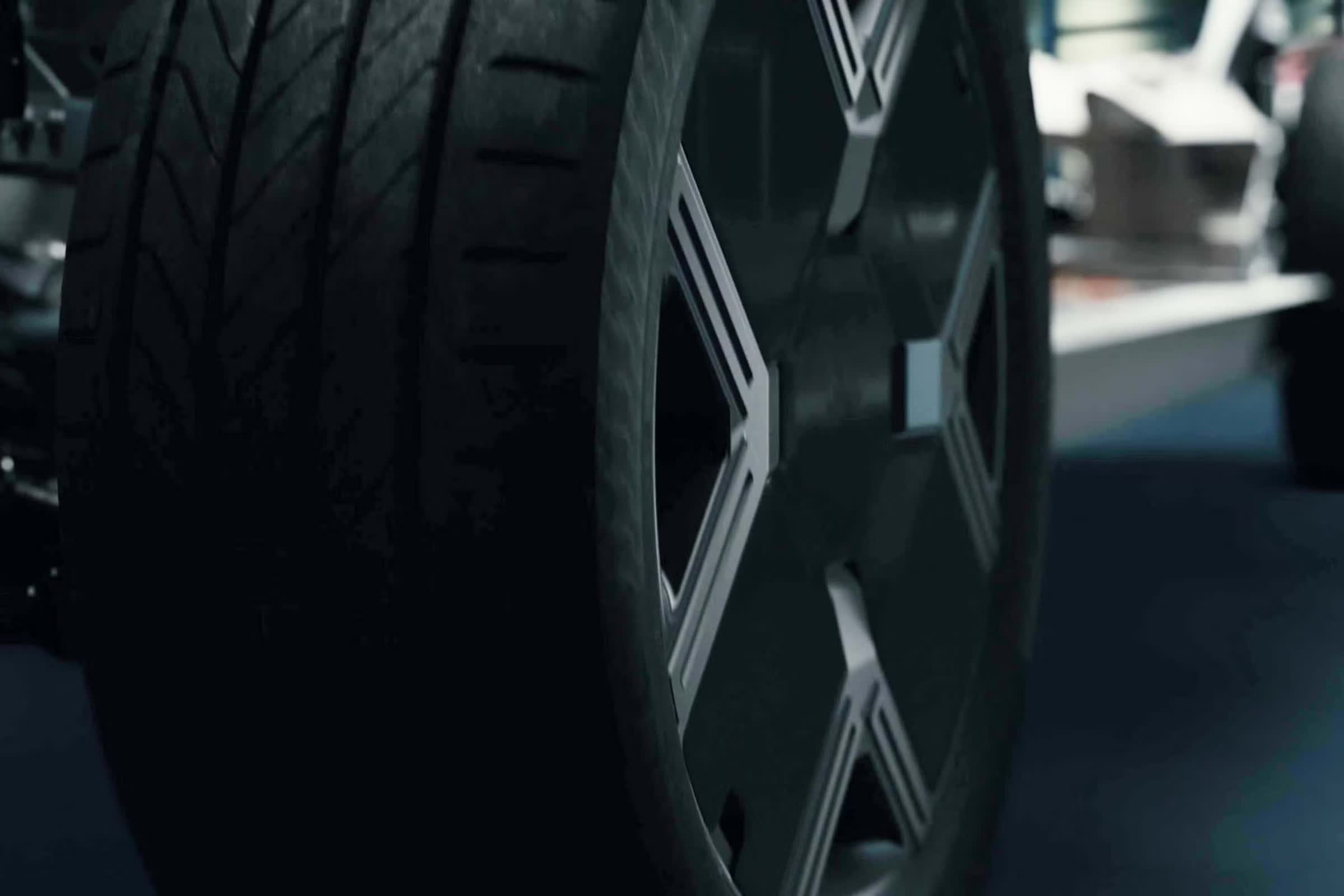
The E-box integrates functions for DC fast charging, AC charging, battery management, and high-voltage distribution into a single enclosure, sharing sensors, cooling, and control logic. This reduces component count and packaging complexity, frees up additional space for the cabin and storage, and gives Ford tighter control over charging behavior and efficiency. The E-box also supports bidirectional charging, enabling the truck to export power for tools, electronics, and even home backup.

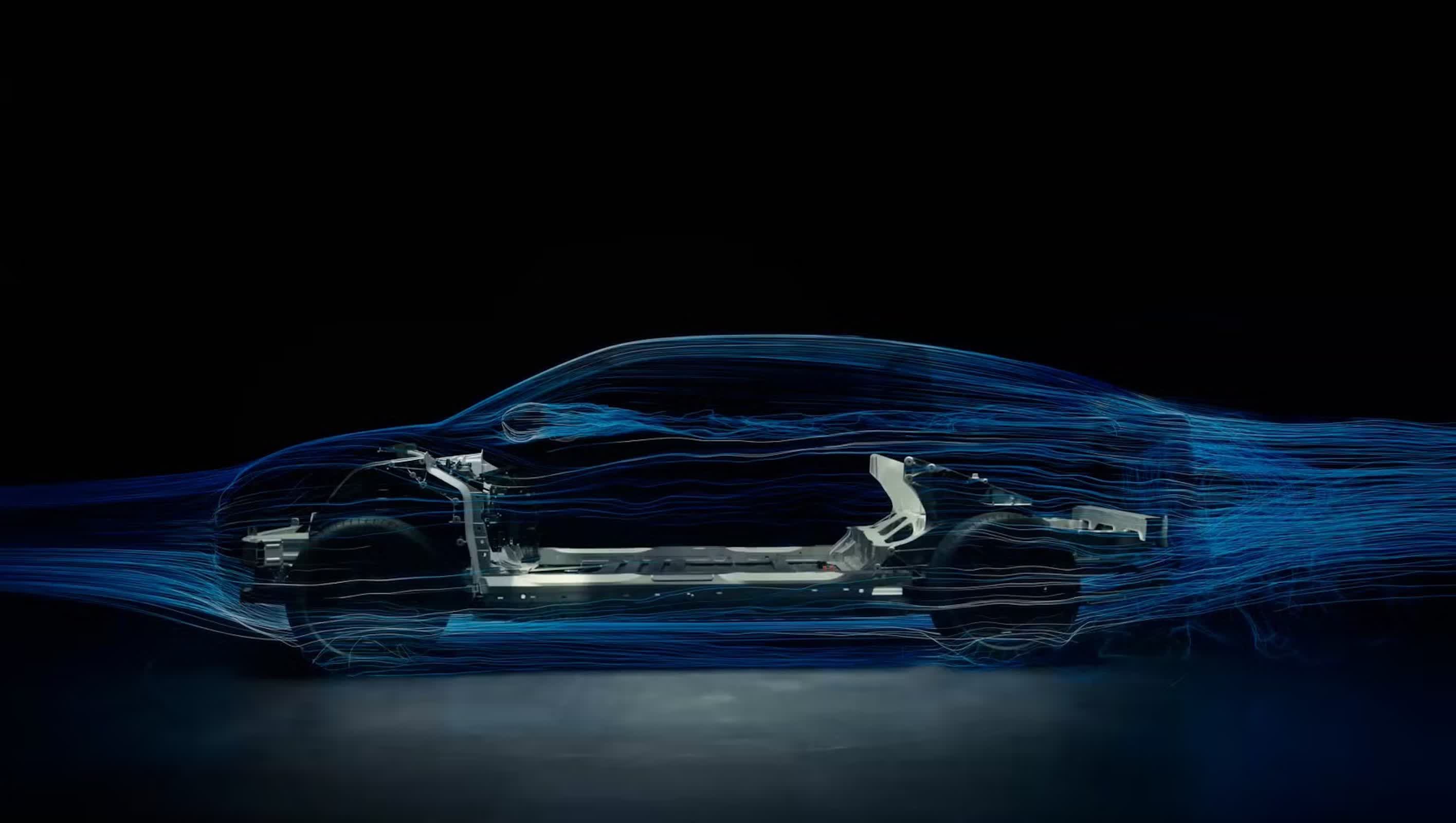
Aerodynamics are another major focus, as drag dominates energy consumption at highway speeds. Ford's aerodynamics team, which includes engineers with experience in Formula 1, treated airflow as an early design constraint rather than an afterthought.

Ford presented airflow simulations comparing the UEV truck to a conventional compact pickup silhouette, similar to its Maverick, showing how the traditional shape generates a high-drag wake behind the cab and over the bed.

For the UEV truck, the team sculpted a roofline and body that maintains a cohesive airflow and directs it past the bed in a teardrop pattern, dramatically reducing wake. Internal testing suggests this design reduces drag by more than 15 percent compared with any pickup currently on the market.

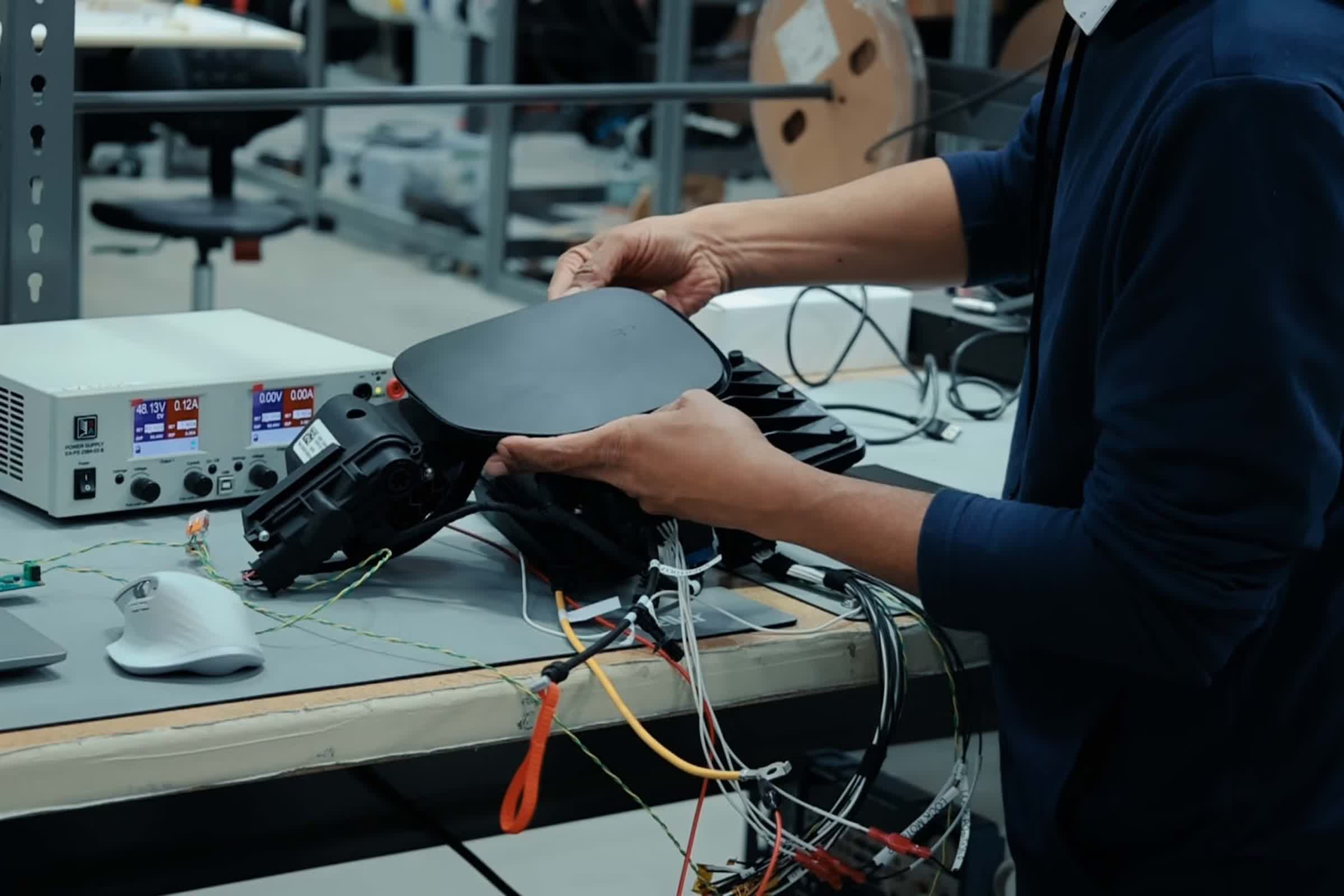
Even details such as the exterior mirrors were redesigned with efficiency in mind. By combining the motors for glass adjustment and folding into a single unit, Ford reduced the mirror housing by more than 20 percent, lowering frontal area and mass while gaining roughly 1.5 miles of range.

The platform's mechanical structure is built around a radical reduction in part count. Ford is using large aluminum unicastings at the front and rear of the truck to replace dozens of individual stamped or cast pieces that would typically be welded or bonded together.

Together with the structural battery pack, these front and rear castings form a three-piece understructure that acts as the vehicle's backbone. The front and rear subframes, which carry the suspension and wheels, bolt to this core, creating a rolling chassis with fewer joints and welds.

Ford has not yet released final specifications, images, or pricing for the UEV-based pickup, and the company's recent decision to end production of the F-150 Lightning has raised questions about its long-term EV commitment. The technology behind the UEV platform suggests that Ford is betting the path to a mainstream electric truck lies in structural battery packs, simplified wiring, integrated power electronics, and careful aerodynamics – not merely larger batteries.

Permalink to story:

 
In my opinion this is a rare look at how a single product can finally make a breakthrough, or kill much of the public interest and good will that has taken 15+ years to build.

Grab a brandy and find a good seat. It's bound to be quite fun either way.
 
I cannot begin to express how much I want this truck. I was interested in the hybrid Mav before but this is even better. I don’t need a giant F-150. I just need something for the occasional stuff a homeowner needs a truck for. Moving appliances, mulch, etc. I have an EV sedan and it’s excellent. The quibbles I have with it are design decisions that have nothing to do with being an EV.

shut-up-and-take-my-money-futurama.gif
 
What is the range, though?
The range is 5 million miles. Is that enough for you? I don't get why people are so hung up on range. Do you travel hundreds of miles everyday? No? Then why worry about it?

Anyway, don't hold your breath. Ford couldn't make a profit off a $70,000+ electric truck so they scrapped it, but they're going to come up with a $30,000 version that's profitable and isn't a piece of junk that nobody wants. Sounds legit.
 
I still want the Slate Pickup truck. The big manufacturers are so anti-repair. In one of our fleet trucks we had minor damage done to a headlight and it cost us $2800 to repair because it could only be bought from Ford and they needed to "program" the headlight. FYI, part of the LED turn signal burnt out. Not all of them, just like 5 out of the hundred or so in the assembly. It wouldn't pass inspection and the whole headlight needed replaced.

Sorry. I don't want any as my personal vehicle.
 
"The UEV platform is dedicated solely to battery-electric powertrains. Eliminating the need to package engines, transmissions, and conventional crash structures ..."

Sounds like a money-saver to me. Eliminating crash structures most likely will aid in eliminating lawsuits from crashes, due to the reduced number of survivors.
 
The range is 5 million miles. Is that enough for you? I don't get why people are so hung up on range. Do you travel hundreds of miles everyday? No? Then why worry about it?
Because vehicles are expensive, duh! This isnt your grandpappy's days where you could buy a second vehicle for a fiver.

If you are going to spend tens of thousands of dollars on a vehicle, that vehicle needs to do everything. As public charging is still a mess tot his day, and not everywhere has chargers, you need to be able to get to where you need to go, and get to a charger, without having to significantly alter your route. If you cant, but you can buy other vehicles that can, guess what happens to your sales? If you park outside in the winter, that range gets cut down HARD, and what was fine in the summer suddenly cant make it out of your zip code without making multiple stops and adding hours onto whatever trip you are trying to make, or even making it impossible with your $50k EV. Dont even get me started on towing, the lightning EV truck was pathetic, not even 100 miles on a 330kW battery! My old big block gas slurper can double that while wheezing along rotating 7.5 liters of old iron.

Oh and dont forget you're only supposed to go from 10 or 20% to 80% when charging as to not wear out the battery, so take off another 30% of that range for you will not be able to use it either! Suddenly that 300 mile EV can barely make it 120 miles in the winter before having to charge again.

Lack of charger access is a thing. Winter range loss is real. Battery degradation is real. One can cite many examples where the range of their EV wouldnt suffice for something they do, and that is a problem when most cannot afford a second vehicle.

What gets me is why people ask such dumb questions as "why do people get hung up on range" when plenty of people have already explained why range is important to them. Is it ignorance? Is it facetious hypotheticals being presented to imply any who dont like what you do are dumb? Is it genuine delusion as to why people dont want to immediately adopt the new "thing"?
"The UEV platform is dedicated solely to battery-electric powertrains. Eliminating the need to package engines, transmissions, and conventional crash structures ..."

Sounds like a money-saver to me. Eliminating crash structures most likely will aid in eliminating lawsuits from crashes, due to the reduced number of survivors.
Not what that means, but nice try.

You need additional crash structure int he front of a ICE vehicle because, well, there is a half ton ENGINE up there, and that has a lot of INERTIA that must be absorbed so the cylinder head doesnt try to fuse with your torso.

You dont need that structure in a BEV where the motors and battery are both below the floor.
Wake me up when Ford (really every automaker) stops making plasticky junk that is designed to fail after 8 years and be impossible to repair.
We keep hearing that, yet american automobiles set a new record with an average age of over 12 years last year.

People have been saying this line since fuel injection first showed up in the late 80s. People said this about the cars in the mid to late 2000s that they now laude as being indestructible tanks. Watching people fellate the Ford Trition or the Chevy 3400/3800 V6 today is just hilarious, or for a more recent example, the honda civic that everyone swore up and down would blow up in a few years because of its poor overstressed 1.5L turbo engine. Now everyone talks about how great those 10 year old civics with that same engine are.
 
We keep hearing that, yet american automobiles set a new record with an average age of over 12 years last year.

People have been saying this line since fuel injection first showed up in the late 80s. People said this about the cars in the mid to late 2000s that they now laude as being indestructible tanks. Watching people fellate the Ford Trition or the Chevy 3400/3800 V6 today is just hilarious, or for a more recent example, the honda civic that everyone swore up and down would blow up in a few years because of its poor overstressed 1.5L turbo engine. Now everyone talks about how great those 10 year old civics with that same engine are.

True, but it's all a matter of perspective. As someone who owns 2 mid-2000s vehicles, I can tell you without a shadow of a doubt that they are both simpler (and far cheaper) to work on and significantly more robustly built than their modern counterparts. Since you mentioned it, a new Buick with a 3800 V6 purchased in the mid 2000's will probably be dying at around the same time as a Buick with the new(er) 1.2T I3 purchased in the early 2020's, used by the same manufacturer, in the same markets, for the same price (adjusted for inflation). And don't even get me STARTED on belt-driven CVTs. Yeesh!

Also Honda's 1.5T was plagued by fuel dilution issues too, so most people who owned the first ones had theirs either repaired or replaced, skewing the longevity stat in its favor.

Finally, 10 years old is rookie years. You're talking to someone who owns 2 vehicles 20+ years old, purchased secondhand, with over 150k miles of service since purchasing them, with just maintenance (on original engines and transmissions no less). There's NO WAY anything on the market today is going to survive to 250k miles, let alone 350k miles (like mine), without expensive work (I believe Tesla door handles are still a $2k job), let alone major work/overhauls. Period.
 
The range is 5 million miles. Is that enough for you? I don't get why people are so hung up on range. Do you travel hundreds of miles everyday? No? Then why worry about it?

Anyway, don't hold your breath. Ford couldn't make a profit off a $70,000+ electric truck so they scrapped it, but they're going to come up with a $30,000 version that's profitable and isn't a piece of junk that nobody wants. Sounds legit.

In an urban area, "short trips" are routine. But people, especially farmers and what not, travel hundreds of miles each week just to get to the store, doctors, etc.
Not everyone lives in an urban environment. Some like the ability to get OUT of the city where it is
quiet and private.
 
The range is 5 million miles. Is that enough for you? I don't get why people are so hung up on range. Do you travel hundreds of miles everyday? No? Then why worry about it?

Anyway, don't hold your breath. Ford couldn't make a profit off a $70,000+ electric truck so they scrapped it, but they're going to come up with a $30,000 version that's profitable and isn't a piece of junk that nobody wants. Sounds legit.

How many times do I have to drive hundreds of miles in a year to make an EV a non starter? The last thing I want on a vacation or long trip is to stop every few hours to charge for a few hours, especially considering the fact that chargers are nowhere near as ubiquitous as gas stations.

Next thing nobody mentions is with only 3 frame pieces with a battery in the middle, how's this thing going to hold up in a crash? No crumple zone there. Is the weak point the 2 frame sections, or the battery? Is the idea that at $30k you just buy another one with any somewhat serious crash?

As is usual, an entire article raving about the new revolutionary EV and how great it is and how they've thought of everything.

I've always said EV's have a use case and a viable market. They're just NOT for everyone, and this hasn't fixed that. Besides, how much of that price tag is subsidized by the very profitable ICE market? It's the only reason Ford still exists as a vehicle manufacturer after dropping Billions of dollars trying to capture a saturated market.
 
Sounds good, fingers crossed it delivers. Over 300 miles on a battery is essential for an EV to really compete with ICE/hybrid vehicles.
 
Back