Full Intel Arc B570 GPU specifications leak ahead of launch

DragonSlayer101

Posts: 974   +14
Staff
What just happened? Two of Intel's upcoming Arc Battlemage discrete graphics cards have been extensively leaked ahead of their anticipated launch on December 3 (tomorrow!). One SKU was prematurely listed on Amazon last week and now the other has been detailed, seemingly revealing its key specifications. Both GPUs are expected to target the budget to mid-range market.
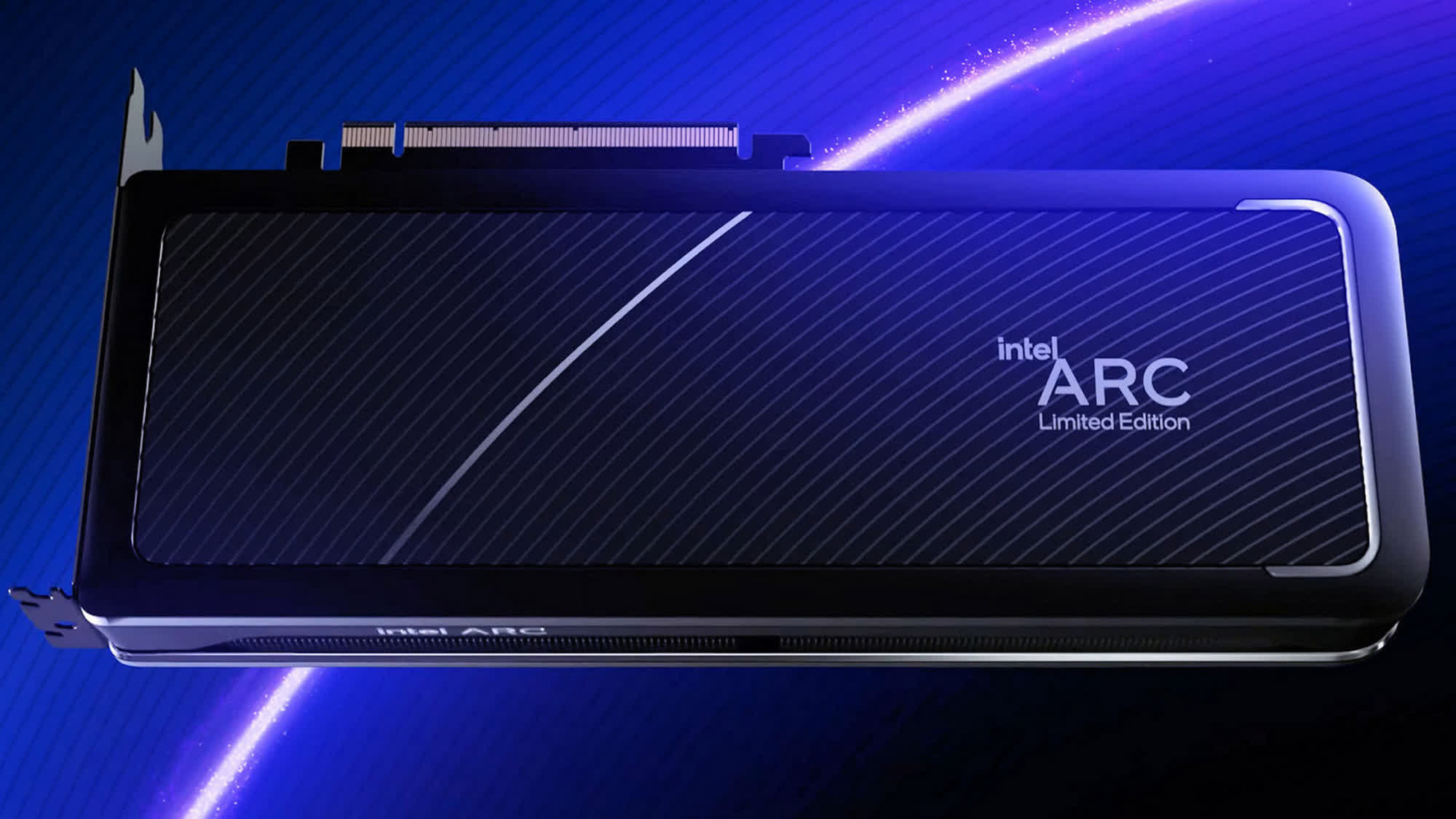
Intel is expected to unveil at least two Battlemage SKUs this week, the Arc B580 and the Arc B570. The latest leak has revealed the full specifications of the ASRock Arc B570 Challenger OC. According to a post by tipster Roland Quandt on Bluesky, the card will feature 144 XMX Engines and 18 Xe2 cores. It is also expected to include 10 GB of GDDR6 memory on a 160-bit bus, delivering a maximum bandwidth of 380 GB/s.

Interestingly, the card will operate on a PCIe 4.0 x8 interface rather than the PCIe 5.0 x16 interface used by some competitors, resulting in comparatively lower bandwidth. As indicated by its name, the card is factory overclocked, reaching peak speeds of up to 2.6 GHz. The accompanying image also reveals that the B570 will support DisplayPort 2.1 and HDMI 2.1. However, the specific version of DisplayPort 2.1 remains unclear, though online speculation suggests it could support UHBR 13.5.

Intel Arc B570

[image or embed]

– Roland Quandt (@rquandt.bsky.social) December 1, 2024 at 5:10 AM

According to an early Amazon listing, the ASRock Arc B580 Steel Legend graphics card will feature 20 Xe2 cores – two more than the B570. The card will include 12 GB of GDDR6 memory running at 19 Gbps and will be factory overclocked to a speed of 2.8 GHz. The listing also detailed dual 8-pin power connectors and support for 8K resolution (7,680 x 4,320).

Intel is expected to announce the Arc Battlemage lineup on December 3, with rumors suggesting the cards will go on sale starting December 12. The Amazon listing hinted that the B580 might be priced at $249, though it's unclear if this is the final price or merely a placeholder. Pricing details for the B570 were not included in the images shared by Quandt, but if the B580 is indeed $249, the B570 could be priced around $200.

A recent leak from tipster Golden Pig Upgrade Pack claimed that both the B570 and B580 outperform Nvidia's RTX 4060 Ti, which is priced at approximately $400. If Intel manages to price its upcoming cards at the rumored levels, Nvidia and AMD could face stiff competition. However, the leak did not specify the metrics used for the comparison, so this claim should be taken with caution.

Permalink to story:

 
Looking at that memory config, I'm going to guess the card does OK in games dependent on shader performance, but struggle mightily in anything even remotely memory constrained. I also suspect the cards will hold up *far* better at 1080, and will be significantly weaker then the competition as resolution increases.

I suspect it could beat the 4060 in 1080, but suspect it looses in 1440 and gets crushed at 4k.
 
If the rumored prices of $250 and $200 hold true, they would be phenomenal budget 1080p cards...but not really anything higher with only 12GB or less of VRAM. Hopefully there's a B590 we haven't heard about with at least 16GB but I'm not holding my breath the way Intel's been going lately.
 
Looking at that memory config, I'm going to guess the card does OK in games dependent on shader performance, but struggle mightily in anything even remotely memory constrained. I also suspect the cards will hold up *far* better at 1080, and will be significantly weaker then the competition as resolution increases.

I suspect it could beat the 4060 in 1080, but suspect it looses in 1440 and gets crushed at 4k.

Why would either lose to the 4060 when memory constrained when the 4060 is even more memory constrained?
 
So, I suppose they convened a discussion meeting where someone inquired, "Why was the Alchemist's sales performance so weak?" Another participant responded, "Well, I think we overemphasized the VRAM capacity, and consumers were confused by the “super expensive” 16GB GDDR6, perceiving it as a scam." The group agreed that this was the root cause of the weak sales and decided to reduce the VRAM in the next version. Now, with their own fabrication facilities idle, they have contracted TSMC to produce chips with and added just 10GB of VRAM to maximize value to their R&D on the chip and it’s software stack.

The only logical explanation is that Intel is operating below capacity and releasing subpar products merely to maintain an active presence in the market.

If they aim to sell cards rather than the company itself, they must develop a card focused on AI, equipped with dual chips: one GPU at 4 or 3nm equivalent to the RTX 5080, and one 4 or 3nm ASIC that they can work together via a 512bit bus with at least 1200+ GB/s bandwidth and at least 128GB of HBM2 VRAM (even better 256+GB with 1024bit bus and 2000+GB/s, the aim for bandwidth is 10tks/sec with a model the size of vram, so the model size * 10). Additionally, the card should feature a socket for an NVMe SSD to optionally store and load large language models (LLMs) directly from that. All these features should be offered at a maximum price of $999 including taxes. That’s a product that is equivalent with the Intel’s caliber and long history.

If they provide this type of hardware and open-source the drivers, the community will likely develop the entire software stack (equivalent to CUDA) within the first year. Addressing user problems is crucial for their success. If users have a problem then it’s Intel problem too. With the current cards they release, they are merely disrupting the gaming ecosystem, as developers will cannot create better games due to the presence of significant weak hardware in the market.
 
Last edited:
4060ti performance for $200-250 really gets the $/performance needle back in line with where it should be.

If it's a 1080p card then even 10gb of RAM will be fine.
 
Back