Google plans to terminate ChromeOS in 2034, court documents reveal

Alfonso Maruccia

Posts: 2,509   +934
Staff
In a nutshell: Google introduced its Chromebook systems in 2011. Powered by ChromeOS, the machines initially gained popularity in niche markets such as education. The cloud-based proprietary operating system that powers these devices, however, is reportedly on track to be phased out. Its successor, the upcoming "Aluminium OS" project, is expected to take its place.
After years of rumors and speculation, Google confirmed in 2025 that it plans to "fuse" Android and ChromeOS into a single desktop platform. The new system, known internally as Aluminium OS, is reportedly already under active development. What remains unclear is the fate of ChromeOS, the operating system that has powered every Chromebook sold to date.

According to recently surfaced court documents, ChromeOS is slated for retirement. Google will continue to support the internet-focused OS for several more years but plans to phase it out entirely by 2034. After that, Aluminium OS could become the unified platform for new desktop machines and thin clients sold under Google's brand.

The revelation comes from court transcripts in Google's antitrust case, where a US judge officially recognized Mountain View as holding an unlawful monopoly in web search. After losing the battle against the Department of Justice, Google is now focused on mitigating the case's most severe consequences. So far, the company has retained ownership of the Chrome web browser, but ChromeOS and future OS iterations remain a separate and uncertain issue.
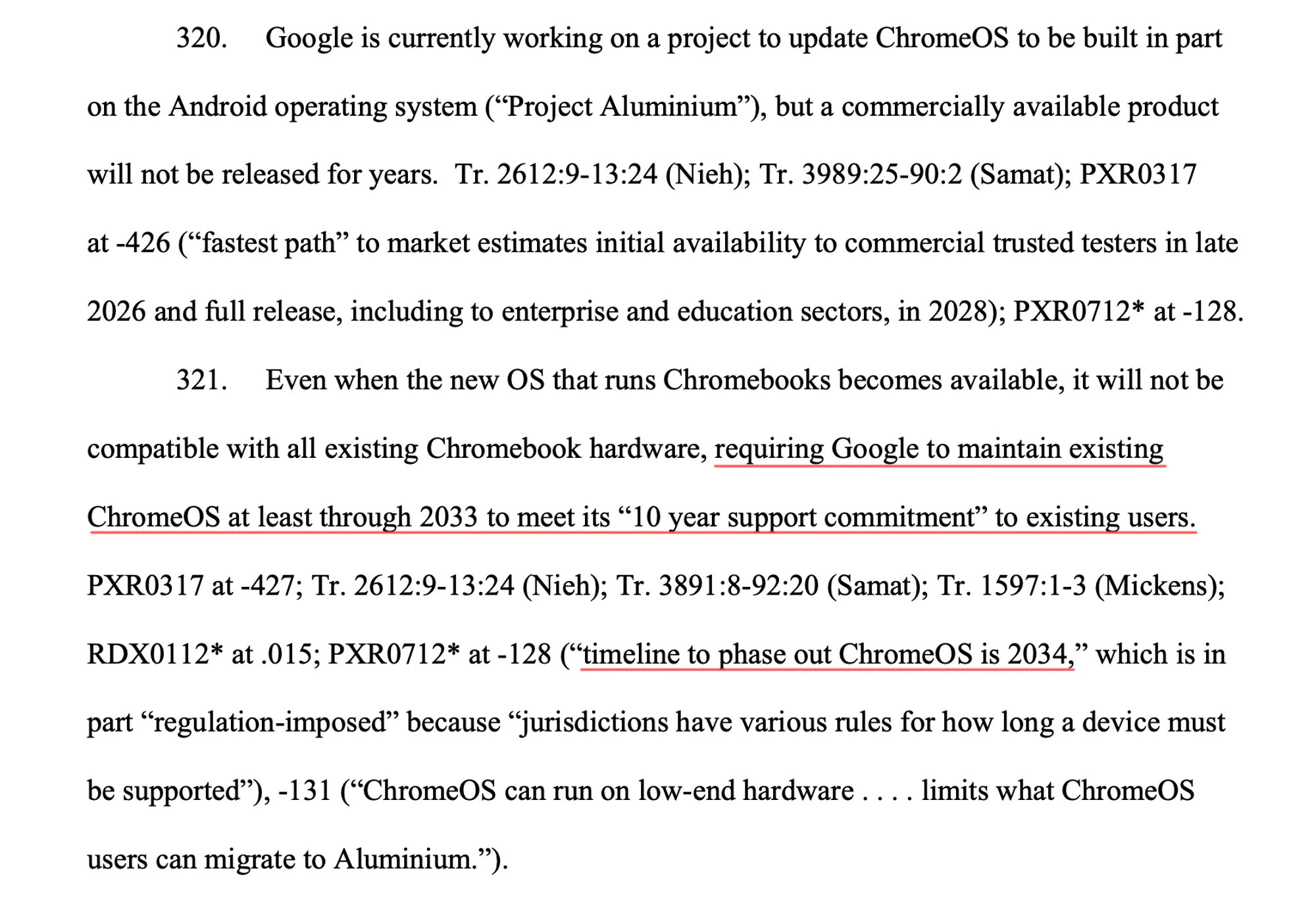
The transcript confirms that Google is required to continue supporting existing ChromeOS devices "at least" until 2033, in order to honor its 10-year support commitment to customers. The judge ruled that Google can no longer impose unlawful search agreements on third-party companies, but ChromeOS and its derivatives are essentially sophisticated layers built around the Chrome browser and Linux.

Chrome's layout engine remains a crucial component of ChromeOS and is expected to play the same role in Aluminium OS. The new system is anticipated to be an Android variant optimized for desktop scenarios, offering full – or at least largely compatible – support for Android and ChromeOS apps adapted for larger screens. Aluminium OS is also expected to be the first Android line capable of running on both Arm and x86 CPU architectures.

The US Department of Justice sued Google to prevent the company from abusing its dominant position in the web search market. If Aluminium OS functions as Google has indicated in court, Mountain View could potentially establish a new dominant position in low-cost educational devices and desktop Android clients in the coming years.

Permalink to story:

 
This is gonna send the education world into a frenzy. We love Chromebooks because they are simple to work with and unlike full operating systems are much harder to install anything on. Also way easier to manage on the admin end.
Question is, will Google make this easy to access for DIYers?
Of course not. This is Google, they are salivating at all the ways they can further lock down future products.
 
This is gonna send the education world into a frenzy. We love Chromebooks because they are simple to work with and unlike full operating systems are much harder to install anything on. Also way easier to manage on the admin end.
Of course not. This is Google, they are salivating at all the ways they can further lock down future products.
They are just replacing Chromebooks with Aluminumbooks so I doubt it will be a big deal.
 
They are just replacing Chromebooks with Aluminumbooks so I doubt it will be a big deal.
If aluminum OS is indeed a full OS it'll be a pretty big deal. Android is significantly more annoying to lock down and manage then chromeOS is and google's latest software work is not inspiring confidence.
 
If aluminum OS is indeed a full OS it'll be a pretty big deal. Android is significantly more annoying to lock down and manage then chromeOS is and google's latest software work is not inspiring confidence.
Google messing things up is a fair point. But the need to lockdown education devices is an obvious need and strong incentive. So... 50% chance of success?
 
Based on the spelling, this idea probably originated from one of their brainstorming sessions in the EU.

I can't say I'm surprised, though. Google has been converging on a merge of both platforms for some time, since 2016. And really, there's been numerous attempts by smartphone makers to implement elements of ChromeOS's windowing system into Android, such as Samsung and it's "turn your smartphone into a desktop PC" DEX feature. This was kind of inevitable.

Plus, each platform is currently its own project inside Google, which means duplicate work. Although, consolidating all of that effort under one project means that some people are going to be made redundant, so expect a round of layoffs following the official announcement.
 
Based on the spelling, this idea probably originated from one of their brainstorming sessions in the EU.

I can't say I'm surprised, though. Google has been converging on a merge of both platforms for some time, since 2016. And really, there's been numerous attempts by smartphone makers to implement elements of ChromeOS's windowing system into Android, such as Samsung and it's "turn your smartphone into a desktop PC" DEX feature. This was kind of inevitable.

Plus, each platform is currently its own project inside Google, which means duplicate work. Although, consolidating all of that effort under one project means that some people are going to be made redundant, so expect a round of layoffs following the official announcement.
I believe the AluminIUM spelling is a nod to its ChromIUM roots.

One of my concerns is ChromeOS Flex as it is not 'allowed' to run Android (or Linux). What is the path forward for those millions of users--especially the ones who bought into 'Your PC can't run Windows 11? Get Flex'.
 
I believe the AluminIUM spelling is a nod to its ChromIUM roots.

One of my concerns is ChromeOS Flex as it is not 'allowed' to run Android (or Linux). What is the path forward for those millions of users--especially the ones who bought into 'Your PC can't run Windows 11? Get Flex'.
I think what you're trying to ask is "what is the official path forward for devices running Flex?" and the answer is "there isn't one". But that's true for devices with support for ChromeOS anyway. ChromeOS Flex was simply a retrofit for devices that were never meant to support ChromeOS. When it was brought under Google's stewardship, it got software support, sure, but only insofar as it created a bigger mote around the ChromeOS ecosystem.They were built with a shelf life―all Chromebooks are technologically obsolete before they've even been shipped the first time.
 
I guess it will be fun to see if this can compete with Windows 11 for those who don't like Microsoft that much. Most of the games I play are on Android so a desktop Android compatible OS wouldn't take much convincing if it could do other, more useful, things too. x86 or 64 bit compatibility would be really great.
 
Back