HDMI 2.2 doubles bandwidth to 96Gbps, enabling uncompressed 4K at 240Hz

Skye Jacobs

Posts: 1,988   +58
Staff
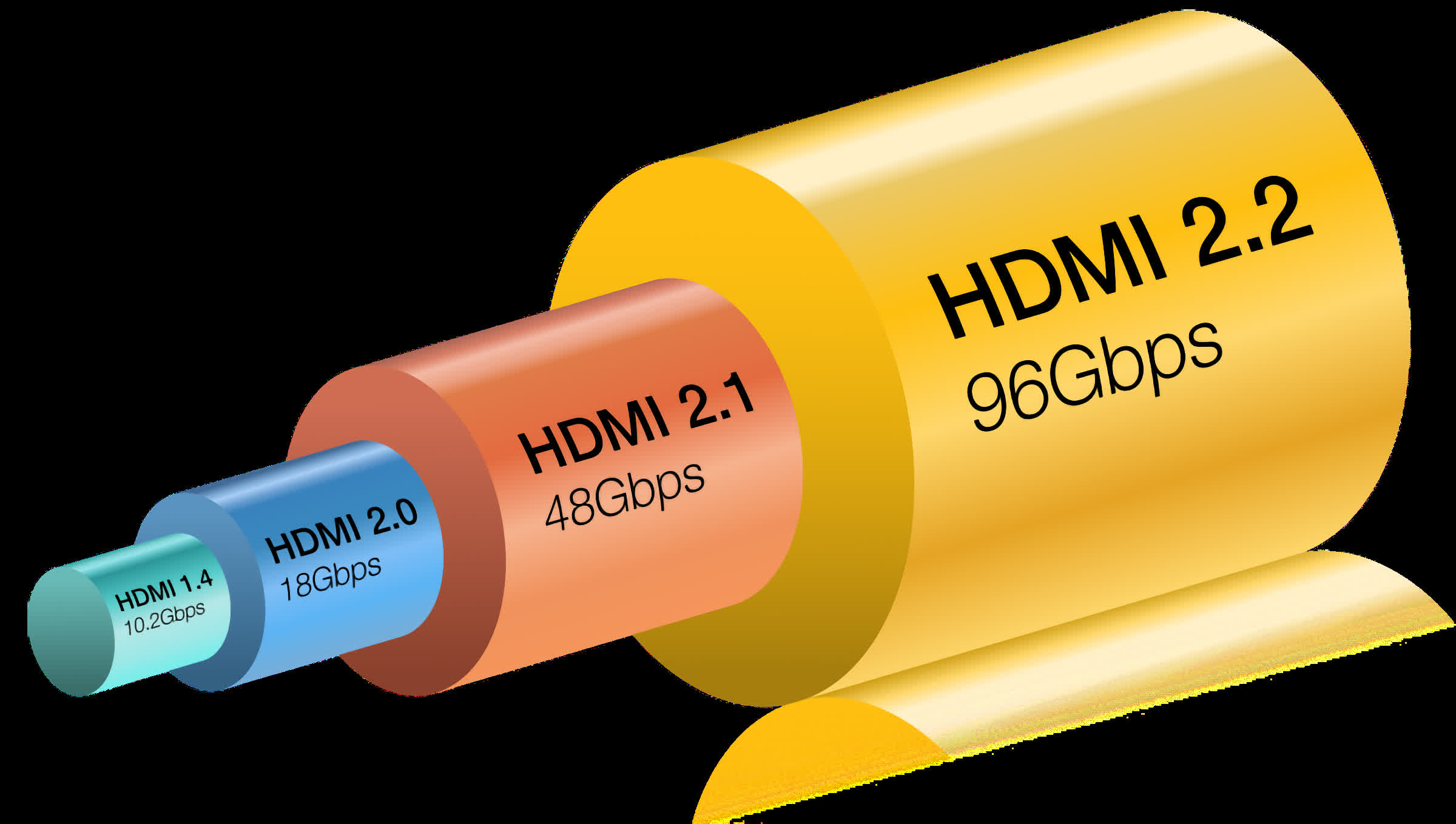
Forward-looking: The next version of HDMI is mainly about pushing bandwidth higher to carry better video and audio, not small, incremental tweaks. HDMI 2.2, teased at CES 2025 and formally released by the HDMI Forum in June of that year, raises maximum bandwidth to 96Gbps, twice that of HDMI 2.1, allowing more uncompressed video data to move between devices.
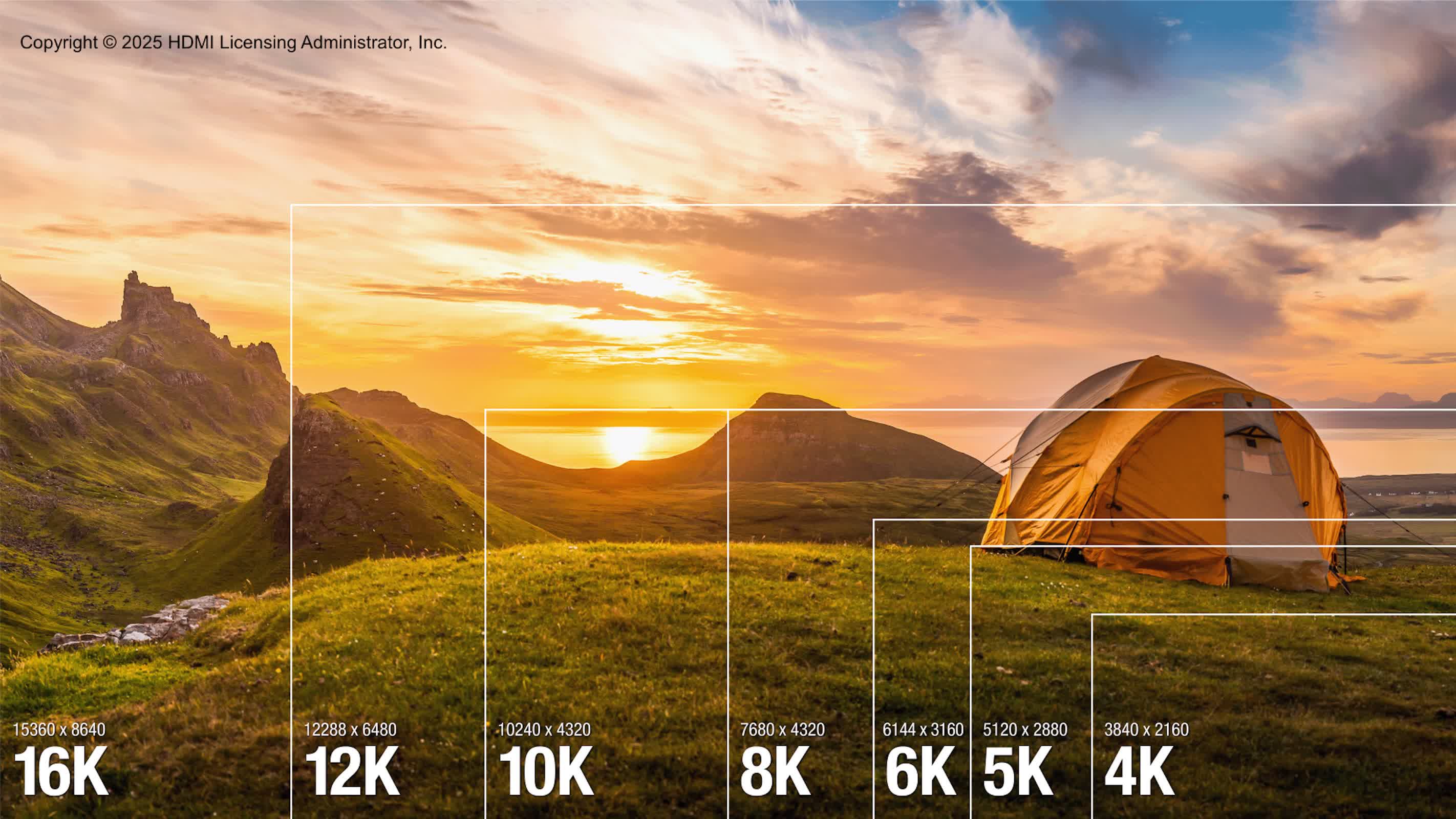
HDMI 2.2 can carry uncompressed 4K video at up to 240Hz, something that currently requires Display Stream Compression (which as we've shown however, is not a big limitation). It can also reach 4K at 480Hz using 4:2:0 chroma subsampling, and handle uncompressed RGB 8K at 60Hz.

The added bandwidth cuts down on the compression and other tricks current hardware has had to rely on to push high frame rates. For gamers, that extra headroom makes it easier to drive high refresh rates at 4K and beyond without leaning as heavily on compression or workarounds.

With compression still in the toolkit when needed, the spec allows for more extreme modes, too, including 1440p at refresh rates above 1,000Hz – numbers that, for now, sit well beyond everyday use.
That leap is tied to FRL2, the updated signaling technology underpinning HDMI 2.2. The transition is already underway at the hardware level. "We're hearing chip manufacturers will start to sample their FRL2 chips this year," Rob Tobias, CEO and president of the HDMI Licensing Administrator, told ARMdevices at Computex 2026. "And so we should start to see some 96 or up to 96 gigabit HDMI 2.2 products next year." Certification efforts are ongoing, and the first wave of compatible devices is expected in 2027.

Still, the headline number – 96Gbps – doesn't tell the whole story. HDMI 2.2 rolls out in multiple tiers, including 64Gbps and 80Gbps versions, and certification doesn't require manufacturers to hit the top speed. That means two devices both labeled "HDMI 2.2" could perform very differently depending on how they're built. For buyers, that puts more weight on spec sheets than branding.

In the PC space, the timing is complicated by the fact that DisplayPort 2.1 already delivers up to 80Gbps and is widely used in high-end monitors. For enthusiasts running multi-display setups, HDMI hasn't been the primary interface for some time, and that's unlikely to change overnight. Licensing costs may also factor into how quickly HDMI 2.2 gains traction compared with DisplayPort.
Where HDMI continues to hold ground is in the living room. Features like ARC, CEC, and ALLM are already deeply integrated into TVs and home theater systems, and HDMI 2.2 adds another layer with Latency Indication Protocol, or LIP, aimed at tightening audio-video synchronization – a persistent issue with soundbars and AV receivers. It's a small but practical upgrade, and one that targets a problem many users encounter even in otherwise high-end setups.

Even so, there's a gap between what the specification allows and what current content actually demands. Most games and video still operate well below the limits of HDMI 2.1, and 4K at 120Hz – already supported – remains underutilized. It's easy enough to imagine future consoles taking advantage of higher refresh rates, but widespread use will depend on both hardware and software catching up.

That lag is likely to show up in the rollout. GPU support isn't expected until late 2027 or later, and early adoption will likely be confined to premium hardware. On the TV side, HDMI capabilities often depend on the underlying processing chips, which have historically led to uneven feature support even among top-tier models. There's little reason to expect a cleaner transition this time around.

For now, HDMI 2.2 is more about preparing for future hardware than something people need to upgrade to right away. The spec sets a high ceiling, but it may take several product generations before most users see a tangible benefit. In the meantime, its presence will likely be felt more in product positioning than in everyday performance.

Permalink to story:

 
Which really doesn’t matter because you’d actually have to be able to run things at the frame rate and once you’re beyond 120-144hz you’re well into the diminishing returns of noticeability.
 
Shame there's no proper standards with the cables so you have no idea what the black thing you are staring at is capable of. The situation is made even worse by cesspits like Amazon happily selling counterfeit cables and junk which just outright lies about it's capabilities. It would also be nice if the TV/Monitor told you what cable you needed to run at the res/framerate you wanted and what cable it had detected.
 
Last edited:
What comes first the chicken ( displays hdmi 2.2 capable) or the egg ( the gpus that have hdmi 2.2 capabilities)? 🤔
 
My expectations are low after the botched treatment of HDMI 2.1, with the HDMI Forum "including" HDMI 2.0 devices as HDMI 2.1, the first round of defective chips, and AV receivers & most TVs still limited to 40gbps instead of the full 48.
 
Haven't seen any good ones yet... if you've got a link to an AVR with DP though, I'm all ears...
I remember reading about passive vs active dp to HDMI. I know it matters in some instances. But my knowledge on this topic is very outdated. The last time I tried it was long ago when my GPU was lacking an extra HDMI port to use for receiver. That is how I found out a typical DP to HDMI does not work, or did not workj at the time.
 
I remember reading about passive vs active dp to HDMI. I know it matters in some instances. But my knowledge on this topic is very outdated. The last time I tried it was long ago when my GPU was lacking an extra HDMI port to use for receiver. That is how I found out a typical DP to HDMI does not work, or did not workj at the time.
Yeah… but if you need to use an adapter, might as well just use HDMI… hopefully one day there will be high end AVRs with DP alongside high-end TVs that offer DP… but we’re years away from that I fear.
 
Shame there's no proper standards with the cables so you have no idea what the black thing you are staring at is capable of. The situation is made even worse by cesspits like Amazon happily selling counterfeit cables and junk which just outright lies about it's capabilities. It would also be nice if the TCV told you what cable you needed to run at the res/framerate you wanted and what cable it had detected.
Very true, there should be a mandate that all HDMI cables should be properly marked with its maximum display and speed capabilities.

Right now no matter where you buy, they offer just a bunch of cables that don't even have any markings not really knowing what the hell are we connecting until we go through the trail on error.
 
We need display port on more things and most of it has to do with how the HDMI forum can control who can and cannot use their software and on what platform. They refused to let AMD use HDMI 2.1 on Linux for their 9000 series even on their closed source drivers. And I'm not one of those hardcore open source things, but when companies use the DMCA to exert leverage and force them into making an inferior product through no fault of their own, that's bad for everyone. I have been in the market for a couple years now and I have only found 1 with a Display Port. It was LCD based and I need an ultra short throw, which this one was not.
 
I remember reading about passive vs active dp to HDMI. I know it matters in some instances. But my knowledge on this topic is very outdated. The last time I tried it was long ago when my GPU was lacking an extra HDMI port to use for receiver. That is how I found out a typical DP to HDMI does not work, or did not workj at the time.
The rule of thumb now is DisplayPort can do anything, HDMI can only do itself for dvi. DP truly is the superior standard.
Ok so yet another enthusiast level question, but wouldn't uncompressed 4K be noticeable right away on truly big screens?
Yes, so long as the video in question was at least 4k native and uncompressed in the first place.
 
The rule of thumb now is DisplayPort can do anything, HDMI can only do itself for dvi. DP truly is the superior standard.

Yes, so long as the video in question was at least 4k native and uncompressed in the first place.
What many people don't understand about upscaling is that the AI tech that powers it physically takes up space in the die and the size of the die is proportional to the cost. Upscaling isn't free. I would rather have a die that, for example, can do 4k90 native rather than something that can do 4k60 native but can does 4k120 with upscaling.

Many people think upscaling is free, it is not. There is so much AI nonsense on the dies of consumer graphics card and many people don't realize it. People are absolutely paying for these "free features" and many people would be better off with more die space dedicated to just rendering than arguing over FSR or DLSS. If it wasn't for RT and upscaling, graphics cards would be significantly cheaper
 
If only TVs and AVRs supported DisplayPort….

Would be retarded, as HDMI has ARC/eARC which is gold. Great feature.

Loving my 77" QD-OLED and 20.000 dollar sound system daily. eARC is magic. DP would make no sense. Hence why TVs don't have it.

TVs are meant to be viewed from a distance. They are not PC monitors. They focus on HDMI, which has ARC/eARC and when it comes to gaming, consoles is the focus, not PCs, consoles use HDMI.

Some early 4K TVs had DP and it was a joke, they removed it quickly.

TVs are TVs. Monitors are monitors. Made for different things. HDMI is the default on TV/console. DP is default on PC/monitors, however HDMI is supported too.
 
Last edited:
I think some new TVs have DP ports.
No they don't. Some old TVs had. Was removed. Waste of port/bandwidth. No-one really needed it. Every single graphic card worth owning have HDMI 2.x
 
Last edited:
What comes first the chicken ( displays hdmi 2.2 capable) or the egg ( the gpus that have hdmi 2.2 capabilities)? 🤔

Probably the displays; I remember when NVIDIA backported HDMI 2.1 features (mainly VRR) into HDMI 2.0 because LGs OLED users were stuck waiting for the 2xxx series to actually use the feature on their displays.
 
Would be retarded, as HDMI has ARC/eARC which is gold. Great feature.

Loving my 77" QD-OLED and 20.000 dollar sound system daily. eARC is magic. DP would make no sense. Hence why TVs don't have it.

TVs are meant to be viewed from a distance. They are not PC monitors. They focus on HDMI, which has ARC/eARC and when it comes to gaming, consoles is the focus, not PCs, consoles use HDMI.

Some early 4K TVs had DP and it was a joke, they removed it quickly.

TVs are TVs. Monitors are monitors. Made for different things. HDMI is the default on TV/console. DP is default on PC/monitors, however HDMI is supported too.
Only because they want the licensing fees… having DisplayPort would be awesome - you don’t need arc/earc if you simply run another cable from the TV to your receiver (audio out) . People have been running perfectly good sound systems long before ARC/EARC was a thing…
 
No they don't. Some old TVs had. Was removed. Waste of port/bandwidth. No-one really needed it. Every single graphic card worth owning have HDMI 2.x
You are wrong, my friend:

I knew I read about these just a few months ago. But seeing so many confident people denying it made me question my memory.
 
Back