TL;DR: California's highway surveillance network is facing renewed scrutiny after privacy and civil rights advocates discovered dozens of concealed license plate readers in the southern part of the state. The activists say the devices are quietly feeding data into a federal predictive intelligence program developed by the US Border Patrol to monitor domestic travel patterns.
In a letter to Gov. Gavin Newsom, more than two dozen advocacy organizations – including the Electronic Frontier Foundation and Imperial Valley Equity and Justice – urged California officials to revoke permits for the installation of these covert sensors. The groups said the devices are part of an extensive domestic monitoring system that could be collecting information on millions of drivers.
Their appeal follows an Associated Press investigation published in November, which documented how the Border Patrol embedded similar readers inside seemingly ordinary roadside fixtures in Arizona. According to land-use permits obtained by AP, the devices were concealed within orange and yellow construction barrels and other safety equipment.
Data collected through these hidden networks was fed into what federal officials described as a "predictive intelligence" system capable of analyzing vehicle movement across state lines.
Sources familiar with the program told the Associated Press that the algorithm sifts through vehicle location histories to identify unusual or repetitive travel patterns. The system flags movement it deems abnormal – such as drivers making short border-region trips or taking inconsistent routes – and uses that information to recommend follow-up stops or investigations.
According to AP reporting, some flagged vehicles were later intercepted by local police acting on referrals from federal agents. In some cases, drivers were stopped for routine traffic violations without being informed that their routes had been digitally profiled by the intelligence network.
In California, advocacy groups documented roughly 40 license plate readers across San Diego and Imperial counties, both bordering Mexico. More than half were hidden in construction barrels nearly identical to those seen in Arizona.
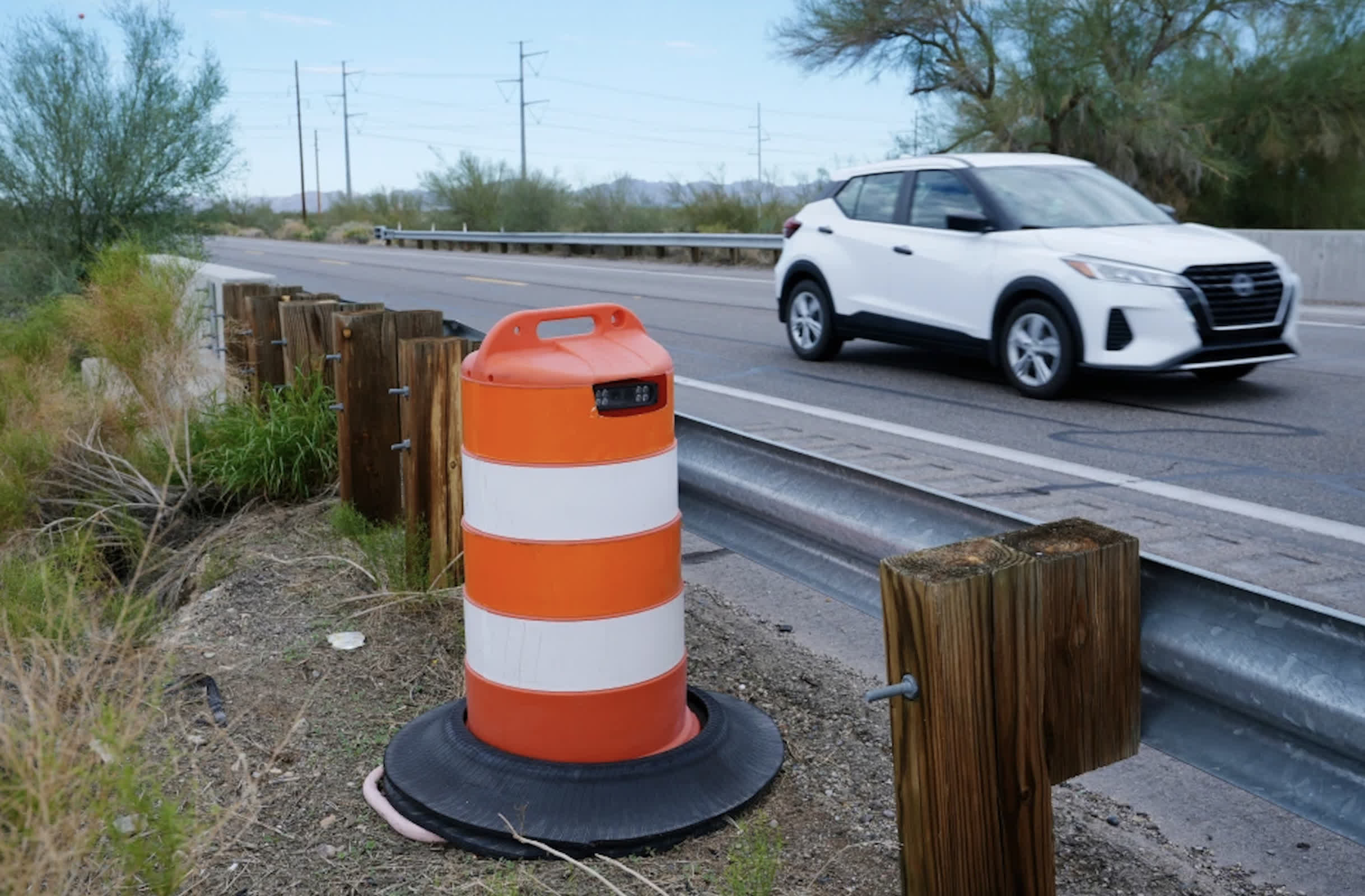
A license plate reader used by the US Border Patrol is hidden in a traffic cone alongside the highway in Gila Bend, Ariz.
While ownership of each device could not be independently verified, the advocacy groups said they reviewed permits from the California Department of Transportation showing that both the Border Patrol and the Drug Enforcement Administration had applied to install license plate readers on state highways. Documents also indicated that data collected by the DEA's network is routinely shared with the Border Patrol.
The Associated Press previously confirmed that California motorists had already been affected by the Border Patrol's domestic travel tracking initiative. In a 2024 case, a Border Patrol agent justified pulling over a Nissan Altima partly based on surveillance records suggesting the driver took six hours to cover the 50-mile stretch between the Mexican border and Oceanside, California. In court filings, the agent wrote that such "delays are consistent with smuggling tactics."
Another incident, detailed in 2023 court documents, involved a woman detained at a checkpoint after traveling what agents described as a "circuitous route" between Los Angeles and Phoenix. In both cases, federal authorities alleged the drivers were linked to smuggling operations and pursued criminal charges or asset seizures.
Civil liberties experts warn that the growing use of predictive models tied to license plate data raises profound constitutional questions. Courts have long upheld the legality of reading license plates on public roads. Still, legal scholars note that large-scale aggregation – particularly when paired with algorithmic profiling – veers toward mass surveillance, which is barred under the Fourth Amendment.
"Increasingly, courts have recognized that surveillance technologies can violate protections against unreasonable searches and seizures," the advocacy groups warned in their letter to Newsom. "The use of LPRs combined with predictive algorithms represents precisely the kind of pervasive government tracking that should alarm lawmakers."
A spokesperson for the California Department of Transportation told the Associated Press that the state "prioritizes public safety and privacy" but did not comment directly on the advocacy letter. Newsom's office did not immediately respond to requests for comment.
US Customs and Border Protection, which oversees the Border Patrol, declined to comment on the California allegations but has previously said its license plate program is "governed by a multi-layered policy framework" and is used to "identify threats, disrupt criminal networks, and protect public safety." The DEA stated that it does not publicly discuss investigative tools or techniques.
According to the AP, the predictive intelligence system has operated under administrations of both political parties. Its continuation has reignited debate over the federal government's expanding domestic data collection capabilities, and whether the line between border enforcement and everyday surveillance has effectively disappeared.
Image credit: Ed Parker, The Associated Press
Hidden license plate readers in California are feeding a federal surveillance system


