Hilarious viral video shows driverless delivery vans causing chaos on Chinese streets

DragonSlayer101

Posts: 953   +13
Staff
Facepalm: Driverless cars were expected to reduce traffic congestion and make roads safer, but they have often malfunctioned at the most inopportune times, causing traffic jams or even crashes that have resulted in loss of life. New viral videos from China once again highlight how dangerous and unpredictable autonomous vehicles can be.
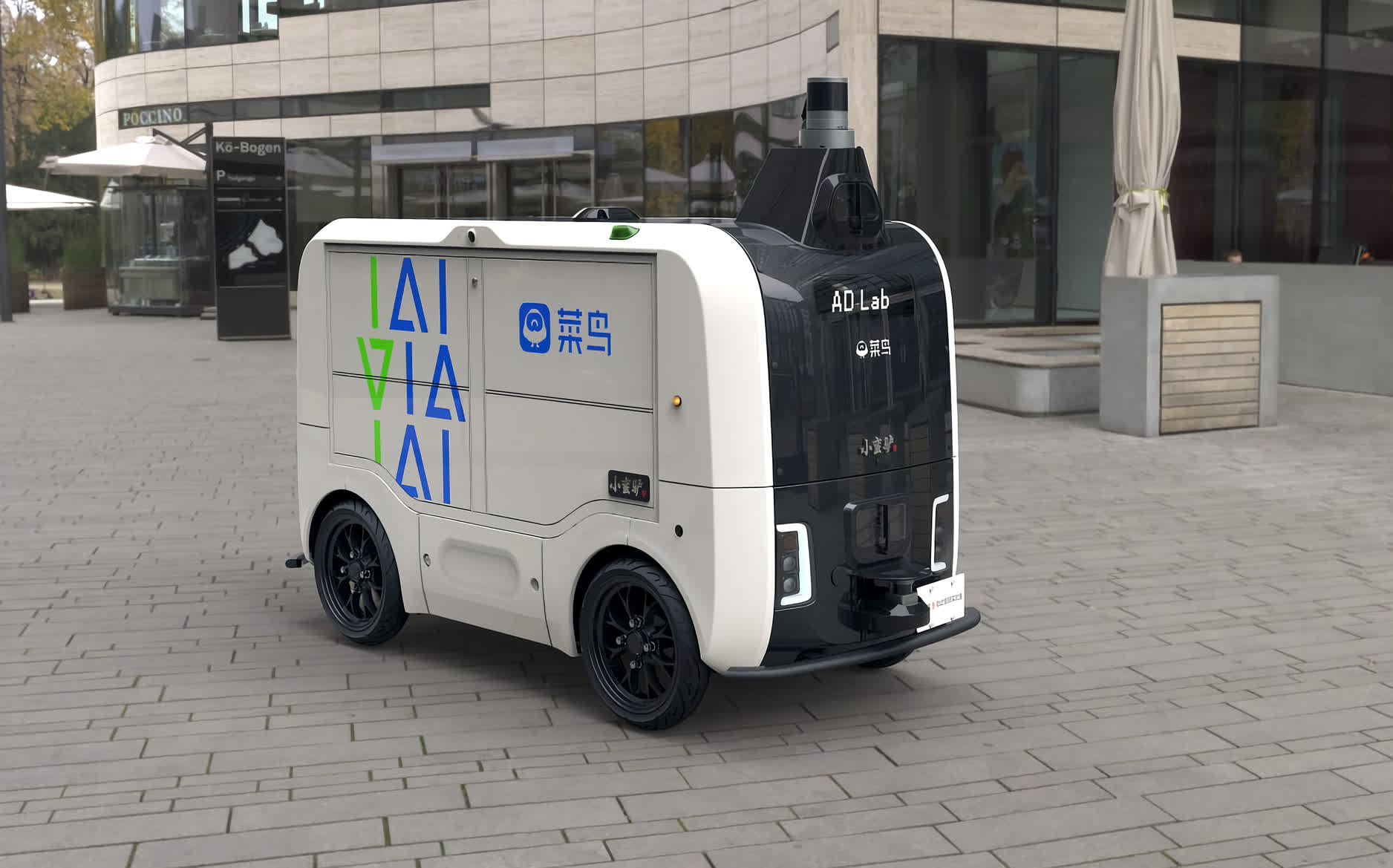
Videos trending on Chinese social media show self-driving delivery vans running amok on city streets – plowing through wet concrete, driving on shoulders and embankments, speeding along potholed roads, blocking traffic, rolling over barriers, and crashing into other vehicles. One clip even appears to show a driverless van speeding on a highway with a motorbike lodged in its wheel arch.

It's unclear when the videos were recorded, but some clips have been shared on X and Instagram, drawing millions of views and thousands of sarcastic comments. While some commentators joked that nothing can stop China's driverless vans, others pointed out that the vehicles continued moving despite correctly identifying the obstructions in front of them.

Many social media users expressed shock at the chaos and questioned why Chinese authorities would allow these vehicles to operate on city streets without proper safety checks. Some described the incidents as a "beta test gone wild" and questioned whether autonomous vehicles are truly the future of logistics and human transportation, as tech companies claim.

Self-driving technology will continue to improve in the coming years, but the videos highlight that AI is still not capable of reliably navigating unpredictable human environments, and that even the most advanced automated systems are not yet ready to fully replace humans in real-world conditions.

China's autonomous vehicle network has expanded rapidly in recent years, with companies such as ZTO Express and J&T Express deploying thousands of self-driving vans to transport goods from local logistics hubs to consumers' homes. Currently, autonomous vehicles in China operate at up to Level 2 ADAS, but major automakers expect to receive approval for Level 3 systems by the end of this year.

Despite the push for higher levels of vehicle automation, China recently slowed automakers' plans to sell more advanced self-driving cars following a tragic crash involving the Xiaomi SU7 last March. The incident, which occurred in Anhui Province, killed three female university students when the vehicle struck a barrier at 72 miles per hour while in self-driving mode.

Permalink to story:

 
Dictatorships are nice for this kind of stuff... no one can complain too vociferously and the appropriate officials, assuming they've been bribed the correct amount, will turn a blind eye.

This is actually GOOD for the rest of us living in the democratic world, as the tech can get ironed out over in China, then come to us when it's much better :)
 
The driverless vehicles just driving there seems to be no intelligence behind them. The last clip showed the driverless vehicle blissfully unaware its dragging a scooter, I wonder what happened to the scooters operator.
 
Anyone who ever claimed autonomous vehicles would reduce congestion was either being wildly dishonest or selling a pitch deck. That outcome only exists in a fantasy where every vehicle is autonomous, perfectly interoperable, centrally coordinated, and immune to edge cases. That world is not coming—certainly not in any foreseeable future, and likely never at full scale. Mixed traffic alone permanently breaks the congestion-reduction argument.

What these videos from China actually show isn’t a temporary glitch—it’s a structural problem. Autonomous systems are brittle. They can identify objects and still make catastrophically wrong decisions because perception is not judgment. Recognizing a barrier, a motorcycle, or wet concrete is meaningless if the system cannot reason about context, intent, and consequences the way a human can. AI doesn’t “understand” chaos; it fails inside it.

The idea that these systems are being unleashed on public roads as rolling beta tests is indefensible. These aren’t closed industrial environments or controlled rail systems—they’re unpredictable human spaces. When things go wrong, the cost isn’t a software rollback; it’s injury and death. Calling this “progress” while normalizing fatalities is an ethical failure, not a technological one.

And the congestion argument collapses even further when you realize autonomous vehicles, as currently deployed, often make traffic worse: stopping erratically, blocking lanes, freezing when confronted with ambiguity, and requiring human intervention that ripples backward through traffic flow. A single confused robot car can snarl an entire corridor the same way any poor driver can. All we’re doing here is adding dumb drivers to the existing chaos and making excuses for their basic failures rather than solving real problems by insisting on elevating total driver capability across the spectrum.

If the real goal were safer roads, the priorities would be obvious:

* Enforce traffic laws consistently
* Raise driver training standards
* Crack down on reckless behavior
* Improve road design and maintenance

Those measures are proven, cheap compared to AV R&D, and effective. They just don’t enrich billionaire tech executives or generate flashy demos.

Automation has a place—in constrained, predictable domains. But forcing half-baked autonomy into personal vehicles is not innovation; it’s ideology. Until these systems can outperform competent human drivers in unstructured, mixed environments without external babysitting, they don’t belong on public roads.

Get the surveillance tech and half-trained AI out of personal vehicles. Fix the human problems we already know how to fix. That would save far more lives than pretending this is the future because investors want it to be.
 
Last edited:
Anyone who ever claimed autonomous vehicles would reduce congestion was either being wildly dishonest or selling a pitch deck. That outcome only exists in a fantasy where every vehicle is autonomous, perfectly interoperable, centrally coordinated, and immune to edge cases. That world is not coming—certainly not in any foreseeable future, and likely never at full scale. Mixed traffic alone permanently breaks the congestion-reduction argument.
Why couldn’t China, after years of testing and development, mandate that all vehicles be autonomous? And, if it works… it might spread…

Again, one of the good points of a dictatorship…
 
Here in the north roads turn white for the winter, no lines are visible, its hard, even for a human, to separe the road from ditch.

I dont expect AI to drive our roads anytime soon
 
That was a great laugh.

They seem to have sensors and I assume there is some autonomous driving going on. However, I would guess that a lot of them are "tele-operated" or remote controlled most of the time.
 
I guess if they could detect bumps or wild swinging where normally there's none then they could alert an operator to check an intervene. In the case of the sand in the lane then they could just tell the units to move to the middle lane for a period of time. No idea what was happening where it was bumping up the kerb but an operator could presumably sort that out. Same thing if the vehicle is stuck in the same place for more than a short period of time. Maybe the operator could just drive close to a street lamp to remove the scooter? ;)


TBF these vehicles have done 31 million miles so they'll rack up a few mistakes along the way.
 
That was hilarious!!

Why can't they be as good and safe as our Waymo driverless cars here in the US??
Waymo has had only approx. 1400 crashes and a few deadly incident after all.

/s
 
Why couldn’t China, after years of testing and development, mandate that all vehicles be autonomous? And, if it works… it might spread…

Again, one of the good points of a dictatorship…
Well, since you asked…

That idea certainly sounds simple on the surface, but there are quite a few big obstacles—technical, economic, and political—that I think make it much harder in practice.

First, the technology still isn’t universally reliable. Even after years of testing, autonomous systems struggle mightily with edge cases: bad weather, unpredictable human behavior, mixed traffic, construction zones, rural roads, and sensor failures. Mandating all vehicles be autonomous means the system has to work safely everywhere, ALL the time. No country—China included—is even remotely there yet.

Second, the transition problem is enormous in the extreme. China has hundreds of millions of existing vehicles. Forcing people to scrap or retrofit them would be wildly expensive and disruptive, especially for rural populations and small businesses. Sure, dictatorships can easily impose costs, but they still have to manage social stability—and mass mobility disruptions are risky even for authoritarian governments.

Third, infrastructure and liability matter. Autonomous vehicles require standardized infrastructure, mapping, connectivity, and maintenance. When something goes wrong, who is responsible? The manufacturer? The software provider? The state? Even in a dictatorship, unclear liability creates massive economic drag and slows innovation making a successful rollout monumentally difficult.

Fourth, innovation itself is a double-edged sword under authoritarianism. While a dictatorship can mandate adoption, they still often struggle with bottom-up problem solving, which slows things down. Autonomous driving has proven to improve fastest through open competition, transparency about failures, and legal challenges—all things that are more constrained in authoritarian systems. Not that it could be achieved, just the historic reality of the governance model.

Finally, there’s absolutely a political reality here to consider: total autonomy means total data. Location, travel patterns, social networks—everything becomes visible to the state. Even in China, that level of surveillance could trigger public resistance and/or quiet noncompliance, undermining effectiveness. When your system must work everywhere always, your infrastructure becomes more rigid and even passive resistance can become much more problematic.

So, sure, a dictatorship can move faster on mandates, but speed isn’t the same as success. Complex, safety-critical technologies tend to advance best when adoption is gradual, voluntary, and subject to scrutiny.
 
Well, since you asked…

That idea certainly sounds simple on the surface, but there are quite a few big obstacles—technical, economic, and political—that I think make it much harder in practice.

First, the technology still isn’t universally reliable. Even after years of testing, autonomous systems struggle mightily with edge cases: bad weather, unpredictable human behavior, mixed traffic, construction zones, rural roads, and sensor failures. Mandating all vehicles be autonomous means the system has to work safely everywhere, ALL the time. No country—China included—is even remotely there yet.
It isn’t YET… but the tech is new…I’m looking to the future :)
Second, the transition problem is enormous in the extreme. China has hundreds of millions of existing vehicles. Forcing people to scrap or retrofit them would be wildly expensive and disruptive, especially for rural populations and small businesses. Sure, dictatorships can easily impose costs, but they still have to manage social stability—and mass mobility disruptions are risky even for authoritarian governments.
They manage social stability quite well - by imprisoning / executing anyone who disagrees… ask the demonstrators at Tienemen Square how well that worked out for them?
Third, infrastructure and liability matter. Autonomous vehicles require standardized infrastructure, mapping, connectivity, and maintenance. When something goes wrong, who is responsible? The manufacturer? The software provider? The state? Even in a dictatorship, unclear liability creates massive economic drag and slows innovation making a successful rollout monumentally difficult.
You pick a city, and just “go”…. Liability is irrelevant here…
Fourth, innovation itself is a double-edged sword under authoritarianism. While a dictatorship can mandate adoption, they still often struggle with bottom-up problem solving, which slows things down. Autonomous driving has proven to improve fastest through open competition, transparency about failures, and legal challenges—all things that are more constrained in authoritarian systems. Not that it could be achieved, just the historic reality of the governance model.
They don’t have to rely on any one tech - and Chinese automakers have rapidly caught up to the rest of the world. Autonomous driving has “proven” nothing - the tech is in its infancy! We still have decades to go here.
Finally, there’s absolutely a political reality here to consider: total autonomy means total data. Location, travel patterns, social networks—everything becomes visible to the state. Even in China, that level of surveillance could trigger public resistance and/or quiet noncompliance, undermining effectiveness. When your system must work everywhere always, your infrastructure becomes more rigid and even passive resistance can become much more problematic.
China loves “total data”… rigidity would be considered a plus there!
So, sure, a dictatorship can move faster on mandates, but speed isn’t the same as success. Complex, safety-critical technologies tend to advance best when adoption is gradual, voluntary, and subject to scrutiny.
They have time… and while outsiders can “scrutinize” all they want, you can’t do that from within the country…

Oh, and next time write your own rebuttal without ChatGPT please…
 
Just needs some time to iron out the rough edges. China is already making bigger strides in terms of tech.

Of course the expertise they got from western companies who wanted to make things cheap in China and sell at the same high price and the subsequent experience they gained from the productions, (some call it blueprint leaks) helped to develop further and improvise on products.

Once someone asked you to do something in thousands at a time, you will next be able to do it on your own.

 
It isn’t YET… but the tech is new…I’m looking to the future :)

They manage social stability quite well - by imprisoning / executing anyone who disagrees… ask the demonstrators at Tienemen Square how well that worked out for them?

You pick a city, and just “go”…. Liability is irrelevant here…

They don’t have to rely on any one tech - and Chinese automakers have rapidly caught up to the rest of the world. Autonomous driving has “proven” nothing - the tech is in its infancy! We still have decades to go here.

China loves “total data”… rigidity would be considered a plus there!

They have time… and while outsiders can “scrutinize” all they want, you can’t do that from within the country…

Oh, and next time write your own rebuttal without ChatGPT please…
So hand-waving assertions, future promises, and one-liners that avoid the substance of the argument. “It’s new,” “they’ll just do it,” or “liability doesn’t matter,” which really isn’t reasoning.

I just read brushed aside technical limits, economic disruption, governance tradeoffs, and historical evidence without engaging with them.

Look, you asked a question and received a thoughtful answer. Accusing me of using ChatGPT isn’t a rebuttal—it’s a distraction.

Did I ruffle feathers here? That certainly wasn’t my intent. Have a good one.
 
Last edited:
So hand-waving assertions, future promises, and one-liners that avoid the substance of the argument. “It’s new,” “they’ll just do it,” or “liability doesn’t matter,” which really isn’t reasoning.

I just read brushed aside technical limits, economic disruption, governance tradeoffs, and historical evidence without engaging with them.

Look, you asked a question and received a thoughtful answer. Accusing me of using ChatGPT isn’t a rebuttal—it’s a distraction.

Did I ruffle feathers here? That certainly wasn’t my intent. Have a good one.
You ruffled nothing - but thanks for the reply. I notice you didn’t have a rebuttal though…
 
You ruffled nothing - but thanks for the reply. I notice you didn’t have a rebuttal though…
Okay; good. Appreciate the clarification.

Rebuttal of what, disagreement? Pretty confident the response still stands. It doesn’t seem like we’re on the same page regarding what constitutes a rebuttal. Lol. Let’s agree to disagree and move on. Cheers.
 
Anyone who ever claimed autonomous vehicles would reduce congestion was either being wildly dishonest or selling a pitch deck. That outcome only exists in a fantasy where every vehicle is autonomous, perfectly interoperable, centrally coordinated, and immune to edge cases. That world is not coming—certainly not in any foreseeable future, and likely never at full scale. Mixed traffic alone permanently breaks the congestion-reduction argument.

What these videos from China actually show isn’t a temporary glitch—it’s a structural problem. Autonomous systems are brittle. They can identify objects and still make catastrophically wrong decisions because perception is not judgment. Recognizing a barrier, a motorcycle, or wet concrete is meaningless if the system cannot reason about context, intent, and consequences the way a human can. AI doesn’t “understand” chaos; it fails inside it.

The idea that these systems are being unleashed on public roads as rolling beta tests is indefensible. These aren’t closed industrial environments or controlled rail systems—they’re unpredictable human spaces. When things go wrong, the cost isn’t a software rollback; it’s injury and death. Calling this “progress” while normalizing fatalities is an ethical failure, not a technological one.

And the congestion argument collapses even further when you realize autonomous vehicles, as currently deployed, often make traffic worse: stopping erratically, blocking lanes, freezing when confronted with ambiguity, and requiring human intervention that ripples backward through traffic flow. A single confused robot car can snarl an entire corridor the same way any poor driver can. All we’re doing here is adding dumb drivers to the existing chaos and making excuses for their basic failures rather than solving real problems by insisting on elevating total driver capability across the spectrum.

If the real goal were safer roads, the priorities would be obvious:

* Enforce traffic laws consistently
* Raise driver training standards
* Crack down on reckless behavior
* Improve road design and maintenance

Those measures are proven, cheap compared to AV R&D, and effective. They just don’t enrich billionaire tech executives or generate flashy demos.

Automation has a place—in constrained, predictable domains. But forcing half-baked autonomy into personal vehicles is not innovation; it’s ideology. Until these systems can outperform competent human drivers in unstructured, mixed environments without external babysitting, they don’t belong on public roads.

Get the surveillance tech and half-trained AI out of personal vehicles. Fix the human problems we already know how to fix. That would save far more lives than pretending this is the future because investors want it to be.
"Elevating" might be the operational principle here; put special elevated (or underground) roads strictly for these vehicles. Keep them away from people.
 
Here in the north roads turn white for the winter, no lines are visible, its hard, even for a human, to separate the road from ditch.

I don't expect AI to drive our roads anytime soon
Yeah... I recall driving home blissfully (slowly) at night through the countryside keeping my vehicle between the sparse rows of trees alongside the road.
I don't live there anymore.
 
Anyone who ever claimed autonomous vehicles would reduce congestion was either being wildly dishonest or selling a pitch deck. That outcome only exists in a fantasy where every vehicle is autonomous, perfectly interoperable, centrally coordinated, and immune to edge cases. That world is not coming—certainly not in any foreseeable future, and likely never at full scale. Mixed traffic alone permanently breaks the congestion-reduction argument.

What these videos from China actually show isn’t a temporary glitch—it’s a structural problem. Autonomous systems are brittle. They can identify objects and still make catastrophically wrong decisions because perception is not judgment. Recognizing a barrier, a motorcycle, or wet concrete is meaningless if the system cannot reason about context, intent, and consequences the way a human can. AI doesn’t “understand” chaos; it fails inside it.

The idea that these systems are being unleashed on public roads as rolling beta tests is indefensible. These aren’t closed industrial environments or controlled rail systems—they’re unpredictable human spaces. When things go wrong, the cost isn’t a software rollback; it’s injury and death. Calling this “progress” while normalizing fatalities is an ethical failure, not a technological one.

And the congestion argument collapses even further when you realize autonomous vehicles, as currently deployed, often make traffic worse: stopping erratically, blocking lanes, freezing when confronted with ambiguity, and requiring human intervention that ripples backward through traffic flow. A single confused robot car can snarl an entire corridor the same way any poor driver can. All we’re doing here is adding dumb drivers to the existing chaos and making excuses for their basic failures rather than solving real problems by insisting on elevating total driver capability across the spectrum.

If the real goal were safer roads, the priorities would be obvious:

* Enforce traffic laws consistently
* Raise driver training standards
* Crack down on reckless behavior
* Improve road design and maintenance

Those measures are proven, cheap compared to AV R&D, and effective. They just don’t enrich billionaire tech executives or generate flashy demos.

Automation has a place—in constrained, predictable domains. But forcing half-baked autonomy into personal vehicles is not innovation; it’s ideology. Until these systems can outperform competent human drivers in unstructured, mixed environments without external babysitting, they don’t belong on public roads.

Get the surveillance tech and half-trained AI out of personal vehicles. Fix the human problems we already know how to fix. That would save far more lives than pretending this is the future because investors want it to be.

That's pretty funny using ChatGPT to trash AI and self driving cars.

How'd you like mine -

Your whole position quietly assumes the baseline is “competent human drivers.” It isn’t. The baseline is humans killing ~1.19 million people a year on roads globally (over 3,200/day), and 39,345 in the US in 2024. We’ve had a century to “just drive better.” It’s clearly not happening at scale. What does happen is narrative bias: one autonomous fatality becomes an eternal indictment, while thousands of human-caused deaths every day get treated as background noise.

If you actually care about outcomes, follow the data instead of vibes. A peer-reviewed Waymo analysis covering 56.7 million fully driverless (rider-only) miles reports statistically significant lower crash rates vs human benchmarks in any-injury-reported, airbag-deployment, and suspected serious injury+ categories. That doesn’t mean “perfect,” it means “measurably better in the metrics we track.” And when companies screw up, regulators shut them down (see Cruise).

So sure: demand strict rules, transparency, and hard safety thresholds. Just don’t pretend the “human-only” status quo is ethical while calling everything else ideology.
 
That's pretty funny using ChatGPT to trash AI and self driving cars.

How'd you like mine -

Your whole position quietly assumes the baseline is “competent human drivers.” It isn’t. The baseline is humans killing ~1.19 million people a year on roads globally (over 3,200/day), and 39,345 in the US in 2024. We’ve had a century to “just drive better.” It’s clearly not happening at scale. What does happen is narrative bias: one autonomous fatality becomes an eternal indictment, while thousands of human-caused deaths every day get treated as background noise.

If you actually care about outcomes, follow the data instead of vibes. A peer-reviewed Waymo analysis covering 56.7 million fully driverless (rider-only) miles reports statistically significant lower crash rates vs human benchmarks in any-injury-reported, airbag-deployment, and suspected serious injury+ categories. That doesn’t mean “perfect,” it means “measurably better in the metrics we track.” And when companies screw up, regulators shut them down (see Cruise).

So sure: demand strict rules, transparency, and hard safety thresholds. Just don’t pretend the “human-only” status quo is ethical while calling everything else ideology.
And let’s not forget the kicker - humans aren’t getting any better at driving… but AI is!
 
That's pretty funny using ChatGPT to trash AI and self driving cars.

How'd you like mine -

Your whole position quietly assumes the baseline is “competent human drivers.” It isn’t. The baseline is humans killing ~1.19 million people a year on roads globally (over 3,200/day), and 39,345 in the US in 2024. We’ve had a century to “just drive better.” It’s clearly not happening at scale. What does happen is narrative bias: one autonomous fatality becomes an eternal indictment, while thousands of human-caused deaths every day get treated as background noise.

If you actually care about outcomes, follow the data instead of vibes. A peer-reviewed Waymo analysis covering 56.7 million fully driverless (rider-only) miles reports statistically significant lower crash rates vs human benchmarks in any-injury-reported, airbag-deployment, and suspected serious injury+ categories. That doesn’t mean “perfect,” it means “measurably better in the metrics we track.” And when companies screw up, regulators shut them down (see Cruise).

So sure: demand strict rules, transparency, and hard safety thresholds. Just don’t pretend the “human-only” status quo is ethical while calling everything else ideology.
First, invoking use of ChatGPT is a distraction and subtle way to attempt to minimize and discredit the point from the outset. This isn’t an argument about whether tools exist; it’s about whether current autonomy claims hold up in reality. So take a long walk with your passive aggressive attitude.

Second, you’re right: the baseline isn’t competent human drivers. But that’s not a relevant comparison. A relevant comparison is what actually reduces harm in the real world, under real constraints, right now.

Quoting aggregate global death statistics doesn’t, under any circumstances, justify deploying immature systems into unstructured public environments. By that logic, any intervention that claims future improvement would be ethical regardless of present risk. That’s not how safety engineering works. Aviation, medicine, and nuclear power don’t get to “learn at scale” by killing people in public and calling it “progress.”

Your Waymo citation sidesteps several points:

1. Domain restriction:
Waymo operates in heavily geofenced, mapped, weather-limited, low-speed urban cores with constant remote oversight. That’s not “self-driving cars,” it’s a controlled sandbox. Success in this context does not remotely generalize to mixed traffic everywhere else.

2. Benchmark ambiguity:
“Human benchmarks” are statistical averages across wildly different roads, drivers, weather, and conditions. These don’t compare and are a perfect example of cherry-picking statistics to support the argument. Beating an average that includes drunk drivers, street racers, and distracted teens is a low bar—and not evidence these systems outperform competent human drivers in the vast majority of complex driving scenarios.

3. Failure asymmetry:
Human drivers fail idiosyncratically; autonomous systems fail systemically. When they get something wrong, they tend to get it wrong the same way, at scale, until patched. That’s a fundamentally different risk profile, and it’s why “miles driven” alone is an insufficient safety metric.

4. Congestion and operational harm:
Even if you grant marginal safety improvements in narrow domains, it doesn’t address the congestion, blocking, freezing, and human-intervention already observed. Safety isn’t just fatalities per mile; it’s system-level performance.

We know what works for human drivers. If we don’t implement it’s because it’s politically inconvenient, not technically impossible. Plenty of countries enforce licensing standards, traffic laws, and road designs do achieve far lower fatality rates—without beta-testing experimental autonomy on the public.

I’m simply arguing against ideology masquerading as inevitability as an excuse for inappropriate deployment. Automation belongs where it can be: constrained, predictable, verifiable, and failsafe.

Rail, ports, mines, warehouses, limited-route transit—great. Personal vehicles in open-ended human environments? Not yet, and not on the public’s body count.

Again, calling skepticism “vibes” is a passive aggressive side step. Why should the public bear the downside risk for a technology that primarily serves investors and balance sheets?

Slogans, selective stats, and “the future requires sacrifice” rhetoric isn’t progress—it’s marketing, with a tolerance for collateral damage, in the name of tech-bro profit.

For future reference, I’m only interested in substantive discussion about the article itself. Passive-aggressive opinions, snark, or meta commentary about tools instead of ideas isn’t insightful, or interesting.
 
Back