
In brief: It's been over 20 years since Valve conducted the first-ever Steam survey. Technology has come a very long way since then, yet the latest results are still published every month. But why did Valve start the survey? It was to discover what minimum specs would allow most people to play Half-Life 2.

The Steam survey, which allows users of the platform to reveal their hardware and software specs to Valve so the data can be collated, might not be perfect, but it has long given us a good idea of what's popular in the world of PC gaming.
Also read: 20 Years of Steam: From Half-Life 2 to the Steam Deck
In Half-Life 2's new 20th anniversary developer commentary, Valve senior engineer Jay Stelly reveals how the survey was born as a result of the iconic game.
"During development, we faced numerous decisions influenced by our choice of minimum spec – the least powerful CPU and GPU combination that would still deliver a good experience for customers," Stelly said in the Route Kanal level commentary track, as per PC Gamer. "In the early 2000s, there was far more variety among GPUs than today, with wide differences not only in speed but in fundamental approaches to rendering."
Anyone who thinks compatibility issues are a problem today is unlikely to have been playing PC games 20 or 30 years ago. This writer recalls the nightmare that was trying to get Wing Commander 3 running on my 486 SX-33 with 4MB of RAM and a double-speed CD-ROM drive.
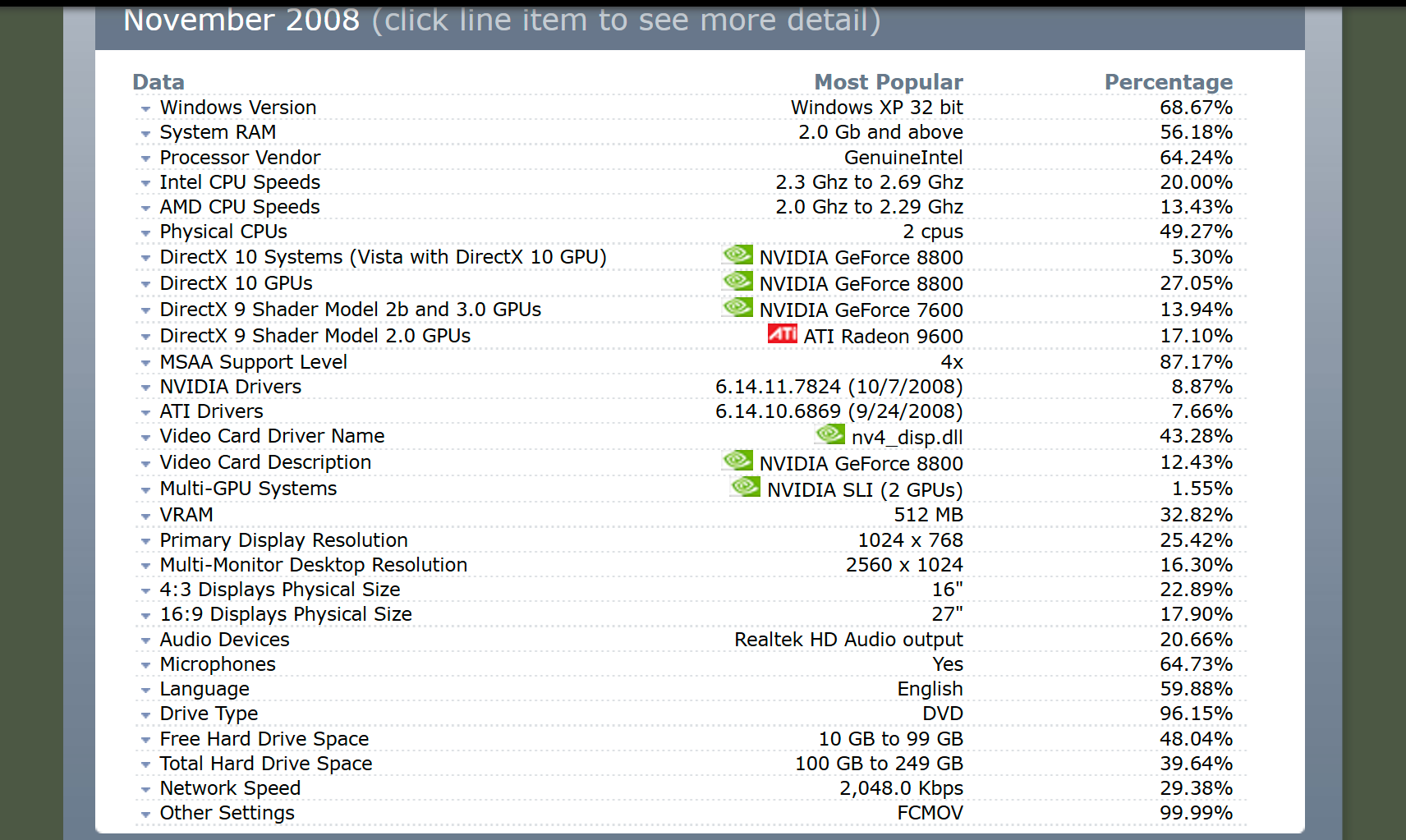
Steam survey results from 2008 (click to enlarge)
As Stelly notes, there was more variety of GPUs available back then, from 3Dfx and ATI to 3DLabs and Matrox, and a lot of games were only playable (or worked at all) if you had the latest and greatest hardware.
"But at the time, we had no real data on the hardware our customers were using," Stelly added. "What CPUs and GPUs did they have? How much RAM? Which version of Windows? We reached out to Microsoft, hoping they might know answers to questions like, 'How many DX7 cards are in use? Or DX8?' Unfortunately, they didn't have the data either."
"Realizing we were at risk of making bad decisions without these insights, we developed an analysis tool that allowed players to report their hardware specs to us, and integrated it into the early version of Steam. The data was so useful that we decided to make it public, launching the Steam Hardware Survey in April 2003. It's been helping us – and hopefully other developers – make informed decisions ever since."
The latest Steam hardware and software survey, which covers October's results, shows that a massive 77.3% of participants' GPUs come from Nvidia, while just 15% are from AMD. Intel still leads in the CPU category, but its dominance is being eroded every month as AMD reaches an all-time-high share of 34.5%. Windows 11, meanwhile, is back on top as the most popular OS, though it only edges out Windows 10 by just over a single percentage point.
The developer commentary in Half-Life 2 is part of the game's 20th anniversary update, which also included a temporary free giveaway of the full game, and a bundle including the two episodic expansions.
How Half-Life 2's minimum specs led to the creation of the Steam Hardware survey


