Steam will soon let users add hardware specs and performance data to reviews

Daniel Sims

Posts: 2,470   +74
Staff
Crystal ball: A seemingly minor update to the Steam beta client might lay the groundwork for Valve to collect performance data for many games across a wide variety of PCs. While the company's plans for the data remain unclear, it could inform shoppers how well games might run on hardware similar to their own.
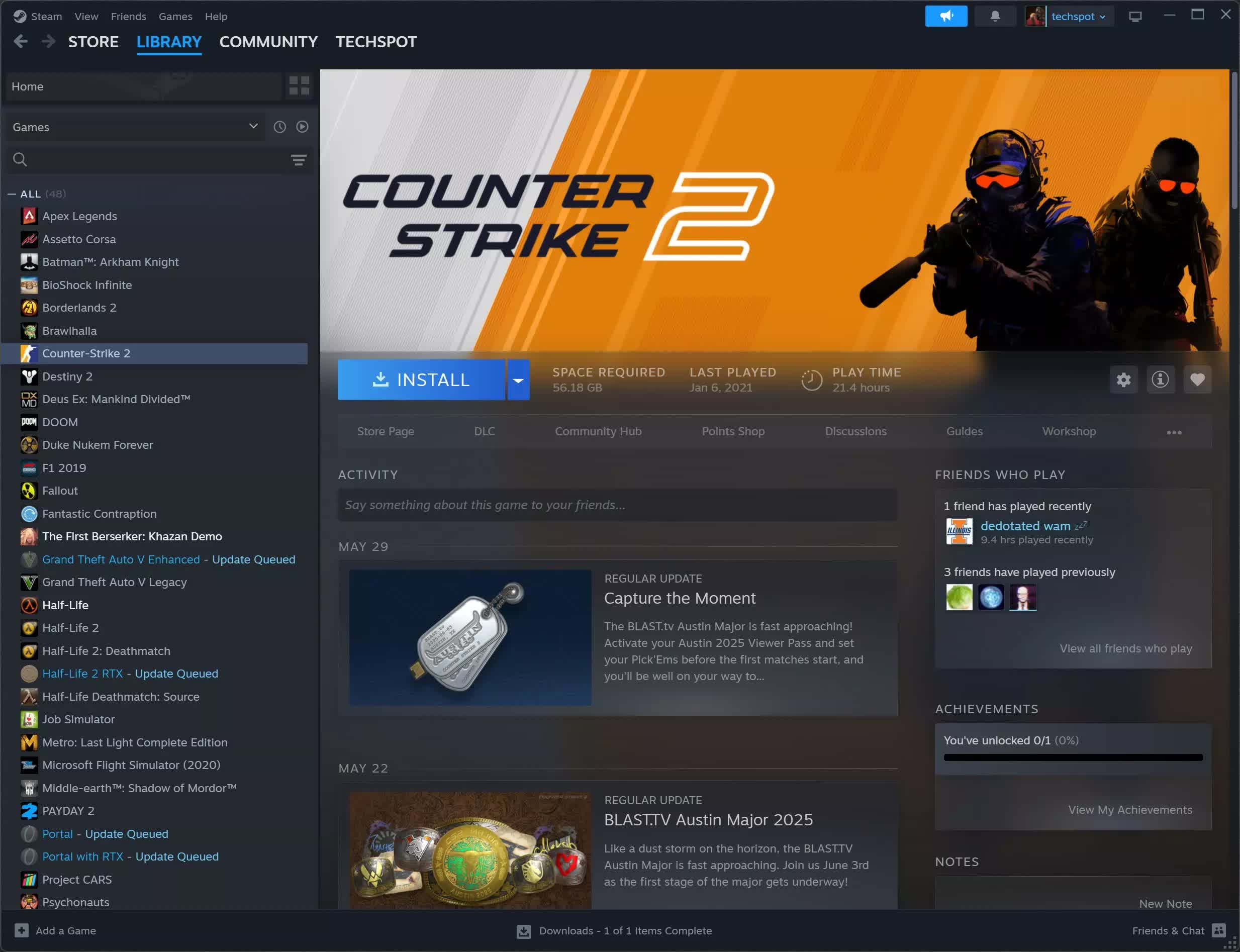
According to the February 12 Steam beta patch notes, users can now automatically include hardware specs in game reviews and provide Valve with anonymized frame rate data. The features appear to be in the early stages of development but could eventually provide helpful performance metrics.

To enter the Steam beta and try the new features, head to Settings > Interface > Client Beta Participation, select Steam Beta Update, and restart the client. When writing a review on a game's store page, check the box labeled "Attach PC specs to this review" on the right, and a prompt will appear asking to add a new PC configuration.

After clicking the prompt, Steam will gather information about the device the client is running on and create a profile, which users can attach to reviews while logged in from anywhere. However, the initial release of the feature has some kinks to iron out. It sometimes cannot tell whether it is working within the Steam client or a web browser, and the hardware inspector may detect a PC's integrated graphics instead of the dedicated GPU.

Once Valve resolves these issues, attaching hardware specs to Steam reviews will make them more informative. For example, when reading reviews that complain about performance, shoppers and developers can now see whether the problems are tied to certain system configurations.

While the method for providing Valve with performance data remains unclear, the company aims to improve Steam by learning more about game compatibility. Frame rate data will not be tied to individual Steam accounts, but will be connected to information about hardware specs. The performance monitor that Valve added to Steam last year likely led to this development.
The company also states that it will first focus on collecting data from SteamOS devices, suggesting that it aims to gauge how various titles run on the Steam Deck and the upcoming Steam Machine. However, the feature might become far more useful on Windows devices.

Steam's ubiquity in the PC gaming market has made the monthly Steam hardware and software survey one of the most widely cited snapshots of what CPUs, GPUs, and operating systems users have installed. Collecting game performance data on a similar scale could create a useful resource for developers and players.

Permalink to story:

 
Thats great. It will really help out all the "game has bad optimizations" as we all see they are running a 10 year old potato arguing that it should run fine.

It will also help us notice trends in negative reviews. Say all AMD users are complaining but Nvidia are not, we might be able to identify why folks are having a problem based on their hardware.
 
This is a great move, I personally know people who have complained a game runs bad, but they're on a 13 year old CPU and the GPU is an old low end model (1050) but for some reason, they're making a review on Steam about it's terrible performance.

If reviews had specs attached, you could easily filter out the noise, I wonder if you could filter out the reviews for hardware that is "newer than 5 years" for example.
 
So we get to be unpaid beta testers twice over? Fun! Hey Valve, how about just sell the games and maybe consider making a couple more? Also if you don't know how your hardware performs before you sell it, try testing it yourself using a paid employee.

Why do these companies always ultimately focus efforts away from game development over time? It's almost like they prefer making money to making games.
 
Thats great. It will really help out all the "game has bad optimizations" as we all see they are running a 10 year old potato arguing that it should run fine.

It will also help us notice trends in negative reviews. Say all AMD users are complaining but Nvidia are not, we might be able to identify why folks are having a problem based on their hardware.
Would be better if devs learned how to use UE5 properly, but, yeah, let's blame the potato. According to steam hardware survey, around 80% of gamers have potatos. So who's fault is it? The gamers that don't want to spend $1000 on a kit of RAM or the Developers ignoring 80% of their target market?
 
Would be better if devs learned how to use UE5 properly, but, yeah, let's blame the potato. According to steam hardware survey, around 80% of gamers have potatos. So who's fault is it? The gamers that don't want to spend $1000 on a kit of RAM or the Developers ignoring 80% of their target market?
Many times its not the games fault. So many people are actually running potatos.

I remember when starfield came out and the folks complaining were all not running it on a SSD. They got laughed out of the forum complaining about optimizations. Despite that requirement being written in English on the requirements.

Do some games need better optimization? Yes. But many pc users are too stupid to use their own pc properly.

Yes, it is a end users problem if they are running a potato and want to play the latest game on max settings. Thats not the games fault. Thats a user issue.
 
I want to see how quickly this will expose bad ports.

If Valve pulls this off, Steam basically becomes a crowdsourced performance database at a scale no review outlet can match. It’s like the hardware survey, but actually actionable for deciding whether to buy a game.
 
Many times its not the games fault. So many people are actually running potatos.

I remember when starfield came out and the folks complaining were all not running it on a SSD. They got laughed out of the forum complaining about optimizations. Despite that requirement being written in English on the requirements.

Do some games need better optimization? Yes. But many pc users are too stupid to use their own pc properly.

Yes, it is a end users problem if they are running a potato and want to play the latest game on max settings. Thats not the games fault. Thats a user issue.
Okay, but if a developer doesn't know how to use nanite and lumen then they are rendering stuff that isn't visable and UE5 doesn't handle that automatically, which it should. So when half your GPU power is being tied up trying to remd stuff that isn't even on your screen. You have a problem. That isn't a potato problem, that's a developer problem.

And just a note, having an SSD for gaming isn't unreasonable for the minimum requirements. For a VERY long time, gaming on an SSD was one of the most affordable upgrades you could do for a PC. There was a time when a 250GB SSD was a few hours work, basically negligible. I have a box full of 120-500gig SSDs because of how cheap they used to be. You were literally able to get a 250gb sata SSD for under $30. Asking people to have a PC that costs as much as a used car just to reach 60FPS, that's a problem. It was just a few years ago that a PC built from the best hardware available cost as much or less as a single 5090 does today.

So, no, I don't think that asking someone to spend $20-30 on an upgrade is unreasonable. Asking someone to pay 3 months mortgage on a gaming PC is. And I'm not knocking people who do spend money on their hobby. Some people spend lots more than that on cars or art supplies. What it comes down to is that what the market has said is that 80% of consumers said this is the limit of what we're willing to spend. At that point, the 80% are correct and it isn't the potato's fault or problem. It's the developers problem.
 
Last edited:
Okay, but if a developer doesn't know how to use nanite and lumen then they are rendering stuff that isn't visable and UE5 doesn't handle that automatically, which it should. So when half your GPU power is being tied up trying to remd stuff that isn't even on your screen. You have a problem. That isn't a potato problem, that's a developer problem.

And just a note, having an SSD for gaming isn't unreasonable for the minimum requirements. For a VERY long time, gaming on an SSD was one of the most affordable upgrades you could do for a PC. There was a time when a 250GB SSD was a few hours work, basically negligible. I have a box full of 120-500gig SSDs because of how cheap they used to be. You were literally able to get a 250gb sata SSD for under $30. Asking people to have a PC that costs as much as a used car just to reach 60FPS, that's a problem. It was just a few years ago that a PC built from the best hardware available cost as much or less as a single 5090 does today.

So, no, I don't think that asking someone to spend $20-30 on an upgrade is unreasonable. Asking someone to pay 3 months mortgage on a gaming PC is. And I'm not knocking people who do spend money on their hobby. Some people spend lots more than that on cars or art supplies. What it comes down to is that what the market has said is that 80% of consumers said this is the limit of what we're willing to spend. At that point, the 80% are correct and it isn't the potato's fault or problem. It's the developers problem.
Hard drives are ancient technology, anyone actively using one to hold games in 2026 has got to expect this kind of thing to happen. Just like those who bought a 1060 for 3x MSRP in 2022 need to expect their "high spec" PC is gonna have trouble running newer games.
 
Thats great. It will really help out all the "game has bad optimizations" as we all see they are running a 10 year old potato arguing that it should run fine.
On the other side ...
What exactly do mean those terms Minimum and Recommended?
1080p @ 30 fps and Lowest quality .. probably would be minimum.
But what about the other? Is it good for 1080p @ 60 fps and Medium or something better?
 
Steam has nothing to do with Discord though.
I think what he is suggesting is that Valve needs to create a competing service as Discord is doing some really shady stuff as of late. It looks like they might allow themselves to be bought by an AI surveillance company. To further extrapolate, I think it's being suggested that Vlave's history of being very pro-consumer means they can be trusted with such a service.
 
True but latest Discord is requiring identification or ID scans for full access. There is an opportunity here for a all in one experience without extra apps that require id and facial scans. Questions?

Discord will require a face scan or ID for full access next month | The Verge https://share.google/8B03GuZvT5R5elOsN
only if you use certain public spaces.

if you are chatting with your friends in your own discord room, there is no need for any of that.
 
Back